
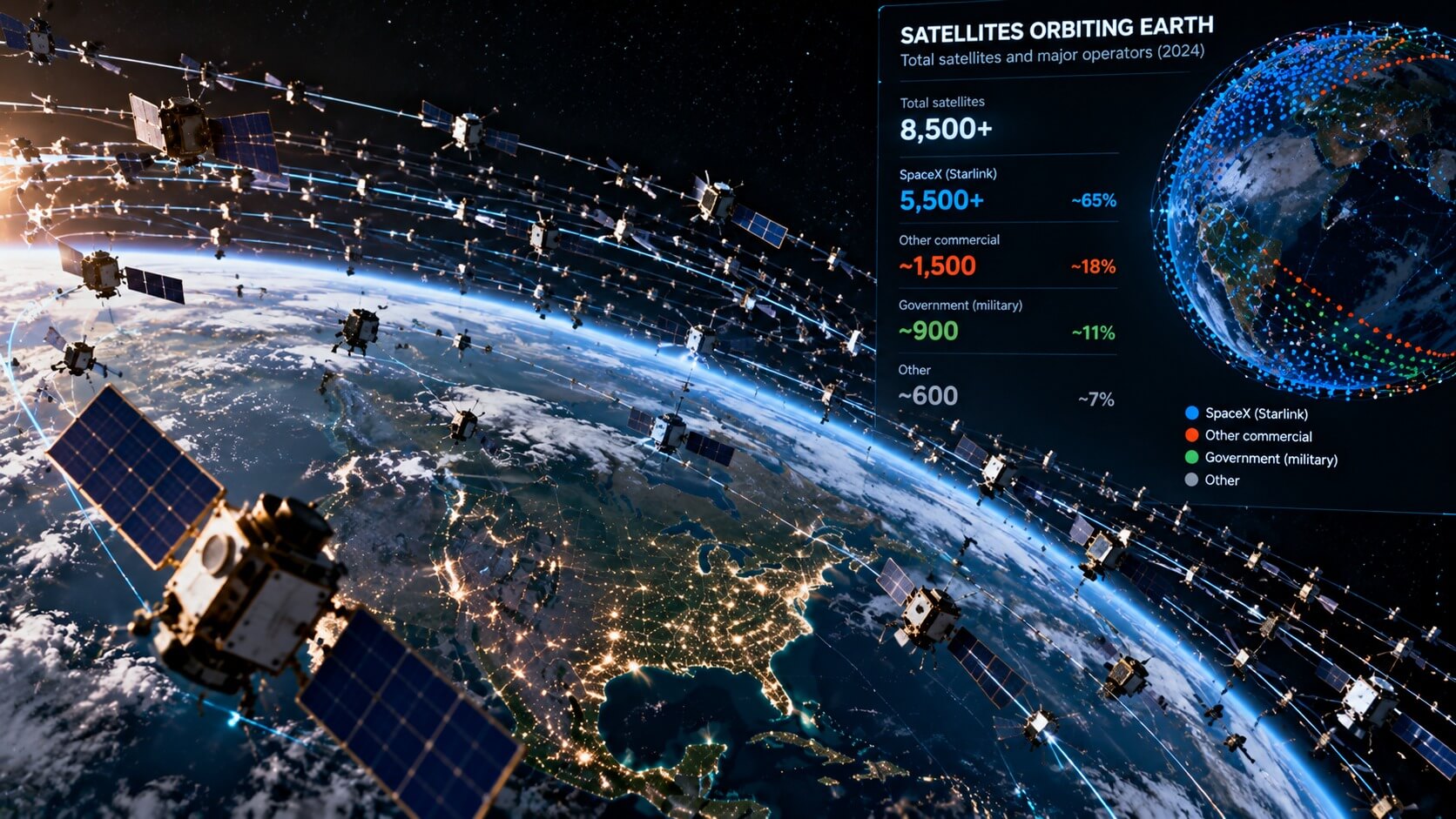
How Many Satellites Orbit Earth Today? And How Many Belong to SpaceX?
Thousands of active satellites orbit Earth, and SpaceX operates a substantial share of them through its Starlink constellation. However, the exact number changes frequently as new spacecraft launch, older satellites retire, and inactive satellites reenter the atmosphere.
There is also an important distinction between the number of satellites in orbit, the number that are operational, and the number operated by SpaceX.
These figures should not be treated as interchangeable.
SpaceX has become one of the world's largest satellite operators through Starlink, a broadband communications network designed to provide internet connectivity across extensive geographic areas.
For investors, this expansion matters because satellites are becoming essential infrastructure for communications, Earth observation, navigation, and national security.
However, the business models behind these services differ significantly. A satellite internet operator earns revenue differently from a company selling imagery or environmental monitoring data.
How Many Satellites Are Orbiting Earth?
There is no permanently fixed number of satellites in orbit.
Satellite populations change as operators launch new spacecraft, retire older ones, and perform end-of-life disposal procedures.
The total also depends on what is being counted.
Three categories help explain the difference:
- Active satellites: Spacecraft currently operating or performing their intended missions.
- Inactive satellites: Spacecraft that have stopped functioning but remain in orbit.
- Other orbital objects: Rocket bodies, fragments, and other debris that are not operational satellites.
These distinctions are important because headlines about the number of objects in space can refer to very different populations.
A tracked object is not necessarily an operational satellite.
Similarly, the cumulative number of satellites launched is not the same as the number still orbiting Earth.
Some spacecraft have already reentered the atmosphere, while others remain in orbit after their missions have ended.
Reliable satellite counts should therefore specify the reporting date, source, operational status, and categories included.
Space surveillance organizations and satellite tracking databases maintain information about orbital objects, but their totals may differ because of classification methods and reporting delays.
For investors, operational spacecraft are generally more relevant than the total number of objects in orbit, although inactive satellites and debris still matter because they create operational risks.
Why Is the Number of Satellites Increasing?
The expansion of satellite populations reflects changes in technology, launch economics, and demand for services delivered from space.
Commercial Satellite Constellations
A satellite constellation is a group of spacecraft designed to operate together.
Instead of relying on one large satellite, operators can distribute their capabilities across multiple spacecraft.
This can improve geographic coverage, increase service availability, and allow individual satellites to be replaced without rebuilding an entire system.
Large constellations have become particularly important for broadband communications.
However, constellation size alone does not determine service quality.
Network performance also depends on satellite capacity, orbital design, ground infrastructure, and the ability to manage traffic efficiently.
Lower Barriers to Launching Satellites
Advances in satellite manufacturing and commercial launch services have made access to orbit more practical for some companies and institutions.
Smaller spacecraft can sometimes be developed more quickly and at lower cost than traditional large satellites.
Shared launch missions also allow multiple customers to place satellites into orbit on the same rocket.
However, launch expenses represent only part of the investment required.
Operators must also finance satellite manufacturing, ground infrastructure, communications equipment, software, ongoing operations, and eventual replacement.
Lower launch costs can encourage expansion, but they do not guarantee profitability.
Growing Demand for Global Connectivity
Many rural and remote regions have limited access to reliable terrestrial broadband infrastructure.
Satellite internet can provide connectivity where installing fiber-optic networks or other conventional infrastructure is difficult or expensive.
Ships, aircraft, emergency response teams, and businesses operating in remote locations can also benefit from satellite connectivity.
These applications have helped create demand for large communications constellations.
How Many Satellites Does Elon Musk Own?
Elon Musk is closely associated with SpaceX, the company responsible for developing and operating the Starlink satellite network.
However, it is important to distinguish between personal ownership and corporate ownership.
Starlink satellites are operated by SpaceX, not individually owned by Elon Musk in a personal capacity.
Therefore, the more accurate question is how many satellites SpaceX operates or how many Starlink satellites remain in orbit.
Those figures change as the company launches additional spacecraft, replaces older satellites, and completes disposal procedures.
A current count should distinguish between:
- Satellites launched: The cumulative number of Starlink spacecraft placed into space.
- Satellites still in orbit: Starlink spacecraft that have not yet reentered the atmosphere.
- Operational satellites: Spacecraft actively contributing to the network.
- Inactive or retiring satellites: Spacecraft that remain in orbit but are no longer providing their intended service.
These categories can produce different totals.
It would therefore be misleading to present a cumulative launch figure as the number of operational Starlink satellites.
Investors following Starlink should use dated fleet information and avoid relying on satellite counts that may already be outdated.
What Is Starlink, and Why Does It Need So Many Satellites?
Starlink is SpaceX's satellite broadband network.
It uses a large constellation of satellites in low Earth orbit to provide internet connectivity to customers in supported locations.
Traditional satellite internet systems have often relied on spacecraft much farther from Earth, including satellites in geostationary orbit.
Starlink's lower orbital altitude reduces the distance signals need to travel, helping reduce communication delays.
However, satellites in low Earth orbit move rapidly relative to the ground and cover smaller geographic areas individually than satellites at much higher altitudes.
A coordinated constellation helps maintain continuous coverage as spacecraft move around the planet.
It also provides additional network capacity where customer demand is high.
Starlink therefore depends on the performance of an interconnected system rather than simply the number of satellites it owns.
Why Does Starlink Keep Launching Satellites?
Additional spacecraft can help Starlink expand capacity, improve coverage, introduce technological upgrades, and replace aging satellites.
Satellites have finite operating lives, so maintaining a large constellation requires continuing launches.
Some spacecraft may also need replacement earlier than expected because of technical failures or other operational problems.
For investors, this creates an important distinction.
A growing satellite fleet can represent expanding infrastructure, but it also requires substantial capital expenditure and ongoing replacement spending.
The financial sustainability of a constellation depends on whether its services generate enough economic value to justify those costs.
Are Starlink Satellites Earth Observation Satellites?
No. Starlink satellites are designed primarily for communications rather than dedicated Earth observation.
This distinction matters because different satellite systems provide different services and generate revenue in different ways.
| Satellite category | Primary purpose | Typical commercial value |
|---|---|---|
| Communications | Transmit data and provide connectivity | Internet subscriptions and network services |
| Earth observation | Collect information about Earth's surface and atmosphere | Imagery, monitoring, and analytics |
| Navigation | Provide positioning and timing signals | Navigation and location-based services |
| Weather and scientific | Measure atmospheric, environmental, or scientific conditions | Forecasting, research, and specialized data |
These categories are not always mutually exclusive.
For example, some scientific satellites also collect environmental measurements that can be classified as Earth observation.
However, a communications constellation should not automatically be counted as an Earth observation system.
This distinction is particularly important when comparing market sizes or estimating the number of satellites serving a particular industry.
For a deeper look at dedicated Earth observation spacecraft, read How Many Earth Observation Satellites Are There? A Look at the Growing EO Market.
Which Countries Have the Most Satellites?
Satellite ownership and operation are distributed across governments, private companies, and international organizations.
The United States has a major presence in the global satellite industry, supported by commercial operators, government programs, and defense-related systems.
China also operates a substantial satellite infrastructure and continues to develop commercial and government space capabilities.
Other countries maintain satellites for communications, navigation, Earth observation, weather forecasting, and national security.
However, ranking countries is more complicated than counting satellites under national flags.
A spacecraft may be owned by a private company, operated by an international organization, or registered in a jurisdiction different from the location of its investors.
Large commercial constellations can also significantly influence national totals.
SpaceX, for example, contributes substantially to the number of satellites associated with the United States, even though Starlink serves customers internationally.
Investors should therefore distinguish between satellite ownership, registration, operational control, and national space capabilities.
For a closer comparison of national satellite infrastructure and ownership, see Which Country Leads in Space? A Look at Satellite Ownership by Nation.
Does Having More Satellites Mean a Company Is More Successful?
Not necessarily.
A large constellation can provide advantages in coverage, capacity, and service availability.
But satellite quantity alone does not reveal whether a business is generating attractive financial returns.
Investors should consider several factors.
Revenue: Is the company generating meaningful income from its satellite infrastructure?
Customer demand: Are customers paying for the service and continuing to use it?
Operating costs: How much does the company spend on launches, manufacturing, ground infrastructure, and maintenance?
Replacement requirements: How frequently must satellites be replaced, and how much will that cost?
Competition: Can rival operators provide similar services at competitive prices?
Capital requirements: Does the company generate enough cash to finance expansion, or does it depend on external funding?
A company can have impressive technology and a large fleet while still facing difficult financial challenges.
Conversely, a company that owns relatively few satellites may build a valuable business by selling specialized data or software services.
The commercial value of a satellite network depends on the services it provides and the economics of delivering them.
How Does Starlink Make Money?
Starlink's core commercial model is based on providing satellite internet connectivity.
Customers generally pay for access to the network, while the business invests in satellites, ground infrastructure, user terminals, and launches.
Its services can address residential users, businesses, maritime operators, aviation customers, and other connectivity needs.
Revenue depends on factors such as customer numbers, service pricing, geographic availability, and demand for network capacity.
However, revenue growth alone does not establish profitability.
Operating a large satellite network requires ongoing investment in replacement spacecraft, infrastructure, customer equipment, and technological improvements.
The business also faces competition from terrestrial broadband and other satellite operators.
Regulatory requirements, spectrum coordination, and market-specific licensing conditions can affect where and how services are offered.
SpaceX is privately held rather than a company whose common shares trade on a public stock exchange.
Investors should therefore distinguish between direct ownership of SpaceX shares and exposure to publicly traded companies supplying equipment, technology, or services to the broader satellite industry.
Indirect exposure does not necessarily reproduce SpaceX's financial performance.
Neither Starlink's growth nor the expansion of the global satellite population guarantees investment returns.
What Does Satellite Growth Mean for Earth Observation?
The expansion of satellite infrastructure has implications beyond communications.
More accessible launches, improved satellite manufacturing, and advances in data processing can also support Earth observation businesses.
Companies collecting imagery and environmental measurements can use satellites to monitor agriculture, infrastructure, natural disasters, and industrial activity.
The commercial opportunity differs from satellite internet.
A communications provider sells connectivity.
An Earth observation company sells information, analytical products, or monitoring services.
The distinction matters because each business model has different customers, costs, competitive dynamics, and revenue sources.
Earth observation operators may also benefit from improvements in artificial intelligence, which can help turn raw satellite measurements into useful alerts and analytical products.
However, increased access to satellite technology can also intensify competition.
Companies must demonstrate why customers should pay for their products rather than rely on publicly available data or competing commercial providers.
For a broader explanation of the Earth observation industry's technology, business models, and investment considerations, see Earth Observation Explained: What It Is, How It Works and Why Investors Should Care.
What Are the Risks of Putting More Satellites Into Orbit?
The rapid growth of satellite constellations creates operational, financial, and environmental challenges.
Orbital Congestion
As more satellites occupy heavily used orbital regions, operators must monitor potential collisions and coordinate spacecraft movements.
A collision can damage or destroy operational satellites and generate additional debris.
Large constellations therefore require reliable tracking, collision avoidance, and operational coordination.
Space Debris
Inactive spacecraft, spent rocket bodies, and fragments from previous missions can remain in orbit and threaten other satellites.
Responsible disposal planning is becoming increasingly important.
The traditional 25-year post-mission disposal guideline remains an important historical reference, but newer standards can impose shorter deadlines.
For example, the U.S. Federal Communications Commission adopted a five-year disposal requirement for certain covered spacecraft in low Earth orbit that plan uncontrolled atmospheric reentry.
The European Space Agency has also introduced stricter debris mitigation requirements for covered missions.
These standards are not universal rules applying identically to every satellite, but they illustrate the growing regulatory importance of orbital sustainability.
Replacement Costs
Satellites have finite operating lives.
Even successful networks must replace spacecraft as they age, fail, or become technologically outdated.
For a large constellation, replacement is an ongoing financial and operational requirement rather than a one-time expense.
Regulation
Satellite operators must comply with licensing, spectrum coordination, and applicable orbital debris mitigation requirements.
Rules vary by jurisdiction, mission, and orbital environment.
Regulatory changes can affect satellite design, operating procedures, and the costs of maintaining a constellation.
These issues are important because the long-term economics of satellite networks depend on more than the initial cost of launching spacecraft.
What Investors Should Watch Next
The global satellite population will remain an important indicator of activity in the space industry, but it is only one part of the picture.
For communications networks, investors should examine customer growth, network capacity, pricing, capital expenditure, and replacement requirements.
For Earth observation businesses, the key questions include demand for imagery, the value of analytical services, customer retention, and the ability to generate sustainable revenue.
For the wider industry, launch costs, regulatory requirements, orbital congestion, and technological improvements will influence which business models succeed.
The most useful approach is to distinguish between satellites that have been launched, satellites that remain in orbit, satellites that are operational, and satellites that generate commercial value.
Those are four different measures, and confusing them can lead to an inaccurate understanding of the space economy.
The central investment lesson is that satellite growth creates infrastructure and commercial possibilities, but the financial value of that growth depends on how effectively companies turn orbital capabilities into services customers are willing to pay for.
Disclaimer: This article is for informational and educational purposes only and does not constitute financial or investment advice. Investing in space-related companies involves risks, including technological uncertainty, competition, regulatory changes, and potential loss of capital. Conduct independent research before making investment decisions.