
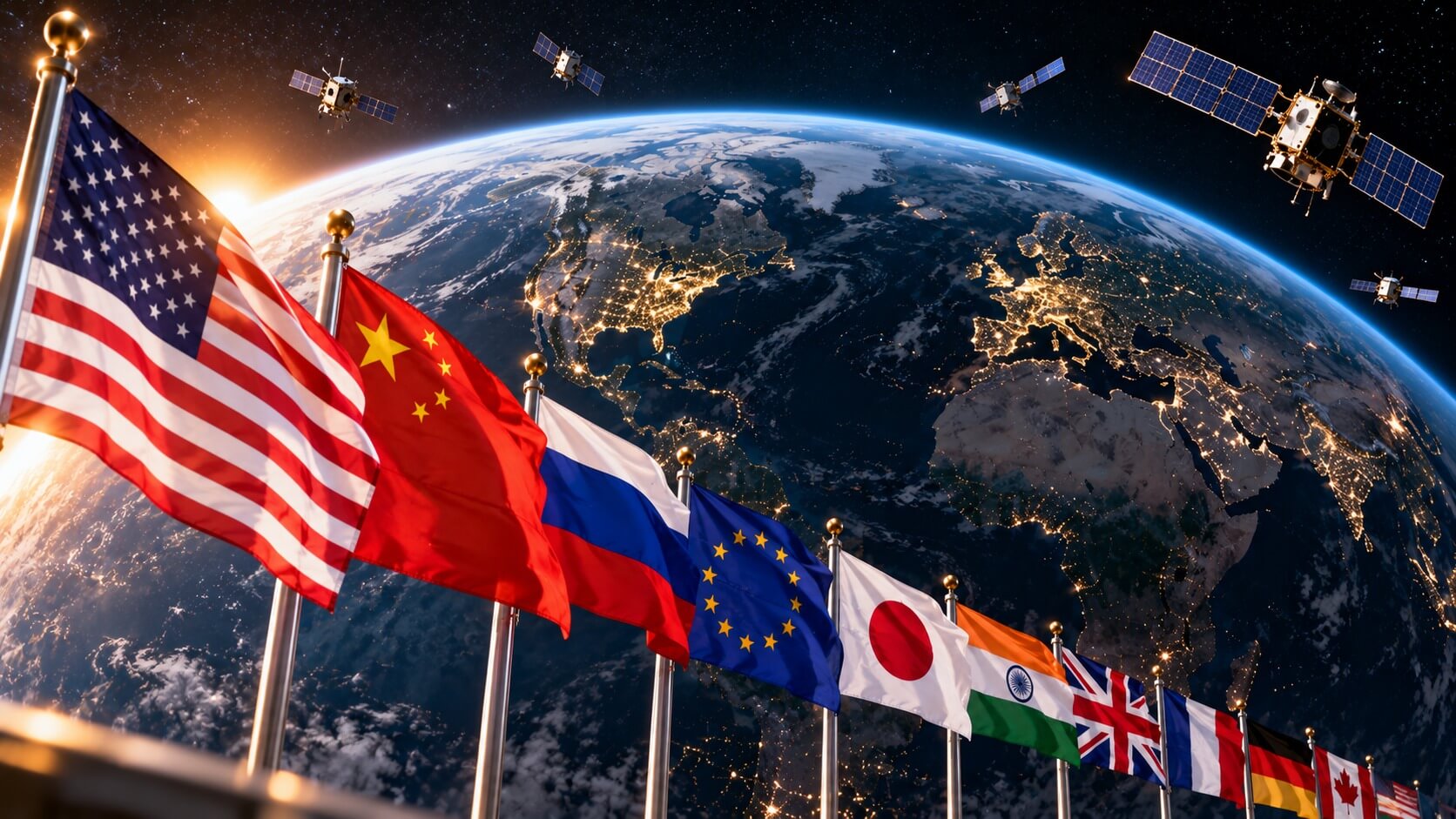
Which Country Leads in Space? A Look at Satellite Ownership by Nation
The United States is a leading country in the global satellite industry, supported by its large commercial satellite fleet, advanced launch capabilities, government programs, and defense infrastructure. China is another major space power, with expanding capabilities in communications, navigation, Earth observation, and scientific missions.
However, determining which country leads in space is more complicated than simply counting satellites.
Satellite ownership, operational control, launch capabilities, scientific achievements, and commercial activity are different measures of national space leadership.
A country may operate thousands of communications satellites while another specializes in advanced scientific spacecraft or navigation systems.
For investors, these distinctions matter because the economic value of space infrastructure depends on the services it provides, the customers it serves, and the costs required to maintain it.
Which Country Has the Most Satellites?
The United States has one of the world's largest satellite fleets and a particularly strong position in commercial satellite operations.
SpaceX's Starlink constellation is a major contributor to the number of satellites associated with the United States.
China also operates a substantial and expanding satellite fleet, supported by government programs and commercial initiatives.
However, an exact ranking requires a reporting date and a consistent definition of satellite ownership.
Different databases may classify spacecraft according to their registered country, operator, owner, or mission.
These classifications do not always produce identical results.
For example, a satellite may be manufactured in one country, launched from another, registered in a third jurisdiction, and operated by a multinational company.
As a result, satellite rankings should be interpreted as estimates based on specific methodologies rather than permanent measures of national leadership.
Why Do Satellite Rankings Change?
Satellite populations change as operators launch new spacecraft, retire older satellites, and remove spacecraft from orbit.
Large commercial constellations can significantly influence national totals.
A single operator launching hundreds of satellites may change a country's reported satellite population without necessarily changing its capabilities in scientific research, navigation, or Earth observation.
Investors should therefore consider both satellite quantity and the economic activities those spacecraft support.
Why Is the United States a Major Space Power?
The United States has developed extensive capabilities across government space programs, commercial launch services, satellite communications, Earth observation, navigation, and national security.
Its space industry includes government agencies, established aerospace manufacturers, and specialized commercial businesses.
Commercial Satellite Operators
American companies play an important role in the development and operation of satellite constellations.
SpaceX operates Starlink, a large satellite broadband network designed to provide internet connectivity.
Other U.S. companies participate in Earth observation, satellite manufacturing, communications, and space infrastructure.
The commercial sector is important because private companies can develop services for customers beyond traditional government space programs.
However, the size of a satellite fleet does not automatically indicate profitability or financial strength.
Launch Capabilities
The United States has substantial commercial and government launch capabilities.
Reusable launch technology has changed the economics of some missions by allowing certain rocket components to be recovered and flown again.
More accessible launch services can support satellite deployment and replacement.
However, launch costs remain only one part of the total expense of operating a satellite system.
Government and Defense Programs
NASA supports scientific research and space exploration, while other government organizations operate or procure satellite capabilities for weather forecasting, navigation, communications, and national security.
Government contracts can create substantial opportunities for commercial suppliers.
However, companies dependent on public-sector spending also face procurement delays, budget uncertainty, and regulatory requirements.
How Strong Is China's Space Program?
China has developed a substantial space program encompassing satellite communications, navigation, Earth observation, scientific research, and human spaceflight.
Its satellite infrastructure supports civilian, commercial, scientific, and government objectives.
Navigation and Communications
China operates BeiDou, its own global satellite navigation system.
Like the American GPS system, BeiDou provides positioning, navigation, and timing services.
Developing an independent navigation capability reduces reliance on foreign systems and supports transportation, logistics, telecommunications, and other industries.
China is also developing satellite communications infrastructure, including systems intended to expand broadband connectivity.
Earth Observation
Chinese satellites collect information about land use, weather, agriculture, natural disasters, and other environmental conditions.
These capabilities support government planning, scientific research, environmental management, and commercial applications.
Earth observation also has strategic importance because timely satellite information can support national security and infrastructure monitoring.
Strategic Importance
China's investment in space reflects its interest in technological independence, economic development, and national security.
Competition between the United States and China may influence government spending, satellite technology, export controls, and demand for domestic space infrastructure.
For investors, these developments can create opportunities for suppliers and commercial operators, but they can also introduce geopolitical and regulatory risks.
Which Other Countries Are Important in Space?
The global space industry extends well beyond the United States and China.
Several countries have developed specialized capabilities and commercial opportunities.
Russia
Russia has a long history of spaceflight and continues to operate satellites for communications, navigation, Earth observation, and national security.
Its GLONASS system provides satellite navigation services.
The Russian space sector has also been affected by geopolitical tensions, sanctions, international restrictions, and changes in commercial partnerships.
These factors can influence access to technology, international markets, and financing.
India
India has developed launch vehicles, scientific missions, communications satellites, and Earth observation capabilities through the Indian Space Research Organisation (ISRO) and an expanding private space sector.
Its space program includes satellite navigation capabilities through NavIC and missions supporting scientific and commercial objectives.
India's space industry offers opportunities in satellite manufacturing, launch services, and downstream applications.
However, the development of commercial opportunities depends on investment, regulation, customer demand, and the ability of private companies to compete internationally.
Japan
Japan maintains capabilities in satellite communications, navigation, Earth observation, and scientific exploration.
Its space activities involve the Japan Aerospace Exploration Agency (JAXA), research institutions, and industrial companies supplying technology and equipment.
Japan also operates the Quasi-Zenith Satellite System, which supports positioning services in its regional coverage area.
Commercial opportunities include satellite components, Earth observation services, and specialized space technologies.
European Countries
European space capabilities are developed through national programs, commercial businesses, and cooperation through the European Space Agency.
France, Germany, Italy, and other European countries contribute to satellite manufacturing, launch systems, Earth observation, and scientific missions.
The European Union also supports major space infrastructure, including the Galileo navigation system and the Copernicus Earth observation program.
Because these systems involve multiple countries and institutions, attributing every spacecraft to a single nation can be difficult.
European cooperation illustrates how space leadership can depend on shared infrastructure and industrial partnerships rather than the satellite fleet of one country alone.
What Does It Mean for a Country to Have 763 Satellites?
A claim that a country has exactly 763 satellites needs context before it can be interpreted correctly.
The figure may come from an older satellite database, a historical reporting date, or a particular classification of spacecraft.
It should not be treated as a current satellite count without checking its original source.
The number might refer to active satellites, all satellites still in orbit, government-owned spacecraft, or a combination of commercial and government systems.
For example, the United States has a large commercial satellite sector, and SpaceX operates a substantial constellation through Starlink.
Including those spacecraft can significantly affect the country's overall total.
A ranking that counts only government-operated satellites would tell a different story.
Before comparing countries, it is important to establish:
- The date on which the count was recorded.
- Whether inactive satellites are included.
- Whether commercial and government spacecraft are both counted.
- How satellites operated by international organizations are classified.
- Whether the figures refer to ownership, registration, or operation.
Without these details, a number such as 763 cannot reliably establish which country leads in space.
For investors, a dated satellite count is useful only when it is interpreted alongside the types of spacecraft involved and the services they provide.
Satellite Numbers vs. Space Leadership: What's the Difference?
The country with the most satellites is not necessarily the country with the strongest space industry in every respect.
Satellite counts measure the number of spacecraft, but they do not directly measure the quality of their instruments, their economic value, or the technological sophistication of the systems supporting them.
Consider five different measures of space leadership.
| Measure | What it tells us |
|---|---|
| Satellite fleet size | How many spacecraft a country or its operators maintain |
| Launch capability | How effectively the country can place payloads into orbit |
| Navigation infrastructure | Whether it operates independent positioning systems |
| Commercial space industry | The scale and competitiveness of its space businesses |
| Scientific and technical capabilities | The sophistication of its missions, instruments, and research |
A country may operate relatively few satellites but specialize in advanced scientific missions.
Another may have a large satellite population because one commercial operator maintains a broadband constellation.
Neither figure alone provides a complete picture of national space capabilities.
For investors, this distinction matters because the commercial opportunity may lie in a specialized technology or service rather than in the country with the largest fleet.
Why Do Private Companies Change the Satellite Rankings?
Historically, governments played a dominant role in developing satellite infrastructure.
Today, private companies operate large constellations and provide services that reach customers around the world.
Starlink is a prominent example. Its expansion has increased the number of communications satellites associated with the United States.
Commercial Earth observation businesses have also expanded access to satellite imagery and analytical services.
This shift makes national rankings more complicated because satellite ownership, corporate headquarters, launch location, and customer markets do not necessarily coincide.
A satellite might be built by one company, launched from another country, operated by a business headquartered elsewhere, and used by customers across several continents.
The result is an interconnected global industry in which commercial capabilities matter alongside government programs.
What Does the Global Space Race Mean for Investors?
Competition between countries can influence the commercial space industry in several ways.
Government Contracts
Governments purchase satellite systems, launch services, communications, and data products.
These contracts can provide important revenue opportunities for companies supplying civilian and defense programs.
However, contract awards and renewals depend on budget decisions, procurement procedures, and political priorities.
Domestic Manufacturing and Supply Chains
Countries seeking greater technological independence may support domestic production of satellites, components, and launch systems.
This can benefit local suppliers but may also increase costs or restrict access to international markets.
Investors should consider how export controls, supplier concentration, and manufacturing capacity affect individual businesses.
Earth Observation and National Security
Governments use satellite imagery and monitoring capabilities for environmental management, disaster response, infrastructure assessment, and national security.
Commercial operators may benefit from this demand, particularly when they can deliver timely, reliable information.
For companies in this market, the ability to turn satellite observations into useful intelligence can be as important as owning the spacecraft themselves.
Regulatory and Geopolitical Risks
Space technology can be subject to export controls, sanctions, spectrum restrictions, and national security rules.
Changes in international relations may affect partnerships, customer access, and supply chains.
Investors should consider these risks when evaluating businesses that depend on international customers or government contracts.
How Does Earth Observation Fit Into the Global Space Race?
Earth observation is an economically important part of the satellite industry because its data supports activities on the ground.
Satellites can monitor agricultural conditions, forest cover, construction, infrastructure, natural disasters, and environmental changes.
Countries invest in these capabilities for scientific, economic, and strategic reasons.
Commercial businesses can also sell imagery and analytical services to customers who need frequent, reliable information.
However, Earth observation is only one category within the broader satellite population.
Communications constellations, navigation systems, weather satellites, and scientific missions all contribute to national space capabilities.
To understand the broader Earth observation industry, see Earth Observation Explained: What It Is, How It Works and Why Investors Should Care.
For a closer look at the number of satellites dedicated to observing Earth, see How Many Earth Observation Satellites Are There? A Look at the Growing EO Market.
The wider satellite population and the role of commercial communications constellations are examined in How Many Satellites Orbit Earth Today? And How Many Belong to SpaceX?.
Will the United States Continue to Lead in Space?
The United States has substantial advantages, including established commercial operators, government research programs, launch capabilities, and a large technology sector.
China is also investing in its space infrastructure and developing capabilities across multiple satellite categories.
Other countries continue to strengthen their positions through specialized technology, international partnerships, and commercial investment.
Future leadership will depend on more than satellite numbers.
Launch economics, technological progress, government priorities, commercial demand, and international cooperation will all influence the industry's development.
For investors, the important question is not simply which nation wins the space race.
It is which companies can convert technological capabilities and growing demand into durable competitive advantages and sustainable financial results.
Disclaimer: This article is for informational and educational purposes only and does not constitute financial or investment advice. Investing in space-related companies involves risks, including technological uncertainty, geopolitical tensions, regulatory changes, and potential loss of capital. Conduct independent research before making investment decisions.