
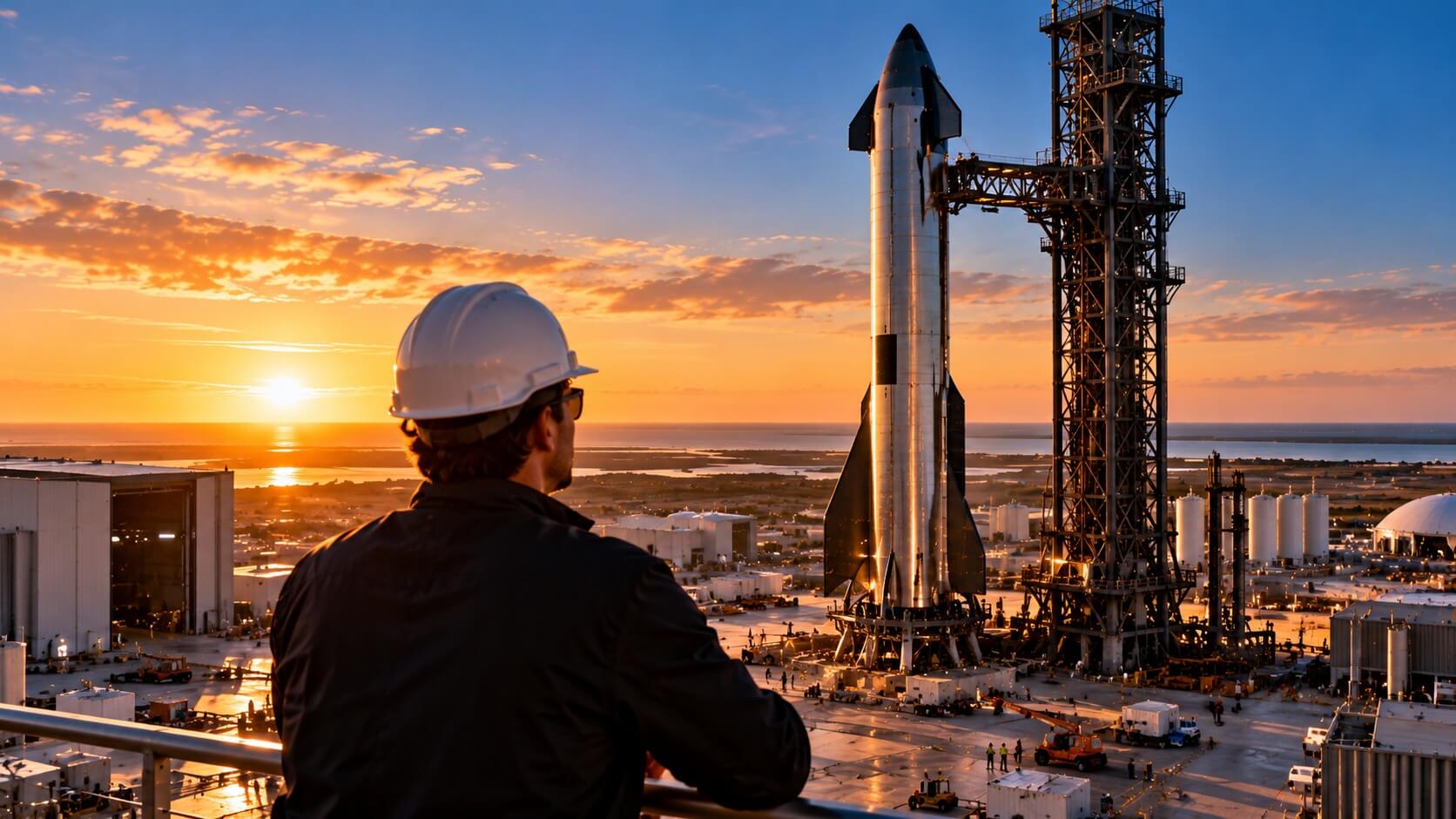
Elon Musk founded SpaceX in 2002 and is widely reported to have invested approximately $100 million of his own money during its early development. That figure is often described as the cost of starting SpaceX, but it is better understood as an estimate of Musk's initial financial commitment rather than a precisely documented incorporation expense.
Building the company required far more than registering a business. SpaceX needed engineers, manufacturing facilities, rocket engines, launch infrastructure, and years of testing before it could establish reliable commercial operations.
NASA development agreements, government contracts, and other funding subsequently helped SpaceX expand beyond its founder's original investment.
The company's history illustrates both the financial risks of developing aerospace technology and the commercial opportunities created by successful launch systems.
How Much Money Did Elon Musk Initially Invest in SpaceX?
Approximately $100 million is the figure most commonly associated with Elon Musk's early investment in SpaceX.
Musk founded the company in 2002 after building substantial personal wealth through earlier technology ventures, including PayPal.
He directed a significant portion of that wealth toward developing rockets and reducing the cost of reaching space.
However, the widely reported $100 million should not be interpreted as one independently verified payment made when SpaceX was incorporated.
It represents an approximate early financial commitment. Detailed capitalization records from the company's founding period are not publicly available in the same way as financial statements from a publicly traded corporation.
Consequently, it is difficult to determine precisely how much Musk contributed at incorporation, how much he invested later, and how those funds were allocated.
The distinction matters because legally establishing a company can be relatively inexpensive. Developing a rocket capable of reaching orbit requires substantial capital over many years.
For SpaceX, the main financial challenge was funding engineering and testing before commercial operations could generate sufficient revenue.
Where Did Elon Musk Get the Money to Start SpaceX?
Much of Musk's initial financial capacity came from his earlier technology businesses.
He was involved in Zip2, an internet software company acquired by Compaq in 1999.
He subsequently founded X.com, an online financial services company that merged with Confinity and evolved into PayPal.
In 2002, eBay acquired PayPal in a transaction valued at approximately $1.5 billion. Musk received substantial proceeds from the acquisition, giving him the resources to pursue capital-intensive ventures.
SpaceX was founded that same year.
Musk also became involved in Tesla during its early development, although Tesla and SpaceX were separate businesses with different financing structures.
SpaceX therefore began with an unusual advantage: its founder could commit substantial personal capital before the company had demonstrated a successful orbital launch.
Most entrepreneurs cannot independently finance rocket development at that scale.
Aerospace startups generally need outside investment, government development support, or commercial contracts to pursue similarly demanding projects.
Why Was Starting SpaceX So Expensive?
Building an orbital launch company requires substantial spending before successful commercial flights can generate revenue.
SpaceX needed engineers, manufacturing equipment, testing facilities, launch infrastructure, propulsion systems, and specialized components.
Unlike a software startup, a rocket company cannot develop its principal product using only computers and a small team.
Launch vehicles must withstand extreme temperatures, powerful propulsion forces, structural stress, and complex flight conditions.
Engines, fuel systems, guidance equipment, electronics, and other components require extensive design and testing.
Even successful ground tests cannot guarantee that an entire rocket will perform correctly during launch.
Failures can destroy expensive hardware, delay development, and require additional engineering work before another attempt.
These characteristics create substantial financial risk. Companies must invest heavily before proving that their technology can deliver payloads reliably into orbit.
That is one reason aerospace businesses often require more patient capital than conventional consumer technology startups.
What Was SpaceX's First Rocket?
SpaceX's first orbital launch vehicle was Falcon 1, a relatively small rocket developed to demonstrate the company's ability to reach Earth orbit.
Its early launch history was difficult.
March 2006: The first Falcon 1 launch failed.
March 2007: The second attempt also failed to reach orbit.
August 2008: A third launch was unsuccessful.
September 28, 2008: The fourth Falcon 1 launch successfully reached orbit.
The fourth flight marked a major technical milestone. SpaceX had demonstrated that a privately developed liquid-fueled rocket could reach Earth orbit.
That achievement strengthened its credibility with prospective customers, investors, and government agencies.
However, reaching orbit did not mean the company had immediately become profitable.
SpaceX still needed larger rockets, additional contracts, manufacturing capacity, and reliable commercial operations to build a sustainable business.
How Close Was SpaceX to Running Out of Money?
By 2008, SpaceX was under severe financial pressure.
Three unsuccessful Falcon 1 launches had consumed resources, while continued development required substantial additional capital.
Musk was also facing financial pressures involving Tesla, and the global financial crisis made fundraising difficult for many businesses.
Accounts of SpaceX's early history describe 2008 as a critical period when another major setback could have threatened the company's survival.
The successful fourth Falcon 1 launch demonstrated that its core technology could work.
Later that year, NASA awarded SpaceX a major Commercial Resupply Services contract, strengthening its commercial prospects.
The combination of technical progress and a substantial government customer improved the company's outlook.
For investors, this episode illustrates a central risk of capital-intensive technology businesses: a promising company can exhaust its funding before its technology reaches commercial maturity.
Access to sufficient capital through delays and failures can be just as important as the underlying engineering concept.
How Much Money Did NASA Give SpaceX?
NASA played an important role in SpaceX's development, but its financial commitments should not be confused with Musk's original personal investment.
In 2006, NASA selected SpaceX for a Commercial Orbital Transportation Services agreement with an initial funded value of approximately $278 million.
The program supported the development and demonstration of commercial cargo transportation capabilities for the International Space Station.
In December 2008, NASA awarded SpaceX a Commercial Resupply Services contract valued at approximately $1.6 billion for 12 cargo missions.
These agreements were not simply unrestricted cash gifts.
They involved technical milestones, defined services, contractual obligations, and payment arrangements.
NASA sought commercial transportation capabilities, while SpaceX gained development support, a major customer, and a stronger financial foundation.
Over time, the company secured additional government and commercial contracts involving cargo transportation, astronaut missions, and satellite launches.
SpaceX's growth therefore combined substantial private entrepreneurial risk with public-sector procurement and development support.
It would be inaccurate to describe its success as either entirely self-financed or entirely government-funded.
Did Elon Musk Build SpaceX Alone?
No. Musk founded SpaceX and played a central role in financing, strategy, and technical direction, but its rockets were developed by large teams of engineers, technicians, manufacturing specialists, and other professionals.
One important early contributor was Tom Mueller, a propulsion engineer who helped lead the development of SpaceX's rocket engines.
The company's achievements also depended on specialists in structures, avionics, software, manufacturing, launch operations, and mission management.
Developing an orbital launch system requires thousands of components and numerous technical systems to work together under demanding conditions.
Musk's contributions included supplying capital, establishing ambitious objectives, and directing major strategic decisions.
However, the engineering achievements resulted from coordinated organizational work rather than the efforts of one individual.
For investors, the distinction matters. A founder can strongly influence strategy and capital allocation, but long-term competitiveness also depends on employees, manufacturing processes, technical capabilities, and institutional knowledge.
Focusing exclusively on a prominent founder can obscure the operational factors that determine business performance.
How Did SpaceX Go From Falcon 1 to Falcon 9?
Falcon 1 demonstrated that SpaceX could reach orbit. The next challenge was developing a larger launch vehicle capable of serving more commercial and government customers.
Falcon 9 completed its first successful launch in June 2010.
Designed to carry significantly larger payloads than Falcon 1, it became central to SpaceX's commercial launch operations.
The company also developed Dragon spacecraft technology for cargo transportation and eventually human spaceflight.
One of SpaceX's most consequential strategic decisions was pursuing reusable rocket hardware.
Traditional orbital launch systems generally discarded major stages after each mission. SpaceX instead worked toward recovering and reusing Falcon 9 first-stage boosters.
In December 2015, a Falcon 9 first stage successfully landed after an orbital-class launch.
In March 2017, SpaceX launched a previously flown Falcon 9 booster again.
These milestones demonstrated that major rocket components could be recovered and reused.
Reusability does not eliminate launch expenses, but it can reduce hardware replacement costs and improve vehicle utilization.
The financial benefit depends on refurbishment costs, flight frequency, and the number of missions completed by each booster.
These developments helped transform SpaceX from an early-stage rocket developer into a major commercial launch provider.
How Much Does It Cost to Launch a SpaceX Rocket?
The amount a customer pays SpaceX for a launch is different from the company's internal cost of conducting that mission.
SpaceX has publicly advertised Falcon 9 launch services at prices in the tens of millions of dollars.
For example, its published standard Falcon 9 price reached approximately $67 million in 2022. Other published prices and contractual terms can differ depending on the mission and period.
These advertised prices represent charges to customers, not confirmed internal operating expenses.
Actual launch costs depend on manufacturing, hardware reuse, refurbishment, personnel, infrastructure, and mission-specific requirements.
Reusable boosters create an opportunity to distribute manufacturing costs across multiple flights.
Consider a simplified hypothetical example.
Suppose a booster costs $40 million to manufacture.
If it flies only once, the entire manufacturing expense is associated with one mission.
If it completes 10 flights, its average initial manufacturing expense becomes $4 million per flight, before refurbishment, maintenance, financing, and other operating costs.
These numbers are illustrative and do not represent SpaceX's actual booster manufacturing expenses.
The example shows why hardware reuse can improve launch economics, provided the cost of preparing vehicles for additional flights remains manageable.
How Did SpaceX Become More Than a Rocket Company?
SpaceX has expanded well beyond its original launch vehicle business.
Its activities span several areas of the space economy:
- Launch services: Falcon 9 and Falcon Heavy transport commercial and government payloads into space.
- Spacecraft transportation: Dragon supports cargo delivery and human spaceflight.
- Satellite communications: Starlink operates a satellite-based internet network.
- Next-generation launch systems: Starship is being developed as a large reusable transportation system for future missions.
These businesses have different customers, costs, and growth drivers.
Launch revenue depends on demand for placing payloads into orbit. Crew transportation depends on government and private mission requirements.
Starlink's business model involves recurring communications revenue, network infrastructure, customer equipment, and competition with other connectivity providers.
Starship requires substantial development spending, with uncertain future commercial economics.
This diversification makes SpaceX fundamentally different from a company focused exclusively on luxury space tourism.
Private passenger missions are part of its transportation capabilities, but they do not define the entire business.
For more information about private orbital passenger missions, see How Much Does a SpaceX Flight Cost per Person?.
How Much Would It Cost to Start a Company Like SpaceX Today?
There is no reliable universal estimate for establishing a modern equivalent of SpaceX.
The required investment depends on the technology, business model, and scope of development.
A startup manufacturing small satellite components has very different capital requirements from one designing an orbital launch vehicle.
Rocket development requires funding for propulsion systems, engineering, testing, manufacturing, launch infrastructure, and regulatory compliance.
A large reusable launch system would generally require substantially more resources than a small experimental rocket.
Costs also depend on how much technology the company develops internally.
Some aerospace startups purchase existing components and outsource manufacturing. Others design propulsion systems, electronics, software, and structures themselves.
Greater vertical integration can require more initial investment but may provide stronger control over technology, production, and supply chains.
A new launch company must also compete with established providers.
Demonstrating that a rocket can fly is only the beginning. Customers also need competitive pricing, reliable service, available launch capacity, and confidence that the provider can continue operating.
Musk's approximately $100 million early investment should therefore not be treated as a fixed benchmark for the capital required to establish a comparable business today.
Was Elon Musk's Investment in SpaceX Worth It?
SpaceX's growth and reported private-market valuations suggest that Musk's early financial commitment became one of his most consequential investments.
However, calculating an exact investment return is more complicated than comparing an initial contribution with a later company valuation.
SpaceX has historically been privately held, with valuations influenced by financing transactions and secondary share sales.
A private-company valuation is not equivalent to cash received by a shareholder.
The economic value of Musk's ownership also depends on his actual equity stake, dilution, transaction terms, and the price at which shares could be sold.
Calculating a precise lifetime return would require detailed records of capital contributions, ownership changes, distributions, and realized proceeds.
Those records are not fully public.
Consequently, a reliable lifetime percentage return cannot be calculated from the widely repeated $100 million figure alone.
What is clear is that SpaceX developed from a privately financed startup into a major aerospace business with launch operations, spacecraft technology, government contracts, and satellite communications services.
That expansion created substantial economic value, but it also required years of development and exposure to significant technical and financial risks.
Can Ordinary Investors Buy SpaceX Shares?
SpaceX has historically operated as a privately held company rather than a conventional publicly traded stock.
Ordinary retail investors have therefore not generally been able to purchase its shares directly through standard brokerage accounts.
Some private-market funds or investment vehicles may offer indirect exposure, but eligibility, fees, liquidity, and ownership structures can vary substantially.
Investors should examine products claiming to provide SpaceX exposure carefully.
A fund holding a small position in SpaceX is not economically equivalent to owning SpaceX shares directly. Its performance also depends on its other investments, expenses, and valuation methods.
Likewise, purchasing shares in another aerospace company does not necessarily provide exposure to SpaceX's business model.
Publicly traded space businesses may specialize in launches, satellites, communications, manufacturing, or other technologies, each with different financial characteristics.
For investors interested in the broader commercial space industry, see Space Tourism Explained: How the Market Works, What It Costs, and Who's Investing.
What Can Investors Learn From SpaceX's Early Funding?
SpaceX's history illustrates several important principles of investing in capital-intensive technology companies.
Development takes time and capital. Breakthrough technologies may require years of spending before generating meaningful commercial revenue.
Technical setbacks create financing risks. SpaceX's early launch failures demonstrate how quickly development expenses can accumulate.
Major customers can change a company's outlook. NASA's agreements supported development and provided opportunities to demonstrate commercial transportation capabilities.
Reusability can create competitive advantages. Recovering and reusing expensive hardware can improve economics when refurbishment costs are controlled and flight frequency is sufficient.
Execution matters more than ambition alone. SpaceX's growth depended on engineering, manufacturing, government relationships, customer contracts, and sustained financing.
Investors evaluating younger aerospace businesses should examine cash reserves, spending rates, technical milestones, customer demand, contractual commitments, and future financing requirements.
Extraordinary growth potential does not eliminate the risk of losing invested capital.
What Does SpaceX's History Tell Us About Space Tourism?
SpaceX was not founded primarily as a luxury tourism company.
Its original objective centered on developing more affordable access to space through improved launch technology.
Over time, the company's transportation capabilities enabled privately financed orbital missions.
Crew Dragon has carried private individuals into orbit, demonstrating that human spaceflight can extend beyond traditional government astronaut programs.
However, private orbital missions remain extraordinarily expensive, with certain historical arrangements involving tens of millions of dollars per passenger.
The ability to transport civilians does not automatically make orbital travel affordable to the general public.
The commercial challenge is reducing costs while maintaining reliability, safety, and sufficient demand.
SpaceX's development illustrates how advances in launch technology can create new markets. But turning technically successful missions into profitable mass-market services is not guaranteed.
For a closer look at which companies have demonstrated passenger flights, read Does Space Tourism Really Exist Yet? What's Actually Flying Today.
The Real Cost of Building SpaceX
Elon Musk's approximately $100 million early investment is an important part of SpaceX's founding story, but it does not represent the total amount ultimately required to develop the company.
SpaceX needed years of engineering, repeated launch attempts, manufacturing investment, and substantial additional commercial and government funding.
Its successful Falcon 1 orbital launch in 2008 established technical credibility. Subsequent NASA contracts, Falcon 9 development, reusable boosters, Dragon spacecraft, and Starlink helped expand the business.
The larger lesson is that building a successful aerospace company requires more than an ambitious idea and initial funding.
It requires sustained capital, technical execution, reliable operations, and customers willing to pay for the services being developed.
SpaceX's growth demonstrates the potential value of solving difficult engineering problems. Its early history also shows how vulnerable capital-intensive ventures can be before achieving commercial success.
Disclaimer: This article is for informational purposes only and does not constitute financial or investment advice. Investing in aerospace and other capital-intensive technology businesses involves significant financial, operational, and technological risks.