
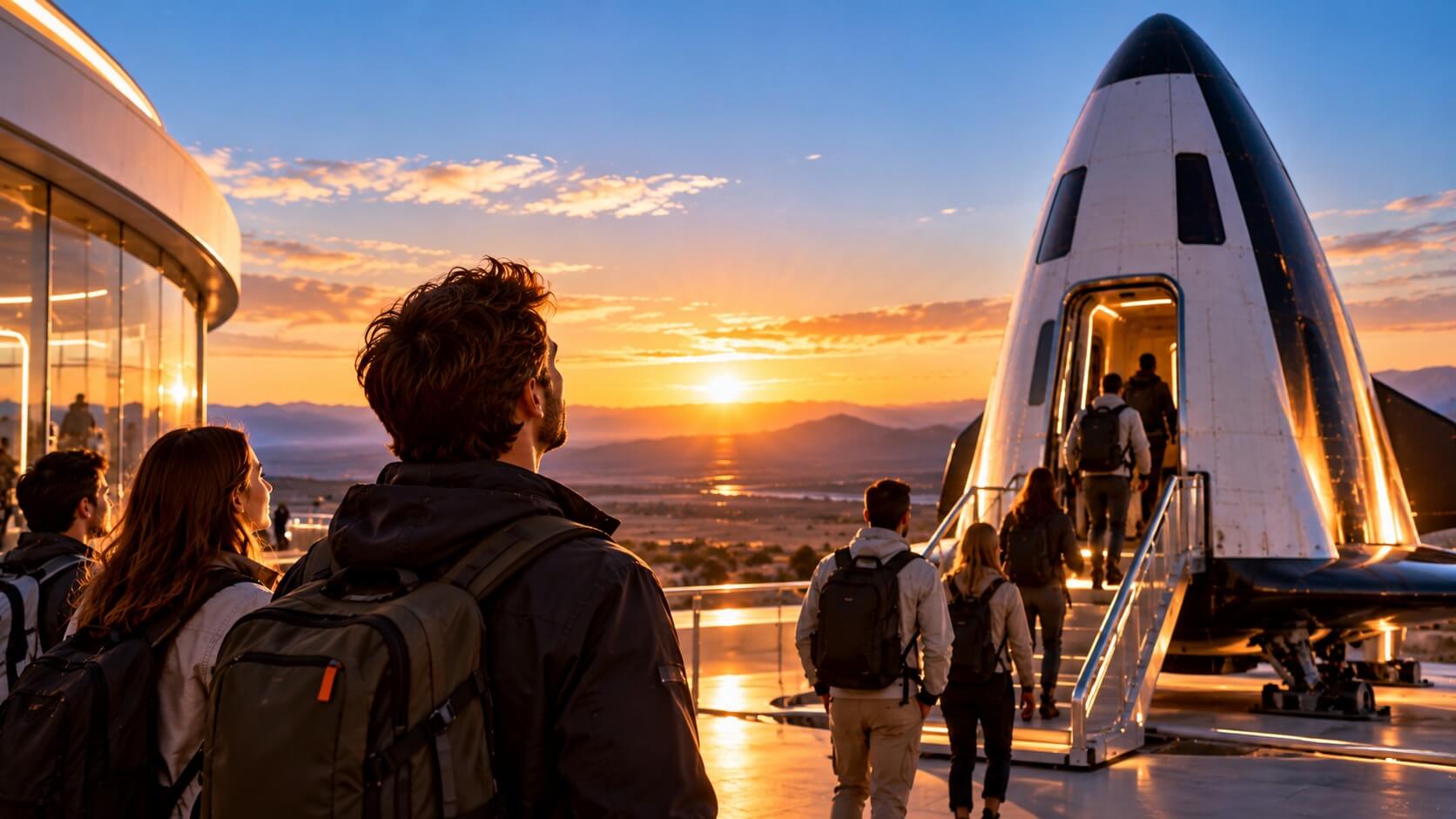
Yes, an ordinary person can travel to space without becoming a professional astronaut. Private individuals have already flown aboard spacecraft operated by Blue Origin, Virgin Galactic, and SpaceX. However, the main obstacle is affordability: suborbital flights have been advertised for hundreds of thousands of dollars, while private orbital missions can cost tens of millions per passenger.
Personal wealth is not the only possible route. Some private astronauts have participated through sponsorships, charitable initiatives, or privately funded crew selections. These opportunities are rare, however, and there is no widely available program offering affordable space tourism to the general public.
For most people, the practical questions are whether they can afford a flight, meet the medical and training requirements, and accept the risks involved.
Can Anyone Really Buy a Ticket to Space?
Commercial spaceflight has expanded access beyond the traditional government astronaut profession.
Historically, most people traveling to space were selected and trained by agencies such as NASA. Today, private individuals can participate in commercially organized missions without following that career path.
However, booking a spaceflight is not comparable to purchasing an airline ticket.
Prospective passengers need access to an operator or mission organizer accepting private participants. They must also satisfy the financial, medical, training, and scheduling requirements of the specific mission.
Several companies have demonstrated civilian spaceflight:
- Blue Origin: Has carried private passengers on short suborbital journeys aboard New Shepard.
- Virgin Galactic: Has completed commercial suborbital flights using a rocket-powered spaceplane.
- SpaceX: Has transported private individuals into Earth orbit aboard Crew Dragon, including commercially organized missions.
These achievements establish that civilian spaceflight is possible, but they do not mean seats are continuously available for purchase.
For an overview of which programs have actually flown passengers, read Does Space Tourism Really Exist Yet? What's Actually Flying Today.
How Much Money Do You Need to Go to Space?
The cost depends primarily on whether you want a brief suborbital experience or a multi-day orbital mission.
Suborbital flights reach space and return without completing an orbit. Orbital missions travel fast enough to circle Earth and can last several days.
The financial difference is substantial.
| Spaceflight experience | Historical price reference | Accessibility |
|---|---|---|
| Virgin Galactic suborbital flight | $450,000 advertised in 2022 | Primarily wealthy customers |
| Blue Origin New Shepard | No standardized public ticket price | Individual commercial arrangements |
| Private orbital mission | Around $55 million per seat in certain historical arrangements | Ultra-wealthy or institutionally funded participants |
| Sponsored private mission | Personal cost varies | Extremely limited opportunities |
These are historical benchmarks, not confirmed current booking prices.
The approximately $55 million figure has been associated with certain private astronaut missions organized by Axiom Space using SpaceX transportation. Blue Origin's widely reported $28 million seat auction in 2021 was an exceptional event, not a standard commercial fare.
To put the cost in perspective, someone earning $80,000 annually would need more than five years of gross income to cover a $450,000 ticket, before taxes or living expenses.
That comparison illustrates why space tourism remains a luxury market rather than an ordinary travel option.
For a detailed breakdown, see How Much Does Space Tourism Cost? A Realistic Price Breakdown.
Do You Have to Be Rich to Become a Space Tourist?
For someone purchasing a commercial seat with personal funds, substantial wealth is currently the most realistic requirement.
However, not every private astronaut has personally paid for their flight.
Some passengers have traveled through sponsorships, privately funded crew selections, or arrangements involving research institutions and other organizations.
One example is Inspiration4, the privately financed SpaceX orbital mission launched in September 2021.
Entrepreneur Jared Isaacman funded the mission and selected three additional crew members from different professional backgrounds.
Among them was Hayley Arceneaux, a physician assistant at St. Jude Children's Research Hospital.
Her participation demonstrated that someone could reach orbit without personally purchasing a multimillion-dollar ticket or following the traditional government astronaut career path.
However, Inspiration4 was an exceptional mission, not an ongoing program that ordinary applicants can routinely join.
Personal wealth is therefore not an absolute requirement for every private astronaut, but it remains the dominant practical barrier for people seeking to purchase their own spaceflight.
Can You Win a Free Trip to Space?
Some privately funded missions have included competitions, charitable initiatives, sponsorships, or special passenger selection programs.
These arrangements can allow participants to fly without paying the full commercial cost themselves.
However, such opportunities are extremely uncommon. There is no established global program regularly awarding free space tourism flights to ordinary consumers.
Anyone considering a promotional opportunity should verify the organization responsible, eligibility criteria, selection process, and financial conditions.
Unexpected payment requests or promises of guaranteed astronaut selection deserve particular scrutiny.
Even when a flight is sponsored, participants may still need to complete medical assessments, training, and other mission preparation.
A sponsored seat can remove the financial barrier, but it does not eliminate the physical and operational requirements of spaceflight.
Do You Need to Be Physically Fit to Go to Space?
Commercial passengers do not necessarily need the same qualifications as career NASA astronauts, but they must be medically suitable for their specific mission.
During launch, passengers experience acceleration forces greater than those encountered during ordinary air travel.
Suborbital flights involve brief weightlessness followed by the forces associated with returning to Earth. Orbital missions introduce additional challenges because passengers may spend several days in microgravity.
Possible physiological effects include motion sickness, changes in fluid distribution, temporary balance problems, and other responses to weightlessness.
Medical screening and physical requirements vary between operators and mission types.
Age alone does not necessarily prevent participation. Wally Funk flew aboard Blue Origin's first crewed New Shepard mission in 2021 at age 82, while William Shatner traveled aboard New Shepard later that year at age 90.
These examples demonstrate that commercial spaceflight is not restricted to young professional astronauts.
However, successful flights by older passengers do not establish that everyone of a similar age or health status is eligible.
Individual suitability must be assessed according to the operator's medical requirements and the physical demands of the mission.
How Much Training Does an Ordinary Space Tourist Need?
Training depends heavily on the type and duration of the flight.
Suborbital passengers generally prepare for launch acceleration, a brief period of weightlessness, and landing. Training may cover safety equipment, seating procedures, cabin movement, and emergency instructions.
Blue Origin's New Shepard is designed to operate autonomously, so passengers do not need to pilot the spacecraft.
Orbital missions require substantially more preparation.
Participants may need to learn spacecraft procedures, communication protocols, emergency responses, and how to live and work in microgravity.
Missions visiting the International Space Station can involve additional training related to station operations and interactions with professional astronauts.
Some private orbital participants undergo months of preparation.
This creates a practical barrier beyond ticket price. Someone with full-time employment, family responsibilities, or limited scheduling flexibility may find it difficult to commit the necessary time.
Prospective passengers should therefore evaluate both the financial cost and the personal commitment required.
Is Space Tourism Safe Enough for Ordinary People?
Commercial human spaceflight involves substantial risks and should not be assumed to have the same safety profile as conventional passenger aviation.
Launch vehicles operate under extreme physical conditions. Passengers may experience significant acceleration, weightlessness, and demanding atmospheric reentry or descent procedures.
Spacecraft also depend on complex engineering systems that must operate correctly throughout the mission.
Commercial operators use testing, inspections, training, and safety procedures to manage these risks, but successful previous flights do not eliminate the possibility of future accidents.
In 2014, a Virgin Galactic SpaceShipTwo test flight ended in a fatal accident.
Blue Origin's New Shepard program experienced an uncrewed launch failure in September 2022, during which the capsule escape system activated.
These incidents illustrate why operational reliability remains a central concern.
In the United States, commercial human spaceflight participants are generally required to receive information about relevant risks and provide informed consent under applicable regulations.
Regulatory oversight does not mean that commercial spaceflight has the same certification framework or safety record as conventional airline transportation.
Anyone considering a flight should carefully review the operator's safety disclosures, understand the mission-specific risks, and seek appropriate medical advice about personal suitability.
Can You Go to Space Without Being an Astronaut?
Yes. You do not need to follow the traditional career path of a government astronaut to participate in commercial spaceflight.
However, the term "astronaut" can refer to different types of participants.
Professional astronauts are typically selected and trained to conduct missions for government agencies or commercial organizations.
Private spaceflight participants may include paying customers, researchers, educators, mission specialists, and government representatives traveling aboard commercially operated spacecraft.
Some private astronauts perform scientific activities or other mission duties rather than simply enjoying the experience.
Others participate primarily to experience weightlessness and view Earth from space.
These roles involve different responsibilities and training requirements, but neither necessarily requires the same career background as a traditional NASA astronaut.
Commercial spaceflight has expanded who can travel beyond Earth, although participants must still satisfy the requirements of their particular mission.
Will Space Tourism Ever Become Affordable?
Space tourism could become less expensive as technology and commercial operations improve, but there is no reliable timetable for mass-market affordability.
Several developments could influence future prices.
Reusable launch vehicles may reduce the need to manufacture new hardware for every mission. Higher flight frequency could spread fixed expenses across more customers, while greater passenger capacity could lower some costs per seat.
Competition might also encourage operators to reduce prices.
However, human spaceflight still requires safety systems, training, maintenance, infrastructure, specialized personnel, and emergency procedures.
Lower launch costs alone will not eliminate these expenses.
Consider several hypothetical ticket prices:
| Hypothetical ticket price | Potential customer market |
|---|---|
| $500,000 | Primarily high-net-worth individuals |
| $100,000 | Wealthy consumers and some exceptional discretionary buyers |
| $25,000 | Broader luxury travel market, but still expensive |
| $5,000 | Potentially accessible to more upper-income households |
These are illustrative affordability scenarios, not forecasts of future ticket prices or verified estimates of demand.
Even at $5,000, space tourism would remain prohibitively expensive for many households.
Lower prices would also leave other barriers, including medical eligibility, scheduling, safety concerns, and limited passenger capacity.
For space tourism to become mainstream, operators would need to combine substantially lower costs with reliable operations and enough capacity to serve many more customers.
Could SpaceX Make Space Tourism Affordable?
SpaceX is developing Starship, a large reusable launch system intended to support a range of future missions.
Its long-term design ambitions include transporting larger payloads and potentially more passengers than current orbital spacecraft.
In principle, carrying more passengers while reducing the cost of each launch could significantly change the economics of orbital travel.
However, Starship's future role in commercial passenger tourism remains uncertain.
Developing a powerful launch vehicle does not automatically establish a safe and economically viable passenger service.
Human transportation would require additional systems, testing, operational procedures, and regulatory compliance.
No confirmed public ticket price or commercial schedule establishes when ordinary customers might travel aboard Starship.
Claims that SpaceX will soon offer orbital vacations for a few thousand dollars should therefore be treated as speculation rather than established pricing.
Crew Dragon remains the spacecraft that has demonstrated SpaceX's private orbital passenger capability.
Starship could eventually influence accessibility, but affordable mass-market orbital tourism remains a possibility rather than an established reality.
What Should Someone Check Before Paying for a Spaceflight?
Prospective passengers should evaluate considerably more than the advertised ticket price.
Operational readiness: Has the company successfully carried passengers using the spacecraft being offered? Is that vehicle currently operational or still undergoing development?
Full financial commitment: What are the deposit requirements, payment schedule, cancellation conditions, and consequences of launch delays?
Medical eligibility: What examinations or physical requirements must passengers satisfy before being accepted?
Training and scheduling: How much preparation is required, and how much flexibility must the passenger maintain?
Insurance and liability: What coverage is available, what risks must participants accept, and what financial obligations arise under the contract?
Conventional travel insurance should not automatically be assumed to cover commercial human spaceflight.
Customers should also consider the opportunity cost of committing substantial funds to a reservation that may be affected by technical or operational delays.
A sound decision requires realistic expectations about the experience, its total cost, and the risks involved.
What Does Accessibility Mean for Space Tourism Investors?
For investors, affordability is one of the factors determining how large the commercial space tourism market could eventually become.
At extremely high ticket prices, operators depend on a relatively small population of wealthy customers. Lower prices could expand demand, but they may also reduce revenue per passenger.
Consider a hypothetical company selling six seats per flight.
At $500,000 per seat, a fully booked flight generates $3 million in revenue.
At $100,000 per seat, the same flight generates $600,000.
To maintain the same annual ticket revenue at the lower price, the operator would need five times as many fully booked flights, assuming passenger capacity remains unchanged.
Increasing flight frequency could require additional vehicles, employees, maintenance, and infrastructure.
This demonstrates why cheaper tickets do not automatically produce a more profitable business.
The economics depend on passenger demand, ticket pricing, flight frequency, operating expenses, and capital requirements.
For retail investors, useful indicators include completed passenger flights, recognized revenue, operating costs, capital expenditures, cash reserves, and financing needs.
Customer interest is encouraging, but long-term commercial success requires the ability to serve passengers at economically sustainable costs.
What Is the Most Realistic Way for an Ordinary Person to Reach Space?
For most people, personally purchasing a commercial spaceflight remains financially unrealistic.
Suborbital experiences are generally less expensive than multi-day orbital expeditions, but their historical prices still exceed what most households can reasonably afford.
Sponsored missions and special passenger selections offer alternative routes, although opportunities are rare and unpredictable.
Scientific and professional pathways connected to aerospace, research, and commercial space operations may provide other possibilities, but they require relevant qualifications and do not guarantee a flight.
Over the longer term, reusable technology, greater passenger capacity, and more frequent operations could help reduce costs. Whether those improvements will make space tourism broadly affordable remains uncertain.
Commercial spaceflight has already demonstrated that people outside traditional government astronaut programs can travel beyond Earth.
The remaining challenge is expanding access beyond a small population of wealthy, sponsored, or professionally selected participants.
For ordinary consumers, space tourism is possible but financially out of reach for most. For the industry, the critical test is whether operators can make participation more accessible while maintaining safety and sustainable economics.
Disclaimer: This article is for informational purposes only and does not constitute financial or investment advice. Commercial human spaceflight involves significant physical, operational, and financial risks.