
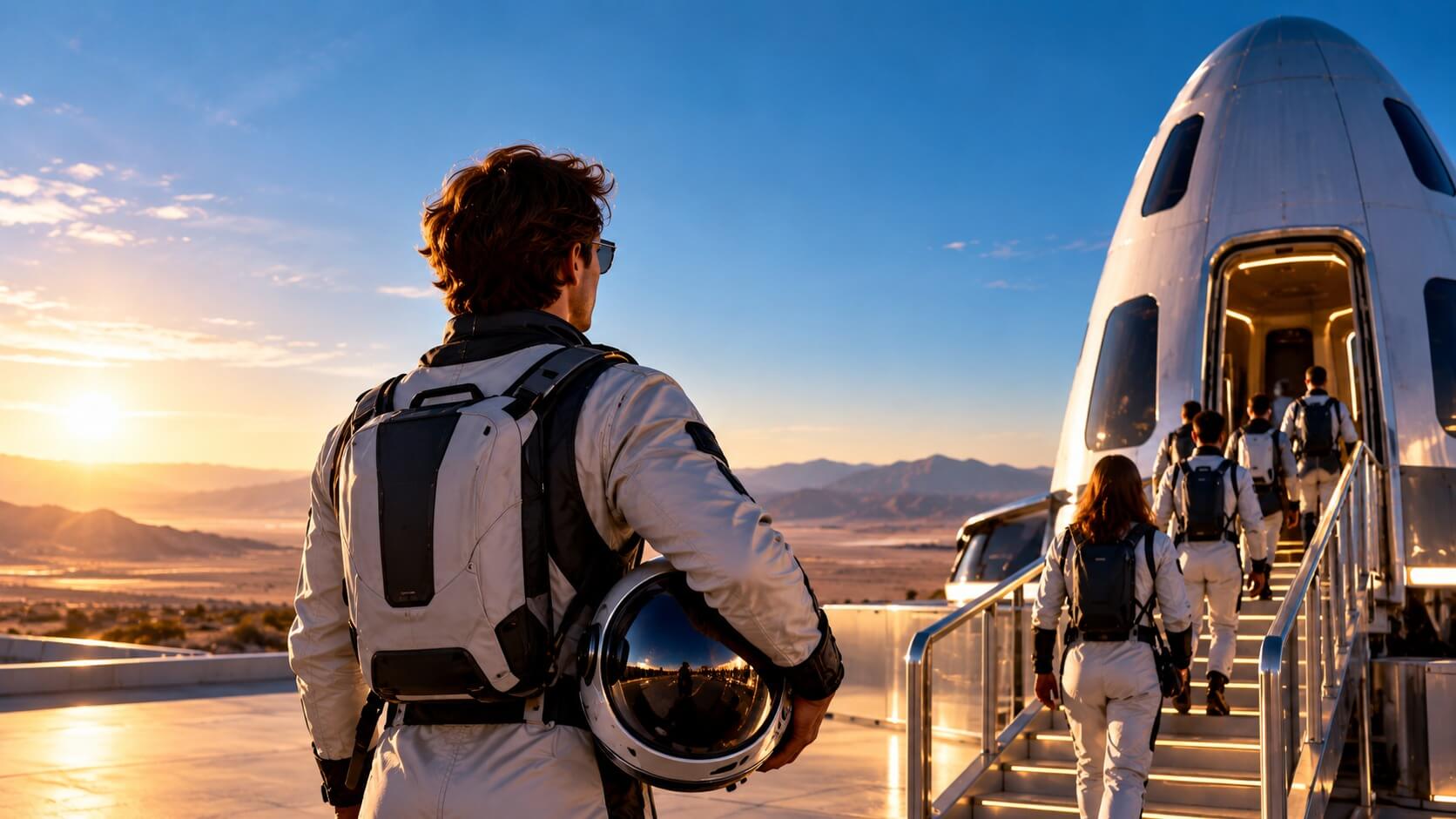
Space tourism can cost several hundred thousand dollars for a short suborbital flight or tens of millions of dollars for a multi-day orbital mission. The price depends on the spacecraft, flight duration, destination, and services included.
Virgin Galactic previously advertised tickets at $450,000, while certain privately arranged orbital missions have been associated with prices around $55 million per passenger. Blue Origin has not consistently published a standard retail price for New Shepard seats. These are historical reference points, not confirmed current booking prices.
The difference is substantial: a few minutes of weightlessness above Earth and several days in orbit require very different technology, training, and financial resources.
How Much Does It Cost to Go to Space?
The clearest way to compare space tourism prices is to separate suborbital experiences from orbital missions.
| Type of experience | Indicative price per person | Typical experience |
|---|---|---|
| Virgin Galactic suborbital flight | $450,000 historical advertised price | Short flight with several minutes of weightlessness |
| Blue Origin New Shepard | No standard public ticket price | Brief suborbital journey above the Kármán line |
| Private orbital mission | Tens of millions of dollars | Several days in Earth orbit |
| Private mission involving an orbital space station | Around $55 million in certain publicly discussed arrangements | Extended orbital stay with mission activities |
These figures are historical benchmarks or broad price indications, not verified current quotations. Actual costs depend on the mission and commercial agreement.
A suborbital spacecraft reaches space and returns without completing an orbit. An orbital spacecraft must achieve enough horizontal speed to remain around Earth, support passengers for an extended period, and bring them home safely.
That additional complexity explains much of the difference in pricing.
For a broader overview of the industry and its investment implications, see Space Tourism Explained: How the Market Works, What It Costs, and Who's Investing.
How Much Does a Virgin Galactic Flight Cost?
Virgin Galactic announced a $450,000 ticket price when it reopened reservations in 2022. Customers were required to make an initial deposit to secure a seat.
This became one of the most widely reported benchmarks for commercial suborbital space tourism because relatively few operators disclosed comparable public prices.
Virgin Galactic's system uses a carrier aircraft to lift a rocket-powered spaceplane to high altitude. The spaceplane separates, accelerates upward, and gives passengers a brief period of weightlessness before returning to Earth.
The experience is designed around a short journey rather than an extended stay in orbit.
However, the historical $450,000 price should not be interpreted as a guaranteed current quotation. Virgin Galactic has been developing its next-generation Delta-class spaceplanes, and commercial availability depends on vehicle readiness, testing, and operating schedules.
Prospective customers should rely on the terms of an actual reservation agreement, including the quoted price, deposit requirements, and expected flight schedule.
How Much Does a Blue Origin Space Tourism Ticket Cost?
Blue Origin's New Shepard offers suborbital passenger flights, but the company has not consistently published a standard retail ticket price.
Its first public seat auction in 2021 produced a winning bid of $28 million. That exceptional auction result attracted worldwide attention but should not be mistaken for the normal price paid by every passenger.
New Shepard uses a reusable rocket booster and passenger capsule. The capsule travels above the Kármán line, approximately 100 kilometers (62 miles) above sea level, before returning under parachutes.
Passengers experience several minutes of weightlessness during a journey lasting roughly 10 to 11 minutes, based on the vehicle's demonstrated flight profile.
For customers comparing providers, the important distinction is between exceptional auction prices, historical reports, and actual commercial quotations.
Without a confirmed offer, assigning a precise current price to an ordinary Blue Origin seat would be misleading.
For a detailed explanation, read How Much Does a Blue Origin Seat Cost? What Bezos' Trip Reveals.
How Much Does a SpaceX Flight Cost per Person?
SpaceX's Crew Dragon spacecraft has carried private passengers into Earth orbit, including missions arranged by commercial spaceflight organizations.
Unlike a short suborbital journey, an orbital mission can last several days and requires a spacecraft capable of supporting passengers throughout the flight.
One frequently cited reference point is approximately $55 million per passenger for certain privately arranged missions involving visits to the International Space Station.
However, this is not a universal SpaceX ticket price. It reflects particular commercial arrangements and should not be applied automatically to every private orbital mission.
Costs can vary depending on launch services, mission duration, destination, astronaut training, spacecraft operations, and agreements between participating organizations.
Some private missions are organized as complete expeditions rather than sold through a standardized individual-seat booking system.
For this reason, comparing an orbital mission directly with a Virgin Galactic or Blue Origin ticket can be misleading. The customer is purchasing a substantially different experience.
For more detail, see How Much Does a SpaceX Flight Cost per Person?.
Why Is Orbital Space Tourism So Much More Expensive?
The primary difference is the speed and energy required to reach orbit.
A suborbital spacecraft travels upward, reaches its maximum altitude, and returns to Earth. An orbital spacecraft must accelerate to approximately 28,000 kilometers per hour (17,500 miles per hour) to maintain low Earth orbit.
Achieving that speed requires a more powerful launch system and substantially greater energy.
Orbital spacecraft must also support passengers for extended periods, requiring systems for oxygen, temperature control, food, water, waste management, communications, navigation, and emergency procedures.
Returning from orbit creates additional engineering challenges. Spacecraft must withstand intense heating during atmospheric reentry and safely decelerate before landing or splashdown.
These requirements increase development, training, operating, and mission support costs.
The higher price therefore reflects more than additional time in space. Orbital tourism involves a fundamentally different level of transportation capability and mission complexity.
What Is Actually Included in a Space Tourism Ticket?
A commercial space tourism package may include training, medical assessments, specialized equipment, mission preparation, and the flight itself. The exact services depend on the provider and contract.
For suborbital passengers, preparation may involve safety briefings, cabin familiarization, procedures for weightlessness, and instruction on what to expect during acceleration and descent.
Some providers may also arrange accommodation or transportation associated with the experience, but customers should not assume these services are included.
Orbital missions generally require more extensive preparation. Training may involve spacecraft systems, emergency procedures, mission activities, and coordination with multiple organizations responsible for launch, operations, or destination access.
Before comparing advertised prices, customers should confirm what the quoted amount actually covers.
Two packages with similar prices may differ in training requirements, flight duration, accommodation, transportation, and contractual obligations.
Are There Hidden Costs Beyond the Ticket Price?
The advertised price may not represent the total amount a passenger ultimately spends.
Travel to the launch location, accommodation, additional training arrangements, personal insurance, and other services can create extra expenses depending on the contract.
Reservation terms deserve particular attention. Customers should understand whether deposits are refundable, what happens after a launch delay, and whether the operator can change the scheduled flight date.
Medical and physical requirements also matter. Spaceflight involves acceleration forces, weightlessness, and other stresses that may require screening or specialized preparation.
Insurance should be examined separately. Conventional travel insurance cannot automatically be assumed to cover commercial human spaceflight.
Finally, customers should consider the financial consequences of committing substantial funds to a discretionary experience that may take place years after booking.
A $500,000 purchase represents a major financial commitment even before accounting for additional expenses or potential delays.
Could Space Tourism Prices Fall in the Future?
Space tourism prices could decline as spacecraft become more reusable, operations improve, and flight frequency increases. However, lower prices are not guaranteed.
Reusability is one potential source of savings. Flying the same vehicle repeatedly can reduce the need to manufacture new hardware for every mission, although inspections, maintenance, refurbishment, and staffing remain necessary.
Higher flight frequency may also help operators spread fixed expenses across more paying customers.
Consider a hypothetical company with $120 million in annual fixed costs.
If it operates 20 passenger flights annually, those fixed costs represent $6 million per flight. If it increases to 100 flights without increasing total fixed costs, the allocation falls to $1.2 million per flight.
This is an illustrative calculation, not a prediction. In practice, expanding operations would likely require additional maintenance, personnel, equipment, and infrastructure.
Competition could also influence prices if more companies develop reliable passenger transportation systems.
However, spaceflight has demanding engineering, safety, and regulatory requirements. Operators cannot assume that lower ticket prices will be sustainable unless their costs decline sufficiently.
And lower operating costs do not necessarily mean lower customer prices. Companies may maintain premium pricing if available seats remain limited and demand is strong.
How Much Would Space Tourism Need to Cost to Become Mainstream?
There is no universally accepted ticket price at which space tourism would become a mass-market activity.
At $500,000 per passenger, the potential customer base is largely concentrated among wealthy individuals.
At $100,000, the experience would remain prohibitively expensive for most households, even if it became accessible to a broader group of affluent consumers.
At $10,000, more people might consider purchasing a ticket, although the expense would still represent a major luxury purchase.
These are hypothetical affordability scenarios, not forecasts of future prices or customer demand.
Affordability is only one obstacle. Safety perceptions, medical eligibility, training requirements, travel time, and willingness to experience the physical demands of spaceflight could also limit participation.
Even with substantial price reductions, space tourism may remain a specialized luxury market rather than becoming comparable to ordinary airline travel.
For a closer look at the practical and financial barriers, see Can a Normal Person Pay to Go to Space? What It Really Takes.
What Do Space Tourism Prices Mean for Investors?
High ticket prices can make space tourism appear extremely profitable, but revenue and profit are different measures.
Consider a hypothetical operator selling six seats per flight at $500,000 each. A fully booked mission would generate $3 million in passenger revenue.
At 20 completed flights annually, ticket sales would total $60 million.
However, the company would still need to cover employees, vehicle development, maintenance, infrastructure, insurance-related expenses, and other operating costs.
It could therefore generate tens of millions of dollars in annual revenue while continuing to report substantial losses.
For investors, the most useful questions concern operating economics: how frequently can vehicles fly, how much does each mission cost, how many paying passengers can be carried, and how much additional capital is required to expand?
Virgin Galactic illustrates why these factors matter. As a publicly traded company, its financial performance can be evaluated through reported revenue, operating expenses, cash balances, capital expenditures, and financing requirements.
SpaceX and Blue Origin are privately held and operate broader aerospace businesses, making it harder for outside investors to isolate the financial performance of their tourism activities.
A growing market for passenger spaceflight does not automatically translate into attractive shareholder returns. Sustainable profitability depends on the relationship between ticket revenue, flight frequency, operating costs, and capital investment.
Is Space Tourism Worth the Price?
Whether a space tourism flight is worth hundreds of thousands or millions of dollars depends on the passenger's financial circumstances, expectations, and willingness to accept the risks.
A suborbital flight offers a brief experience of weightlessness and views of Earth from space. An orbital mission provides a longer and more demanding experience, potentially involving several days in orbit.
Customers should compare more than ticket prices. Flight duration, altitude, training, physical requirements, safety considerations, scheduling uncertainty, and included services all influence the value of the experience.
For most people, commercial space tourism remains financially inaccessible. Prices may decline as technology and operations improve, but widespread affordability would require substantial reductions in cost and significant expansion in flight capacity.
For investors, the more important question is whether operators can turn these expensive experiences into reliable, repeatable, and economically sustainable services.
The future of space tourism will depend not simply on how much customers are willing to pay, but on whether companies can consistently deliver flights at costs that support a viable business.
Disclaimer: This article is for informational purposes only and does not constitute financial or investment advice. Space tourism and investments in space-related companies involve significant financial and operational risks.