
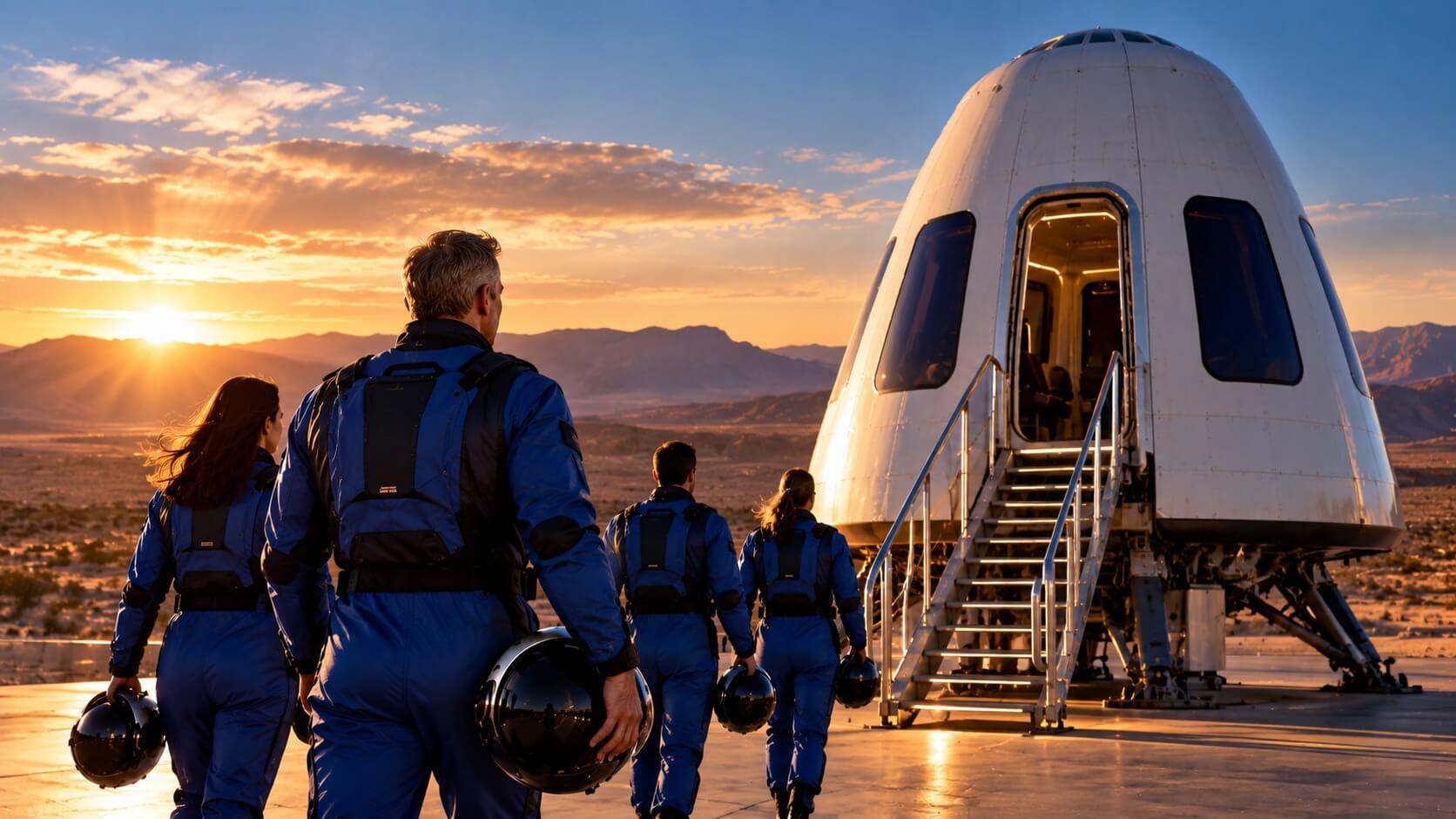
Blue Origin has not consistently published a standard ticket price for its New Shepard space tourism flights. The most famous publicly disclosed figure is $28 million, the winning bid in a 2021 auction for a seat on the company's first crewed mission. That was an exceptional auction result, not the normal price of a commercial ticket.
Jeff Bezos flew aboard New Shepard on July 20, 2021, but as Blue Origin's founder, he was not an ordinary paying customer. The auction was for a separate passenger opportunity, and the winning bidder ultimately did not participate in that flight.
For prospective customers, the key distinction is between a highly publicized inaugural mission and the cost of purchasing an ordinary seat. Without a confirmed commercial quotation, there is no reliable basis for assigning one fixed price to every Blue Origin flight.
How Much Does a Blue Origin Ticket Actually Cost?
There is no single publicly established retail price that can reliably be applied to every New Shepard passenger.
Unlike conventional airlines, Blue Origin has not consistently operated a public booking system displaying fixed ticket prices. Passenger arrangements have historically been handled individually, making actual transaction prices difficult to compare.
Three different price references are often confused:
| Price reference | Amount | What it represents |
|---|---|---|
| First New Shepard seat auction | $28 million | Winning bid for a special passenger opportunity in 2021 |
| Jeff Bezos' personal flight | No disclosed commercial ticket price | Founder participating in his company's inaugural crewed mission |
| Standard commercial seat | No consistently published fixed price | Individual passenger arrangements with pricing generally undisclosed |
The $28 million auction result is a documented historical figure, but it should not be used as the typical cost of flying with Blue Origin.
Some industry reports have suggested that ordinary commercial seats could cost considerably less. However, without a confirmed public price list or disclosed customer agreement, quoting a precise amount would be speculative.
For a broader comparison of commercial spaceflight prices, see How Much Does Space Tourism Cost? A Realistic Price Breakdown.
How Much Did Jeff Bezos Pay for His Spaceflight?
There is no publicly disclosed conventional ticket price for Jeff Bezos' July 20, 2021, New Shepard flight.
Bezos founded Blue Origin in 2000 and financed much of its early development through his personal wealth. His participation was therefore fundamentally different from that of a customer purchasing a tourism package.
He flew alongside his brother Mark Bezos, aviation pioneer Wally Funk, and Oliver Daemen.
The mission lasted approximately 10 minutes and crossed the Kármán line, commonly recognized internationally as the boundary of space at 100 kilometers (62 miles) above sea level.
Bezos' participation attracted worldwide attention because he was both the company's founder and one of the world's wealthiest individuals.
However, the cost of developing New Shepard should not be confused with the expense of operating a single passenger flight.
Blue Origin spent years designing, manufacturing, testing, and operating its reusable rocket system before carrying people. Those development expenditures were far broader than the costs directly associated with Bezos' individual journey.
Publicly available information does not establish exactly how much his flight cost the company.
Why Did Someone Bid $28 Million for a Blue Origin Seat?
The $28 million winning bid reflected an extraordinary opportunity: participating in Blue Origin's first crewed spaceflight alongside Jeff Bezos.
The company organized an auction for one of the passenger seats, attracting substantial international attention.
But the winning bidder was not simply purchasing a few minutes of weightlessness. The opportunity included participation in a historic, highly publicized mission involving the company's founder.
That exclusivity helps explain why the auction price should not be treated as representative of ordinary commercial demand.
A customer might pay an exceptional premium to participate in an inaugural event without being willing to spend the same amount on a routine flight years later.
Blue Origin announced that the auction proceeds would benefit its Club for the Future foundation.
The winning bidder ultimately did not fly on the July 2021 mission, with scheduling conflicts cited as the reason. Oliver Daemen instead joined the crew.
For investors, the auction demonstrated that at least one bidder valued this particular opportunity at an extraordinary amount. It did not establish a sustainable ticket price for recurring commercial operations.
What Do Passengers Get for the Money?
New Shepard provides a short suborbital spaceflight rather than an extended journey into Earth orbit.
The system consists of a reusable rocket booster and a passenger capsule designed to carry up to six people.
During launch, the booster carries the capsule upward before the two separate. The capsule continues toward its maximum altitude, allowing passengers to experience several minutes of weightlessness.
Large windows provide views of Earth's curvature and the darkness of space. Passengers can briefly float inside the cabin before returning to their seats for descent.
The capsule lands under parachutes, while the booster performs a separate powered landing for potential reuse.
The entire journey typically lasts around 10 to 11 minutes, based on New Shepard's demonstrated flight profile.
The principal attractions are crossing the boundary of space, experiencing weightlessness, and viewing Earth from an unusual perspective.
Passengers do not spend days in orbit or visit a space station. Those experiences require different spacecraft, substantially more training, and much larger mission budgets.
How High Does Blue Origin Fly?
New Shepard is designed to carry passengers above the Kármán line, approximately 100 kilometers (62 miles) above sea level.
This altitude is widely used internationally as a conventional boundary between Earth's atmosphere and space.
Crossing it allows passengers to experience a genuine suborbital spaceflight, but reaching that altitude is not the same as entering orbit.
An orbital spacecraft must also achieve enough horizontal velocity to continue circling Earth rather than immediately returning to the surface.
New Shepard follows a suborbital trajectory. Its capsule rises above the Kármán line and returns to Earth during the same short mission.
By comparison, SpaceX's Crew Dragon is designed to operate in Earth orbit, where missions can last several days.
For New Shepard passengers, the experience centers on the brief period of weightlessness and the view from the capsule rather than an extended stay in space.
Is Blue Origin Cheaper Than SpaceX?
Blue Origin's New Shepard and SpaceX's Crew Dragon offer fundamentally different commercial spaceflight experiences.
New Shepard carries passengers on short suborbital journeys. Crew Dragon has supported private orbital missions lasting several days, including visits to the International Space Station.
Orbital flight requires substantially greater launch energy, extended life-support capabilities, complex mission planning, and controlled atmospheric reentry from orbital velocity.
These requirements help explain why privately arranged orbital missions can involve costs of tens of millions of dollars per passenger.
Approximately $55 million per seat has been publicly associated with certain private orbital mission arrangements. This is a historical reference for specific missions, not a universal SpaceX retail price.
Because Blue Origin has not consistently disclosed standard commercial seat prices, a precise current dollar-for-dollar comparison is not possible.
Nevertheless, suborbital and orbital flights serve different customer needs. Someone primarily interested in experiencing weightlessness and seeing Earth from space may consider a short suborbital journey. A customer seeking several days in orbit is purchasing a much more demanding mission.
The distinction is explored in How Much Does a SpaceX Flight Cost per Person?.
Why Doesn't Blue Origin Publish a Fixed Ticket Price?
Blue Origin has not publicly established one definitive explanation for its historical approach to passenger pricing.
However, several characteristics of early commercial space tourism may help explain why standardized prices are less common than in conventional travel.
Limited capacity: New Shepard's capsule accommodates up to six passengers, leaving relatively few seats available on each mission.
Low flight volume: When commercial flights are infrequent, operators may use individual customer arrangements rather than maintain a fixed public fare structure.
Different passenger requirements: Scheduling, training, participation arrangements, and additional services may vary between customers.
Developing market demand: Companies entering a new luxury market may experiment with pricing as they learn what customers are willing to pay.
These are possible commercial explanations, not confirmed statements about Blue Origin's internal pricing decisions.
For customers, limited pricing transparency makes comparing providers more difficult. For investors, it also limits the ability to estimate New Shepard's passenger revenue and operating margins.
How Much Revenue Could Blue Origin Make From Space Tourism?
New Shepard's potential passenger revenue depends on three main factors: the price charged per seat, the number of paying passengers, and the frequency of commercial flights.
Because Blue Origin does not publicly disclose a consistent standard ticket price or detailed financial results for its tourism operations, any revenue calculation requires assumptions.
Consider a hypothetical flight carrying six paying passengers:
| Hypothetical price per seat | Revenue from six seats |
|---|---|
| $250,000 | $1.5 million |
| $500,000 | $3 million |
| $1 million | $6 million |
| $2 million | $12 million |
These figures are illustrative scenarios, not confirmed Blue Origin prices or actual revenue results.
They also represent gross ticket revenue, not profit.
Flight operations involve personnel, vehicle inspections, maintenance, launch infrastructure, training, insurance-related arrangements, and other expenses.
For example, a mission generating $3 million in passenger revenue would not necessarily be profitable if its direct and allocated costs exceeded that amount.
Annual profitability would also depend on flight frequency, vehicle utilization, and the capital required to develop and maintain the system.
Without reliable public information about these costs, New Shepard's financial performance cannot be calculated with confidence.
Does Reusing the Rocket Make Tickets Cheaper?
New Shepard's reusable design offers the potential to reduce the average hardware cost of commercial spaceflight.
Instead of manufacturing a new booster for every launch, Blue Origin can potentially spread the cost of reusable hardware across multiple missions.
However, reuse does not eliminate operating expenses. Vehicles still require inspections, maintenance, replacement components, ground crews, and safety procedures.
The economic benefit depends on how many flights each vehicle completes, how much refurbishment it requires, and how reliably the system operates.
A reusable rocket that flies only occasionally or needs expensive maintenance between launches may deliver less savings than expected.
Greater operational efficiency could eventually improve New Shepard's financial margins or support lower passenger prices.
But cost reductions do not automatically translate into cheaper tickets. If available seats remain limited and customers are willing to pay premium prices, an operator may choose to maintain higher fares.
Can Anyone Buy a Blue Origin Ticket?
Blue Origin has demonstrated that private individuals can travel aboard New Shepard, but having enough money does not automatically guarantee a seat.
Prospective passengers may need to satisfy medical, physical, training, and operational requirements.
Commercial spaceflight involves acceleration forces, brief weightlessness, and physical demands that differ from ordinary airline travel. Participants must also understand the risks involved.
Scheduling presents another challenge. Flights depend on vehicle readiness, weather, safety assessments, and operational planning. Delays can occur even after passengers have been selected.
Completed passenger missions should not be confused with continuous commercial booking availability.
Anyone considering a flight should verify the operator's current status, reservation procedures, payment requirements, cancellation terms, and expected schedule before making a financial commitment.
For most households, the extraordinary cost remains the primary obstacle.
What Does Blue Origin's Pricing Reveal About the Space Tourism Market?
Blue Origin's pricing history illustrates the difference between extraordinary demand for an exclusive experience and the economics of a repeatable tourism business.
The $28 million auction demonstrated that a historic inaugural flight could attract an exceptional willingness to pay. It did not prove that large numbers of customers would regularly purchase seats at comparable prices.
A sustainable business requires recurring demand, reliable operations, and sufficient revenue to cover development and operating costs.
Blue Origin also operates beyond passenger tourism, developing launch vehicles and other space technologies. Its broader business cannot be evaluated solely through New Shepard ticket sales.
Because the company is privately held, ordinary retail investors cannot purchase its shares on a conventional public stock exchange. Its detailed financial performance is also less transparent than that of publicly traded companies.
Investors interested in the broader commercial spaceflight industry can explore Space Tourism Explained: How the Market Works, What It Costs, and Who's Investing for a wider discussion of business models, investment opportunities, and financial risks.
What Should You Expect to Pay for Blue Origin?
The most accurate answer is that Blue Origin has not consistently published a standard price for an ordinary New Shepard seat.
The widely reported $28 million figure came from a special auction in 2021, not a typical commercial ticket sale. Jeff Bezos' participation in the inaugural flight did not establish a retail price either.
Anyone seriously considering a New Shepard flight should seek a current quotation directly from the operator and confirm the services included, deposit requirements, cancellation conditions, and expected flight schedule.
For investors, the larger lesson is that exceptional ticket prices do not necessarily indicate a large or profitable recurring market.
Blue Origin has demonstrated the technical feasibility of private suborbital passenger flights. The commercial challenge is turning those capabilities into reliable, repeatable operations supported by enough paying customers to justify their costs.
Disclaimer: This article is for informational purposes only and does not constitute financial or investment advice. Commercial spaceflight involves significant safety, operational, and financial risks.