
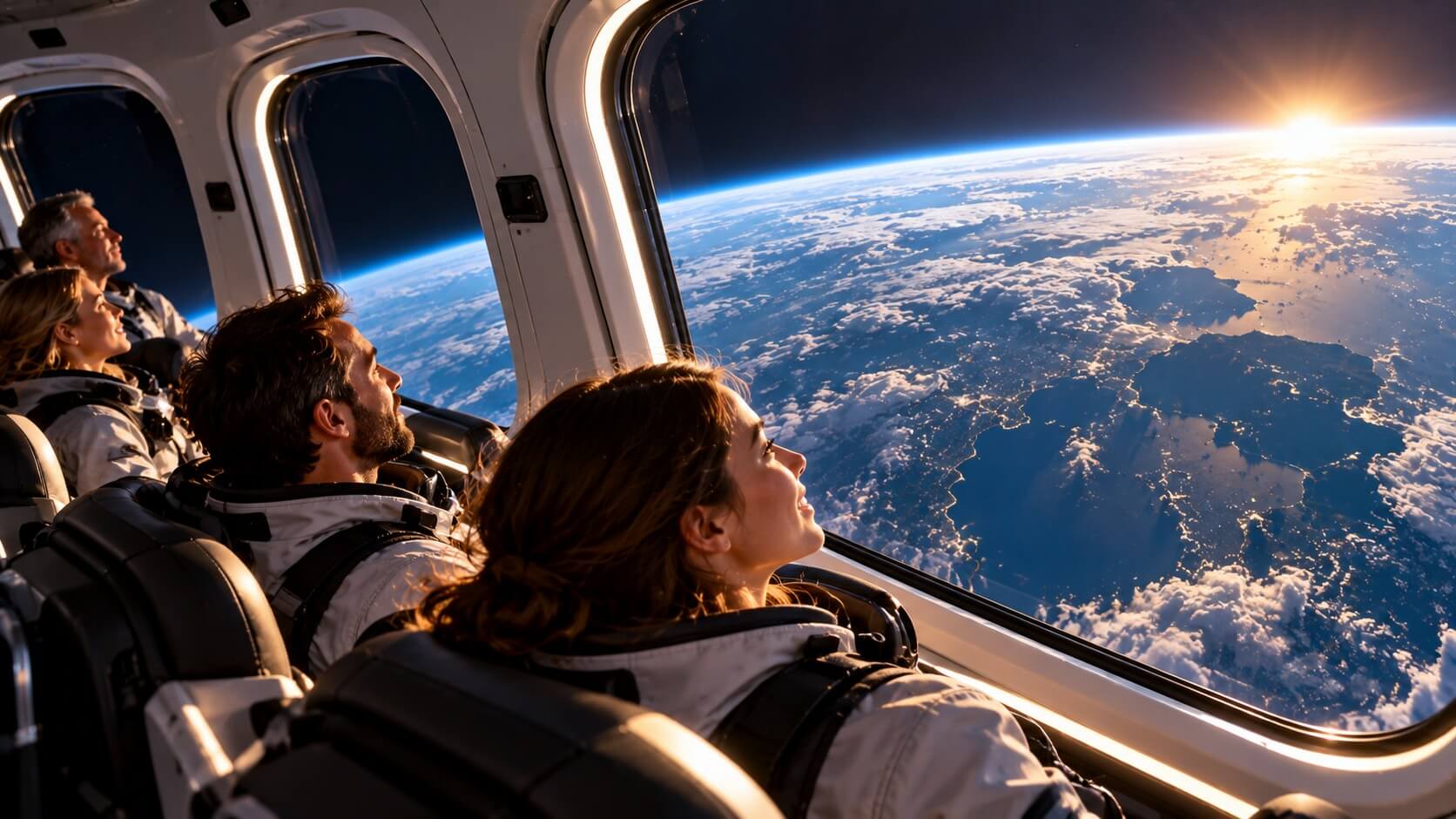
Yes, space tourism already exists. Private individuals have traveled beyond Earth's atmosphere on short suborbital flights and spent several days in orbit aboard commercial spacecraft. Blue Origin, Virgin Galactic, and SpaceX have all demonstrated passenger spaceflight, although their services, operating schedules, and commercial maturity differ substantially.
The key distinction is between a company that has successfully carried passengers and one that offers regular, readily available commercial flights.
As of 2026, space tourism is a real but small industry. Some operators have completed multiple passenger missions, while others are developing new spacecraft or preparing for future commercial operations.
Which Space Tourism Companies Have Actually Flown Passengers?
Blue Origin, Virgin Galactic, and SpaceX have demonstrated three different approaches to private passenger spaceflight.
| Company | Type of experience | Demonstrated capability | Commercial maturity |
|---|---|---|---|
| Blue Origin | Suborbital capsule flight | Multiple crewed New Shepard missions | Passenger flights suspended since January 2026 for at least two years |
| Virgin Galactic | Suborbital spaceplane flight | Completed commercial passenger missions | Transition toward next-generation Delta-class vehicles |
| SpaceX | Orbital spacecraft flight | Multiple private orbital missions | Established orbital transportation capability, with individually arranged missions |
All three have carried private individuals into space, but none operates like a conventional airline with frequent scheduled departures and affordable public fares.
Blue Origin's New Shepard carries passengers above the Kármán line, approximately 100 kilometers (62 miles) above sea level. Virgin Galactic developed an air-launched spaceplane for suborbital experiences. SpaceX's Crew Dragon transports passengers into Earth orbit, including missions to the International Space Station (ISS).
These differences affect flight duration, ticket prices, training requirements, and availability.
For a broader overview of the industry, see Space Tourism Explained: How the Market Works, What It Costs, and Who's Investing.
Is Blue Origin Still Flying Space Tourists?
Blue Origin's New Shepard program has demonstrated repeated passenger spaceflight using a reusable rocket booster and capsule.
Its first crewed mission launched on July 20, 2021, carrying Jeff Bezos, Mark Bezos, Wally Funk, and Oliver Daemen.
The flight lasted approximately 10 minutes and crossed the Kármán line. Subsequent missions carried additional private passengers, including commercial and sponsored participants.
New Shepard completed its most recent passenger flight on January 22, 2026. On January 30, 2026, Blue Origin announced that New Shepard flights would be paused for at least two years while the company redirects resources toward its lunar program. New Shepard is therefore not currently operating passenger flights, and no near-term departures are confirmed.
The program has also experienced earlier interruptions.
In September 2022, an uncrewed New Shepard mission suffered a launch failure, prompting an investigation and temporary suspension of flights. The program later resumed uncrewed operations and subsequently returned to passenger missions.
This history demonstrates why completed flights do not guarantee uninterrupted commercial availability.
Although New Shepard is designed for reuse, each mission still requires vehicle inspections, preparation, safety assessments, trained personnel, and suitable launch conditions.
Prospective customers should therefore distinguish between New Shepard's proven passenger capability and its currently suspended flight operations.
What Happened to Virgin Galactic's Space Tourism Flights?
Virgin Galactic began commercial suborbital service in 2023, carrying paying passengers and research participants aboard its SpaceShipTwo system.
Unlike Blue Origin's vertical rocket launch, Virgin Galactic uses a carrier aircraft to lift a rocket-powered spaceplane to high altitude. The spaceplane separates, accelerates upward, and provides a brief period of weightlessness before returning to a runway.
The company demonstrated commercial passenger operations but subsequently retired its VSS Unity spaceplane after its final flight in June 2024.
That decision formed part of a transition toward next-generation Delta-class spacecraft, designed to support greater flight capacity and more scalable operations.
Developing and introducing a new fleet requires engineering, testing, financing, and regulatory work. Historical passenger flights therefore do not establish that the replacement vehicles are ready for regular commercial service.
For customers, the relevant question is when the new spacecraft can actually carry passengers. For investors, important indicators include development milestones, vehicle readiness, operating costs, cash reserves, and financing requirements.
Has SpaceX Actually Taken Tourists Into Orbit?
Yes. SpaceX has transported private individuals into Earth orbit on multiple missions using Crew Dragon.
Unlike suborbital vehicles, Crew Dragon can support passengers for several days and transport crews to destinations such as the International Space Station.
Several missions demonstrate its capabilities.
Inspiration4 (September 2021): A privately financed mission carrying four civilians into orbit for approximately three days. The spacecraft operated independently without docking with the ISS.
Axiom Space missions: Commercially organized private astronaut missions using SpaceX transportation to the ISS. Participants have included private individuals, government-sponsored astronauts, and research personnel.
Polaris Dawn (September 2024): A privately funded mission that included the first commercial spacewalk and tested specialized spacesuits and procedures.
Fram2 (April 2025): The first human spaceflight mission to enter a polar orbit, allowing its crew to observe Earth's polar regions from space.
These missions establish that private orbital spaceflight has progressed beyond a single experimental demonstration.
However, they also illustrate its unusual commercial structure. Missions are generally arranged individually and may involve wealthy sponsors, commercial organizers, research institutions, or government participants.
They are not equivalent to purchasing an ordinary airline ticket.
What's the Difference Between Suborbital and Orbital Tourism?
A suborbital flight reaches space without achieving the speed required to remain in orbit. Passengers experience several minutes of weightlessness before returning to Earth.
An orbital spacecraft accelerates to approximately 17,500 miles per hour (28,000 kilometers per hour), allowing it to continue circling Earth. Passengers can remain in space for days rather than minutes.
| Feature | Suborbital tourism | Orbital tourism |
|---|---|---|
| Typical flight duration | Around 10 minutes for New Shepard; longer overall for air-launched spaceplanes | Several days or longer |
| Time in weightlessness | Several minutes | Extended periods |
| Main experience | View of Earth and brief weightlessness | Living and traveling in Earth orbit |
| Companies with demonstrated flights | Blue Origin, Virgin Galactic | SpaceX |
| Financial accessibility | Extremely expensive | Generally far more expensive |
| Operational complexity | High | Very high |
A suborbital passenger is not purchasing a stay aboard a space station. Similarly, an orbital mission involves substantially greater training, technical complexity, and financial commitment.
This distinction is essential when comparing space tourism providers and evaluating what services are actually available.
Can You Book a Space Tourism Flight Right Now?
Booking availability depends on the provider, spacecraft readiness, and type of mission. A company having completed passenger flights does not necessarily mean seats are available for immediate purchase.
Blue Origin has historically used individualized passenger arrangements rather than an airline-style booking system with fixed public fares. However, New Shepard passenger flights have been suspended since January 30, 2026, for at least two years. No near-term New Shepard departures are confirmed, regardless of whether prospective customers can inquire about future opportunities.
Virgin Galactic has accepted reservations, but its transition to Delta-class spacecraft affects the timing of future commercial flights.
Private orbital missions involving SpaceX are generally organized through commercial mission providers or customized agreements.
Prospective passengers should confirm whether a spacecraft is currently operational, whether reservations are being accepted, and whether a specific mission has an established schedule.
They should also review deposit requirements, cancellation conditions, medical eligibility, and the consequences of delays.
A planned launch date or advertised future experience is not the same as a confirmed passenger departure.
How Many People Have Actually Traveled as Space Tourists?
Private space travel began long before the current generation of commercial spacecraft.
In 2001, Dennis Tito traveled to the International Space Station aboard a Russian Soyuz spacecraft. His journey is widely regarded as the first privately funded orbital space tourism flight.
Additional private individuals subsequently visited the ISS through arrangements involving Russian spacecraft and commercial intermediaries.
The industry expanded after 2021 as Blue Origin began New Shepard passenger missions, Virgin Galactic introduced commercial suborbital flights, and SpaceX supported privately financed orbital expeditions.
However, there is no universally accepted total number of space tourists.
Some definitions include only people who personally paid for their flights. Others include sponsored passengers, researchers, government astronauts traveling on commercially arranged missions, and privately funded crew members.
Organizations also differ in their definitions of the boundary of space, particularly for suborbital flights.
Any precise passenger count therefore needs a clearly stated definition and reporting date.
The established trend is that private human spaceflight has progressed from rare individual journeys to multiple commercially organized missions, although passenger volumes remain tiny compared with conventional transportation.
Why Isn't Space Tourism More Common?
The main barriers are high costs, limited passenger capacity, operational complexity, and safety requirements.
Current commercial spacecraft carry relatively small crews. New Shepard's capsule accommodates up to six passengers, while privately arranged Crew Dragon missions generally involve a handful of crew members.
Even with sufficient customer demand, limited capacity restricts how many people can travel.
Flight frequency presents another challenge. Spacecraft require inspections, maintenance, mission preparation, and operational approval. Technical problems can delay entire programs.
These interruptions also have financial consequences. Companies may continue paying employees, maintaining infrastructure, and funding development while passenger flights are suspended.
Safety requirements further limit how quickly operations can expand. Human spaceflight exposes passengers to launch acceleration, weightlessness, reentry forces, and other hazards that differ from conventional tourism.
Successful demonstrations are important, but developing reliable, repeatable commercial operations requires substantially more work.
Can Ordinary People Become Space Tourists?
Commercial spaceflight is no longer restricted to professional government astronauts. Private individuals from different professional backgrounds have participated in suborbital and orbital missions.
However, the financial barrier remains enormous.
Historical suborbital ticket prices have reached hundreds of thousands of dollars, while certain privately arranged orbital missions have involved prices of tens of millions per passenger.
These costs place ordinary commercial participation beyond the reach of most households.
Some passengers have traveled through sponsorships, privately funded crew selections, or institutional arrangements rather than paying the full cost personally.
Such opportunities are unusual and should not be treated as widely available alternatives to purchasing a ticket.
Medical evaluations, physical requirements, training, and schedule flexibility can also affect eligibility.
For a detailed examination of affordability and participation requirements, see Can a Normal Person Pay to Go to Space? What It Really Takes.
How Much Does Space Tourism Cost Today?
Prices depend primarily on whether passengers want a brief suborbital experience or an extended orbital mission.
Virgin Galactic publicly advertised tickets at $450,000 in 2022. That remains a historical reference, not a confirmed current quotation.
Blue Origin has not consistently published a standard retail price for New Shepard seats. Its widely reported $28 million auction in 2021 involved an exceptional inaugural-flight opportunity rather than an ordinary commercial ticket.
Private orbital missions involve much larger financial commitments. Approximately $55 million per seat has been publicly associated with certain Axiom Space private astronaut arrangements, but this is not a universal price for SpaceX transportation.
Actual costs depend on the mission organizer, destination, duration, training, and contractual services.
For a detailed comparison, see How Much Does Space Tourism Cost? A Realistic Price Breakdown.
What Would Make Space Tourism a Mature Industry?
Commercial maturity requires more than proving that a spacecraft can carry passengers.
Consistent flight frequency: Regular passenger missions would provide stronger evidence of operational capacity and the potential for recurring revenue.
Operational reliability: Vehicles must demonstrate that they can fly repeatedly while managing inspections, maintenance, safety requirements, and technical risks.
Demonstrated customer demand: Reservations and expressions of interest are not equivalent to completed flights or recognized revenue. Companies need customers who can afford their services and are willing to participate.
Financial sustainability: Operators must eventually generate sufficient revenue to support ongoing operations and capital investment.
A company can successfully carry passengers while continuing to lose money if development and operating expenses exceed revenue.
For publicly traded businesses, investors can examine cash flow, capital expenditures, financing needs, and progress toward commercial milestones. Privately held companies generally disclose less detailed financial information.
Space tourism will become more commercially mature when flights are not only technically possible but also repeatable, reliable, and economically sustainable.
What Does the Future of Space Tourism Look Like?
The industry's future depends on whether companies can reduce costs, increase flight frequency, and expand the number of customers able to participate.
Reusable spacecraft may improve economics by spreading hardware costs across multiple missions. Greater passenger capacity could also reduce the average cost per seat.
However, these improvements are not guaranteed. Human spaceflight still requires extensive training, maintenance, infrastructure, and safety procedures.
The market may develop unevenly. Suborbital tourism could remain a luxury experience, while orbital missions serve a combination of private passengers, researchers, and government-supported participants.
Future commercial space stations could create additional demand for orbital transportation, although their development timelines and financial viability remain uncertain.
For investors, announced projects should be distinguished from completed missions, operational capacity, and actual revenue.
Long-term growth will depend on demonstrated customer demand and sustainable operating economics rather than technological ambition alone.
Space Tourism Is Real, but It Isn't Mainstream Yet
Space tourism has moved beyond experimental demonstrations in one important respect: private individuals have traveled into space aboard commercially operated vehicles.
Blue Origin and Virgin Galactic have demonstrated suborbital passenger flights. SpaceX has supported multiple private orbital missions, including independent expeditions and visits to the International Space Station.
But these achievements do not mean space tourism has become a mature mass-market industry.
Flights remain expensive, relatively infrequent, and dependent on specialized infrastructure and extensive preparation.
For prospective passengers, the most important question is whether a particular service is currently operational and accepting customers under clear contractual conditions.
For investors, the question is whether operators can transform successful missions into reliable, recurring, and financially sustainable businesses.
Space tourism already exists. Making it accessible to a substantially larger market remains the challenge.
Disclaimer: This article is for informational purposes only and does not constitute financial or investment advice. Commercial human spaceflight involves substantial safety, operational, and financial risks.