
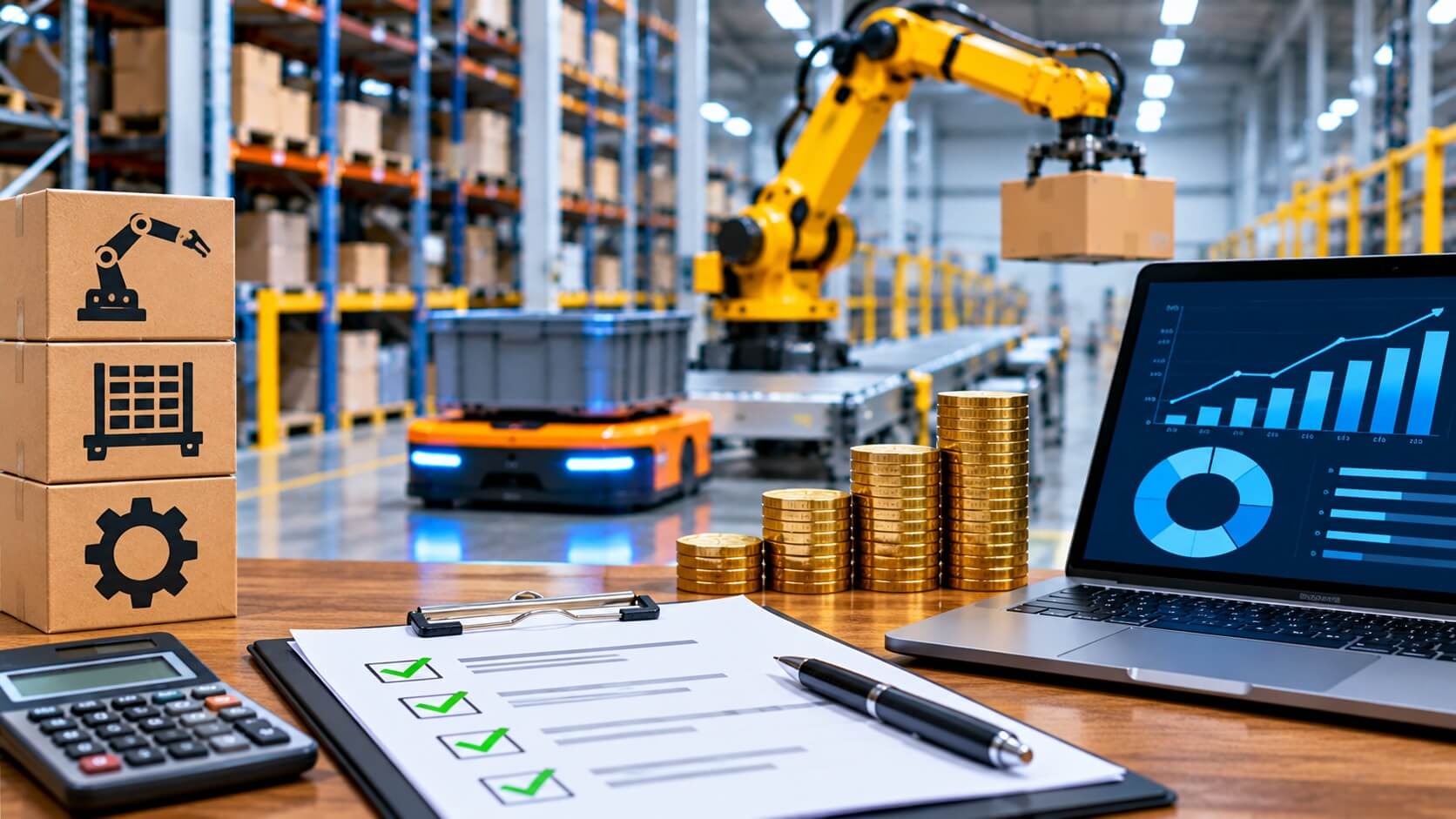
Warehouse automation can cost anywhere from a few thousand dollars for basic software and scanning equipment to several million dollars for a large, highly automated distribution center.
The price depends on warehouse size, order volume, the technologies selected, and how extensively the business wants to automate its operations.
A small warehouse may improve efficiency with inventory software, barcode scanners, and limited material handling equipment. A large retailer may invest in robotic storage systems, autonomous mobile robots, conveyor networks, and sophisticated software that coordinates thousands of daily operations.
The most important consideration is not simply the initial cost. Businesses must determine whether automation can generate enough labor savings, productivity improvements, and additional capacity to justify the investment.
For investors, understanding these costs helps explain how warehouse automation suppliers generate revenue and why customers sometimes delay major automation projects.
How Much Does It Cost to Automate a Warehouse?
Warehouse automation costs vary considerably because different technologies solve different operational problems.
The following ranges are illustrative planning estimates, not verified market averages or supplier quotations. Actual project prices can fall outside these ranges.
| Automation Solution | Illustrative Cost Range |
|---|---|
| Basic inventory software and scanning equipment | $2,000–$25,000 |
| Warehouse management software implementation | $10,000–$150,000+ |
| Small conveyor installation | $25,000–$150,000+ |
| Limited mobile robot deployment | $50,000–$300,000+ |
| Robotic picking workstation | $100,000–$500,000+ |
| Automated storage and retrieval installation | $250,000–$5 million+ |
| Large integrated warehouse automation project | $5 million–$50 million+ |
These categories can overlap, and their costs are not necessarily additive.
For example, a robotic storage project may already include software, equipment integration, and installation services.
Similarly, a large warehouse automation contract may combine several technologies into one integrated system.
The wide variation reflects differences in capacity, complexity, equipment configuration, and operational requirements.
A business automating a small number of repetitive tasks faces a very different investment from a company redesigning an entire distribution center.
What Determines the Cost of Warehouse Automation?
Several factors influence the final price of an automation project.
Warehouse Size
Larger warehouses generally require more equipment, longer transportation routes, and more complex system integration.
However, warehouse size alone does not determine automation costs.
A compact facility handling thousands of individual orders may require more sophisticated technology than a much larger warehouse storing relatively few pallets.
Order Volume
Order volume is one of the most important economic considerations.
A warehouse processing hundreds of orders per day has different requirements from a distribution center handling tens of thousands.
Higher volumes may justify faster equipment, additional robots, and more advanced sorting systems.
However, these capabilities increase the initial investment.
Product Characteristics
The size, weight, shape, and variety of products influence which technologies can be used.
Standardized cartons and pallets are generally easier to automate than irregularly shaped products or fragile merchandise.
Businesses handling a wide variety of products may require more sophisticated robotic gripping, storage, and identification systems.
Existing Infrastructure
Automating an existing warehouse can require substantial modifications.
The building may need changes to flooring, electrical systems, storage racks, network infrastructure, or equipment layouts.
A newly constructed facility can sometimes be designed around automation from the beginning.
However, new construction introduces additional capital costs that must be considered separately.
Level of Integration
Warehouse automation equipment rarely operates in isolation.
Robots, conveyors, storage systems, and software must communicate with existing inventory and business applications.
Complex integration requirements can increase engineering costs and extend implementation schedules.
These expenses are sometimes underestimated when businesses focus primarily on equipment prices.
How Much Does a Warehouse Robot Cost?
Warehouse robots vary widely in price because they perform different tasks.
A mobile robot transporting containers is fundamentally different from a robotic arm designed to identify and pick individual products.
Autonomous Mobile Robots
Autonomous mobile robots, or AMRs, move products and materials through warehouses.
Their cost depends on payload capacity, navigation capabilities, sensors, software, and fleet size.
A small mobile robot may cost tens of thousands of dollars, while larger or specialized systems can cost considerably more.
However, the purchase price does not represent the entire deployment cost.
Businesses may also need fleet management software, charging stations, wireless network improvements, maintenance agreements, and integration services.
A warehouse deploying twenty robots must evaluate the cost of the entire operating system rather than multiplying a single robot's price by twenty.
Automated Guided Vehicles
Automated guided vehicles, or AGVs, transport materials along established or controlled routes.
They are frequently used for repetitive movements involving pallets, containers, or industrial materials.
Pricing depends on vehicle capacity, navigation technology, and the infrastructure required to support operations.
Some installations require additional guidance equipment or modifications to warehouse layouts.
Robotic Picking Arms
Robotic picking systems use mechanical arms, sensors, cameras, and gripping devices to handle products.
The robotic arm itself represents only part of the total cost.
A complete picking workstation may require machine vision, specialized grippers, safety equipment, conveyors, software, and installation services.
The complexity increases when robots must handle products with different shapes, sizes, and packaging materials.
For investors, these differences help explain why robotics suppliers may have very different selling prices and profit margins.
How Much Do Automated Storage Systems Cost?
Automated storage and retrieval systems, commonly called AS/RS, are among the more capital-intensive warehouse technologies.
These systems store products in organized structures and retrieve them using machines such as cranes, shuttles, or mobile robots.
Their cost depends on storage capacity, retrieval speed, building configuration, and equipment design.
A relatively small installation may cost hundreds of thousands of dollars.
Large, high-capacity systems can require investments of several million dollars or more.
The potential economic benefits include improved storage density, reduced travel time, and greater inventory-handling capacity.
However, these systems can also require substantial engineering work and integration with existing warehouse operations.
Businesses must consider whether expected productivity improvements justify the investment.
For example, a warehouse operating in an expensive real estate market may place significant value on storing more products within the same building.
Another facility with inexpensive space and relatively low order volume may find the same technology financially unattractive.
The value of automated storage therefore depends on the operating environment, not simply the technical capabilities of the equipment.
How Much Does Warehouse Automation Software Cost?
Software is a major component of warehouse automation spending.
Even facilities with limited robotics may rely on software to track inventory, manage orders, and coordinate employees.
Warehouse management systems can be purchased through different commercial models.
Subscription-Based Software
Some warehouse software providers charge recurring subscription fees.
Pricing may depend on the number of users, facilities, transactions, or software features.
Subscription models can reduce initial licensing expenses, but customers must consider ongoing costs.
A lower upfront payment does not necessarily mean a lower total cost over several years.
Enterprise Software Implementations
Large warehouses may require complex software installations involving multiple systems.
These projects can include customization, integration, data migration, testing, and employee training.
Implementation expenses can be substantial, particularly when software must communicate with automated equipment and existing enterprise applications.
Warehouse Execution and Control Software
Highly automated facilities may also use warehouse execution systems and warehouse control systems.
These applications help coordinate equipment, prioritize activities, and manage operational workflows.
Their costs depend on system complexity and the number of technologies being integrated.
Software spending is important for investors because recurring revenue models can differ significantly from equipment sales.
However, implementation costs, customer support, and competition can still affect software profitability.
What Are the Hidden Costs of Warehouse Automation?
The initial equipment quotation rarely captures every expense associated with automation.
Several additional costs can materially affect the economics of a project.
Installation and Integration
Automated equipment must be installed, configured, tested, and connected to existing operations.
Complex projects may require engineers, software developers, equipment technicians, and external consultants.
Integration problems can delay deployment and increase expenses.
Building Modifications
Warehouses may require electrical upgrades, floor reinforcement, new storage structures, safety barriers, or network improvements.
These costs can be significant when retrofitting older facilities.
Maintenance and Repairs
Robots and mechanical systems require regular maintenance.
Motors, sensors, batteries, belts, and other components may need inspection or replacement.
Maintenance contracts can also create recurring expenses.
Employee Training
Automation changes how employees perform their jobs.
Workers may need training to operate equipment, manage exceptions, monitor systems, and follow new safety procedures.
Technical employees may require additional skills.
Operational Disruption
Installing automation in an active warehouse can temporarily reduce productivity.
Businesses may need to operate parallel processes or schedule construction around normal operations.
Unexpected delays can increase labor and logistics costs.
Software and Technology Upgrades
Automation systems may require ongoing software updates, cybersecurity improvements, and equipment upgrades.
Businesses should consider the expected useful life of the technology and the potential cost of future modernization.
These expenses should be included when calculating the total cost of ownership.
Is Warehouse Automation Cheaper Than Hiring Workers?
Automation can reduce labor costs, but it is not automatically cheaper than employing warehouse workers.
The comparison depends on how much work the technology replaces or improves and how much the system costs over its useful life.
Consider a hypothetical warehouse evaluating a robotic installation.
The project requires an initial investment of $1 million.
The company expects annual labor and operational savings of $300,000.
However, maintaining the system and paying recurring software expenses costs an additional $75,000 annually.
The estimated annual net operating benefit would be:
$300,000 − $75,000 = $225,000
Using a simplified payback calculation:
$1,000,000 ÷ $225,000 = approximately 4.4 years.
This means the project would recover its initial investment in approximately four years and five months under those assumptions.
The example is illustrative rather than a forecast of typical automation performance.
It also excludes financing costs, taxes, changes in working capital, and the time value of money.
Actual results could differ substantially.
If the warehouse processes fewer orders than expected, the savings may be smaller.
If labor costs increase or order volumes grow, the system may generate greater economic benefits.
The relevant question is whether automation creates more value than its total cost over time.
What Is the Return on Investment for Warehouse Automation?
Return on investment measures whether the financial benefits of automation justify the capital committed.
Warehouse operators often evaluate automation using payback periods, cash flow forecasts, and discounted investment calculations.
Payback Period
The payback period estimates how long it takes for project benefits to recover the initial investment.
A shorter payback period may be attractive, particularly when technology changes rapidly.
However, payback alone does not capture all financial risks or benefits.
Net Present Value
Net present value, or NPV, compares the present value of expected future cash flows with the initial investment.
It accounts for the fact that money received in the future is generally worth less than money available today.
This approach can provide a more complete evaluation than a simple payback calculation.
Productivity Improvements
Automation may allow a warehouse to process more orders using the same amount of space or fewer labor hours per order.
These improvements can be valuable even when employee headcount does not decline.
Inventory and Error Reduction
Improved inventory tracking and automated handling may reduce certain mistakes, product damage, and fulfillment errors.
These benefits can lower operating costs and improve customer service.
However, they should be measured realistically rather than assumed.
The profitability of automation depends on actual operating results.
Can Small Warehouses Afford Automation?
Small warehouses can adopt automation without investing in a fully robotic facility.
The most practical approach is often to identify specific operational problems and automate them gradually.
For example, a small distributor experiencing inventory errors might begin with barcode scanning and warehouse management software.
A business with repetitive product movements might introduce selected conveyor equipment.
A growing fulfillment operation could later evaluate mobile robots or automated storage systems.
This phased approach allows businesses to test whether automation produces measurable benefits before making larger investments.
However, smaller warehouses may face challenges involving financing, maintenance expertise, and system utilization.
Expensive equipment can be difficult to justify when order volumes are low or unpredictable.
Some suppliers offer robotics-as-a-service arrangements, where customers pay recurring fees instead of purchasing all equipment upfront.
These models can reduce initial capital requirements, although they may involve long-term contracts and ongoing expenses.
Businesses must compare the full financial commitment rather than focusing exclusively on initial payments.
Why Do Warehouse Automation Costs Matter to Investors?
Warehouse automation costs influence both customer demand and supplier profitability.
For companies purchasing automation, high initial investment can delay adoption.
For equipment manufacturers and systems integrators, large projects can generate substantial revenue but also create execution risks.
Capital Spending Cycles
Warehouse automation projects often depend on corporate investment budgets.
During periods of economic uncertainty, businesses may postpone large projects.
Higher borrowing costs can also reduce the attractiveness of capital-intensive installations.
This can make automation equipment demand cyclical.
Supplier Revenue and Margins
Large automation contracts can generate significant sales.
However, equipment manufacturing, engineering, installation, and customization all involve expenses.
A supplier may report strong revenue growth while experiencing weak margins if project costs exceed expectations.
Investors should examine profitability and cash flow alongside sales growth.
Recurring Revenue Opportunities
Maintenance contracts, software subscriptions, and support services can provide ongoing revenue after equipment installation.
These activities may create longer customer relationships.
However, recurring revenue does not guarantee high margins or strong customer retention.
Customer Concentration
Some automation suppliers depend on a limited number of large customers.
A postponed project or reduced investment program can materially affect expected revenue.
Understanding how much customers must spend to adopt a supplier's technology helps investors evaluate potential demand.
The competitive landscape is examined in Who Leads Warehouse Automation? The Companies Behind the Industry.
How Does Warehouse Automation Affect Warehouse Profitability?
Automation can improve warehouse profitability by reducing operating costs, increasing productivity, and allowing facilities to handle more orders.
However, the benefits depend on the relationship between investment costs and operational improvements.
A warehouse with high order volumes and repetitive workflows may achieve attractive utilization of automated equipment.
A facility with unpredictable demand or low throughput may struggle to recover its investment.
Automation can also change a warehouse's cost structure.
Traditional operations may rely heavily on wages and other variable labor expenses.
Automated facilities often require more upfront capital and ongoing equipment-related costs.
This can create operating leverage.
When order volumes increase, the facility may process additional work without increasing costs at the same rate.
But when volumes decline, fixed costs remain.
The result can be greater profitability during strong demand and increased financial pressure during periods of underutilization.
For a detailed explanation of warehouse operating margins and the economics of automation, see How Profitable Is a Warehouse? The Economics of Automation.
What Can Make Warehouse Automation More Expensive Than Expected?
Several factors can cause automation projects to exceed their original budgets.
One is inaccurate demand forecasting.
A company may invest in equipment designed for order volumes that never materialize.
Another is implementation complexity.
Existing warehouse layouts, software systems, and operational procedures may require more modifications than initially expected.
Technology limitations can also affect costs.
Robots that perform well in controlled environments may encounter difficulties handling certain products or operating under changing conditions.
Maintenance requirements and equipment downtime can reduce expected productivity improvements.
Finally, changing business needs may require additional investments.
A warehouse designed around one product mix may need modifications when inventory characteristics or customer demand change.
These risks explain why successful automation projects require careful planning and realistic financial assumptions.
Is Warehouse Automation Worth the Cost?
Warehouse automation is worth considering when it solves a meaningful operational problem and generates financial benefits that justify its total cost.
The strongest economic cases often involve repetitive tasks, high order volumes, expensive labor, limited storage space, or demanding fulfillment requirements.
However, automation should not be treated as an automatic solution for every warehouse.
A facility with low volumes, inexpensive labor, or highly unpredictable workflows may obtain better results from simpler improvements.
Businesses should compare several alternatives, including process redesign, software improvements, selective equipment upgrades, and larger robotic installations.
For investors, the industry's long-term opportunity depends on customers finding these investments financially worthwhile.
Automation suppliers that consistently deliver reliable systems with measurable economic benefits may be better positioned to generate repeat business.
Yet strong demand does not guarantee supplier profitability.
Competition, implementation costs, customer concentration, and valuation remain important considerations.
The central lesson is that warehouse automation should be evaluated as an economic investment, not simply a technological upgrade.
Disclaimer: This article is for informational and educational purposes only and does not constitute financial or investment advice. Cost ranges and financial examples are illustrative and may differ substantially from actual market quotations. Investing involves risk, including the potential loss of capital.