
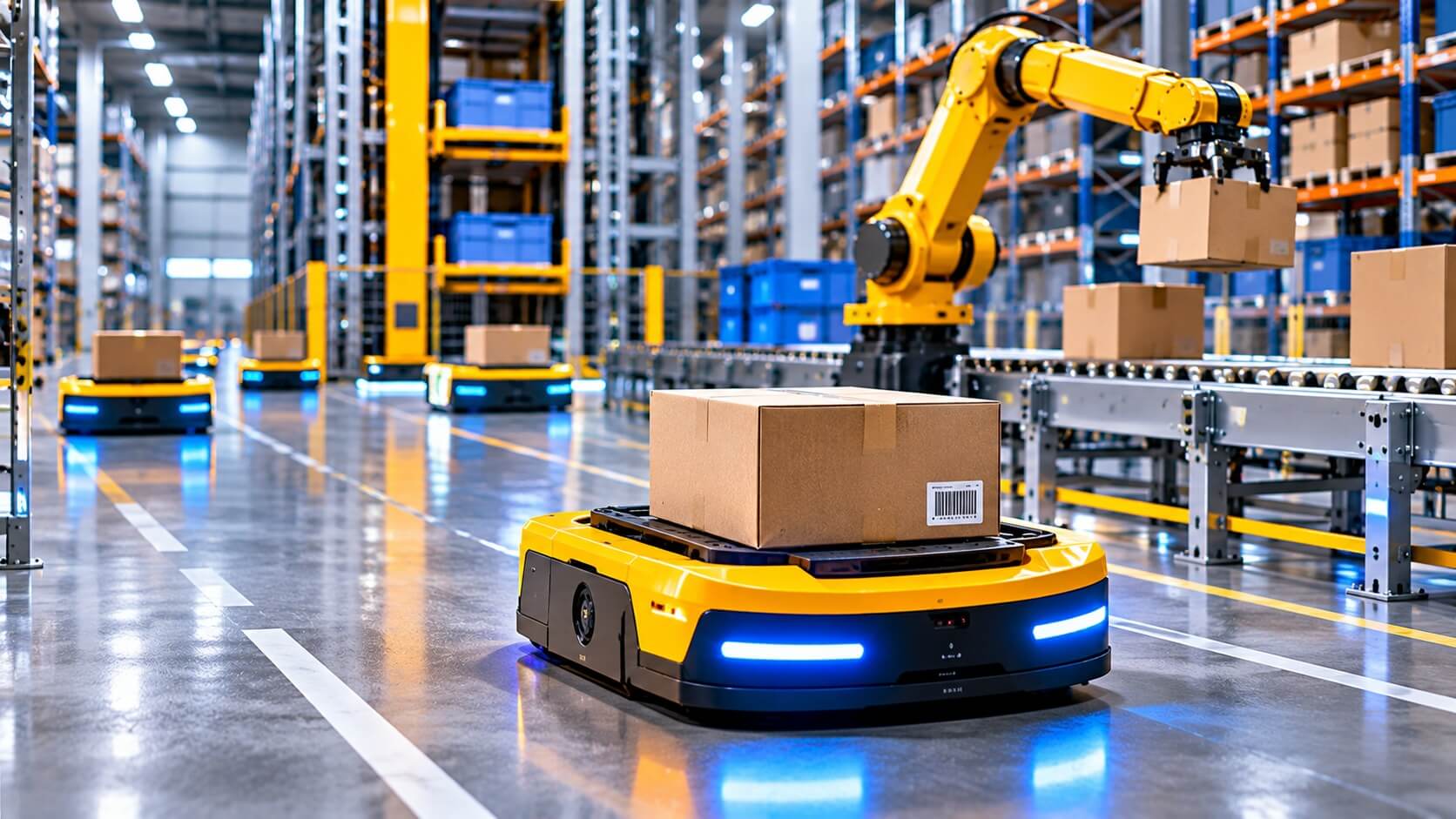
There is no single company that leads every part of warehouse automation. The industry is divided among major industrial automation suppliers, specialized warehouse robotics companies, software providers, and systems integrators.
Companies such as Daifuku, Dematic, Vanderlande, Honeywell, and SSI SCHAEFER are important participants in large-scale warehouse automation. Meanwhile, businesses such as AutoStore, Symbotic, and Geek+ focus on particular robotic technologies and automated fulfillment solutions.
The answer to who leads warehouse automation depends on what is being measured: revenue, installed systems, robotics technology, customer relationships, or market specialization.
For investors, these distinctions matter because the largest automation company is not necessarily the fastest-growing business or the most attractive investment.
Understanding the competitive landscape helps identify which companies may benefit as warehouses become increasingly automated.
Who Is the Leader in Warehouse Automation?
Warehouse automation has several major competitors rather than one universally recognized leader.
Different companies specialize in different technologies and customer segments.
Daifuku is a major global supplier of material handling and automated logistics systems. Dematic, part of KION Group, is another important competitor in integrated warehouse automation.
Vanderlande, owned by Toyota Industries, provides automated logistics systems for warehouses and parcel operations, alongside its airport-related activities.
Honeywell participates through warehouse automation technologies, software, and integrated logistics solutions.
SSI SCHAEFER is another established supplier of warehouse storage and automation systems.
Specialized robotics companies compete in narrower areas.
AutoStore focuses on high-density automated storage and retrieval systems. Symbotic develops AI-enabled robotic systems for large distribution operations, while Geek+ specializes in mobile robotics and warehouse automation.
These businesses are not directly comparable in every respect.
Some provide complete warehouse systems. Others supply specific equipment, software, or robotic platforms that can become components of larger installations.
A company's leadership therefore depends on the particular market being examined.
The Major Companies Behind Warehouse Automation
Daifuku: Large-Scale Material Handling Automation
Daifuku is a Japanese company with extensive experience in material handling and automation.
Its technologies are used across manufacturing, distribution, and other industrial environments.
In warehouse logistics, the company supplies automated storage and retrieval systems, conveyors, sorting equipment, and integrated material handling solutions.
Daifuku's competitive position comes partly from its ability to design and implement complex systems for large customers.
Such projects can involve multiple technologies working together across extensive facilities.
For investors, Daifuku offers exposure to warehouse automation alongside other material handling markets.
That diversification is important because not all company revenue comes from warehouse robotics.
Large industrial automation suppliers may benefit from established customer relationships and engineering expertise, but they also face exposure to capital spending cycles and project execution risks.
Dematic: Integrated Warehouse Automation
Dematic is a major warehouse automation provider owned by KION Group, a publicly traded German industrial company.
Dematic develops automated storage, picking, sorting, and material handling systems.
Its business emphasizes integrated solutions that combine physical equipment with software and operational design.
Large distribution centers frequently require multiple systems to operate together.
Dematic competes by providing the engineering and integration capabilities needed to deliver these projects.
For investors, KION offers exposure to Dematic through a broader business that also includes industrial trucks and related services.
This means KION's financial performance depends on more than warehouse automation alone.
Investors should distinguish between the performance of Dematic and that of the entire parent company when evaluating the investment opportunity.
Vanderlande: Automation for Warehouses and Logistics
Vanderlande is an automation company owned by Toyota Industries.
It develops systems for warehouse operations, parcel handling, and airport baggage processing.
Within warehouse automation, Vanderlande supplies technologies designed to improve product movement, order fulfillment, and distribution efficiency.
Its experience in large logistics environments is relevant because customers often need reliable systems capable of operating continuously.
The company's ownership structure matters for investors.
Vanderlande is not independently listed on a stock exchange, so investors cannot purchase shares in the business directly.
Its parent company's activities extend beyond warehouse automation, making the relationship between automation growth and shareholder returns less direct.
Honeywell: Industrial Technology and Warehouse Solutions
Honeywell is a diversified industrial technology company with activities spanning automation, aerospace, and other industrial markets.
Its warehouse automation capabilities have included material handling equipment, warehouse execution software, and integrated distribution solutions.
Honeywell's involvement illustrates how warehouse automation overlaps with broader industrial automation.
The company can apply engineering, controls, software, and systems integration capabilities to logistics operations.
However, warehouse automation represents only part of its wider business.
For investors, this means company-wide revenue growth and valuation may be influenced more heavily by other business segments.
It is also important to monitor corporate restructuring and portfolio changes, since the composition of diversified industrial companies can evolve over time.
SSI SCHAEFER: Storage Systems and Integrated Automation
SSI SCHAEFER is an established supplier of warehouse storage and logistics technologies.
Its offerings include storage equipment, automated systems, robotics integration, and warehouse software.
The company serves businesses seeking to improve storage density, inventory movement, and fulfillment efficiency.
Its position reflects the importance of combining traditional warehouse infrastructure with increasingly sophisticated automation.
SSI SCHAEFER is privately held rather than independently traded on a public stock exchange.
Investors interested in the warehouse automation industry should therefore distinguish between companies that participate commercially and those that provide direct public equity exposure.
Which Companies Lead Warehouse Robotics?
Warehouse robotics is a more specialized segment of the automation industry.
While large systems integrators design complete facilities, robotics-focused companies often develop technologies for particular warehouse activities.
Three important examples illustrate different approaches.
AutoStore: High-Density Robotic Storage
AutoStore develops automated storage and retrieval technology built around compact storage grids.
Robots travel across the top of these grids to retrieve inventory bins and deliver them to workstations.
The approach can improve storage density and reduce the space required for certain warehouse operations.
AutoStore's systems are especially relevant to businesses handling large numbers of smaller products.
Its business model also involves a network of integration partners that help deliver systems to end customers.
AutoStore is publicly traded in Norway, giving investors relatively focused exposure to automated storage technology.
However, its performance depends on customer demand, system adoption, competitive pressure, and the profitability of its commercial model.
Symbotic: Robotics for Large Distribution Centers
Symbotic develops warehouse automation systems using robotics, machine vision, and AI-enabled software.
Its technology is designed to automate activities such as handling, organizing, and moving cases and pallets within distribution facilities.
The company has attracted attention through its relationship with Walmart and other large-scale automation initiatives.
Large retailers can provide substantial commercial opportunities because their distribution networks include multiple facilities with similar operational requirements.
However, dependence on major customers can create financial risks.
A delayed deployment, contract change, or reduction in customer spending may materially affect revenue expectations.
Symbotic is publicly traded in the United States and offers investors exposure to large-scale warehouse robotics.
Investors should evaluate its revenue growth alongside project profitability, customer concentration, cash flow, and execution risks.
Geek+: Autonomous Mobile Robots
Geek+ is known for developing autonomous mobile robots used in warehouse and logistics operations.
These robots can transport shelves, containers, and goods between storage and processing locations.
Mobile robotics can be attractive to businesses seeking more flexible automation than some traditional fixed infrastructure systems.
Depending on the installation, robots may be added or redeployed as operational requirements change.
Geek+ competes with other mobile robotics providers and broader warehouse automation suppliers.
Its competitive position depends on factors such as system reliability, software capabilities, deployment costs, and international expansion.
For investors, the distinction between a robotics company's commercial success and the accessibility of its shares is important. Listing status, exchange access, and share structure should be verified before considering an investment.
How Do the Leading Warehouse Automation Companies Compare?
The industry becomes easier to understand when companies are grouped by their principal activities.
| Company | Main Focus | Competitive Position |
|---|---|---|
| Daifuku | Material handling and integrated automation | Large industrial and logistics systems |
| Dematic (KION) | Warehouse automation and integration | Complex distribution center projects |
| Vanderlande | Logistics automation | Warehousing, parcels, and airport systems |
| Honeywell | Industrial and warehouse technologies | Broad engineering and software capabilities |
| SSI SCHAEFER | Storage and logistics automation | Integrated storage and warehouse solutions |
| AutoStore | Robotic storage and retrieval | Compact, high-density inventory systems |
| Symbotic | AI-enabled warehouse robotics | Large-scale distribution automation |
| Geek+ | Autonomous mobile robots | Flexible robotic goods movement |
This comparison is based on business focus, not a verified ranking by market share or revenue.
The distinction is essential because companies compete across different parts of the warehouse automation market.
A supplier specializing in robotic storage systems may have a strong position within that category without being the largest warehouse automation business overall.
Similarly, an industrial group may generate substantial revenue from automation while operating across several unrelated markets.
What Makes a Warehouse Automation Company a Market Leader?
Leadership in warehouse automation involves more than having the most advanced robots.
Customers invest in automation to improve their operations, not simply to adopt new technology.
Several capabilities influence which suppliers win contracts and retain customers.
Proven Reliability
Warehouse operations often run for extended periods and handle large volumes of products.
Equipment failures can interrupt order fulfillment and create expensive delays.
Companies with a history of reliable installations may have an advantage over less-established competitors.
Systems Integration
Large warehouses contain equipment and software from multiple suppliers.
A company that can coordinate these technologies effectively may deliver more value than a supplier offering an isolated robotic product.
Integration capabilities are particularly important for complex projects involving existing facilities.
Customer Relationships
Major retailers and logistics providers can represent valuable long-term customers.
Successful deployments may lead to additional installations, upgrades, and service agreements.
However, customer concentration can also increase financial risk.
Software Capabilities
Software coordinates inventory, robotic movements, equipment performance, and order fulfillment.
Strong software can improve the productivity of physical automation systems.
It can also create ongoing customer relationships through maintenance, support, and upgrades.
Cost and Return on Investment
Customers ultimately evaluate whether automation improves their financial performance.
A technologically impressive system may struggle commercially if it is too expensive to install or maintain.
Suppliers that deliver measurable productivity improvements at competitive costs may have stronger long-term prospects.
For a practical explanation of the underlying technologies, see Types of Warehouse Automation and How They Work.
Why Do Large Retailers Matter So Much to Automation Suppliers?
Major retailers operate distribution networks with enormous logistical requirements.
They handle large inventories, frequent shipments, seasonal demand fluctuations, and complex fulfillment processes.
This creates opportunities for automation suppliers capable of delivering systems at scale.
A successful project with a major retailer can become an important commercial reference.
It may also create opportunities for additional deployments across multiple facilities.
However, large customers often possess substantial negotiating power.
They may demand customized systems, favorable pricing, performance guarantees, and extensive support.
These requirements can reduce supplier margins or increase implementation complexity.
Some retailers also develop automation technologies internally, potentially competing with external suppliers in selected applications.
Therefore, winning a large customer contract does not automatically guarantee attractive long-term profitability.
Investors should consider the economics of these relationships rather than focusing exclusively on announced contract values.
How Much Does It Cost to Deploy Systems From Leading Automation Companies?
The cost of warehouse automation depends heavily on the solution being implemented.
A company purchasing a limited number of mobile robots faces a different financial commitment from a retailer automating an entire distribution center.
Important cost categories include equipment, software, installation, integration, building modifications, maintenance, and employee training.
Complex projects may also require changes to warehouse layouts and existing operating procedures.
The initial purchase price is only one part of the economic calculation.
Customers must consider how much the system costs to operate and whether it produces enough savings or additional capacity to justify the investment.
This is especially relevant when comparing different automation suppliers.
A less expensive system may offer limited capabilities, while a more costly installation could generate greater productivity improvements.
Conversely, a sophisticated system may be financially unattractive if the facility does not have enough order volume to use it efficiently.
These differences influence which suppliers win contracts and which technologies become commercially successful.
For a more detailed examination, read How Much Does Warehouse Automation Cost? A Practical Breakdown.
Are the Biggest Warehouse Automation Companies the Best Investments?
Not necessarily.
Industry leadership and investment attractiveness are related but different concepts.
A company may have a strong competitive position while its shares trade at a valuation that already reflects years of expected growth.
Another business may be smaller but offer faster expansion, stronger margins, or a more focused commercial model.
Investors should also distinguish between diversified industrial groups and specialized automation companies.
Diversified Industrial Companies
Businesses such as Daifuku, KION, and other large industrial groups may provide exposure to warehouse automation alongside additional activities.
Diversification can reduce dependence on one technology or customer segment.
However, growth in warehouse automation may have a limited effect on total company earnings when other divisions account for a substantial portion of revenue.
Specialized Automation Companies
Businesses such as AutoStore and Symbotic provide more concentrated exposure to particular automation technologies.
Their financial performance may be more closely connected to warehouse automation adoption.
However, specialization can also increase exposure to competition, technology changes, project delays, and fluctuations in customer spending.
What Investors Should Evaluate
Important financial considerations include revenue growth, profit margins, operating cash flow, customer concentration, order backlog, and valuation.
Investors should also examine whether reported growth is translating into sustainable profitability.
For companies implementing large projects, revenue recognition and cash collection may not occur at the same time.
Strong reported sales do not necessarily mean a company is generating substantial free cash flow.
The broader economics of the industry are explained in Warehouse Automation: What It Is and How the Industry Works.
What Could Change the Competitive Landscape?
Warehouse automation is evolving as robotics, artificial intelligence, and software capabilities improve.
Several developments could change which companies lead the industry.
One is the growing ability of robots to handle products with different shapes, sizes, and materials.
Another is the use of more advanced software to coordinate equipment and adapt to changing warehouse conditions.
Flexible automation may also become increasingly important.
Traditional systems can require extensive fixed infrastructure, while some newer robotic solutions allow businesses to change layouts or expand capacity more gradually.
The economics of automation could also change as equipment costs, labor expenses, and financing conditions evolve.
Lower deployment costs could make automation accessible to more small and medium-sized businesses.
At the same time, competition may intensify as new companies enter the market and established industrial suppliers develop additional technologies.
Mergers, acquisitions, and partnerships may further reshape the competitive landscape.
As automation becomes more capable, its effects on employment will also become increasingly important. For a closer examination of which warehouse tasks may be automated and how workers could be affected, read Will Warehouse Workers Be Replaced by AI? What the Shift Means.
Investors should monitor actual customer adoption, profitability, and technological performance rather than assuming that today's leaders will maintain their positions indefinitely.
Which Warehouse Automation Companies Are Worth Watching?
The most important companies to follow depend on the type of exposure an investor wants.
Daifuku and KION represent established industrial automation businesses with significant logistics capabilities.
AutoStore provides more specialized exposure to automated storage technology.
Symbotic offers exposure to robotic automation for large distribution operations.
Vanderlande, SSI SCHAEFER, and other established suppliers remain important competitors even when their shares cannot be purchased independently.
Geek+ and other mobile robotics developers illustrate the growing importance of flexible robotic systems.
None of these companies should be considered an automatic investment choice simply because warehouse automation is expanding.
A strong market position must ultimately translate into profitable growth, healthy cash flow, and returns that justify the price investors pay.
The key question is not only which company leads warehouse automation today.
It is which businesses can maintain technological relevance, win profitable contracts, and capture lasting economic value as the industry develops.
Disclaimer: This article is for informational and educational purposes only and does not constitute financial or investment advice. Investing involves risk, including the potential loss of capital.