
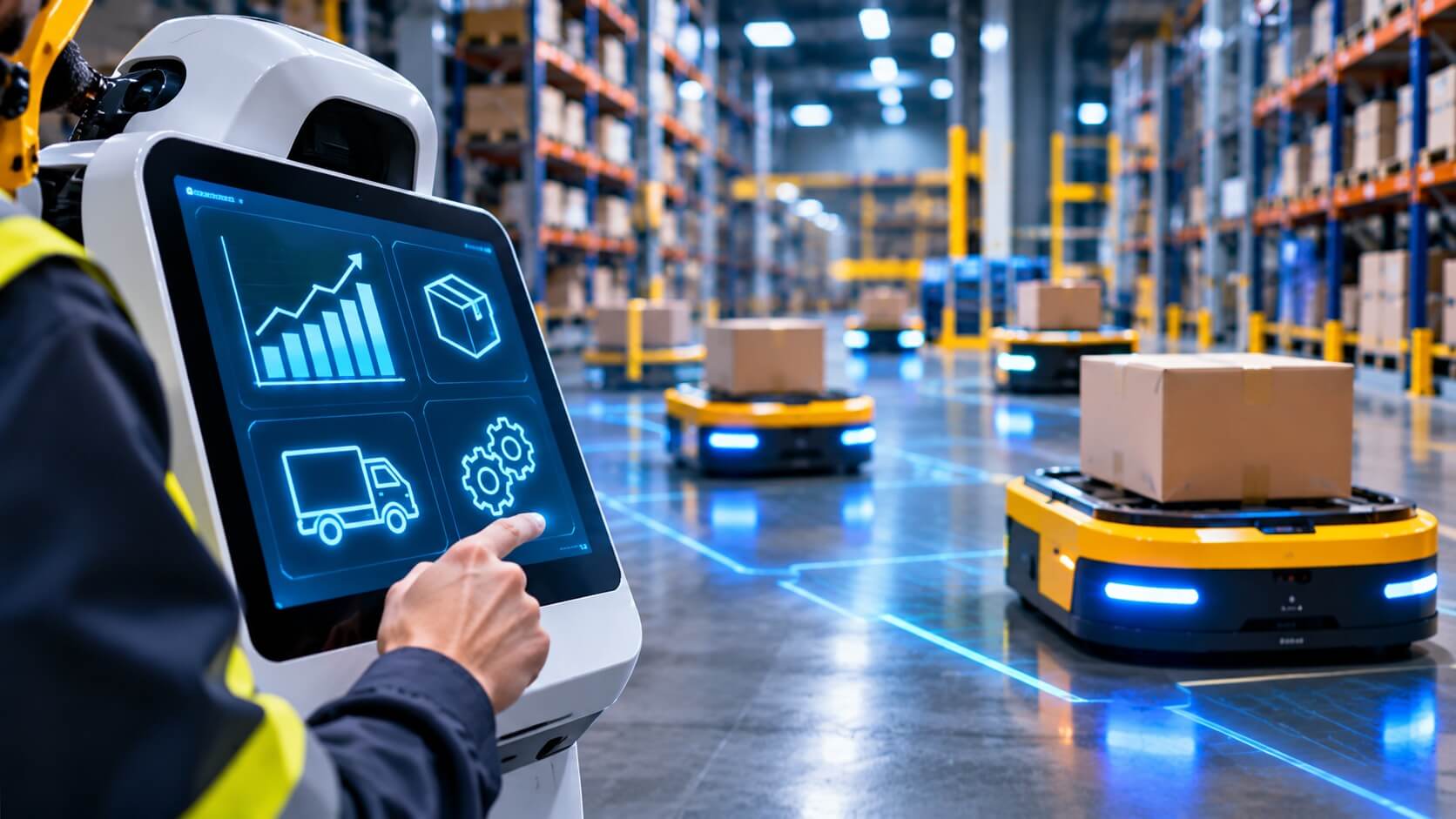
Artificial intelligence and warehouse robots will replace some tasks currently performed by warehouse workers, but they are unlikely to eliminate every warehouse job.
The biggest changes will affect repetitive activities such as moving products, sorting packages, retrieving inventory, and performing standardized picking operations.
At the same time, automated warehouses still require people to maintain equipment, resolve problems, supervise operations, and handle tasks that machines cannot perform reliably.
The result is likely to be a transformation of warehouse employment rather than the complete disappearance of warehouse workers.
However, that transformation will not affect everyone equally. Some employees may move into new roles, while others could face job displacement or pressure to acquire different skills.
For investors, the economic implications extend beyond employment. Automation can change labor costs, warehouse productivity, corporate profitability, and demand for robotics technology.
Will AI Eliminate Warehouse Jobs?
AI is unlikely to eliminate all warehouse jobs, but it can reduce demand for certain types of manual labor.
The distinction between automating tasks and eliminating jobs is important.
A warehouse employee may perform several activities during a typical shift, including transporting goods, identifying products, preparing orders, resolving inventory problems, and operating equipment.
Automation might replace some of these activities without eliminating the entire position.
For example, a mobile robot can transport inventory between storage locations and picking stations.
This reduces the need for employees to walk long distances or move certain materials manually.
However, employees may still be required to select products, inspect items, manage exceptions, and prepare shipments.
In other cases, automation can eliminate enough tasks that businesses need fewer workers to achieve the same output.
This is particularly possible when companies redesign facilities around automated systems rather than simply adding robots to existing workflows.
The overall employment impact therefore depends on how extensively companies automate operations and whether business growth creates additional work.
Which Warehouse Jobs Are Most at Risk From Automation?
Warehouse jobs involving repetitive, predictable physical activities are generally more exposed to automation.
Machines perform best when tasks follow consistent procedures and products can be handled using standardized equipment.
Some activities are already widely automated in modern distribution facilities.
Material Transportation
Moving products between warehouse locations is one of the clearest applications of robotics.
Autonomous mobile robots and automated guided vehicles can transport containers, pallets, and other materials.
These systems may reduce the need for workers to perform repetitive transportation tasks.
However, human-operated equipment remains important in many warehouses, especially where loads or operating conditions vary.
Package Sorting
Automated sorting systems can identify packages and direct them toward shipping destinations.
Large parcel facilities can process substantial volumes using conveyor networks and sorting equipment.
This reduces the amount of manual sorting required.
Employees may still be needed to manage damaged packages, unusual items, equipment problems, and exceptions.
Inventory Retrieval
Automated storage and retrieval systems can locate and transport inventory without requiring employees to travel through storage aisles.
Goods-to-person systems bring products to workstations, reducing walking and manual retrieval.
This changes the nature of warehouse picking jobs.
Instead of traveling through a facility, workers may remain at stations where inventory arrives automatically.
Repetitive Picking and Packing
Robotic arms equipped with cameras and gripping systems can handle certain products.
These technologies may automate repetitive picking, placing, and packaging activities.
However, products with unusual shapes, fragile materials, or unpredictable packaging remain challenging.
The degree of job exposure depends on the characteristics of the products being handled.
Which Warehouse Jobs Are Harder to Replace With AI?
Some warehouse roles involve complex judgment, physical adaptability, or responsibility for managing unpredictable situations.
These activities are generally more difficult to automate completely.
Maintenance Technicians
Automated facilities require technicians to inspect, repair, and maintain robotic equipment.
Sensors, motors, batteries, conveyors, and control systems need regular attention.
As automation expands, demand for certain technical maintenance skills may increase.
However, this does not guarantee that every displaced warehouse worker can move directly into a maintenance position.
Technical roles may require specialized training and qualifications.
Warehouse Supervisors
Supervisors coordinate employees, equipment, safety procedures, and operational priorities.
Software can support scheduling and performance monitoring, but unexpected situations still require human decisions.
The responsibilities of supervisors may evolve toward managing automated systems and technical teams.
Quality Control and Exception Handling
Warehouse operations frequently encounter problems that do not follow predictable patterns.
Products may arrive damaged, labels may be incorrect, or inventory records may conflict with physical stock.
Employees often need to investigate these situations and determine appropriate responses.
AI may increasingly assist with identifying problems, but resolving complex exceptions can remain difficult.
Robotics and Software Specialists
Automated warehouses require employees who understand how equipment and software interact.
These roles can include robotics technicians, controls specialists, systems engineers, and software support personnel.
The number and type of positions depend on the facility's automation architecture and maintenance arrangements.
Some companies employ these specialists directly, while others rely on external suppliers.
How Are Amazon and Walmart Changing Warehouse Jobs?
Amazon and Walmart provide examples of how large retailers are integrating robotics into logistics operations.
Both companies use automation to improve productivity and reduce repetitive manual activities.
However, their systems serve different operational requirements.
Amazon has developed robotic technologies for inventory transportation, product handling, and fulfillment operations.
Its systems include mobile robots and robotic manipulation technologies designed to support specific warehouse tasks.
Walmart has invested in automated distribution and fulfillment systems, including technologies developed through its relationship with Symbotic.
These systems help organize and move products through large distribution facilities.
The important point is that automation changes how warehouse work is organized.
A facility may require fewer employees to move inventory manually while increasing demand for equipment maintenance, monitoring, and technical support.
However, the existence of new technical roles does not prove that automation creates as many jobs as it displaces.
The employment outcome depends on staffing decisions, business growth, operational redesign, and the scale of automation deployment.
For a closer examination of the technologies used by these retailers, read Amazon and Walmart Warehouse Robots: What They Use and Why.
Will Warehouse Workers Be Replaced by Robots or Artificial Intelligence?
Robotics and artificial intelligence are related technologies, but they are not identical.
Robots perform physical tasks.
Artificial intelligence helps software systems interpret information, recognize patterns, and make or support decisions.
A warehouse robot may transport products using conventional navigation software without relying on advanced AI.
Another robotic system may use computer vision and machine learning to identify products and determine how to handle them.
AI can also operate independently of physical robots.
For example, warehouse software may use forecasting models to estimate demand or optimize inventory placement.
These applications can improve efficiency without directly replacing an employee's physical work.
The distinction matters because warehouse job displacement is driven by the combination of physical automation, software, and operational redesign.
AI alone cannot move a pallet or package a product without suitable equipment.
Similarly, a warehouse can automate substantial amounts of work using conventional machinery without advanced artificial intelligence.
For a practical explanation of these technologies, see Types of Warehouse Automation and How They Work.
Will Warehouse Jobs Disappear by 2030?
There is no reliable basis for predicting that warehouse jobs as a whole will disappear by 2030.
Automation adoption is uneven across businesses, industries, and geographic regions.
Large retailers may have the financial resources and operational scale to deploy sophisticated robotic systems.
Smaller warehouses may continue relying heavily on manual labor because automation investments are difficult to justify.
The pace of adoption also depends on technology costs, financing conditions, equipment reliability, and the availability of workers.
Even when automation is technically possible, it may not be economically attractive.
For example, a facility processing relatively few orders may not generate enough savings to justify an expensive robotic installation.
A high-volume distribution center may face a very different calculation.
Why 2030 Predictions Require Caution
Forecasts about job displacement often estimate how many tasks could potentially be automated.
That is different from predicting how many workers will actually lose their jobs.
A technically automatable task may remain manual because of implementation costs or operational constraints.
Businesses may also use productivity improvements to expand output rather than reduce total employment.
Conversely, some companies may automate primarily to reduce labor requirements.
The outcome will depend on business decisions and economic conditions.
The most defensible expectation is that warehouse work will continue changing through 2030, with some roles becoming less common and others gaining importance.
Specific claims that an entire category of warehouse employment will disappear by that date should be treated skeptically.
Does Warehouse Automation Create Jobs or Destroy Them?
Warehouse automation can both eliminate certain jobs and create demand for different types of work.
The balance varies across companies and economic conditions.
How Automation Can Reduce Employment
A business may introduce robotic systems to perform activities previously requiring several employees.
If the same volume of work can be completed with fewer labor hours, the company may reduce staffing or avoid hiring additional workers.
Automation can also reduce demand for temporary employees during periods of high activity.
These effects are especially relevant in operations involving standardized, repetitive tasks.
How Automation Can Create Employment
Automation creates demand for equipment design, manufacturing, installation, maintenance, and software development.
Robotics suppliers employ engineers, technicians, production workers, and support specialists.
Warehouse operators may also need employees capable of supervising automated systems.
Higher productivity can support business expansion, potentially generating additional employment in logistics and related activities.
However, these new jobs may be located in different regions or require different skills from the positions being displaced.
Why the Net Effect Is Difficult to Measure
Employment changes depend on more than automation.
Consumer demand, economic growth, wages, trade patterns, and business investment also influence warehouse staffing.
A company might reduce labor hours per order while increasing total employment because its order volume grows.
Another company might maintain the same order volume and reduce its workforce.
Both outcomes are possible.
For this reason, the number of robots deployed is not sufficient to determine whether automation is creating or destroying jobs overall.
How Does Automation Affect Warehouse Worker Wages?
Automation can influence wages differently across job categories.
Workers performing tasks that become easier to automate may face weaker demand for their existing skills.
In some circumstances, this could reduce wage growth or bargaining power.
Employees with specialized technical capabilities may experience stronger demand.
For example, maintaining automated storage systems or diagnosing robotic equipment failures requires skills that differ from traditional manual warehouse work.
However, higher demand for technical skills does not automatically translate into higher wages in every market.
Compensation also depends on local labor conditions, employer policies, qualifications, and competition for workers.
Automation may also change the composition of warehouse employment.
A facility could employ fewer workers in repetitive handling positions while hiring more technicians and systems specialists.
This may increase the average technical skill level of the workforce without guaranteeing better outcomes for every employee.
The distribution of benefits is therefore an important part of the employment debate.
Why Do Companies Want to Automate Warehouse Jobs?
Businesses generally invest in warehouse automation to improve operational performance.
Reducing labor requirements can be one objective, but it is not the only one.
Productivity
Automation can reduce the time required to move, retrieve, and process products.
This may allow warehouses to handle more orders with the same amount of space or fewer labor hours per order.
Labor Availability
Warehouses sometimes struggle to recruit and retain employees for physically demanding or repetitive work.
Automation can reduce dependence on labor availability for certain tasks.
Accuracy
Automated systems may reduce some inventory and sorting errors when properly implemented.
Better accuracy can lower the cost of correcting mistakes and improve customer service.
Operating Capacity
Automated facilities may process larger volumes without expanding staffing at the same rate.
This can be valuable during periods of strong demand.
Workplace Safety
Some automated systems can reduce the need for employees to lift heavy loads or perform repetitive transportation tasks.
However, robotics also introduces safety requirements involving moving machinery, maintenance, and human-machine interaction.
Automation does not automatically make every workplace safer.
The actual result depends on equipment design, operating procedures, training, and safety management.
Is Warehouse Automation Bad for Workers?
Warehouse automation can create benefits and disadvantages for workers.
The outcome depends on how technology is introduced and how employers manage the transition.
Potential Benefits
Automation may reduce physically demanding activities, repetitive movement, and certain workplace hazards.
Employees may gain access to technical training and new career opportunities.
More efficient operations may also support business growth and long-term competitiveness.
Potential Disadvantages
Some workers may lose jobs or experience reduced working hours.
Others may need to learn new skills to remain employed.
Automation can also change workplace conditions.
For example, goods-to-person systems may reduce walking but concentrate employees at workstations where performance is closely monitored.
Increased productivity expectations can create additional pressure if workloads and safety procedures are poorly managed.
The Importance of Training
Training can help workers transition into new roles.
However, training programs must be relevant to available positions.
A warehouse employee cannot necessarily become a robotics technician after a short introductory course.
Effective transitions may require substantial education, practical experience, and employer support.
The economic benefits of automation and the consequences for workers should therefore be evaluated separately.
A system can improve corporate profitability while creating difficulties for particular employees.
Can AI Make Warehouse Workers More Productive Without Replacing Them?
Yes. AI and automation can support employees rather than eliminate their roles.
This approach is often called human-machine collaboration.
For example, software can recommend efficient picking routes while employees continue selecting products.
Robots can transport heavy containers to workstations, reducing physical movement.
Computer vision systems may help identify products or detect certain inventory errors.
Predictive maintenance software can assist technicians by highlighting equipment that may require inspection.
These technologies can improve productivity while preserving a meaningful role for human workers.
However, collaboration and replacement are not mutually exclusive.
A company may initially introduce robots to assist employees and later redesign operations to reduce staffing requirements.
The long-term employment impact depends on how businesses use the technology.
What Does Warehouse Job Automation Mean for Investors?
For investors, warehouse automation is connected to productivity, labor costs, capital expenditure, and the competitive position of technology suppliers.
However, lower labor requirements do not automatically produce higher profits.
Labor Savings Versus Automation Costs
A warehouse may reduce labor expenses after introducing robots.
But automation creates other costs, including equipment purchases, maintenance, software, financing, and technical support.
The financial benefit depends on whether operating improvements exceed these expenses.
A company can automate successfully from a technical perspective while generating disappointing financial returns.
Demand for Robotics Suppliers
As businesses invest in automation, equipment manufacturers and software providers may experience greater demand.
However, market growth does not guarantee that every supplier will be profitable.
Competition, project delays, pricing pressure, and implementation expenses can affect financial performance.
Productivity and Competitive Advantage
Retailers and logistics operators may use automation to process orders more efficiently.
If these improvements lower fulfillment costs or increase operating capacity, they can strengthen competitiveness.
However, competitors may adopt similar technologies.
An advantage that initially differentiates one company may become less valuable as automation becomes widespread.
Capital Intensity
Automation can shift warehouse operations toward greater reliance on expensive equipment.
This may increase fixed costs and capital requirements.
During periods of strong demand, automated facilities may benefit from operating leverage.
During weaker demand, underutilized equipment can become a financial burden.
Social and Regulatory Risks
Large-scale job displacement can create political and regulatory attention.
Companies may face increased scrutiny involving employment practices, workplace safety, employee monitoring, and the use of AI.
Investors should consider these risks alongside potential productivity gains.
Could Warehouse Automation Eventually Create Fully Autonomous Facilities?
Highly automated warehouses already exist, but a completely autonomous warehouse is a more demanding objective.
Warehouses must handle unexpected events, damaged products, changing inventory, equipment failures, and complex operational decisions.
Automating every activity may be technically possible in selected environments, but not necessarily economically worthwhile.
A facility handling standardized products may be easier to automate extensively than one processing thousands of irregular consumer items.
Human workers may remain valuable for exceptions, maintenance, quality control, and supervision.
Future advances in robotics and AI could reduce these limitations.
Improved robotic manipulation, machine vision, and software coordination may allow machines to perform a wider range of activities.
However, the speed of progress is uncertain.
The existence of advanced prototypes does not guarantee widespread commercial adoption.
Businesses will continue comparing the cost of automation with the value it creates.
What Warehouse Workers and Investors Should Expect
Warehouse employment is likely to change substantially as robotics, artificial intelligence, and automation become more capable.
Repetitive transportation, sorting, and standardized handling activities face significant automation exposure.
At the same time, maintaining automated equipment, managing exceptions, supervising operations, and integrating software will continue requiring specialized human capabilities.
Some jobs may disappear, others may change, and new roles may emerge.
The overall employment effect cannot be determined simply by counting robots or estimating how many tasks could theoretically be automated.
For workers, the central challenge is adapting to changing skill requirements while managing the risks of displacement.
For businesses, the challenge is implementing automation that improves productivity without creating excessive costs or operational problems.
For investors, the key question is whether automation generates sustainable economic value.
The companies that benefit most may not be those that eliminate the largest number of jobs, but those that deliver reliable technology, measurable productivity improvements, and attractive financial returns.
Disclaimer: This article is for informational and educational purposes only and does not constitute financial or investment advice. Employment outcomes and technological developments are uncertain. Investing involves risk, including the potential loss of capital.