
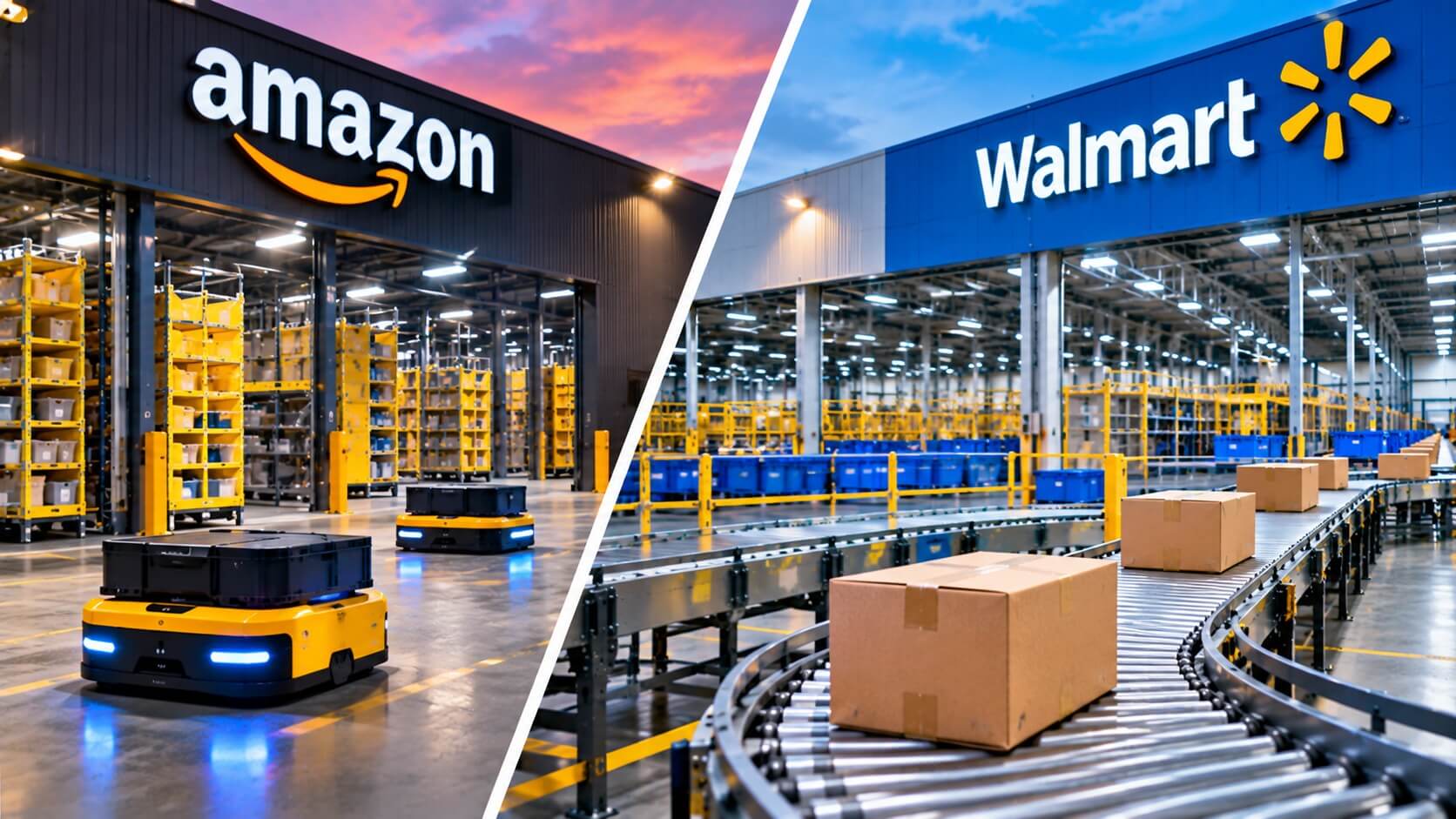
Amazon and Walmart use warehouse robots to move inventory, automate storage, organize products, and improve the speed and efficiency of their distribution networks.
However, the two retailers approach warehouse automation differently.
Amazon has developed a large robotics ecosystem combining proprietary technologies, acquired robotics capabilities, and specialized automation systems. Its robots support fulfillment operations, inventory transportation, robotic picking, and package handling.
Walmart has focused heavily on automating distribution and fulfillment operations through partnerships with technology suppliers, including Symbotic, while also investing in automation capabilities for its broader supply chain.
Both companies aim to reduce repetitive manual work, improve inventory handling, increase operating capacity, and control long-term logistics costs.
For investors, their automation strategies reveal how major retailers are reshaping warehouse operations and creating opportunities for robotics manufacturers, software developers, and systems integrators.
What Robots Does Amazon Use in Its Warehouses?
Amazon operates one of the world's largest warehouse robotics ecosystems.
Its fulfillment network uses several categories of robotic equipment, each designed to perform particular tasks.
These include mobile robots that transport inventory, robotic arms that handle products, automated systems that organize storage, and technologies that move packages through fulfillment facilities.
Amazon's robotics strategy has evolved significantly since its acquisition of Kiva Systems in 2012.
That acquisition provided important technology for mobile robotic platforms capable of transporting inventory shelves.
Over time, Amazon expanded its robotics capabilities through internal development and additional technology investments.
Today, its warehouse automation strategy involves multiple robotic systems working alongside employees and software.
Amazon Drive Robots
Amazon's Drive robots are mobile robotic platforms designed to transport inventory pods within fulfillment centers.
Instead of requiring employees to walk long distances to retrieve products, these robots can move storage units toward designated workstations.
This approach is commonly known as goods-to-person automation.
The technology reduces unnecessary walking and allows employees to focus on activities such as selecting products and preparing orders.
Drive robots are particularly useful in facilities designed around dense inventory storage and high order volumes.
However, they depend on coordinated software, charging infrastructure, and warehouse layouts suited to robotic movement.
Amazon Proteus
Proteus is an autonomous mobile robot developed by Amazon.
Unlike traditional robotic systems that operate primarily within restricted areas, Proteus was designed to navigate in spaces shared with employees.
The robot uses sensors and navigation technology to move through its environment while responding to obstacles.
Proteus was initially introduced for moving carts containing packages within Amazon facilities.
Its significance lies in the possibility of automating transportation activities without requiring every robotic movement to occur inside a separate fenced area.
However, operating safely around employees requires sophisticated navigation, monitoring, and safety systems.
Amazon Sparrow
Sparrow is a robotic system designed to identify and handle individual products.
It combines robotic manipulation with computer vision and artificial intelligence.
Traditional warehouse automation often works best with standardized containers, pallets, or cartons.
Picking individual consumer products is more difficult because items vary in shape, size, weight, and packaging.
Sparrow represents Amazon's efforts to automate more complex item-handling activities.
The broader commercial significance is that improvements in robotic picking could expand the number of warehouse tasks suitable for automation.
Amazon Sequoia
Sequoia is an integrated inventory management and storage system introduced by Amazon.
It combines robotics, automated storage technologies, and software to improve the way inventory is received, stored, and presented for order fulfillment.
The system is designed to reduce unnecessary product movement and improve access to inventory.
Sequoia illustrates how warehouse automation increasingly involves complete operating systems rather than individual robots.
The economic value comes from coordinating multiple technologies to improve the overall fulfillment process.
Amazon Robin and Cardinal
Amazon has also developed robotic systems for package handling.
Robin uses robotic manipulation to help sort packages.
Cardinal was introduced as a robotic workcell capable of handling and organizing packages for subsequent processing.
These technologies address repetitive physical activities that occur after products have been picked and packed.
Automating package movement and sorting can improve consistency and reduce certain manual handling requirements.
However, different robotic systems have different operational capabilities, and not every technology is deployed across Amazon's entire network.
Why Does Amazon Invest So Much in Warehouse Robotics?
Amazon's business model creates strong incentives to improve fulfillment efficiency.
The company handles enormous volumes of customer orders across a geographically distributed logistics network.
Each order may involve inventory storage, picking, packing, sorting, and transportation.
Small improvements in these activities can become economically significant when applied across large volumes.
Reducing Travel Time
Traditional warehouse employees may spend substantial time walking between storage locations.
Goods-to-person robotic systems can reduce this movement by transporting inventory directly to workstations.
This allows workers to spend more time on productive tasks.
Increasing Fulfillment Capacity
Automation can help facilities process more orders without increasing labor requirements at the same rate.
Higher capacity can be particularly valuable during seasonal shopping periods.
However, actual productivity improvements depend on system utilization and operational design.
Improving Inventory Management
Automated storage and tracking systems can improve visibility into product locations.
Better inventory organization may reduce delays and improve order accuracy.
Supporting Faster Delivery
Efficient warehouse operations can shorten the time required to prepare orders for shipment.
This supports Amazon's broader objective of providing reliable and convenient delivery services.
However, warehouse automation is only one part of delivery performance.
Transportation networks, inventory placement, and geographic distribution also influence how quickly customers receive products.
What Robots Does Walmart Use in Its Warehouses?
Walmart has invested in warehouse automation to improve the efficiency of its distribution and fulfillment operations.
Its strategy includes partnerships with specialized technology providers and investments in automated systems designed for different parts of its supply chain.
One of the most important relationships is with Symbotic, a warehouse automation company developing robotic systems for large distribution facilities.
Walmart has also worked with other automation providers and developed technology capabilities supporting its logistics network.
Unlike a single-purpose robotic installation, Walmart's automation strategy involves multiple technologies addressing different operational requirements.
Symbotic Warehouse Robots
Symbotic develops robotic automation systems that organize, move, and handle cases within distribution centers.
Its technology combines mobile robots, machine vision, and software designed to coordinate warehouse activities.
The systems can identify and move products while organizing inventory for downstream distribution.
This is particularly relevant to Walmart's supply chain because its distribution centers handle large volumes of merchandise destined for retail stores.
Automating case handling can improve the efficiency of preparing shipments and organizing products for transportation.
Walmart's relationship with Symbotic has included plans to automate numerous regional distribution centers.
The relationship has also expanded into additional automation initiatives.
However, announced projects and commercial agreements should not be confused with completed installations or guaranteed future revenue.
Deployment schedules, project scope, and financial outcomes can change.
Automated Grocery Distribution
Walmart has also invested in automation for grocery distribution operations.
Grocery logistics creates distinct challenges because products may require temperature-controlled environments and frequent replenishment.
Automated systems can help organize inventory, move products, and prepare shipments.
The potential benefits include improved handling efficiency and better use of warehouse space.
However, grocery automation requires equipment suited to specific product characteristics and operating conditions.
E-Commerce Fulfillment Automation
Walmart's e-commerce operations require systems capable of handling individual customer orders.
These requirements differ from distribution centers that primarily move cases and pallets to retail stores.
Automation can assist with inventory storage, product retrieval, and order preparation.
The technologies selected depend on facility design, product variety, and order volume.
Walmart's broader strategy reflects the need to support both traditional retail distribution and direct-to-consumer fulfillment.
Does Walmart Use Symbotic or Its Own Robots?
Walmart uses automation technologies from external suppliers, including Symbotic, while also developing and integrating its own operational capabilities.
Symbotic is an important technology partner, but it should not be described as the sole provider of Walmart's warehouse automation.
Large retailers typically use different suppliers and systems depending on the type of facility.
Walmart's relationship with Symbotic is particularly significant because it connects a major retail customer with a specialized publicly traded robotics company.
For Symbotic, large-scale deployments can create substantial revenue opportunities.
For Walmart, the objective is to improve supply chain performance.
These financial incentives are different.
Symbotic benefits from selling and supporting automation technology.
Walmart benefits if the systems improve efficiency, reduce costs, or increase operating capacity.
The relationship also creates potential risks.
A supplier heavily dependent on one major customer may experience significant financial effects if project schedules change or customer investment slows.
For investors, understanding these commercial relationships is essential when evaluating warehouse automation companies.
How Do Amazon and Walmart Warehouse Robots Compare?
Amazon and Walmart share the objective of improving logistics efficiency, but their automation strategies reflect different business models and operational requirements.
| Category | Amazon | Walmart |
|---|---|---|
| Main automation focus | E-commerce fulfillment and logistics | Retail distribution, grocery logistics, and e-commerce |
| Robotics approach | Extensive internal development and external technologies | Technology partnerships and integrated automation |
| Notable systems | Drive, Proteus, Sparrow, Sequoia | Symbotic systems and other distribution automation technologies |
| Main operational goal | Faster and more efficient order fulfillment | More efficient inventory movement and store replenishment |
| Important challenge | Handling diverse individual customer orders | Managing large-scale retail distribution and multiple fulfillment models |
| Investor relevance | Operational efficiency within Amazon | Operational efficiency at Walmart and supplier opportunities |
These distinctions are not absolute.
Amazon also handles bulk logistics activities, while Walmart operates e-commerce fulfillment systems that process individual orders.
Both companies use combinations of robotics, software, and conventional material handling technologies.
The central difference is how automation supports their respective distribution networks.
What Is the Difference Between Amazon's and Walmart's Automation Strategies?
Amazon has invested extensively in developing proprietary robotics capabilities.
Its acquisition of Kiva Systems helped establish an important foundation for its warehouse robotics operations.
The company subsequently expanded its internal robotics development activities.
This approach can provide greater control over technology design and integration.
It may also allow Amazon to customize systems around its own fulfillment processes.
However, developing proprietary technology requires substantial investment and specialized expertise.
Walmart has emphasized partnerships with automation suppliers alongside its internal technology and operational capabilities.
Working with established robotics companies can provide access to specialized systems without developing every component internally.
However, partnerships create dependencies involving suppliers, contracts, implementation schedules, and technology performance.
Neither approach is inherently superior.
The best strategy depends on the company's scale, technical capabilities, operating requirements, and financial objectives.
How Much Do Amazon and Walmart Spend on Warehouse Automation?
Amazon and Walmart invest substantial amounts in logistics infrastructure, technology, and distribution operations.
However, neither company's total capital expenditure should be treated as a direct measure of warehouse robotics spending.
Corporate capital expenditure can include buildings, transportation infrastructure, computing equipment, stores, and other assets.
Warehouse automation is only one component.
The cost of a particular robotic installation depends on the equipment involved, facility size, integration requirements, and expected operating capacity.
A large automated distribution center can require a much greater investment than a limited deployment of mobile robots.
Companies also incur ongoing expenses for maintenance, software, technical support, and system upgrades.
For investors, the most useful question is whether automation generates economic benefits that justify these costs.
A retailer may improve productivity while still experiencing financial pressure if implementation costs exceed expectations.
Similarly, a robotics supplier may win large contracts without generating attractive profit margins.
The distinction between revenue, investment spending, and profitability is essential.
For a detailed breakdown of automation equipment, installation, and operating expenses, read How Much Does Warehouse Automation Cost? A Practical Breakdown.
Do Amazon and Walmart Use Artificial Intelligence in Their Warehouses?
Both companies use data-driven technologies and automation software to support warehouse operations.
Artificial intelligence can contribute to robotics, inventory planning, forecasting, and operational optimization.
However, not every automated warehouse system relies on advanced AI.
Many established technologies use conventional software and predefined operating rules.
Computer Vision
Computer vision allows machines to interpret information from cameras.
In warehouse robotics, it can support object identification, package handling, and robotic picking.
Amazon's Sparrow illustrates how vision-based technology can help robots handle individual products.
Robot Navigation
Autonomous robots use sensors and navigation software to move through warehouse environments.
Advanced systems can respond to obstacles and changing conditions.
This is particularly relevant when robots operate in spaces shared with employees.
Inventory Optimization
Software can analyze inventory movement and order patterns to support storage and replenishment decisions.
More advanced models may improve forecasting and task scheduling.
However, the value of these capabilities depends on data quality and actual operational results.
Equipment Coordination
Automated facilities may contain many machines performing different activities.
Software helps coordinate these systems to prevent bottlenecks and improve throughput.
This coordination can be as important as the capabilities of individual robots.
For a broader explanation of the technologies involved, see Types of Warehouse Automation and How They Work.
Do Warehouse Robots Replace Amazon and Walmart Employees?
Warehouse robots can reduce the amount of manual labor required for certain activities.
However, their employment effects are more complex than simply replacing workers with machines.
Automation can change job responsibilities, reduce repetitive physical tasks, and create demand for technical skills.
For example, robots may transport inventory while employees handle exceptions, supervise equipment, or perform tasks that remain difficult to automate.
Automated facilities also require maintenance technicians, engineers, software specialists, and operational managers.
At the same time, some traditional roles may decline as companies automate activities previously performed manually.
The overall employment effect depends on the scale of automation, business growth, and how companies reorganize their operations.
A warehouse may process more orders with fewer labor hours per order without necessarily reducing its total workforce.
But automation can also reduce staffing needs in particular functions.
Investors should avoid assuming that every automated task translates directly into an equivalent reduction in payroll expenses.
Training, maintenance, technical staffing, and equipment costs must also be considered.
Which Companies Benefit From Amazon and Walmart Warehouse Automation?
Large retailers can create significant demand for robotics suppliers, industrial equipment manufacturers, and software companies.
However, the benefits differ depending on each company's role.
Robotics Suppliers
Specialized robotics companies may generate revenue by selling automated equipment and associated systems.
Symbotic is an example of a supplier with an important commercial relationship involving Walmart.
Its business can benefit from automation deployments, but customer concentration and project execution remain significant considerations.
Equipment Manufacturers
Large distribution centers often require conveyors, automated storage equipment, sorting systems, and other material handling technologies.
Established industrial suppliers may participate in these projects directly or through systems integrators.
Software Providers
Warehouse management and execution software helps coordinate inventory, employees, and equipment.
Software providers may benefit from increasing automation complexity and demand for integrated systems.
Systems Integrators
Systems integrators combine technologies from multiple suppliers into functioning warehouse operations.
They can generate revenue from engineering, installation, integration, and ongoing support.
However, complex projects can expose integrators to cost overruns and delivery risks.
For a closer examination of the companies competing in this industry, read Who Leads Warehouse Automation? The Companies Behind the Industry.
What Are the Risks of Large-Scale Warehouse Automation?
Warehouse automation can improve efficiency, but large projects involve meaningful risks.
Implementation Delays
Complex automation installations may require extensive testing and integration.
Unexpected technical problems can delay deployment and increase costs.
Operational Disruption
Installing new equipment in an active facility can interrupt normal operations.
Companies must carefully manage transitions between existing and automated processes.
Technology Limitations
Not every warehouse activity can be automated economically.
Products with unusual shapes, fragile packaging, or unpredictable handling requirements can create technical challenges.
Supplier Dependence
Retailers relying on external technology providers may face risks involving supplier performance, financial stability, or contractual relationships.
Cybersecurity and System Reliability
Automated warehouses depend on connected software and equipment.
System failures or cybersecurity incidents can disrupt order fulfillment.
Financial Returns
Automation projects require investment before their full benefits become visible.
If demand falls or operating savings disappoint, the return on investment may be lower than expected.
These risks affect both retailers and automation suppliers.
What Could Amazon and Walmart Warehouse Automation Look Like in the Future?
Warehouse robotics technology continues to evolve.
Improved machine vision, robotic manipulation, and AI-enabled software could allow machines to handle a wider range of products.
More flexible robotic systems may reduce the need for fixed infrastructure in certain warehouse applications.
Software improvements could also help companies coordinate equipment more efficiently and adapt to changes in order volume.
Amazon and Walmart may continue expanding automation where the economics support additional investment.
However, future deployments will depend on costs, technical reliability, operational requirements, and corporate investment priorities.
Not every technology demonstrated in a pilot project will become widely deployed.
The ability to scale systems economically is more important than the novelty of individual robots.
For investors, major retailer adoption can provide evidence that automation technologies have practical commercial applications.
But adoption alone does not guarantee attractive returns for technology suppliers or shareholders.
What Amazon and Walmart Reveal About the Warehouse Robotics Industry
Amazon and Walmart demonstrate that warehouse automation is becoming an important part of modern retail logistics.
Amazon has built a substantial robotics ecosystem supporting fulfillment, inventory movement, and package handling.
Walmart has expanded automation through technology partnerships and investments in distribution and fulfillment systems.
Both approaches aim to improve productivity, capacity, and operational efficiency.
Their investments also create opportunities for robotics developers, equipment manufacturers, software providers, and systems integrators.
However, the financial outcomes depend on more than technological progress.
Implementation costs, maintenance requirements, customer concentration, competition, and operational performance all influence profitability.
For investors, the most important lesson is that warehouse robotics should be evaluated through its economic results.
The companies most likely to create lasting value are those capable of delivering reliable automation that customers can deploy profitably at scale.
Disclaimer: This article is for informational and educational purposes only and does not constitute financial or investment advice. Investing involves risk, including the potential loss of capital.