
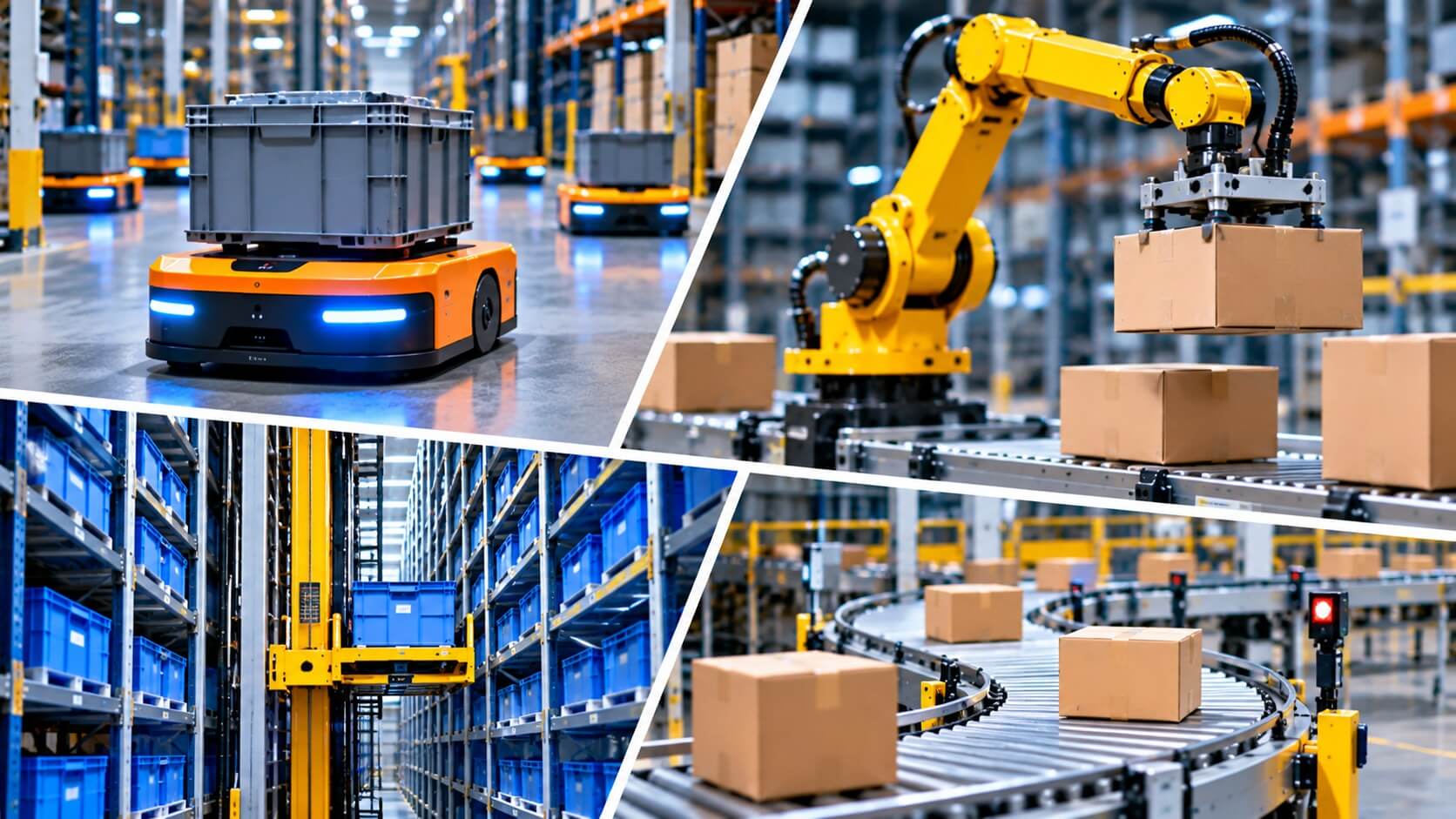
Warehouse automation can be divided into four broad types: basic automation, system automation, mechanized automation, and advanced automation.
These categories describe different ways businesses use technology to improve warehouse operations, from simple inventory software and barcode scanners to conveyor systems, autonomous robots, and AI-powered equipment.
However, these are practical categories rather than a universal industry standard. Modern warehouses frequently combine several types of automation within the same facility.
For businesses, the goal is to move products more efficiently, reduce unnecessary manual work, improve inventory accuracy, and increase order-processing capacity.
For investors, understanding these technologies helps explain why different warehouse automation companies compete in different markets and why some solutions require much larger investments than others.
What Are the Four Types of Warehouse Automation?
Warehouse automation is often described through four overlapping categories.
| Type | Main Function | Common Examples |
|---|---|---|
| Basic automation | Simplifies individual tasks | Barcode scanners, digital inventory tracking |
| System automation | Coordinates warehouse information and workflows | Warehouse management systems, automated task allocation |
| Mechanized automation | Uses equipment to move or handle goods | Conveyors, sortation systems, automated lifts |
| Advanced automation | Uses robotics and intelligent control systems | Autonomous mobile robots, robotic picking, automated storage |
The categories are not mutually exclusive.
For example, an automated storage system combines mechanical equipment, control software, and sometimes advanced robotics.
Similarly, a warehouse management system may coordinate both human workers and automated machines.
The important distinction is what each technology does and how it contributes to the warehouse's overall performance.
1. Basic Warehouse Automation
Basic automation focuses on simplifying repetitive activities without fundamentally redesigning the warehouse.
It often represents the first step toward more sophisticated operations.
Barcode Scanning and Inventory Tracking
Barcode scanners allow employees to record product movements electronically.
When goods arrive, workers scan labels to register inventory.
The same process can be used when products are moved, picked, packed, or shipped.
This reduces reliance on handwritten records and manual data entry.
However, scanning systems still depend on employees following correct procedures.
Digital Inventory Records
Digital inventory systems help businesses monitor stock levels and product locations.
Instead of relying on paper records or disconnected spreadsheets, employees can access updated information through computers or mobile devices.
This improves visibility into warehouse operations.
A business may identify missing inventory, locate products more quickly, or reduce errors caused by outdated records.
When Basic Automation Makes Sense
Basic automation can be useful for smaller warehouses that are not ready to invest in robotic equipment.
It generally requires less infrastructure than large mechanical automation systems.
However, it does not eliminate most physical warehouse activities.
Employees still move goods, operate equipment, and prepare shipments.
For many businesses, these technologies establish the information foundation needed for more advanced automation.
2. System Automation
System automation uses software to coordinate warehouse activities and improve operational decisions.
Instead of automating only one task, it connects different parts of the warehouse workflow.
Warehouse Management Systems
A warehouse management system, or WMS, tracks inventory and organizes warehouse operations.
It can manage receiving, storage locations, order picking, packing, and shipping activities.
When a customer places an order, the system identifies the required products and helps determine how the order should be fulfilled.
Employees may receive instructions through handheld devices or workstations.
In automated facilities, the WMS can also exchange information with robotic equipment and other control systems.
Automated Task Allocation
Software can assign tasks according to priorities, product locations, and available resources.
For example, a warehouse may receive hundreds of orders requiring products stored in different areas.
Rather than allowing employees to choose tasks independently, software can organize work to reduce unnecessary movement.
This can improve productivity without requiring a complete replacement of existing equipment.
Inventory and Demand Analysis
Warehouse software can analyze inventory movements and historical order patterns.
Businesses can use this information to identify frequently purchased products and improve storage decisions.
More advanced systems may incorporate forecasting algorithms to anticipate changes in demand.
However, forecasting accuracy depends on the quality of the available data and the stability of purchasing patterns.
Why System Automation Matters
Software often provides the coordination layer connecting employees, equipment, and inventory.
A warehouse can install expensive machines but still experience operational problems if its software cannot manage workflows effectively.
For investors, this helps explain why warehouse automation includes software companies alongside robotics manufacturers.
3. Mechanized Warehouse Automation
Mechanized automation uses physical equipment to reduce the manual effort required to move and handle products.
These technologies have been used in logistics operations for decades.
They remain important even as more advanced robots enter the market.
Conveyor Systems
Conveyors transport products between different warehouse areas.
They may move cartons from receiving stations to storage locations or from packing areas to shipping docks.
Conveyor systems are particularly useful when products follow predictable routes.
They can reduce the need for employees to carry goods or repeatedly transport containers.
However, fixed conveyor networks may require significant modifications when warehouse layouts change.
Automated Sorting Systems
Sortation equipment directs products or packages toward specific destinations.
For example, a parcel distribution facility may need to separate thousands of packages according to delivery regions.
Automated sorting systems identify the appropriate destination and route packages accordingly.
This technology is especially relevant to high-volume logistics operations.
Automated Lifts and Pallet Handling
Mechanical systems can move goods vertically or transport heavy loads.
Automated pallet handling equipment may reduce the amount of manual forklift activity required in selected warehouse processes.
These systems can be useful where goods are standardized and movements follow predictable patterns.
When Mechanized Automation Works Best
Mechanized automation is often attractive in facilities with high volumes and relatively stable workflows.
A conveyor network can efficiently transport large quantities of products along established routes.
However, it may be less flexible than mobile robotics when operating requirements change frequently.
Businesses must balance throughput, installation costs, available space, and future flexibility.
4. Advanced Warehouse Automation
Advanced automation combines robotics, sensors, software, and intelligent control technologies to perform more complex physical tasks.
These systems can reduce manual handling and improve operational flexibility.
Autonomous Mobile Robots
Autonomous mobile robots, commonly called AMRs, transport goods through warehouse environments.
They use navigation software and sensors to move between locations.
Some robots carry containers or shelves, while others transport pallets or individual items.
Unlike equipment restricted to fixed tracks, many AMRs can adjust their routes in response to obstacles.
This flexibility can make them useful in warehouses where workflows change.
However, robots still require coordination, maintenance, charging infrastructure, and safe operating procedures.
Automated Guided Vehicles
Automated guided vehicles, or AGVs, also move materials through warehouses.
Traditional AGVs follow defined routes using technologies such as magnetic guidance, reflectors, or other navigation systems.
They are often used for predictable material movements.
The distinction between AGVs and AMRs is becoming less rigid as navigation technologies evolve.
Both can reduce repetitive transportation tasks, but their suitability depends on the facility's operating requirements.
Robotic Picking Systems
Robotic picking systems use mechanical arms, cameras, sensors, and gripping devices to identify and handle products.
These systems may retrieve items from containers or place goods into designated locations.
Robotic picking is more challenging when products vary significantly in shape, size, weight, and material.
A robot that handles standardized cartons successfully may struggle with soft packaging or irregular objects.
Advances in machine vision and robotic manipulation are expanding the range of tasks these systems can perform.
Automated Storage and Retrieval Systems
Automated storage and retrieval systems, known as AS/RS, store and retrieve goods using specialized machines.
Some systems use cranes or shuttles operating within storage structures.
Others use robotic platforms to access containers arranged in compact grids.
These technologies can improve storage density and reduce the time employees spend traveling between inventory locations.
However, they often require substantial planning and integration.
What Is an Example of Warehouse Automation?
Consider an online retailer processing thousands of customer orders each day.
In a traditional warehouse, employees may walk through aisles collecting products before bringing them to packing stations.
An automated warehouse can organize the same process differently.
When a customer places an order, the warehouse management system identifies the required items.
Robotic storage equipment or mobile robots transport products to picking stations.
Employees or robotic picking systems select the necessary items.
Conveyors move completed orders toward packing and shipping areas.
Automated sorting equipment directs packages to the appropriate shipping lanes.
Throughout the process, software tracks inventory and coordinates activities.
This example demonstrates how multiple automation technologies work together.
The warehouse does not necessarily need to automate every stage.
A business might automate storage and transportation while retaining employees for picking, packing, and quality control.
The most effective design depends on product characteristics, order volumes, available space, and financial constraints.
What Is the Difference Between Warehouse Automation and Warehouse Robotics?
Warehouse robotics is one part of warehouse automation.
Automation is the broader concept.
It includes software, mechanical systems, inventory tracking, conveyors, robotic equipment, and other technologies that reduce manual work or improve coordination.
Warehouse robotics specifically involves programmable machines performing physical tasks.
For example, a conveyor that moves cartons along a fixed route is a form of mechanized automation.
An autonomous robot that navigates through a facility to deliver containers is a robotic automation system.
A warehouse management application that assigns picking tasks is software automation.
All three can contribute to the same warehouse operation.
This distinction matters for investors because companies specializing in warehouse software may have very different business models from companies manufacturing robotic equipment.
The broader relationship between these technologies and the warehouse automation industry is explained in Warehouse Automation: What It Is and How the Industry Works.
How Does Artificial Intelligence Improve Warehouse Automation?
Artificial intelligence can help automated warehouses make better operational decisions and handle more complex tasks.
However, AI is not required for every form of warehouse automation.
Many established systems operate using predefined rules and conventional control software.
AI becomes particularly useful when warehouses must process complex information or respond to changing conditions.
Smarter Robot Navigation
AI-based systems can help robots interpret sensor data and navigate dynamic environments.
For example, a robot may need to recognize obstacles, identify alternative routes, or adjust its movements around employees.
These capabilities can improve flexibility compared with strictly predefined routes.
Computer Vision
Computer vision allows machines to interpret visual information from cameras.
In warehouse operations, it can support object identification, package inspection, and robotic picking.
The technology may help robotic systems recognize products with different shapes and packaging.
Predictive Maintenance
Automated equipment generates operational data.
Machine learning systems can analyze this information to identify patterns associated with potential equipment failures.
Maintenance teams may use these signals to inspect components before serious problems occur.
However, predictions are not always accurate, and effective maintenance still requires human expertise.
Warehouse Optimization
AI can also support decisions about inventory placement, task scheduling, and workload distribution.
For example, software may identify frequently ordered products and recommend storage locations that reduce handling time.
The economic benefit depends on whether these improvements produce measurable operating savings.
Which Warehouse Automation Technologies Do Amazon and Walmart Use?
Large retailers use combinations of automation technologies rather than relying on one type of robot.
Amazon has deployed robotic systems to assist with moving inventory, transporting goods, and supporting fulfillment operations.
Its facilities use different technologies depending on their size, purpose, and operating requirements.
Walmart has invested in automated distribution systems designed to improve product handling and supply chain efficiency.
Its operations include technologies for moving, storing, and organizing goods within distribution facilities.
These examples demonstrate why modern warehouse automation involves several complementary technologies.
Robots may handle transportation, mechanical systems may move goods between processing areas, and software coordinates the overall operation.
Neither company relies on a single technology for every warehouse task.
Their approaches also illustrate how automation requirements differ between e-commerce fulfillment and distribution operations supplying retail stores.
For a detailed comparison of the systems used by these retailers, read Amazon and Walmart Warehouse Robots: What They Use and Why.
Which Type of Warehouse Automation Is Best?
There is no universally best type of warehouse automation.
The appropriate solution depends on the problems a business needs to solve.
A small warehouse experiencing inventory errors may benefit more from reliable inventory software than from expensive robotic equipment.
A distribution center moving large volumes of standardized cartons may achieve significant benefits from conveyors and sorting systems.
A fulfillment operation handling many different products may benefit from robotic storage and goods-to-person systems.
A facility with changing layouts or unpredictable workflows may value the flexibility of mobile robots.
Businesses should evaluate several operational factors before selecting technologies.
These include order volume, product variety, available space, labor requirements, integration complexity, and expected future growth.
The cost of automation must also be considered alongside the financial benefits.
A system that increases productivity may still be a poor investment if its installation and operating expenses exceed the value it creates.
Can Small Warehouses Use Automation?
Warehouse automation is not limited to large retailers.
Smaller businesses can adopt technologies gradually.
A warehouse might begin by introducing barcode scanning and inventory software.
Later, it could add mobile devices for employees, automated labeling equipment, or selected material handling systems.
More advanced robotic solutions may become appropriate as order volumes increase.
This gradual approach allows businesses to improve operations without necessarily committing to a complete facility redesign.
However, smaller warehouses may face financial constraints.
Some automated systems require substantial initial investment, specialized maintenance, or minimum operating volumes to justify their costs.
Subscription-based software and certain service-based robotics arrangements can reduce some upfront expenses, although long-term costs still need to be evaluated.
The opportunity for automation suppliers is therefore not restricted to the largest distribution centers.
As technologies become more flexible and affordable, smaller facilities may represent additional potential customers.
Who Builds the Different Types of Warehouse Automation Systems?
The warehouse automation market includes companies specializing in different technologies.
Large industrial suppliers and systems integrators develop complete material handling solutions.
Specialized robotics businesses focus on technologies such as mobile robots, robotic storage, or automated picking.
Software companies provide systems that manage inventory and coordinate warehouse activities.
For example, Daifuku and Dematic are important participants in integrated material handling automation.
AutoStore specializes in high-density robotic storage systems.
Symbotic develops automated systems for large distribution operations.
Other companies focus on mobile robotics, warehouse software, or specialized equipment.
These businesses may compete in certain projects while also cooperating through partnerships and systems integration.
A warehouse operator may purchase equipment from several suppliers and rely on a separate integrator to coordinate the installation.
For investors, this makes it important to identify exactly which part of the automation market a company serves.
A business selling warehouse management software may have different growth drivers, margins, and capital requirements from a manufacturer building large mechanical systems.
For a closer examination of the competitive landscape, see Who Leads Warehouse Automation? The Companies Behind the Industry.
What Is the Future of Warehouse Automation Technology?
Warehouse automation is likely to evolve toward more flexible systems, improved robotic handling, and closer integration between equipment and software.
One important development is the ability of robots to handle a wider range of products.
Many warehouse processes remain difficult to automate because products differ in shape, packaging, and physical characteristics.
Improved robotic manipulation could expand the number of activities machines can perform.
Another development is the growing importance of software.
As warehouses deploy more equipment, coordinating machines efficiently becomes increasingly complex.
Better software may allow businesses to improve the performance of existing systems without replacing all their equipment.
Mobile robotics may also expand in applications where flexibility is more valuable than fixed infrastructure.
However, the pace of adoption will depend on costs, reliability, customer demand, and the financial benefits of automation.
Not every promising technology will become commercially successful.
For investors, the important distinction is between technologies that perform well in demonstrations and those that customers can deploy profitably at scale.
What Investors Should Understand About the Four Types of Warehouse Automation
The four broad types of warehouse automation represent different levels and methods of improving warehouse operations.
Basic automation simplifies individual tasks.
System automation coordinates information and workflows.
Mechanized automation uses physical equipment to move and handle goods.
Advanced automation introduces robotics and intelligent systems capable of performing more complex activities.
In practice, successful automated warehouses often combine all four.
The technologies are complementary rather than competing solutions in every situation.
For investors, understanding these differences helps explain the structure of the industry.
Software providers, robotics developers, equipment manufacturers, and systems integrators can all benefit from warehouse automation adoption, but their financial characteristics and risks differ.
The long-term opportunity depends not simply on how many robots are deployed, but on whether automation technologies deliver reliable productivity improvements and attractive economics for customers.
Disclaimer: This article is for informational and educational purposes only and does not constitute financial or investment advice. Investing involves risk, including the potential loss of capital.