
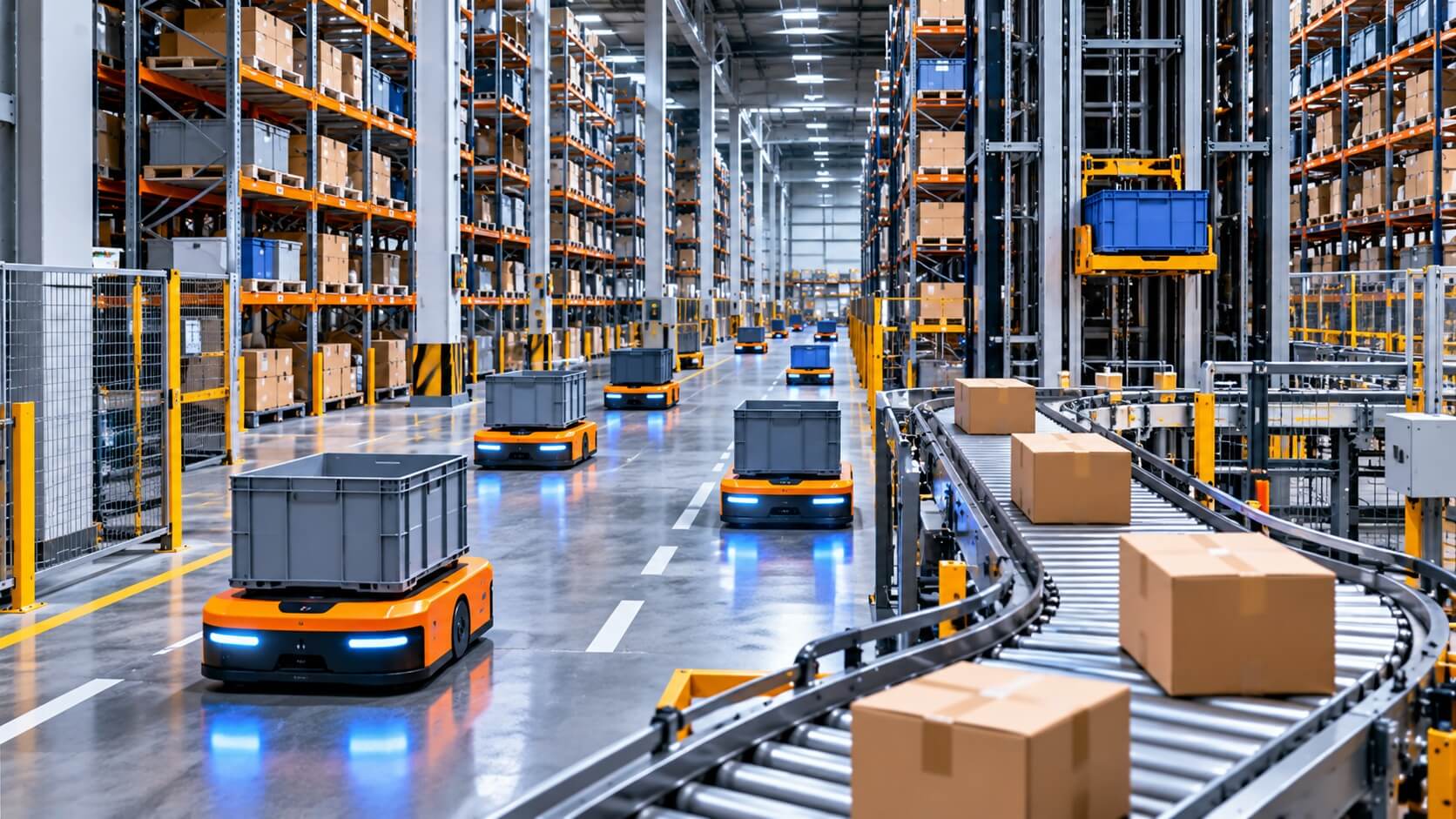
Warehouse automation is the use of machines, robots, software, and intelligent systems to move, store, sort, and manage products with less manual work.
Instead of relying entirely on employees to walk through aisles, locate inventory, transport boxes, and prepare shipments, automated warehouses use technology to make these operations faster, more accurate, and more efficient.
The industry has become increasingly important as e-commerce, labor costs, delivery expectations, and supply chain complexity push businesses to improve their logistics operations.
For investors, warehouse automation represents more than a robotics trend. It is an industry involving equipment manufacturers, software developers, artificial intelligence companies, logistics providers, and major retailers investing in their own infrastructure.
Understanding how these businesses interact is essential to evaluating the industry's long-term opportunities and risks.
What Is Warehouse Automation?
Warehouse automation refers to technologies that perform or coordinate tasks traditionally handled by warehouse employees.
These tasks include receiving products, managing inventory, moving goods between storage locations, picking items for orders, packaging shipments, and preparing products for transportation.
A traditional warehouse depends heavily on people and equipment such as forklifts, pallet jacks, and conveyor belts.
An automated warehouse introduces systems that can perform some of these activities independently or help employees complete them more efficiently.
For example, instead of an employee walking across a large warehouse to retrieve an item, a mobile robot may transport the storage shelf or product container to a workstation.
Other systems can automatically sort packages, identify inventory locations, or determine the most efficient sequence for fulfilling customer orders.
However, warehouse automation does not necessarily mean eliminating human workers.
Many facilities combine automated equipment with employees who handle complex tasks, exceptions, maintenance, supervision, and quality control.
The goal is usually to improve productivity and reliability while controlling operating costs.
How Does Warehouse Automation Work?
Warehouse automation typically combines physical equipment with software that coordinates the movement of goods.
The process begins when products arrive at a distribution facility.
Inventory systems record incoming shipments and determine where products should be stored. Automated equipment may then transport those products to designated storage locations.
When customers place orders, software identifies the required items and determines how to retrieve them.
Robots, conveyor systems, or automated storage machines move products toward picking and packing stations.
Once an order is assembled, additional equipment may sort packages according to their shipping destinations.
The entire process depends on communication between machines, sensors, inventory databases, and warehouse management software.
The Role of Robots
Robots perform physical activities such as transporting containers, retrieving products, moving pallets, and assisting with order preparation.
Some robots follow predefined routes, while others use sensors and navigation software to move through changing warehouse environments.
Robots are particularly useful for repetitive activities involving large numbers of products or frequent movements between locations.
The Role of Software
Software acts as the coordination layer of an automated warehouse.
It tracks inventory, organizes orders, assigns tasks, and determines how different machines should operate together.
Without effective software, even expensive robotic equipment may deliver disappointing results.
The Role of Artificial Intelligence
Artificial intelligence can help warehouse systems recognize objects, forecast workloads, optimize routes, and respond to changing operating conditions.
For example, AI-based systems may analyze order patterns to recommend where frequently purchased products should be stored.
Machine learning can also support equipment monitoring and maintenance planning.
However, not every automated warehouse uses advanced AI. Many successful systems rely on conventional software, sensors, and predefined operating rules.
What Are the Main Types of Warehouse Automation?
Warehouse automation includes several different technologies, each designed to solve particular operational problems.
The most important distinction is between systems that automate information, systems that automate physical movement, and technologies that coordinate complete workflows.
Automated Storage and Retrieval Systems
Automated storage and retrieval systems, commonly called AS/RS, use machines to place products into storage and retrieve them when needed.
These systems can reduce the space required for inventory and limit the distance employees must travel.
They are particularly relevant for facilities handling large inventories or high order volumes.
Autonomous Mobile Robots
Autonomous mobile robots, or AMRs, transport products and materials through warehouses.
Unlike traditional equipment following fixed paths, many AMRs can navigate dynamically around obstacles.
They can support flexible operations where storage layouts and order volumes change.
Conveyors and Sorting Systems
Conveyor systems move products between different parts of a facility.
Automated sortation equipment directs packages toward the appropriate processing area or shipping destination.
These technologies are widely used in distribution centers handling large numbers of parcels.
Robotic Picking and Packing
Robotic arms equipped with cameras, sensors, and specialized gripping devices can identify, pick, and handle products.
Some systems also assist with packaging and palletizing.
Handling products with different shapes, materials, and dimensions remains more challenging than moving standardized containers.
For a closer explanation of these technologies and their practical applications, see Types of Warehouse Automation and How They Work.
Why Are Companies Investing in Warehouse Automation?
Businesses invest in warehouse automation because logistics performance directly affects costs, customer satisfaction, and competitiveness.
Several economic forces support demand for these technologies.
Rising Delivery Expectations
Online customers increasingly expect reliable and rapid delivery.
Retailers must process orders accurately while managing large inventories and fluctuating demand.
Automation can help distribution centers handle more orders without increasing labor requirements at the same rate.
Labor Availability and Costs
Warehouses often require employees to perform repetitive, physically demanding activities.
Recruiting and retaining workers can be difficult, particularly during periods of high demand.
Automation can reduce dependence on certain manual tasks while creating demand for equipment operators, technicians, and maintenance specialists.
Better Use of Warehouse Space
Warehouse space is expensive to lease, build, operate, and maintain.
Automated storage systems can sometimes store more products within the same building by using vertical space and reducing aisle requirements.
For companies operating in expensive logistics markets, this can improve the economics of distribution facilities.
Greater Operational Consistency
Automated systems can perform repetitive activities with consistent timing and procedures.
They may reduce certain picking errors, improve inventory tracking, and support predictable order processing.
However, reliability depends on equipment quality, software integration, maintenance, and operational design.
Automation does not eliminate operational problems. It changes how those problems must be managed.
Who Makes Money From Warehouse Automation?
The warehouse automation industry contains several business models.
Understanding these differences is important because companies can benefit from automation adoption in very different ways.
Robotics and Equipment Manufacturers
These businesses sell physical systems such as mobile robots, robotic arms, automated storage equipment, conveyors, and sorting machines.
Their revenue may come from equipment sales, installation projects, maintenance agreements, and upgrades.
Demand can increase as businesses expand or modernize distribution facilities.
However, equipment manufacturers may face volatile orders, manufacturing costs, and intense competition.
Warehouse Software Providers
Software companies develop systems that manage inventory, coordinate equipment, and optimize warehouse operations.
Some sell software licenses, while others generate recurring subscription or support revenue.
Software can become deeply integrated into a customer's operations, potentially supporting long-term commercial relationships.
Nevertheless, integration complexity, competition, and customer spending decisions can affect profitability.
Systems Integrators
Systems integrators design and implement automation solutions using equipment and software from multiple suppliers.
A large warehouse project may require robots, conveyors, storage systems, control software, and connections to existing business applications.
Integrators coordinate these components into a functioning operation.
Their business depends on project execution, engineering expertise, and customer demand for complex automation installations.
Retailers and Logistics Operators
Retailers and logistics companies generally benefit differently.
Instead of primarily selling automation technology, they use it to improve their own operations.
Potential benefits include lower fulfillment costs, faster delivery, better inventory management, and greater distribution capacity.
These improvements can support profitability, but only when the financial benefits justify the investments.
For a closer examination of the major technology suppliers and competitive landscape, read Who Leads Warehouse Automation? The Companies Behind the Industry.
How Much Does Warehouse Automation Cost?
Warehouse automation costs vary enormously depending on facility size, operational complexity, and the technology selected.
A relatively small operation might begin with inventory software, barcode scanning, or a limited number of mobile robots.
A large distribution center may require extensive automated storage systems, conveyor networks, robotic picking stations, and integrated software.
The total investment involves more than purchasing equipment.
Businesses must also consider installation, facility modifications, software integration, employee training, maintenance, and potential operational disruption.
Some automation providers offer subscription or service-based arrangements that reduce initial equipment purchases, although customers still need to evaluate their total long-term costs.
For warehouse operators, the important question is not simply how much automation costs.
It is whether the technology produces enough economic value to justify the investment.
That requires evaluating labor savings, productivity improvements, maintenance expenses, system utilization, and financing costs.
A detailed examination of these expenses is available in How Much Does Warehouse Automation Cost? A Practical Breakdown.
How Are Amazon and Walmart Using Warehouse Automation?
Major retailers provide practical examples of how warehouse automation is changing logistics.
Amazon has invested heavily in robotic systems across its fulfillment network.
Its operations include mobile robotic platforms, automated movement systems, and robotic technologies designed to assist with inventory handling and order processing.
Amazon has also developed proprietary robotics technologies alongside systems acquired or developed through partnerships.
Walmart has invested in automated distribution and fulfillment technologies to improve inventory handling and the movement of products through its supply chain.
Its automation initiatives have involved technology partnerships and systems designed for different types of distribution facilities.
These companies illustrate two important industry dynamics.
First, large retailers can become major customers for warehouse automation suppliers.
Second, some retailers develop or customize technologies internally, potentially reducing their dependence on external vendors in selected areas.
The financial impact also differs between businesses.
For a robotics supplier, an automation project can generate revenue.
For a retailer, the same project represents an investment intended to improve future operations.
For a detailed comparison, see Amazon and Walmart Warehouse Robots: What They Use and Why.
Will Warehouse Automation Replace Human Workers?
Warehouse automation is likely to change the nature of warehouse employment, but its effects will differ across companies, facilities, and job categories.
Tasks involving repetitive transportation, sorting, and standardized product handling are often more suitable for automation.
Other activities remain difficult to automate completely.
These include handling unusual products, resolving operational problems, maintaining equipment, managing exceptions, and coordinating complex processes.
As automation expands, some traditional warehouse roles may decline or change.
At the same time, automated facilities require technicians, software specialists, maintenance personnel, and employees capable of supervising advanced systems.
The overall employment impact depends on several factors, including adoption rates, business growth, labor costs, and the availability of new roles.
Higher productivity may allow a warehouse to process more orders with fewer labor hours per order without necessarily reducing its total workforce.
However, automation can also displace workers, especially when companies redesign operations around technologies requiring fewer employees.
These outcomes should not be treated as mutually exclusive.
A business may create technical positions while eliminating certain manual roles.
For a broader discussion of job displacement, new employment opportunities, and AI adoption, read Will Warehouse Workers Be Replaced by AI? What the Shift Means.
Does Warehouse Automation Make Businesses More Profitable?
Automation can improve warehouse profitability, but higher productivity does not automatically translate into higher profits.
The financial result depends on the relationship between operating improvements and the total cost of implementing and maintaining the technology.
Consider a warehouse that introduces automated equipment to reduce the labor hours required for order fulfillment.
If the savings exceed equipment depreciation, financing expenses, software fees, maintenance, and other additional costs, profitability may improve.
But if the warehouse operates below capacity or the equipment requires expensive modifications, the investment may take longer to generate attractive returns.
Automation can also provide benefits beyond direct labor savings.
These may include improved inventory accuracy, fewer damaged products, greater storage density, and increased order-processing capacity.
For investors evaluating warehouse operators, it is important to distinguish between revenue growth, operating efficiency, and actual profitability.
A company can process more orders without improving its margins if operating costs remain too high.
Similarly, an automation supplier can experience strong sales growth while struggling with project expenses or weak margins.
The economics of warehouse operations are explored further in How Profitable Is a Warehouse? The Economics of Automation.
Why Is Warehouse Management Software Important?
Physical robots are only one part of warehouse automation.
Software determines how inventory, orders, employees, and automated equipment work together.
A warehouse management system, commonly called a WMS, helps businesses track products and coordinate daily warehouse operations.
It can manage receiving, storage locations, picking activities, inventory records, and shipping workflows.
More advanced environments may also use warehouse execution systems and warehouse control systems to coordinate equipment and optimize operational activities.
The distinction matters because a company can improve warehouse efficiency through software even without deploying a large robotic fleet.
Software also provides an important connection between warehouse operations and broader business systems.
For example, inventory information may need to communicate with purchasing, sales, transportation, and financial applications.
Poor integration can limit the value of automation investments.
From an investment perspective, warehouse software companies may offer business models different from those of physical equipment manufacturers.
Their revenue can include subscriptions, licenses, implementation services, and ongoing support.
However, investors must still evaluate competition, customer retention, implementation costs, and profitability.
For a closer look at the software behind modern warehouses, see Warehouse Management Software: What It Does and Who Uses It.
What Are the Biggest Risks Facing the Warehouse Automation Industry?
Warehouse automation has meaningful growth opportunities, but several risks can affect both technology suppliers and their customers.
High Upfront Investment
Large automation projects can require substantial capital.
When interest rates, financing costs, or economic uncertainty increase, companies may delay warehouse modernization projects.
This can make demand for automation equipment sensitive to business investment cycles.
Complex Implementation
Automated warehouses require different systems to work together reliably.
Problems involving software, equipment, facility design, or integration can delay projects and increase costs.
For suppliers, these complications may reduce project profitability.
For customers, they can interrupt operations and delay expected savings.
Technology Obsolescence
Robotics and AI technologies continue to evolve.
Businesses investing in expensive equipment must consider whether their systems can be upgraded or adapted to changing requirements.
Technology suppliers also face pressure to improve their products and remain competitive.
Competitive Pressure
Warehouse automation includes established industrial companies, specialized robotics businesses, software providers, and emerging technology developers.
Competition can pressure prices and profit margins.
A growing market does not guarantee that every participating company will become profitable.
Customer Concentration
Some automation suppliers depend on a relatively small number of large customers or major projects.
A delayed order or canceled contract can have a significant financial impact.
Investors should examine customer concentration and order visibility when evaluating individual companies.
Cybersecurity and Operational Reliability
Connected warehouses depend on software, networks, and data systems.
Cyberattacks, system outages, and equipment failures can interrupt operations.
As automation becomes more integrated, operational resilience becomes increasingly important.
Is Warehouse Automation a Good Investment Opportunity?
Warehouse automation offers exposure to several long-term economic trends, including e-commerce, industrial productivity, robotics, and software-driven logistics.
However, an attractive industry does not automatically make every company within it an attractive investment.
The investment case depends on which businesses capture value, how much they spend to generate revenue, and whether their competitive advantages are sustainable.
Several factors deserve particular attention.
Revenue Growth and Demand
Investors can examine whether a company is gaining customers, expanding installations, and generating repeat business.
For equipment suppliers, order intake and backlog may provide useful information about future activity, although orders can be delayed or canceled.
For software providers, recurring revenue and customer retention may be especially relevant.
Profit Margins
Revenue growth matters, but profitability determines whether a business can convert commercial demand into sustainable financial results.
Equipment manufacturers, systems integrators, and software providers may have different margin structures.
Comparing companies without considering their business models can be misleading.
Cash Flow
Automation businesses may need significant working capital to manufacture equipment or complete large projects.
Positive accounting earnings do not always mean a company is generating strong cash flow.
Investors should examine operating cash flow, capital expenditure, and financing requirements.
Competitive Advantages
Potential competitive advantages include proprietary technology, established customer relationships, reliable equipment, strong software integration, and extensive service networks.
However, technological leadership can change.
A company with an innovative product today may face stronger competition as the industry develops.
Valuation
Even a company with strong growth prospects can be a poor investment if its stock price already reflects overly optimistic expectations.
Investors should compare valuation with realistic assumptions about revenue growth, margins, cash flow, and competitive risks.
Warehouse automation may create substantial economic value over time, but the distribution of that value among suppliers, customers, employees, and shareholders remains uncertain.
What Could Drive the Next Phase of Warehouse Automation?
Several developments could influence the industry's future.
One is the continued improvement of robotic systems capable of handling a wider variety of products.
Another is the integration of AI into warehouse planning, navigation, inventory management, and robotic manipulation.
Advances in machine vision and robotic gripping may allow machines to perform tasks that previously required human judgment and dexterity.
More flexible automation systems could also make the technology practical for businesses that cannot justify the cost of large, highly customized installations.
Service-based commercial models may lower some initial barriers by allowing customers to pay for automation through ongoing contracts.
At the same time, adoption will depend on economic conditions.
Businesses will continue comparing automation investments against labor costs, facility expenses, financing conditions, and expected demand.
The industry could expand significantly while still experiencing periods of slower orders, pricing pressure, and consolidation.
For investors, monitoring real customer adoption and financial performance is more useful than relying on ambitious technology demonstrations alone.
What Investors Should Understand About Warehouse Automation
Warehouse automation is an important part of the broader transformation of logistics and industrial operations.
It combines robotics, software, automated storage systems, artificial intelligence, and operational expertise to help businesses move products more efficiently.
Its economic value comes from solving practical problems: reducing unnecessary movement, improving order accuracy, managing inventory, increasing capacity, and controlling costs.
The industry creates opportunities for equipment manufacturers, software developers, and systems integrators, while retailers and logistics companies may benefit through improved operations.
However, the relationship between automation adoption and investment returns is not straightforward.
High implementation costs, competition, project delays, changing technology, and uncertain customer spending can affect financial performance.
The most important question for investors is not simply whether more warehouses will become automated.
It is which companies can turn growing demand into durable profits, healthy cash flow, and sustainable competitive advantages.
Disclaimer: This article is for informational and educational purposes only and does not constitute financial or investment advice. Investing involves risk, including the potential loss of capital.