
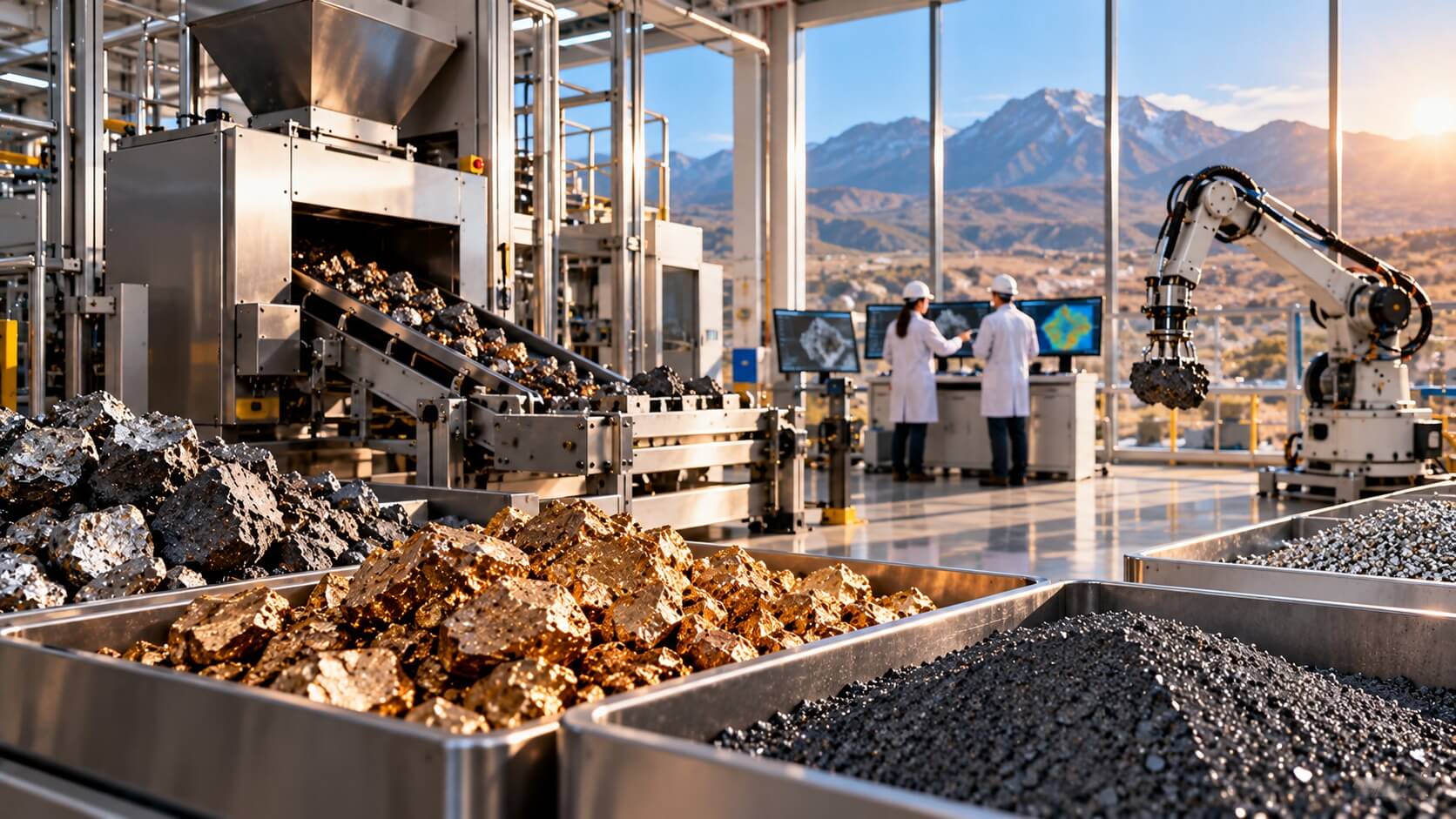
An asteroid could theoretically contain billions or even trillions of dollars' worth of metals, but there is no reliable market price for an asteroid, and its theoretical resource value is not the same as its commercial value.
Some asteroids contain iron, nickel, and potentially precious metals such as platinum and gold. Others contain water-bearing minerals that could support future space missions. The total quantity of these materials can be enormous, particularly in larger asteroids.
However, calculating how much an asteroid is worth requires more than multiplying its estimated metal content by current commodity prices.
A realistic valuation must consider resource concentrations, extraction technology, transportation costs, customer demand, and the amount of material that can actually be recovered and sold.
For investors, this distinction is essential. An asteroid may contain valuable resources without offering a profitable mining opportunity.
How Much Money Is One Asteroid Worth?
There is no single answer because asteroids differ enormously in size, composition, location, and accessibility.
A small rocky asteroid may contain relatively little material with immediate commercial value. A larger metal-rich asteroid could contain substantial quantities of iron, nickel, and other metals.
However, size alone does not determine economic value.
A relatively small asteroid with accessible resources and a favorable orbit could potentially be a more attractive mining target than a much larger asteroid located far from Earth.
The key factors include:
- The asteroid's estimated mass and composition.
- The concentration of valuable or useful resources.
- The amount of material that can realistically be extracted.
- The energy and equipment required for processing.
- The cost of reaching the asteroid and transporting its resources.
- The existence of customers willing to purchase the recovered material.
Without reliable information about these factors, assigning a precise monetary value to an asteroid would be highly speculative.
Why Do Some Asteroids Have Trillion-Dollar Valuations?
Headlines sometimes describe asteroids as containing trillions or even greater amounts of theoretical wealth.
These figures usually come from calculations based on estimated quantities of metals multiplied by their current market prices on Earth.
For example, if researchers estimate that an asteroid contains a substantial amount of nickel, an analyst could multiply the estimated mass of nickel by its market price to calculate a theoretical gross material value.
The arithmetic may be straightforward, but the economic interpretation is not.
Such estimates generally assume that the material exists in the predicted quantity and can be valued at today's prices.
They do not necessarily account for extraction losses, processing expenses, transportation costs, financing, or the effect that additional supply could have on commodity markets.
The Difference Between Resource Value and Market Value
Consider a hypothetical asteroid believed to contain metals with a theoretical value of $1 trillion.
That figure does not mean a company could purchase the asteroid for $1 trillion or generate $1 trillion in revenue from mining it.
The company might be unable to recover most of the material.
Extraction and transportation costs could exceed the value of the recovered metals.
Even if large quantities reached Earth, selling them could affect market prices.
A theoretical resource valuation is therefore not equivalent to a company's revenue, profit, or investment value.
Is Asteroid 16 Psyche Really Worth $10 Quintillion?
Asteroid 16 Psyche is frequently associated with extraordinary estimates of potential metal wealth.
Located in the main asteroid belt between Mars and Jupiter, Psyche has attracted scientific attention because observations suggest it contains substantial amounts of metal.
Some widely circulated media reports have attached a theoretical value of approximately $10 quintillion to the asteroid.
However, this figure is not an established scientific estimate of commercially recoverable resources, nor is it a credible market valuation of the asteroid.
The figure should not be interpreted as the amount of money a mining company could earn.
What Do Scientists Actually Know About Psyche?
Psyche is scientifically interesting because its composition may help researchers understand how planets and other bodies formed during the early history of the solar system.
Observations suggest that the asteroid contains significant metal, although its precise composition and internal structure remain uncertain.
NASA launched the Psyche spacecraft in October 2023 to investigate the asteroid.
The spacecraft is scheduled to arrive at Psyche in 2029, when it will begin collecting information about the asteroid's composition, structure, and geological history.
It is a scientific mission, not a commercial mining operation.
The results may improve our understanding of metal-rich asteroids, but they will not automatically establish whether mining Psyche would be economically viable.
Why Would Psyche Be Difficult to Mine?
Psyche is located in the main asteroid belt, far beyond the Moon.
Reaching it requires a deep-space mission, and transporting substantial quantities of material back to Earth would introduce additional technical and financial challenges.
A mining company would also need specialized equipment capable of extracting and processing material in a low-gravity environment.
Even if the asteroid contained enormous quantities of valuable metals, recovering them could remain prohibitively expensive.
For commercial mining, accessibility and operating costs can matter more than the total amount of material present.
How Much Gold Is in an Asteroid?
Some asteroid materials contain gold, but the exact quantity in most individual asteroids is unknown.
Gold is a naturally occurring element that can be incorporated into rocky and metallic bodies.
However, identifying a metal-rich asteroid does not mean scientists know how much gold it contains.
The concentrations of different metals can vary significantly.
An asteroid containing large quantities of iron and nickel may contain only relatively small amounts of gold.
Can Scientists Measure Asteroid Gold From Earth?
Astronomers can study asteroid composition using reflected light, thermal observations, radar, and other techniques.
Scientists also analyze meteorites to understand the materials that may be present in different asteroid types.
These methods can provide useful information about broad composition, but they generally cannot establish the precise quantity of gold in a specific asteroid.
Direct spacecraft observations and sample analysis can improve confidence.
Even then, determining whether gold is concentrated enough for commercial extraction would require additional investigation.
Does More Gold Mean More Profit?
Not necessarily.
A large amount of gold could create substantial theoretical value, but mining profitability depends on recovery costs and selling prices.
Gold extracted from an asteroid would need to compete with gold produced through established terrestrial mining operations.
If space mining eventually delivered large quantities of gold to Earth, the additional supply could also influence market prices.
The quantity of gold present is therefore only one part of the commercial calculation.
For a closer examination of precious metals and other materials found beyond Earth, read Is There Gold in Space? What Asteroids and the Moon Actually Contain.
How Much Gold Is on the Moon?
Gold has been identified at trace concentrations in lunar materials, but its total quantity is not known with sufficient precision to provide a reliable estimate of commercially recoverable deposits.
The Moon contains many elements also found on Earth, including iron, aluminum, magnesium, titanium, and trace amounts of precious metals.
Scientific analysis of lunar samples has helped researchers understand its geological composition.
However, the existence of gold in lunar material does not mean that accessible, economically attractive gold deposits have been identified.
Could the Moon Contain Enormous Amounts of Gold?
Because the Moon is a massive geological body, even very low average concentrations of gold could imply a substantial total quantity.
But this does not establish the existence of commercially mineable deposits.
The material could be dispersed in extremely low concentrations or located in areas that would be difficult to access.
Mining companies need concentrated, recoverable resources rather than simply large theoretical totals.
This distinction is similar to terrestrial mining.
The presence of a valuable element in ordinary rock does not automatically make that rock economically worth processing.
Is Lunar Gold Mining Realistic?
With current technology and economics, there is no established commercial industry extracting gold from the Moon.
A lunar gold-mining operation would require prospecting, excavation, processing, energy infrastructure, and transportation.
Returning gold to Earth would add further expenses.
Before commercial mining could become realistic, companies would need to identify sufficiently concentrated deposits and demonstrate that the recovered material could be sold at a profit.
At present, other lunar resources may offer more practical applications.
Could We Mine the Moon?
Yes, in principle. The Moon contains materials that could potentially be extracted and used for scientific, industrial, and exploration purposes.
However, large-scale commercial lunar mining has not yet been established.
Several resources are particularly interesting because they could support activities directly on the Moon or elsewhere in space.
Water Ice
Water ice is one of the most important potential lunar resources.
Evidence indicates that water ice exists in some permanently shadowed regions near the lunar poles.
If accessible deposits can be extracted and processed efficiently, water could support astronauts and potentially provide hydrogen and oxygen for certain propulsion systems.
Producing these materials locally could reduce the need to transport all supplies from Earth.
However, the concentration, accessibility, and extraction economics of lunar ice remain important uncertainties.
Oxygen
Oxygen is present in chemically bound form within many lunar minerals.
Future processing systems could potentially extract oxygen for life support and industrial applications.
Oxygen is also an important component of many rocket propellants.
Local production could become valuable if future lunar operations require substantial quantities.
However, extraction would require equipment, energy, and processing infrastructure.
Iron, Aluminum, and Titanium
The Moon contains minerals associated with iron, aluminum, titanium, and other useful elements.
These materials could eventually support manufacturing, construction, or other industrial activities.
Their economic value might come from reducing the amount of material that must be transported from Earth.
For example, producing construction materials locally could become attractive if lunar infrastructure expands significantly.
Helium-3
Helium-3 is another lunar resource that frequently appears in discussions about future mining.
It has attracted interest because of its potential role in certain proposed nuclear fusion reactions.
However, commercial fusion power based on helium-3 has not been demonstrated, and extracting helium-3 from lunar material would present substantial technical challenges.
Claims that lunar helium-3 already represents a proven multitrillion-dollar energy market are therefore speculative.
Would Mining the Moon Be Easier Than Mining Asteroids?
In some respects, the Moon offers practical advantages.
Its location is well understood, it is relatively close to Earth, and spacecraft have already landed on its surface.
The Moon also provides a stable surface where equipment and infrastructure could potentially be installed.
However, lunar mining still presents major challenges.
Equipment must operate in vacuum, extreme temperature conditions, and an environment with abrasive dust.
Power generation, maintenance, transportation, and resource processing would all require reliable systems.
Asteroids present different difficulties, including very low gravity, uncertain surface conditions, and potentially long travel times.
Some near-Earth asteroids may have favorable orbital characteristics, but reaching and operating on them would still require specialized spacecraft.
Neither environment can be considered universally easier to mine.
The answer depends on the specific resource, destination, mission design, and intended customer.
What Makes Space Resources Valuable?
A resource's value depends not only on its physical properties but also on where it is located and who needs it.
Gold and platinum are valuable on Earth because they have established markets.
Water and oxygen, by contrast, may become especially valuable in space because transporting them from Earth can be expensive.
This creates two fundamentally different markets for space resources.
Resources Returned to Earth
A company could attempt to extract precious metals and transport them to Earth.
Its revenue would depend on terrestrial commodity prices and the quantity of material it could recover and sell.
The company would need to compete with established suppliers while covering the additional costs of operating in space.
Resources Used in Space
A company could instead supply water, oxygen, metals, or other materials to customers operating beyond Earth.
In this model, the value of the resource could reflect the cost of delivering an equivalent material from Earth.
For example, water delivered to a useful orbital location could potentially be worth considerably more than water sold at a terrestrial market.
However, that value would depend on actual customer demand and the cost of delivering the resource to the required destination.
A resource stored at a distant asteroid would not automatically command the same price as material available at a spacecraft refueling facility.
How Do You Calculate the Economic Value of an Asteroid?
A realistic economic assessment must go beyond the estimated quantity of valuable material.
One simplified approach is to estimate the revenue from recoverable resources and subtract the costs required to produce and deliver them.
Illustrative operating margin = Revenue from recovered resources − Extraction, processing, transportation, and other operating costs
This calculation is only a starting point. It does not represent the full economic value of an asteroid or the total return on a mining investment.
A full project valuation would also consider development and equipment costs, financing, taxes where applicable, project duration, technical risks, and the time value of money.
One common financial approach is to estimate future cash flows and discount them to their present value, accounting for the timing and risk of the project.
Example: A Hypothetical Asteroid Mining Project
Imagine a company planning to extract and sell metal from an asteroid.
Its economic assumptions are:
- Recoverable metal: 1,000 metric tons.
- Average selling price: $20,000 per metric ton.
- Total estimated project costs: $30 million.
The potential revenue would be:
1,000 × $20,000 = $20 million
If the company spent $30 million in total project costs to recover and deliver the metal, the project would generate a $10 million shortfall before considering any additional unaccounted expenses.
Even though the asteroid contained valuable material, the project would not be profitable under these assumptions.
Now imagine that improved technology reduced total project costs to $12 million.
The same quantity of metal sold at the same price would generate $20 million in revenue against $12 million in costs.
That would leave a potential $8 million project surplus before any additional expenses not included in the estimate.
These figures are hypothetical and do not represent an actual asteroid-mining mission.
The simplified example also ignores the timing of cash flows and the possibility that market prices could change as material is sold.
It illustrates why extraction costs, recoverable quantities, and market prices matter more than an asteroid's theoretical total resource value.
Could Asteroid Mining Make Precious Metals Cheaper?
Potentially, if commercial mining eventually introduces substantial new quantities of precious metals into terrestrial markets.
Commodity prices depend on supply and demand.
If asteroid mining increases supply significantly, prices could decline unless demand grows enough to absorb the additional production.
This creates an important economic consideration.
A mining company cannot necessarily assume that every ton of recovered material will sell at today's market price.
If production becomes large enough to change global supply, the resulting price adjustment could reduce future revenue.
The effect would depend on the specific metal, production volumes, demand, and the pace at which new supply enters the market.
Consequently, very large theoretical resource estimates should not be interpreted as guaranteed future earnings.
Could Space Resources Become More Valuable Than Gold?
In certain circumstances, yes, particularly when comparing the economic usefulness of materials delivered to a specific location rather than their ordinary prices on Earth.
A resource that is relatively inexpensive on Earth could become economically important if it is needed at a location where transportation is difficult or expensive.
Water is a useful example.
On Earth, water is generally inexpensive compared with gold.
But for a spacecraft requiring water at a distant location, the relevant cost includes transporting that water from Earth.
If a space-mining company could deliver usable water at a lower cost, it might create a commercially attractive service.
The same principle could apply to oxygen, propellant ingredients, and construction materials.
This suggests that the first commercially successful space-resource businesses may focus on supplying infrastructure rather than returning precious metals to Earth.
However, the development of these markets depends on future demand from spacecraft, lunar facilities, and other operations.
What Are the Biggest Obstacles to Commercial Space Mining?
The existence of resources does not eliminate the challenges of extracting them.
Several obstacles remain.
Resource uncertainty: Companies need reliable information about the quantity, concentration, and accessibility of useful materials.
Transportation costs: Equipment must reach the mining location, and recovered products must reach customers.
Extraction technology: Mining systems must function reliably in environments very different from Earth.
Processing requirements: Raw materials must be converted into products that customers can use.
Capital investment: Companies may need substantial funding long before commercial revenue begins.
Market demand: A technically successful operation still requires customers willing to pay sustainable prices.
Regulatory uncertainty: Companies must operate within applicable national laws and international space-law obligations.
These factors can determine whether a theoretically valuable resource becomes a viable business.
For a more detailed examination of extraction costs, business models, and financial risks, read Will Asteroid Mining Ever Be Profitable? The Economics Behind the Hype.
What Does the Value of Space Resources Mean for Investors?
The long-term potential of space resources is significant, but investors should distinguish between scientific estimates, technological progress, and commercial performance.
An asteroid containing large quantities of metal does not automatically create a valuable mining company.
Similarly, discovering water ice on the Moon does not prove that extracting and selling it will generate profits.
Investors should focus on measurable indicators of commercial development.
These include successful resource identification, extraction demonstrations, reliable processing technology, credible cost estimates, and contracts with customers.
Companies developing transportation, robotics, spacecraft, or other supporting technologies may also participate in the growth of space-resource activities without directly operating mines.
However, exposure to the broader space economy should not be confused with proven revenue from resource extraction.
A credible business model must explain how the company will recover resources, who will purchase them, and why the selling price will exceed the total cost of delivery.
How Much Is an Asteroid Worth? The Bottom Line
An asteroid's theoretical resource value could be enormous, but its actual commercial value depends on what can be recovered and sold economically.
Large metal-rich asteroids may contain substantial quantities of iron, nickel, and potentially precious metals. The Moon also contains useful resources, including water ice, oxygen-bearing minerals, and metals that could eventually support industrial activity.
However, the total quantity of material present is not the same as the amount that can be mined profitably.
Extraordinary valuations attached to asteroids such as 16 Psyche should therefore be treated as speculative illustrations rather than verified commercial estimates.
For investors, the most promising long-term opportunities may involve resources used directly in space, where local production could reduce transportation costs.
Ultimately, the value of an asteroid or lunar deposit will depend on the technology required to exploit it, the cost of delivering its resources, and the existence of customers willing to pay for them.
Until commercial extraction and delivery systems are demonstrated, the economic value of most space resources will remain highly uncertain.
Financial disclaimer: This article is for informational and educational purposes only and does not constitute investment advice. Space-related investments can be highly speculative and may result in substantial losses. Conduct independent research before making investment decisions.