
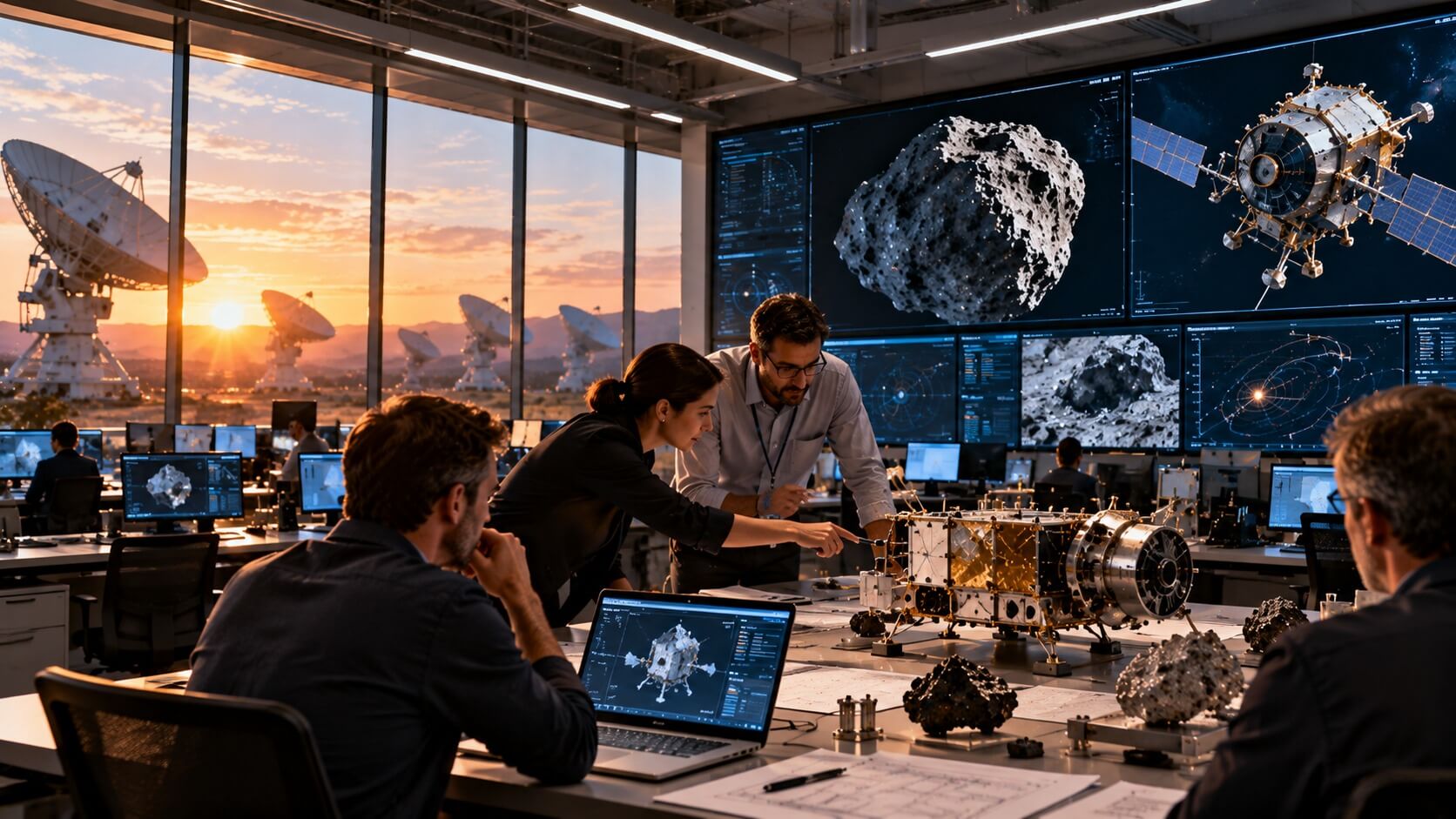
Asteroid mining could eventually become profitable, but no company has yet demonstrated a sustainable commercial business based on extracting and selling resources from asteroids. The biggest obstacle is not whether asteroids contain valuable materials. It is whether those materials can be recovered, processed, and delivered to customers at a total cost below the revenue they generate.
Some asteroids contain metals such as iron, nickel, and potentially platinum-group elements. Others contain water-bearing minerals that could support future spacecraft and refueling operations. However, the theoretical value of these resources is very different from the amount a mining company could realistically earn.
For investors, asteroid mining remains a speculative industry. Its long-term potential depends on transportation costs, reliable extraction technology, financing, and the development of markets willing to purchase resources obtained in space.
Why Is Asteroid Mining Considered a Potentially Valuable Industry?
Asteroids contain materials that are useful on Earth and could become important for future activities in space.
Some metal-rich asteroids contain substantial amounts of iron and nickel, while certain types may also contain platinum-group metals. Water-rich asteroids could potentially provide materials for life support and rocket propellant production.
The opportunity comes from two different business models.
The first involves extracting valuable materials and returning them to Earth for sale.
The second involves extracting resources for customers already operating in space, potentially avoiding the cost of transporting those materials from Earth.
These models have very different economics.
A company returning platinum to Earth would compete with established terrestrial producers and global commodity markets. A company supplying water to spacecraft could instead compete with the cost of launching and delivering that water from Earth.
The second model may offer a more practical early commercial application, although neither has yet been established as a profitable asteroid-mining industry.
How Much Would Asteroid Mining Cost?
There is no reliable universal cost estimate for commercial asteroid mining because no mature operation exists from which to derive standard production costs.
The total investment would depend on the asteroid's location, composition, mission duration, extraction method, transportation system, and intended customer.
However, several major cost categories can be identified.
Launch and Space Transportation
Mining equipment must first be transported from Earth into space.
Depending on the target, a mission may require additional propulsion, navigation systems, and substantial travel time before reaching the asteroid.
Reusable launch vehicles could reduce some transportation expenses, but reaching Earth orbit is only the beginning of an asteroid-mining mission.
The spacecraft must still reach its target, perform its operations, and potentially transport the recovered material elsewhere.
Lower launch costs would help, but they would not eliminate the remaining expenses.
Mining Equipment and Robotics
Mining an asteroid requires machinery capable of operating in extremely low gravity.
Traditional excavation equipment relies partly on gravity and stable ground conditions. On a small asteroid, machinery may need specialized anchoring, collection, and containment systems.
Equipment must also function with limited human intervention because communication delays make continuous remote control difficult.
Developing reliable robotics, extraction tools, and autonomous systems could require substantial research and testing before commercial operations begin.
Processing and Energy Requirements
Recovering useful material is not the same as producing a finished product.
A company extracting metal-bearing material might need to separate the desired elements from surrounding minerals.
A company recovering water would need systems to extract, purify, and store it.
These operations require energy, processing equipment, and reliable thermal management.
The amount of energy needed would depend on the material and the extraction process.
A technically successful system could still be commercially unattractive if processing costs are too high.
Transportation of Extracted Resources
Once materials have been extracted, they must reach a customer.
For precious metals intended for Earth, this could involve return spacecraft, controlled atmospheric reentry, recovery, and terrestrial processing.
For water or propellant intended for use in space, the company would need transportation and storage systems capable of delivering the product to a useful destination.
The delivery location is critical. A kilogram of water at an asteroid is not economically equivalent to a kilogram of water available to a spacecraft that needs it.
Transportation costs can determine whether the resource has commercial value.
Could Mining Precious Metals From Asteroids Be Profitable?
Potentially, but this business model faces particularly difficult economic challenges.
Gold, platinum, and other precious metals have established markets on Earth. This means a company could theoretically sell recovered materials to existing industrial or financial buyers.
However, those markets already have terrestrial suppliers with established infrastructure.
An asteroid-mining company would need to produce and deliver metals at a total cost competitive with the revenue it could obtain.
Why High Metal Prices Are Not Enough
Suppose a company identifies an asteroid containing a large quantity of platinum.
The metal might have substantial theoretical value based on current market prices.
However, the company would still need to determine how much platinum could actually be recovered and how much the entire operation would cost.
A profitable operation would require sufficient revenue from recovered material to cover extraction, processing, transportation, financing, and other business expenses, while providing an adequate return on the capital invested.
Positive operating cash flow alone would not necessarily mean that the original development investment had been recovered.
The existence of a valuable deposit does not guarantee that these conditions can be met.
Could Asteroid Mining Reduce Precious Metal Prices?
Yes, if it eventually introduced sufficiently large quantities of metals into terrestrial markets.
Commodity prices respond to supply and demand. If asteroid mining created a substantial new source of platinum or another scarce metal, the additional supply could affect market prices.
That creates a challenge for companies relying on high commodity prices to justify their business models.
An operation that dramatically increases supply could reduce the selling price of its own product.
The effect would depend on production volume, the speed of supply growth, industrial demand, and the broader market environment.
This is why calculations that multiply an asteroid's estimated metal content by current market prices can be misleading.
Could Mining Water From Asteroids Be More Profitable?
Mining water for use in space may offer a more practical early business model than returning precious metals to Earth.
Water is essential for human life and can also be processed to produce hydrogen and oxygen, which are used in certain rocket propulsion systems.
If future spacecraft, stations, or other infrastructure require substantial quantities of water or propellant, obtaining resources locally could potentially reduce dependence on supplies launched from Earth.
However, the business case depends on where the water is produced and where customers need it.
Why Location Matters More Than the Resource's Earth Price
Water is relatively inexpensive on Earth, but delivering it to a distant location in space can be costly.
Its value in space may therefore reflect the expense of transporting an equivalent quantity from Earth rather than the price of water in a terrestrial market.
Consider a hypothetical spacecraft that requires water at a particular orbital destination.
If an asteroid-mining company can deliver usable water to that location at a lower total cost than an Earth-based supplier, it could potentially offer a competitive service.
But if extracting and transporting asteroid water costs more than launching it from Earth, the business would not have an economic advantage.
The relevant comparison is the delivered cost of the resource, including processing, storage, transportation, and infrastructure costs, not simply its abundance.
The Problem of Customer Demand
A water-mining operation would need customers.
Today, the number of spacecraft and facilities requiring large-scale commercial deliveries of resources obtained from asteroids remains limited.
Future orbital infrastructure, refueling services, and exploration missions could create additional demand.
However, those markets must develop before mining companies can rely on them for substantial recurring revenue.
This creates a dependency: mining companies need customers, while some future space operations may depend on the availability of affordable resources.
Both sides of the market would need to develop together.
How Much Is an Asteroid Actually Worth?
An asteroid's theoretical resource value can be enormous, but that does not establish its commercial value.
Estimates sometimes assign extremely large monetary figures to asteroids by multiplying their assumed metal content by prevailing commodity prices.
These calculations can be useful for illustrating the scale of potential resources, but they omit important economic considerations.
A realistic valuation would need to account for recoverable quantities, extraction efficiency, transportation expenses, processing costs, capital investment, market demand, and the time required to generate revenue.
It would also need to consider financing costs, operational risks, the time value of money, and the possibility that additional supply could change commodity prices.
An asteroid containing valuable metals could therefore have a high theoretical material value while offering little or no commercially recoverable profit.
For a detailed explanation of these valuations and their limitations, read How Much Is an Asteroid Worth? The Value of Space Resources Explained.
What Would a Profitable Asteroid Mining Business Look Like?
A profitable operation would need more than a successful spacecraft mission.
It would require a repeatable system that can identify resources, extract useful material, process it, and deliver products to customers at an economically sustainable cost.
Consider a hypothetical company supplying water to spacecraft.
Its business model would need to answer several questions.
Who is the customer? The company would need identifiable operators willing to purchase water or propellant.
Where is the product delivered? The delivery location would determine transportation requirements and the price customers might be willing to pay.
How much can the company produce? Production volume would affect equipment utilization, revenue potential, and the cost per unit.
How reliable is the operation? Frequent equipment failures or mission delays could make production expensive and unpredictable.
How much capital is required? The company might need substantial financing before generating meaningful revenue.
Can the investment be recovered? The business would need sufficient future cash flow to recover development costs and provide an acceptable return relative to its risks.
A successful business would need to recover its investment over time while covering ongoing costs.
Even a technically impressive mining system could fail commercially if customer demand is insufficient or operating expenses remain too high.
What Could Make Asteroid Mining Cheaper?
Several technological and commercial developments could improve the economics of asteroid mining.
Reusable Rockets
Reusable launch systems could reduce the cost of sending equipment and supplies into space.
Lower transportation costs could make exploration missions and technology demonstrations more affordable.
However, the effect on total mining costs would depend on how much of the mission's budget is associated with launch services.
More Reliable Autonomous Equipment
Mining systems capable of operating independently for extended periods could reduce the need for human intervention.
Improved robotics might also increase extraction efficiency and reduce operational failures.
Reliability is especially important because repairing equipment at a distant asteroid could be extremely difficult or impractical.
Better Resource Identification
Improved observations and prospecting missions could help companies select more promising targets.
Choosing an asteroid with accessible resources and favorable orbital characteristics could reduce mission complexity and improve potential returns.
A large asteroid is not necessarily the best target. A smaller object with suitable resources and easier access might offer better economics.
Growth in Space Infrastructure
A larger network of spacecraft, stations, and refueling facilities could create more customers for resources produced in space.
This could improve demand visibility and support longer-term commercial contracts.
However, future demand remains uncertain, and the development of supporting infrastructure could take many years.
How Soon Could Asteroid Mining Become Profitable?
There is no dependable date for when asteroid mining will become profitable.
The industry must first demonstrate reliable extraction and processing technologies, establish delivery systems, and identify customers willing to pay commercially sustainable prices.
Different resource types may reach commercial viability at different times.
Water extraction for use in space could become practical under conditions where returning precious metals to Earth remains uneconomical.
Similarly, small-scale demonstrations could occur well before large commercial operations.
A company announcing a mission does not mean that it is close to profitability. Even successful extraction may represent only one stage in a much longer development process.
For a closer look at the technological milestones and potential development timeline, read How Close Are We to Space Mining? The Timeline for Asteroid and Lunar Mining.
What Are the Biggest Financial Risks for Asteroid Mining Companies?
Asteroid mining combines the risks of early-stage technology development with the capital requirements of space operations.
Several factors could make investment particularly challenging.
High upfront costs: Companies may need to finance years of research, spacecraft development, and testing before earning meaningful revenue.
Technology failures: A mission failure could destroy expensive equipment and delay commercial development.
Limited customers: Demand for resources produced in space may grow more slowly than companies anticipate.
Additional financing: Companies could require repeated capital injections, potentially diluting existing shareholders if financing involves issuing new equity.
Uncertain commodity prices: Businesses planning to return metals to Earth would remain exposed to changes in market prices.
Regulatory uncertainty: Rules governing space-resource extraction, authorization, and commercial ownership could influence project costs and investment decisions.
These risks make projected revenue and profitability especially uncertain.
Investors should be cautious about business plans that assume rapid market growth, dramatic cost reductions, or guaranteed access to valuable resources without supporting evidence.
Could Space Mining Companies Make Money Before Mining Begins?
Yes. Some companies developing space-resource technologies may generate revenue from related services before operating commercial mines.
Potential activities include spacecraft development, engineering contracts, robotics, resource prospecting, transportation services, and government-funded technology demonstrations.
These activities could provide revenue while companies develop longer-term extraction capabilities.
However, generating revenue from research or transportation contracts is different from demonstrating that asteroid mining itself is profitable.
A company might develop a successful business supplying technology to the space industry without ever operating a mine.
For investors, understanding the source of revenue is essential.
A business supported by existing contracts may have a different risk profile from one whose future depends entirely on successful resource extraction.
What Should Investors Watch Before Considering Asteroid Mining?
Asteroid mining should be evaluated through measurable commercial progress rather than the theoretical value of resources.
Several developments would provide stronger evidence that the industry is moving toward economic viability.
Successful extraction demonstrations: Companies need to show that they can recover useful quantities of material under real space conditions.
Reliable processing systems: Extracted resources must be converted into products that customers can actually use.
Credible cost estimates: Operators should demonstrate an understanding of total production and delivery costs.
Commercial customers: Contracts with identifiable buyers would provide evidence of demand.
Repeatable operations: A sustainable business requires more than a single successful mission.
Sufficient financing: Companies must have the capital to reach important milestones without assuming that future funding will always be available.
These indicators would help investors distinguish technological progress from commercial progress.
For now, the sector remains highly speculative, and even promising companies could experience substantial delays or fail to establish profitable operations.
Will Asteroid Mining Ever Be Worth the Investment?
Asteroid mining could eventually support profitable businesses, particularly if future spacecraft and infrastructure create demand for resources that are expensive to transport from Earth.
However, the economics of returning precious metals to terrestrial markets remain especially uncertain. Companies would need to overcome substantial extraction and transportation costs while competing with existing suppliers and potentially affecting commodity prices.
The strongest early opportunities may involve resources used directly in space, where avoiding Earth-based transportation could provide an economic advantage.
Even then, profitability would require reliable technology, sufficient production volumes, paying customers, sustainable operating costs, and an adequate return on the initial investment.
For investors, the central question is not how much valuable material exists in asteroids. It is whether a company can recover and deliver that material at a total cost below what customers are willing to pay.
Until that capability is demonstrated, asteroid mining remains a potentially important future industry rather than a proven commercial investment opportunity.
For a broader understanding of how asteroid and lunar resource extraction fit into the emerging space economy, read Is Space Mining Real? What Investors Should Know About Mining Asteroids and the Moon.
Financial disclaimer: This article is for informational and educational purposes only and does not constitute investment advice. Space-related investments can be highly speculative and may result in substantial losses. Conduct independent research before making investment decisions.