
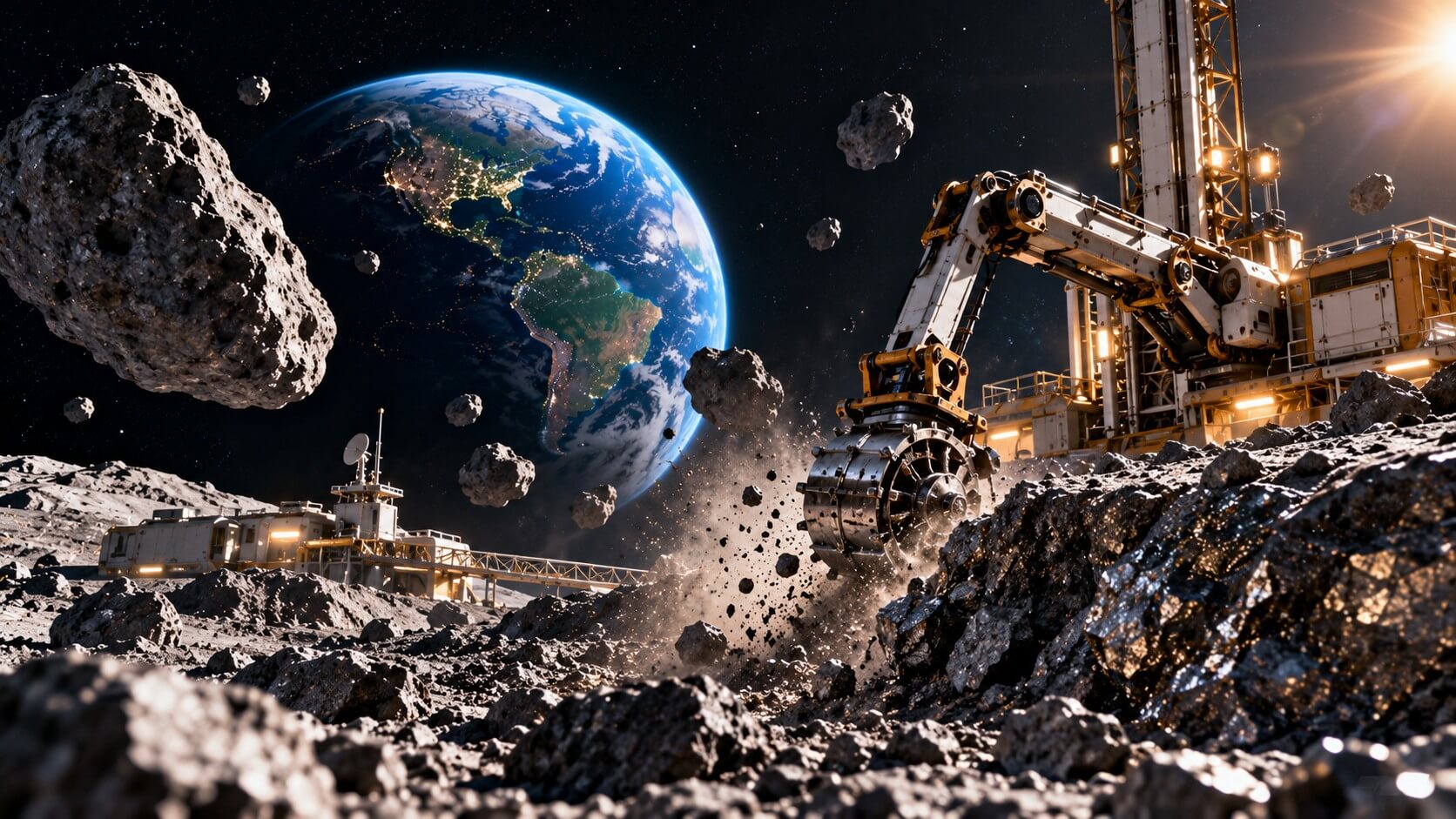
Space mining is real as a field of scientific research and commercial development, but large-scale commercial mining operations on asteroids or the Moon do not yet exist. Companies and space agencies are developing technologies that could eventually extract water, metals, and other useful materials beyond Earth. The challenge is turning those ambitions into technically reliable and economically viable operations.
For investors, the distinction matters. Space mining could become part of the future space economy, supporting lunar exploration, spacecraft refueling, and potentially the use of valuable resources. However, most of the opportunity remains speculative, with major technological, financial, and legal obstacles still unresolved.
What Is Space Mining?
Space mining means extracting useful materials from objects beyond Earth, particularly asteroids and the Moon. Instead of transporting every resource from our planet, future space missions could obtain some of the materials they need directly in space.
There are three main areas of interest:
- Lunar mining: Extracting water ice, oxygen-bearing materials, and other resources from the Moon.
- Asteroid mining: Investigating asteroids for metals, including iron, nickel, and potentially precious metals.
- Space resource utilization: Processing materials found in space to produce water, oxygen, fuel ingredients, construction materials, or other supplies.
These activities are related, but they do not have the same commercial purpose. Mining water on the Moon could help support astronauts and future lunar infrastructure. Extracting metals from an asteroid, by contrast, could require more complex machinery, transportation, and processing systems.
The most practical early applications may involve using resources in space rather than bringing them back to Earth.
Is Space Mining Actually Happening Today?
Not in the way most people imagine it. No company has demonstrated a sustained, industrial-scale commercial mining operation on an asteroid or the Moon that produces and sells extracted resources.
However, important groundwork has already been completed.
NASA's OSIRIS-REx mission returned material from asteroid Bennu to Earth in 2023. Japan's Hayabusa and Hayabusa2 missions also returned asteroid samples for scientific study. These missions demonstrate that spacecraft can reach small celestial bodies, interact with their surfaces, collect material, and transport samples back to Earth.
They do not demonstrate that commercial mining is profitable. Collecting small scientific samples is fundamentally different from extracting, processing, and transporting large quantities of material at a competitive cost.
Meanwhile, lunar exploration programs are investigating resources that could eventually support longer stays on the Moon. Water ice is particularly interesting because it could provide drinking water, support life-support systems, and potentially be processed into hydrogen and oxygen.
The technology is advancing, but the transition from scientific missions and technology demonstrations to a functioning mining industry remains a major step.
Why Are Companies Interested in Mining the Moon and Asteroids?
The business case depends on what can be extracted, how much it costs, and who would buy the resulting materials.
Water Could Be More Valuable Than Gold in Space
Water is one of the most important potential resources because transporting supplies from Earth is expensive. If a future lunar base could obtain usable water locally, it might reduce the amount of material that missions would need to launch from Earth.
Water could also be separated into hydrogen and oxygen, which are used in some rocket propellants. Producing these materials in space could eventually support refueling infrastructure, although doing so would require substantial investment in extraction, purification, storage, and transportation.
The key economic question is whether locally produced resources would cost less than delivering equivalent supplies from Earth.
Metals Could Support Construction in Space
Asteroids contain naturally occurring metals and minerals. Some have compositions that include iron and nickel, while certain types may contain platinum-group elements.
These materials could theoretically be useful for manufacturing equipment or constructing infrastructure in space. However, extracting them would require machines capable of operating in extreme environments, processing raw material with limited human intervention, and functioning reliably for extended periods.
Returning metals to Earth presents a separate challenge: the revenue from selling them would have to exceed the costs of reaching the asteroid, extracting the material, transporting it, and bringing it through Earth's atmosphere.
Scientific Value Is Not the Same as Commercial Value
An asteroid can contain enormous quantities of a particular metal without being an attractive mining target.
A resource becomes commercially valuable only when it can be extracted and delivered to a buyer at an acceptable cost. The amount present in an asteroid is therefore only one part of the equation.
This distinction is central to understanding the industry's prospects. Space mining may eventually create valuable businesses, but the existence of resources does not guarantee that anyone can profitably recover them.
Which Companies Are Working on Space Mining?
Space mining involves a mixture of private companies, technology developers, and government-supported research. Some organizations have pursued resource-extraction concepts directly, while others are developing technologies that could support future operations.
The sector is still emerging, and not every company associated with lunar exploration or asteroid missions is actually a mining company. It is also important to distinguish active ventures from historical projects that no longer operate independently.
For a closer look at the organizations involved, including their projects and commercial ambitions, see Which Companies Are Working on Space Mining? A Look at the Players.
One important distinction for investors is whether a business has demonstrated technology, secured funded contracts, or merely announced a long-term concept. Those are very different stages of commercial development.
How Close Are We to Space Mining?
The answer depends on what counts as mining.
Small-scale experiments, resource prospecting, and technology demonstrations are much closer to reality than continuous commercial extraction. Recovering a sample during a scientific mission is possible today, while establishing a reliable operation that produces useful resources at a competitive price remains a much harder problem.
Lunar resource extraction may have a more immediate practical purpose than bringing precious metals from asteroids back to Earth. A lunar operation could supply nearby missions, avoiding some of the costs associated with transporting resources from Earth.
Asteroid mining for valuable metals faces additional uncertainties, including the choice of target, extraction methods, transportation requirements, and the availability of customers.
The likely development path involves incremental demonstrations rather than a sudden transition to large-scale mining. To understand the technical milestones and possible timeframes, read How Close Are We to Space Mining? The Timeline for Asteroid and Lunar Mining.
Is Space Mining Legal?
Space mining raises legal questions that do not arise in quite the same way in conventional mining on Earth.
The 1967 Outer Space Treaty establishes a framework for the exploration and use of outer space. It prevents countries from claiming sovereignty over the Moon or other celestial bodies through national appropriation. However, the treatment of extracted resources has become a subject of legal and diplomatic debate.
Some countries have adopted national laws that recognize rights to resources obtained from space, while international discussions continue over how resource extraction should be governed in practice.
For commercial operators, legal uncertainty can affect mission planning, investment decisions, ownership claims, and cooperation between countries.
A company cannot assume that finding a resource automatically gives it unrestricted rights to exploit the surrounding celestial body. The legal framework and the practical rules governing future operations remain important considerations.
For a closer examination of the relevant treaties, national laws, and unresolved questions, see Is Space Mining Legal? What the Law Says About Mining Asteroids and the Moon.
Are There Valuable Metals in Space?
Yes. Asteroids contain a variety of naturally occurring materials, including metals that are useful in industry. Some asteroid types are particularly interesting to researchers because of their metallic composition.
The Moon also contains useful materials, although its resource potential differs from that of metallic asteroids. Lunar exploration focuses on materials such as oxygen-bearing minerals and potentially accessible water ice, alongside other elements that could support future operations.
Reports about the enormous theoretical value of asteroid metals can be misleading. A calculation based on the total amount of a metal in an asteroid does not establish how much could actually be extracted or what the material would sell for.
If a large quantity of a precious metal were delivered to Earth, the additional supply could also affect its market price. Revenue cannot be estimated simply by multiplying the total quantity present by today's market price.
For a more detailed explanation of what researchers know about precious metals and other resources beyond Earth, read Is There Gold in Space? What Asteroids and the Moon Actually Contain.
Is SpaceX Planning to Mine Asteroids?
SpaceX plays an important role in the broader space economy through launch services and the development of reusable rockets. Lowering launch costs could help make future space-resource missions more practical.
However, the fact that a company develops rockets capable of carrying equipment into space does not mean that it is already operating a mining business or has demonstrated commercial asteroid extraction.
Potential future involvement in asteroid mining must be distinguished from an operational mining program. Public statements, corporate plans, and long-term ambitions are not equivalent to demonstrated extraction technology, established customers, or profitable resource production.
It is therefore important to evaluate SpaceX's documented activities and Elon Musk's statements separately from speculation about what the company might eventually do.
For a closer look at the evidence, see Is SpaceX Working on Asteroid Mining? What Elon Musk Has Actually Said and Done.
Will Space Mining Ever Be Profitable?
Space mining could become profitable in specific circumstances, but profitability is not established today.
The strongest early business cases may involve supplying resources to customers already operating in space. For example, if a lunar base requires water or oxygen, producing these resources locally could eventually be more practical than repeatedly transporting them from Earth.
The economics depend on several factors:
- Launch costs: How much does it cost to send mining equipment and supporting infrastructure into space?
- Extraction technology: Can the equipment recover useful quantities of material reliably?
- Processing costs: How much energy and machinery are required to turn raw material into a usable product?
- Transportation: Can the extracted resources reach customers without excessive expense?
- Demand: Are there enough customers willing to pay for the material?
- Financing and risk: How much capital must be committed before the operation generates revenue?
These variables interact. A reduction in launch costs would help, but it would not automatically make an extraction system reliable or guarantee a market for its output.
The business case for supplying water to a lunar operation is also different from the case for returning precious metals to Earth. Each requires its own cost estimates, customer assumptions, and assessment of technical risk.
For a deeper look at the financial challenges, read Will Asteroid Mining Ever Be Profitable? The Economics Behind the Hype.
How Much Could Space Resources Be Worth?
The theoretical value of space resources can be enormous, but headline valuations should be treated cautiously.
An asteroid may contain large amounts of metals, yet only a fraction might be accessible. Extracting those materials could require years of development, substantial capital, specialized equipment, and complex transportation systems.
Market prices introduce another complication. A business that brings a large quantity of a rare metal to market could influence the price it receives. The value of an entire asteroid cannot therefore be calculated reliably by applying today's metal prices to every estimated kilogram of material.
The same principle applies to lunar resources. Water ice could have considerable practical value if it can be extracted economically and sold to customers who need it. Its value would depend on location, purity, processing requirements, and the cost of delivering it to the point of use.
These uncertainties explain why estimates of potential resource wealth are not equivalent to forecasts of company revenue or investor returns.
For a more detailed breakdown of resource valuations and their limitations, see How Much Is an Asteroid Worth? The Value of Space Resources Explained.
What Space Mining Means for Investors
For investors, space mining is best understood as a long-term, high-risk area of the emerging space economy rather than an established commercial industry.
The opportunity may extend beyond companies that intend to extract resources directly. Launch providers, spacecraft manufacturers, robotics developers, communications companies, and businesses supplying equipment for lunar missions could all play roles in a future resource-extraction ecosystem.
However, benefiting from growth in the space industry does not necessarily mean benefiting from space mining itself. A company can generate revenue from launch services or satellite operations without ever becoming involved in resource extraction.
Investors evaluating the sector should distinguish between several categories:
Established space businesses: Companies already generating revenue from launches, satellites, or related services. Their existing operations may provide a basis for valuation, although their exposure to space mining could be limited or nonexistent.
Technology developers: Businesses working on robotics, propulsion, prospecting, or resource-processing systems. Their prospects depend on technical progress, contracts, financing, and the eventual market for their products.
Early-stage space-mining ventures: Companies pursuing resource extraction directly. These may offer greater exposure to the theme, but they can also face substantial funding requirements, uncertain timelines, and a high risk of commercial failure.
The most important questions are whether a company has a credible technical plan, sufficient financing, identifiable customers, and a realistic path toward generating cash flow.
Announcements, ambitious targets, and estimates of asteroid wealth are not substitutes for demonstrated commercial progress. Investors should also remember that private companies may be inaccessible to ordinary stock-market investors, while publicly traded companies may have only limited exposure to the space-mining opportunity.
Is Space Mining a Real Investment Opportunity Today?
Space mining is real as a technological ambition and an area of active research, but it has not yet become a mature mining industry.
The distinction between scientific progress and commercial success is essential. Missions can demonstrate that resources exist, spacecraft can reach them, and samples can be recovered. A profitable business must go further: it needs repeatable extraction, reliable transportation, customers, and revenue that exceeds its costs.
The next meaningful milestones are likely to involve better resource mapping, successful extraction demonstrations, practical uses for locally obtained materials, and evidence that customers are willing to pay for them.
For now, space mining offers investors a possible long-term growth theme, not a proven source of earnings. Its eventual importance will depend on whether advances in space transportation and resource-processing technology can turn a compelling scientific idea into an economically sustainable business.
Financial disclaimer: This article is for informational and educational purposes only and does not constitute investment advice. Space-related investments can be highly speculative and may result in substantial losses. Conduct independent research before making investment decisions.