
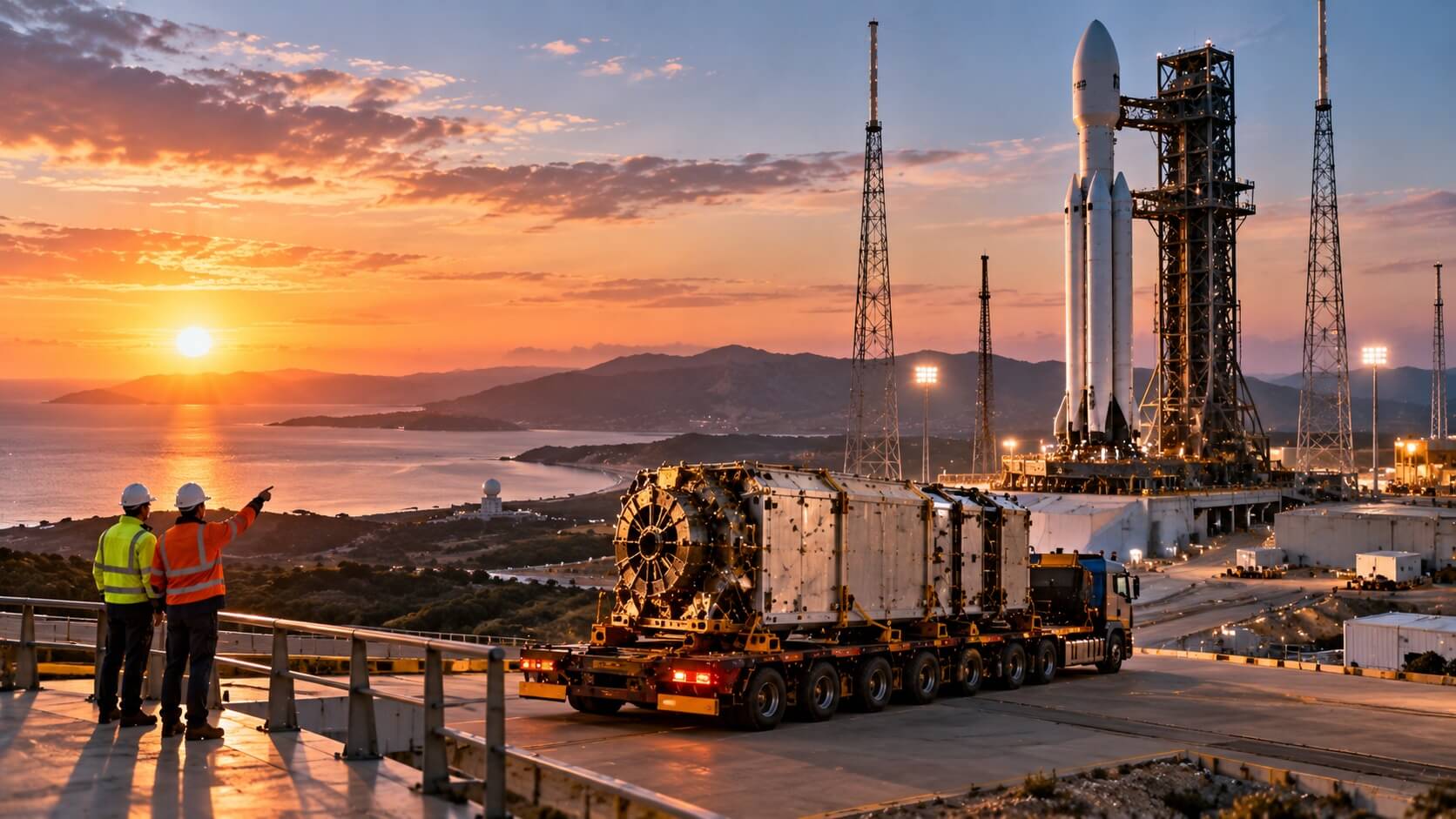
SpaceX is not currently operating an asteroid mine, and there is no publicly demonstrated SpaceX mission dedicated to extracting precious metals from asteroids. However, asteroid mining has been discussed as a potential long-term opportunity associated with the expansion of economic activity beyond Earth, while Elon Musk has emphasized developing the transportation and infrastructure needed for humanity to become multiplanetary.
The distinction matters. SpaceX launched NASA's Psyche spacecraft toward a metal-rich asteroid, and its Starship program is intended to make transporting large amounts of cargo beyond Earth more practical. But launching an asteroid mission is not the same as mining an asteroid.
For investors, SpaceX's connection to space mining is best understood through its transportation technology, its plans for using resources on Mars, and potential future markets rather than an established asteroid-extraction business.
Is SpaceX Actually Mining Asteroids?
No. As of October 2026, SpaceX has not publicly demonstrated a commercial asteroid-mining operation that extracts, processes, and sells resources.
The company's established activities include rocket launches, spacecraft development, satellite communications, and human spaceflight. Its Starship program aims to expand transportation capabilities to the Moon, Mars, and potentially other destinations.
SpaceX has also discussed the longer-term need for resource extraction, manufacturing, and infrastructure beyond Earth, particularly in connection with permanent human settlements. However, these possibilities should not be confused with operational asteroid-mining projects.
A functioning asteroid-mining business would require capabilities beyond launching spacecraft:
- Identifying asteroids containing economically useful resources.
- Sending specialized equipment to the selected targets.
- Extracting and processing materials in low gravity.
- Transporting the recovered resources to customers.
- Generating enough revenue to cover development and operating costs.
SpaceX has demonstrated important launch and spacecraft capabilities, but it has not publicly established this complete commercial mining process.
For a broader explanation of the industry's current development, read Is Space Mining Real? What Investors Should Know About Mining Asteroids and the Moon.
What Has Elon Musk Actually Said About Space Mining?
Elon Musk has consistently emphasized making humanity a multiplanetary civilization. His long-term vision involves establishing a sustainable human presence beyond Earth, particularly on Mars.
That vision has important implications for the use of space resources.
A permanent settlement on another planet would need access to materials for life support, fuel production, construction, and industrial activity. Transporting every necessary resource from Earth indefinitely would be expensive and logistically difficult.
SpaceX's published Mars ambitions describe the need for activities such as resource mining, propellant production, power generation, construction, and transportation to support a permanent settlement.
This is evidence of an interest in using resources beyond Earth, but it is not the same as announcing a dedicated commercial asteroid-mining operation.
Does Elon Musk Want to Mine Asteroids?
Asteroid mining fits within the broader concept of expanding industrial activity into space, but Musk's most clearly documented operational priorities have focused on reusable rockets, Starship, and establishing a human presence on Mars.
Asteroid mining has appeared in discussions of possible future opportunities connected with a larger space economy. However, that should not be interpreted as confirmation that SpaceX has committed to a specific asteroid-mining project.
There is no publicly demonstrated SpaceX commercial asteroid-mining system, and no established production timetable for extracting metals from asteroids.
The distinction is important because public discussions of future industries are not equivalent to funded operational programs.
A company can recognize asteroid mining as a potential market without committing to becoming a mining operator itself.
Is Musk More Interested in Mars Than Asteroid Mining?
Musk's publicly stated long-term objective has centered on making human life multiplanetary, with Mars occupying a central role.
SpaceX's Mars plans involve developing transportation systems and supporting the infrastructure required for settlements.
Resource extraction is relevant because a permanent settlement would need to obtain some materials locally. For example, SpaceX has discussed producing rocket propellant using resources available on Mars.
That is a different business concept from extracting platinum or gold from an asteroid and returning it to Earth.
One involves using resources to support operations in space. The other involves recovering commodities for sale in terrestrial markets.
Both may eventually become part of the space economy, but they face different technical requirements and commercial incentives.
Has SpaceX Ever Sent a Mission to an Asteroid?
Yes. SpaceX launched NASA's Psyche spacecraft on October 13, 2023, using a Falcon Heavy rocket from Kennedy Space Center in Florida.
The spacecraft is traveling toward asteroid 16 Psyche, a metal-rich object located in the main asteroid belt between Mars and Jupiter.
NASA's mission is designed to investigate the asteroid's composition, structure, and geological history. The spacecraft is scheduled to arrive at the asteroid in 2029.
This mission is important for scientific research because Psyche may provide clues about the formation of rocky planets and the early solar system.
However, the Psyche mission is not a commercial mining operation.
SpaceX provided the launch service. NASA is responsible for the scientific mission, which is managed through NASA's Jet Propulsion Laboratory.
Why Is the Psyche Mission Associated With Asteroid Mining?
Asteroid 16 Psyche has attracted considerable public attention because observations suggest that it contains substantial amounts of metal.
Some media reports have assigned extraordinary theoretical values to the asteroid by estimating the market value of its potential metal content.
These calculations are highly speculative. The asteroid's precise composition is not fully established, and there is no demonstrated commercial system capable of extracting and transporting its resources to Earth.
The Psyche mission is intended to improve scientific understanding, not to establish the asteroid's commercial value or begin extracting metals.
For investors, the important distinction is that SpaceX's participation demonstrates its ability to provide launch services for deep-space missions. It does not demonstrate that the company is mining valuable metals.
Could Starship Make Asteroid Mining Possible?
Starship could eventually become an important transportation system for resource-related missions beyond Earth.
SpaceX is developing Starship and its Super Heavy booster as a reusable transportation system intended to carry large amounts of cargo to Earth orbit, the Moon, Mars, and potentially other destinations.
Transporting equipment into space is one of the major costs associated with developing future mining operations.
If Starship achieves its intended capabilities and economics, it could help reduce the cost of deploying spacecraft, robotics, processing equipment, and other infrastructure.
However, cheaper transportation would solve only part of the problem.
Why Lower Launch Costs Matter
Mining equipment must first be transported from Earth before it can begin operating on an asteroid or the Moon.
Lower launch costs could make it easier to send larger machines, additional supplies, and replacement equipment.
This could also allow companies to conduct more exploration missions and technology demonstrations.
However, the total cost of a mining project would still include spacecraft development, navigation, extraction equipment, processing systems, energy supply, and transportation of the recovered resources.
A cheaper rocket does not automatically make asteroid mining profitable.
Could Starship Transport Mining Equipment?
In principle, a spacecraft with substantial cargo capacity could support the deployment of mining equipment or related infrastructure.
But asteroid missions have different requirements from ordinary launches to Earth orbit.
A mining spacecraft might need to travel for months or years, rendezvous with a small celestial body, operate in extremely low gravity, and return useful materials.
Starship's potential contribution would therefore depend on mission design, its demonstrated capabilities, and the development of additional specialized systems.
There is no basis for assuming that Starship alone would provide everything necessary to operate an asteroid mine.
Is SpaceX Interested in Mining Resources on Mars?
SpaceX's published Mars vision includes the use of local resources to support future settlements.
One particularly important application involves producing rocket propellant.
Starship uses liquid methane and liquid oxygen. Mars has an atmosphere containing carbon dioxide, and accessible water resources could potentially provide hydrogen for methane production.
With suitable processing equipment and sufficient energy, carbon dioxide and water could be used to produce methane and oxygen through chemical processes.
This approach is known as in-situ resource utilization, or ISRU, meaning the use of materials found at the destination rather than transporting everything from Earth.
However, the production of propellant at the scale required for sustained Mars operations has not yet been demonstrated on Mars.
Why Would Mars Resource Extraction Matter?
Returning spacecraft from Mars would require substantial amounts of propellant.
Transporting all the fuel needed for return missions from Earth would add mass, cost, and logistical complexity.
Producing propellant locally could reduce some of these requirements, although the necessary industrial systems would need to be deployed, powered, maintained, and demonstrated.
This is why resource utilization is relevant to SpaceX's long-term plans.
However, a system designed to produce fuel for spacecraft is not the same as a commercial mine extracting precious metals for sale.
Its primary purpose would be to support transportation and settlement infrastructure rather than generate revenue from commodity exports.
Could SpaceX Mine Gold or Platinum From Asteroids?
There is no publicly demonstrated SpaceX program dedicated to extracting gold or platinum from asteroids.
Some asteroids contain metals, including iron, nickel, and potentially precious metals. Their composition makes them scientifically interesting and creates theoretical opportunities for future resource extraction.
However, the presence of valuable materials does not guarantee that mining them would be economically practical.
A company would need to identify an asteroid with sufficiently concentrated resources, develop reliable extraction equipment, process the material, and transport it to a market.
Returning precious metals to Earth would introduce substantial transportation costs and market risks.
If asteroid mining eventually delivers large quantities of a precious metal, the additional supply could also affect its market price.
For a closer examination of the resources that actually exist beyond Earth, read Is There Gold in Space? What Asteroids and the Moon Actually Contain.
Which Companies Are More Directly Involved in Asteroid Mining?
While SpaceX provides transportation technology that could support future space-resource operations, other companies are developing projects more directly focused on extracting materials.
AstroForge, for example, has pursued technology intended to reach asteroids and eventually recover valuable metals. Its Odin mission in 2025 encountered communication difficulties, illustrating the challenges of deep-space operations.
TransAstra has worked on concepts involving asteroid capture and resource-handling systems.
Karman+ has pursued an approach focused on extracting asteroid resources that could support activities in space, including potential propellant-related applications.
These businesses differ from SpaceX because resource extraction is more central to their proposed commercial models.
However, their technologies and business plans remain subject to substantial technical and financial uncertainty.
A successful spacecraft mission or technology demonstration does not necessarily establish that commercial mining is viable.
For a broader comparison of companies developing asteroid and lunar resource technologies, read Which Companies Are Working on Space Mining? A Look at the Players.
Could SpaceX Benefit From Asteroid Mining Without Mining Asteroids?
Yes. SpaceX could potentially benefit from a growing space-resource industry even if it never becomes a mining operator.
A future asteroid-mining company would need transportation services to deploy spacecraft, equipment, and supporting infrastructure.
If commercial space-resource activity expands, launch providers could become important suppliers to that industry.
SpaceX could potentially generate revenue by transporting equipment or supporting missions without assuming the full financial and technical risks of extracting resources.
This is a different business model from owning and operating a mine.
Transportation Versus Resource Extraction
Consider two hypothetical companies.
The first builds rockets and charges customers to transport mining equipment into space.
The second finances an asteroid mission, extracts metals, and attempts to sell the recovered material.
The transportation company could earn revenue from a launch contract even if the mining operation ultimately fails.
The mining company would depend much more directly on successful extraction, processing, transportation, and commodity sales.
Of course, transportation providers also face significant risks, including mission failures, competition, and changes in customer demand.
But the example illustrates why companies supporting a new industry may have different commercial opportunities from companies attempting to develop its most speculative technologies.
What Would SpaceX Need to Do to Become an Asteroid Mining Company?
If SpaceX eventually decided to operate asteroid mines directly, it would need to develop or acquire capabilities beyond its existing launch and spacecraft activities.
These would include resource prospecting, specialized extraction equipment, processing technology, and systems for transporting and delivering recovered materials.
It would also need to establish a business model.
Would the company sell precious metals on Earth? Supply water or propellant to spacecraft? Provide mining services to other operators?
Each approach would require different customers, equipment, financing, and operating strategies.
A serious commercial mining program would be supported by evidence such as dedicated missions, funded development projects, extraction demonstrations, and agreements with potential customers.
Until such evidence emerges, investors should distinguish between long-term possibilities and actual operating businesses.
What Does SpaceX's Interest in Space Mining Mean for Investors?
SpaceX's broader ambitions highlight the possibility that future economic activity could extend well beyond satellites and launch services.
Resource extraction might eventually support lunar infrastructure, Mars settlements, spacecraft refueling, and industrial operations in space.
However, this does not mean asteroid mining is already a meaningful source of revenue for SpaceX.
Investors should distinguish between three levels of exposure.
Existing operations: Launch services, satellite communications, spacecraft development, and other activities with identifiable customers and commercial operations.
Enabling technologies: Reusable rockets, large cargo spacecraft, and transportation systems that could support future resource-related missions.
Speculative future opportunities: Asteroid mining, extraterrestrial resource processing, and other industries that may require substantial additional technological and commercial development.
These categories should not be valued as though they carry the same level of certainty.
A company may become highly successful in launch services without ever developing a profitable mining operation. Conversely, an emerging mining industry could eventually create new demand for transportation and infrastructure.
The relevant investment questions concern demonstrated technology, actual contracts, capital requirements, commercial demand, and the likelihood that future activities will generate sustainable earnings.
Is SpaceX Likely to Become an Asteroid Mining Company?
SpaceX has the transportation expertise and long-term ambitions that could make it an important participant in future space-resource activities.
Its development of Starship, involvement in deep-space launches, and plans for resource utilization on Mars demonstrate how its technology could support industrial activity beyond Earth.
Asteroid mining remains a possible future market associated with the expansion of space infrastructure. However, recognizing such an opportunity is not equivalent to establishing an operational mining program.
There is currently insufficient publicly demonstrated evidence to conclude that SpaceX is preparing to begin commercial asteroid extraction on a specific timetable.
The company may eventually provide launch services to mining businesses, develop resource-processing technology for its own missions, pursue direct extraction, or focus on other commercial priorities.
For investors, the most meaningful evidence would be dedicated mining missions, working extraction systems, customers, and a credible path toward profitability.
Until then, SpaceX should be understood primarily through its established and developing space transportation and communications businesses, with asteroid mining remaining a speculative long-term possibility.
Financial disclaimer: This article is for informational and educational purposes only and does not constitute investment advice. Space-related investments can be highly speculative and may result in substantial losses. Conduct independent research before making investment decisions.