
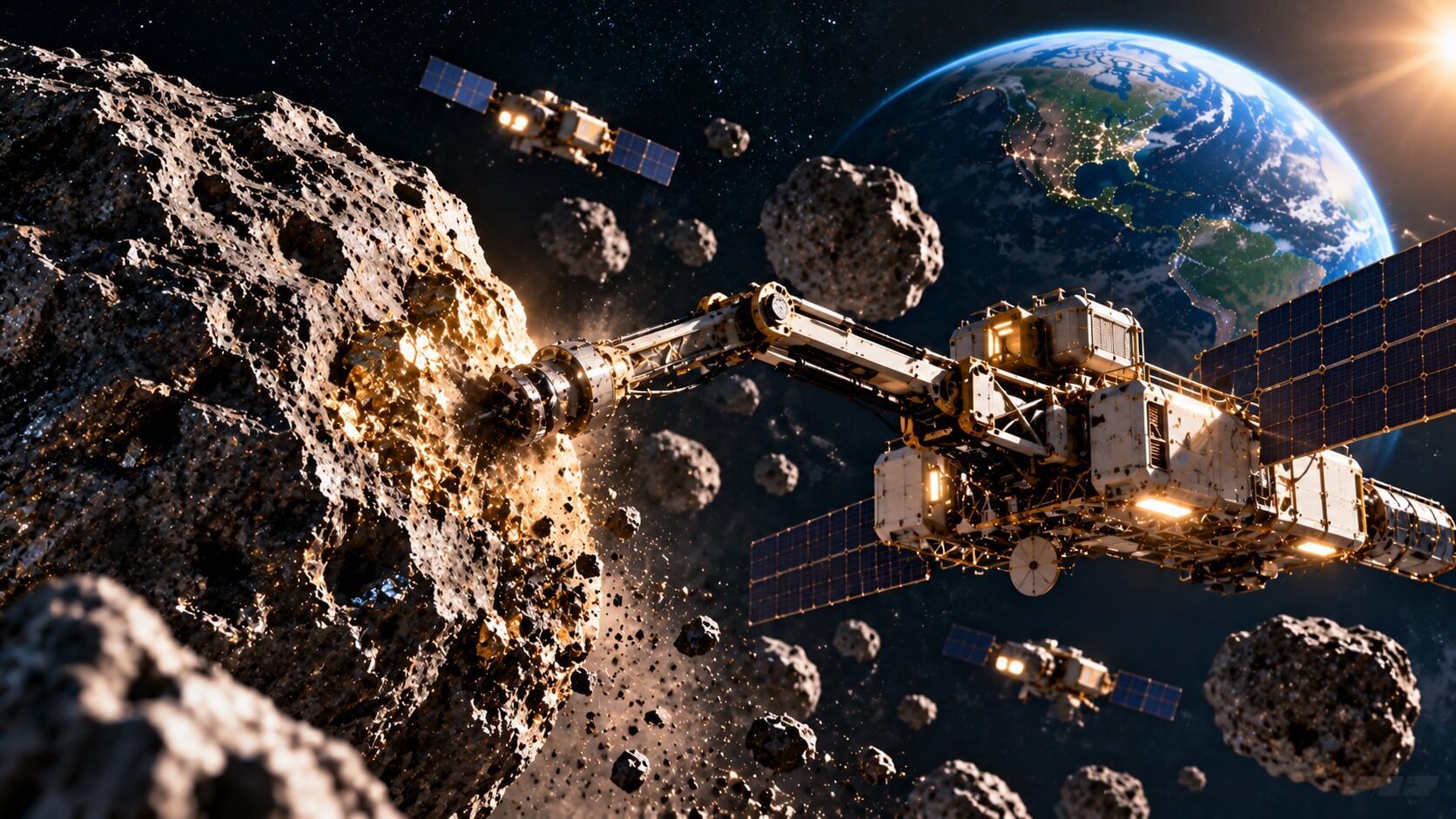
Which Companies Are Working on Space Mining? A Look at the Players
Several companies are developing technologies for asteroid and lunar mining, but commercial extraction of space resources is not yet an established industry. Some businesses are targeting metals in asteroids, while others are exploring water, helium-3, or the infrastructure needed to operate on the Moon.
Among the companies worth following are AstroForge, TransAstra, Karman+, Interlune, ispace, and Lunar Outpost. Their business models differ substantially, and progress in exploration or transportation should not be confused with profitable resource extraction.
To understand the opportunities and limitations of the sector as a whole, start with Is Space Mining Real? What Investors Should Know About Mining Asteroids and the Moon.
Which Companies Are Developing Asteroid Mining Technology?
AstroForge: Targeting Metals in Asteroids
AstroForge is one of the most direct examples of a company attempting to turn asteroid mining into a commercial business. Founded in 2022, the US startup is developing spacecraft and technologies intended to identify, reach, and eventually extract valuable metals from asteroids.
Its focus includes platinum-group metals, a family of elements that includes platinum, palladium, and rhodium. These metals have established industrial applications, making them an interesting target for a business seeking to supply resources to Earth.
AstroForge has pursued multiple spacecraft missions to develop its deep-space capabilities. Its Odin mission launched in February 2025 with the objective of investigating asteroid 2022 OB5. The spacecraft encountered communication and operational difficulties, preventing the mission from achieving its intended scientific objectives.
The company has continued developing its next mission, DeepSpace-2, as part of its longer-term asteroid exploration strategy. However, planned missions should not be confused with completed demonstrations of asteroid mining.
The critical limitation is that reaching an asteroid is only the first step. AstroForge still needs to demonstrate that it can identify commercially suitable resources, extract useful quantities of material, and deliver them economically. Its commercial mining model therefore remains unproven.
For investors, AstroForge represents relatively direct exposure to the asteroid-mining theme, but it is also a highly speculative private venture. Its shares are not available through ordinary stock-market trading.
TransAstra: Developing Technology to Capture Asteroids
TransAstra is another US company working on technologies that could support asteroid resource extraction. Rather than focusing exclusively on selling metals, its approach includes systems for identifying, capturing, and handling small celestial bodies.
One of its concepts involves an inflatable capture system designed to enclose asteroids or other objects. Such technology could eventually help operators handle material in space and move it to locations where it could be processed.
The company's work is relevant because asteroid mining requires more than a drilling machine. Operators must first identify a suitable target, reach it, secure the material, and manage the extracted resources in a difficult environment.
TransAstra has also pursued technology development through NASA-supported programs. However, research funding and demonstrations do not establish that a complete commercial mining system is operational.
Its potential business opportunity extends beyond the sale of extracted resources to the infrastructure and services that might enable a future space-resource industry.
Karman+: Exploring Asteroid Resources for Space Fuel
Karman+ is pursuing an approach focused on extracting resources from asteroids for use in space, particularly water and materials that could support propellant production.
This is an important distinction from the idea of bringing gold or platinum back to Earth. Water obtained from an asteroid could potentially support spacecraft, orbital infrastructure, or future refueling operations if it could be processed and delivered at a competitive cost.
The concept depends on the emergence of customers that need supplies in space. If spacecraft and infrastructure eventually require large quantities of propellant, locally sourced resources could become valuable.
However, that demand must develop alongside the extraction technology. The proposed systems must demonstrate reliable recovery and processing of material, while the wider space economy must provide customers willing to pay for the output.
Karman+ therefore represents a potential infrastructure and resource-supply business rather than a proven commercial mining operator.
Which Companies Are Working on Lunar Mining?
Asteroid mining receives considerable attention because of the potential value of metals, but the Moon may offer a more practical starting point for certain space-resource applications.
The Moon is much closer to Earth than most potential asteroid-mining targets, and future lunar missions could create demand for locally produced water, oxygen, and construction materials. Several companies are developing technologies that could support these activities.
Interlune: Targeting Helium-3 on the Moon
Interlune is a US startup pursuing the extraction of helium-3 from lunar soil.
Helium-3 is a rare isotope of helium on Earth. It has potential applications in specialized scientific and industrial fields, and it is also discussed in connection with possible future fusion-energy systems. However, commercially viable fusion using helium-3 is not an established energy industry.
Interlune's concept involves processing lunar material to recover helium-3. This would require equipment capable of collecting and handling lunar soil, separating the desired isotope, and operating in the Moon's harsh environment.
The potential market is an important uncertainty. Even if extraction technology works, the company would need customers willing to pay enough to cover the substantial costs of lunar operations.
Investors should distinguish between the existence of helium-3 on the Moon and the much more difficult challenge of producing and selling it profitably.
ispace: Building Infrastructure for Lunar Exploration
ispace is a Japanese lunar transportation and exploration company developing lunar landers, rovers, and related technologies.
Its business is not limited to extracting resources. It aims to provide transportation and infrastructure that can help customers reach and explore the Moon.
That capability could be relevant to future mining because resource extraction requires equipment to be delivered to the lunar surface before operations can begin. Rovers and exploration systems could also help investigate terrain and identify promising locations.
Unlike many space-mining startups, ispace is publicly traded on the Tokyo Stock Exchange under securities code 9348. This gives investors access to a company participating in the lunar economy, although its shares do not provide pure exposure to lunar mining.
Its commercial prospects depend on mission execution, customer demand, financing, and the development of a wider lunar services market. Lunar transportation and resource extraction remain separate stages of the industry's development.
Lunar Outpost: Developing Rovers and Surface Systems
Lunar Outpost develops robotic mobility systems and technologies intended for lunar exploration and operations.
Rovers could become important components of future mining operations because they can transport instruments, inspect terrain, collect samples, and help move equipment across the lunar surface.
These systems are enabling technologies rather than mines in their own right. A rover manufacturer could benefit from growing lunar activity even if another company ultimately owns and operates the extraction equipment.
Lunar Outpost remains a private company. Its technologies offer potential exposure to lunar infrastructure development, but its shares are not listed on a public stock exchange.
This distinction matters when assessing commercial opportunities. Companies that supply essential infrastructure may have different revenue models and risks from businesses that depend on successfully extracting and selling lunar resources.
Which Other Companies Could Support Space Mining?
A future space-mining industry would need more than companies that directly extract materials. It would also depend on launch vehicles, lunar landers, robotics, spacecraft, communications, and systems capable of operating in space for long periods.
Several businesses operate in these adjacent areas.
Intuitive Machines: Delivering Payloads to the Moon
Intuitive Machines is a US space company involved in lunar transportation and exploration missions.
Its lunar lander services can help deliver scientific instruments and other payloads to the Moon. Such delivery capabilities could eventually support resource prospecting, technology demonstrations, and the deployment of equipment required for extraction.
Intuitive Machines is publicly traded on Nasdaq under the ticker LUNR. However, its stock primarily represents exposure to its space infrastructure, lunar transportation, and related operations rather than an established mining business.
Revenue from transportation services depends on contracts and mission execution, while a mining business would also need to establish a commercially viable resource supply chain.
Astrobotic: Lunar Delivery and Exploration
Astrobotic develops lunar landers and related technologies intended to transport payloads to the Moon.
These services could support companies seeking to test instruments or investigate potential resources. Before a mining operation can be established, operators need to understand where useful materials are located and whether they can be accessed.
Astrobotic's relevance is therefore primarily as a potential infrastructure provider, not as an established lunar mining operator. Mission execution and technical reliability remain important factors in evaluating its progress.
Firefly Aerospace: Supporting Lunar Missions
Firefly Aerospace develops launch and space transportation systems, including technology for delivering payloads to the lunar surface.
Its Blue Ghost lunar lander program demonstrates the company's role in lunar transportation and exploration infrastructure. These capabilities could help support missions designed to investigate lunar resources and deploy future equipment.
Firefly Aerospace became a publicly traded company in August 2025 and trades on Nasdaq under the ticker FLY. Investors can therefore obtain exposure to its broader launch and spacecraft operations through publicly traded shares.
However, Firefly should not be described as an established lunar mining company. Its business is focused on space transportation, spacecraft, and mission services. Any benefit from a future mining industry would depend on actual contracts and demand.
These companies illustrate why the commercial space economy could expand without every participant becoming a mining company.
Is SpaceX a Space Mining Company?
SpaceX is one of the most important businesses in the broader space industry because of its launch services and reusable rocket technology. Reducing the cost of transporting equipment into space could eventually make resource-extraction missions more feasible.
However, SpaceX should not automatically be classified as an operating asteroid-mining company. Launching spacecraft and extracting resources are different activities.
Even when asteroid mining appears in discussions of potential future business opportunities, that does not demonstrate that SpaceX has established a commercial extraction operation or proven the economics of recovering asteroid materials.
The distinction between documented operations, future plans, and speculation is particularly important for investors.
For a closer examination of the company's activities and Elon Musk's position, read Is SpaceX Working on Asteroid Mining? What Elon Musk Has Actually Said and Done.
Can Investors Buy Stock in Space Mining Companies?
The answer depends on the company and whether the investment provides direct or indirect exposure to resource extraction.
Several businesses pursuing space-resource technologies remain privately held. These include ventures such as AstroForge, TransAstra, Interlune, and Lunar Outpost. Shares in private companies generally cannot be purchased through an ordinary brokerage account, although specialized investment arrangements may sometimes provide access.
Other companies discussed in this article are publicly traded:
- ispace (Tokyo Stock Exchange: 9348): Lunar transportation, landers, and exploration infrastructure.
- Intuitive Machines (Nasdaq: LUNR): Lunar transportation, exploration, and space infrastructure.
- Firefly Aerospace (Nasdaq: FLY): Launch services, spacecraft systems, and lunar transportation.
But there is an important qualification: owning shares in a space company does not necessarily mean investing directly in space mining.
A publicly traded company might earn most of its revenue from lunar transportation, launch services, or other activities unrelated to extracting resources. Its stock price may therefore respond primarily to those existing businesses rather than to future mining opportunities.
Before investing, consider:
- Direct exposure: Does the company actually develop extraction technology, or does it simply provide transportation or equipment?
- Commercial progress: Has it demonstrated a working system, or is it still developing a concept?
- Funding requirements: How much additional capital could be needed before commercial operations begin?
- Customers: Are there signed contracts and identifiable buyers for the resources or services?
- Time horizon: How many technical and commercial milestones must be completed before meaningful revenue is possible?
- Public-market access: Is the company publicly traded, privately held, or accessible only through specialized investment arrangements?
These questions are more useful than simply identifying which companies use the term space mining in their marketing.
How Close Are These Companies to Commercial Space Mining?
The companies in this sector are at different stages of development. Some are designing spacecraft to reach asteroids, others are developing lunar exploration systems, and others provide transportation or technologies that could support future resource extraction.
None of these activities should be confused with operating a mature commercial mine.
The next milestones to watch include successful missions to resource-rich targets, demonstrations of extraction and processing technology, reliable delivery of usable materials, and evidence of demand from paying customers.
The sequence matters. A successful spacecraft mission may reduce one technical uncertainty without proving that the entire business model works. Likewise, a failed mission does not necessarily invalidate the entire industry, but it can expose technical risks, delay commercialization, and increase financing requirements.
For a more detailed assessment of the technical milestones and likely development stages, read How Close Are We to Space Mining? The Timeline for Asteroid and Lunar Mining.
Which Space Mining Companies Are Worth Watching?
There is no single obvious winner because the companies are pursuing different resources, customers, and business models.
AstroForge is worth following for its direct focus on asteroid metals and its ongoing spacecraft development. TransAstra and Karman+ are pursuing technologies related to asteroid handling and resource use. Interlune is targeting lunar helium-3, while ispace and Lunar Outpost are building capabilities relevant to lunar exploration and infrastructure.
Transportation providers such as Intuitive Machines, Astrobotic, and Firefly Aerospace could also play supporting roles if lunar operations expand.
For investors, the most important question is not which company has the most ambitious vision. It is which businesses can demonstrate technical progress, secure sustainable financing, establish real customer demand, and eventually generate revenue that exceeds their costs.
Space mining remains an emerging industry with substantial uncertainty. The companies developing its foundations may create valuable technologies, but their eventual success will depend on much more than the theoretical abundance of resources beyond Earth.
Financial disclaimer: This article is for informational and educational purposes only and does not constitute investment advice. Space-related investments can be highly speculative and may result in substantial losses. Conduct independent research before making investment decisions.