
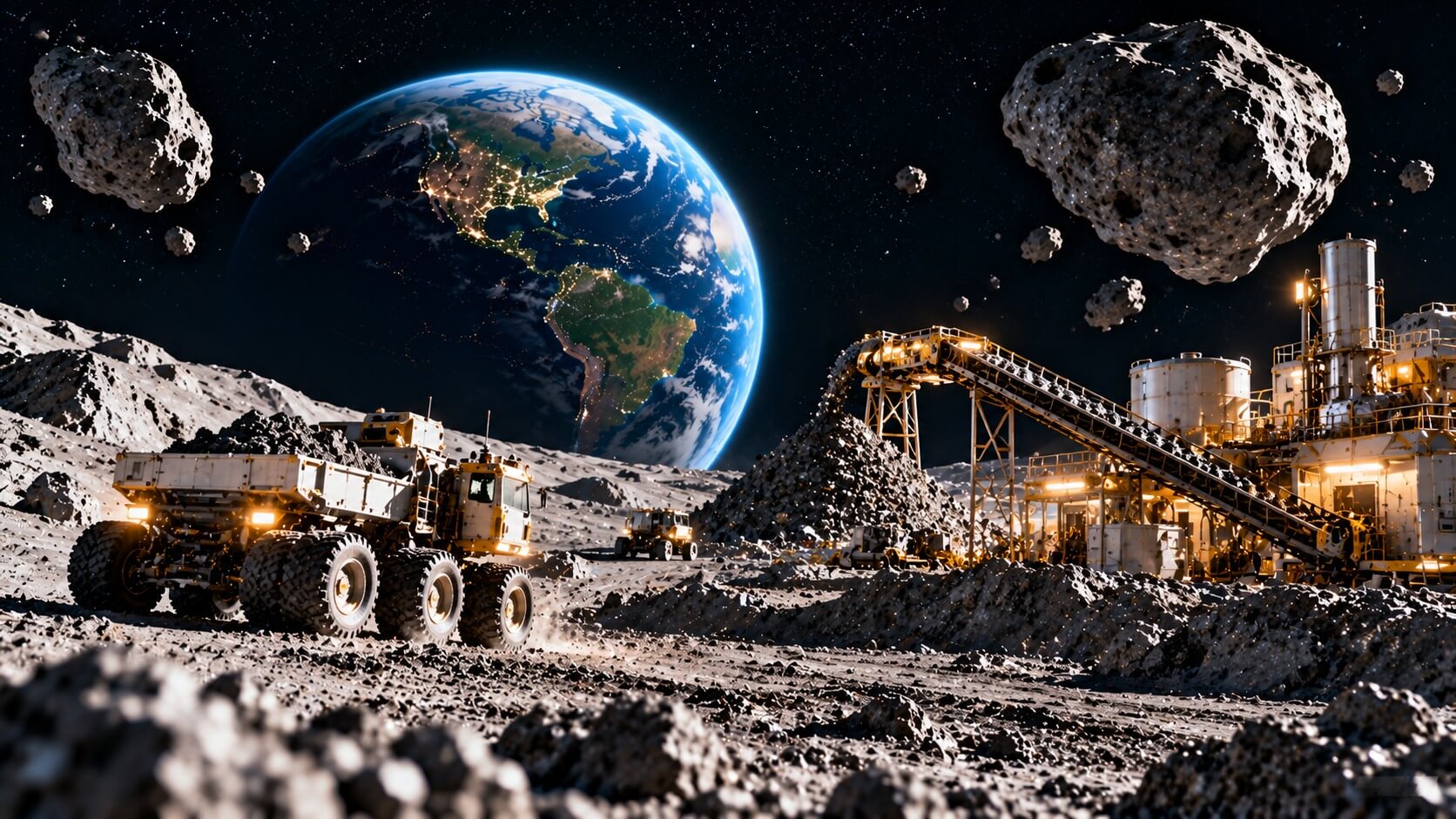
How Close Are We to Space Mining? The Timeline for Asteroid and Lunar Mining
Space mining is moving from scientific exploration toward increasingly ambitious technology demonstrations, but commercial mining of asteroids and the Moon is not yet an established industry. Space agencies have returned asteroid samples, explored lunar resources, and developed technologies that could eventually support extraction beyond Earth.
The key question is not simply whether useful materials exist in space. It is how soon companies could recover those resources repeatedly, process them into useful products, and deliver them to paying customers at an economically viable cost.
Lunar mining and asteroid mining may develop on different timelines because they involve different resources, technical challenges, and potential customers.
How Close Are We to Mining Resources in Space?
Several important capabilities have already been demonstrated, including landing spacecraft on the Moon, collecting asteroid samples, and analyzing extraterrestrial materials. However, these achievements do not mean that large-scale resource extraction is ready for commercial deployment.
Scientific sample collection, resource prospecting, and industrial mining are distinct stages. A spacecraft returning a small amount of asteroid material provides valuable scientific evidence, but a mining business must also establish reliable production, transportation, customer demand, and a sustainable cost structure.
For an overview of the industry's current status and investment considerations, see Is Space Mining Real? What Investors Should Know About Mining Asteroids and the Moon.
Could Lunar Mining Happen Before Asteroid Mining?
Lunar resource extraction may offer some of the earliest practical opportunities because the Moon is relatively accessible and future exploration missions could create demand for locally produced supplies.
Water ice is a major area of interest, particularly in permanently shadowed regions near the lunar poles. If usable deposits can be located, extracted, and processed, water could support astronauts, life-support systems, and potentially the production of rocket propellant ingredients.
Lunar soil also contains oxygen-bearing minerals and materials that could potentially support construction or manufacturing.
However, the existence of these resources does not establish that they can be recovered economically. Operators must determine their concentration, accessibility, physical properties, and processing requirements.
What Must Happen Before Lunar Mining Becomes Commercial?
Several technical and commercial milestones remain necessary:
- Resource mapping: Identifying deposits with sufficient detail to support extraction planning.
- Surface operations: Demonstrating that equipment can operate reliably in lunar dust, extreme temperatures, and challenging terrain.
- Extraction and processing: Recovering usable water, oxygen, or other materials under actual lunar conditions.
- Storage and distribution: Delivering the resulting products to customers in a usable form.
- Commercial demand: Establishing customers willing to pay enough to support the cost of operations.
Some of these technologies can be tested separately, but a commercially viable operation would need to integrate them into a reliable system.
Future lunar bases and transportation networks could create demand, although their scale and development schedules remain uncertain.
How Close Are We to Asteroid Mining?
Asteroid mining faces a different set of challenges. Asteroids can contain valuable metals and other materials, but they are small, remote targets with uncertain surface conditions and compositions.
Reaching an asteroid and collecting a sample are already demonstrated capabilities. NASA's OSIRIS-REx mission returned material from asteroid Bennu in September 2023, bringing back approximately 121.6 grams of rocks and dust. This was an important scientific achievement, but the mission was designed to collect samples, not to mine commercial quantities of resources.
Japan's Hayabusa and Hayabusa2 missions also demonstrated asteroid sample-return capabilities. Together, these missions provide valuable knowledge about asteroid surfaces and spacecraft operations.
Commercial asteroid mining would require a much more complex system capable of extracting and processing far larger quantities of material.
Why Asteroid Mining Takes Longer
Several challenges make asteroid mining difficult to commercialize.
Finding the right asteroid. Not every asteroid contains resources worth extracting. Companies must identify suitable targets, estimate their composition, and determine whether the material can be accessed.
Operating in microgravity. Many asteroids have extremely weak gravity. Conventional mining methods designed for Earth may not work as expected, and equipment must be able to collect and contain material without simply pushing itself away from the surface.
Processing the material. Extracting a metal from rock is not the same as producing a saleable product. A mining system may need substantial energy, specialized machinery, and additional processing equipment.
Transporting the output. If resources are intended for Earth, they must be returned safely. If they are intended for use in space, transportation and storage systems must deliver them to customers where they are needed.
These challenges mean that a successful asteroid mission is only one milestone in a much longer development process.
Could Asteroid Mining Begin With Water Instead of Precious Metals?
Potentially. Water may be useful for supporting spacecraft and future space infrastructure, while some asteroids contain metals that could have industrial value.
The most attractive resource will depend on the location of the deposit and the availability of customers. Water could be useful if a nearby space operation needs it, whereas platinum-group metals would need a viable processing and sales strategy.
This distinction is important because the most valuable resource on paper may not be the most profitable one to extract.
A Realistic Timeline for Space Mining
There is no reliable, universally accepted date for when commercial space mining will begin. The timeline depends on technical progress, funding, government programs, launch costs, and the development of paying customers.
Rather than assigning precise dates to uncertain milestones, it is more useful to consider the stages that must be completed.
Stage 1 — Exploration and Sample Collection
Status: Demonstrated for selected missions.
Spacecraft have reached asteroids and returned samples to Earth. Lunar missions have also collected and analyzed surface materials. These achievements establish important scientific and engineering capabilities, but not commercial mining.
Stage 2 — Resource Prospecting and Extraction Demonstrations
Status: Research and technology development.
Missions must determine where useful deposits exist and test equipment that can collect and process resources under real space conditions. Progress in one environment does not automatically establish that a technology will work on another celestial body.
Stage 3 — Small-Scale Resource Production
Status: A major future milestone.
Operators would need to demonstrate repeatable production of usable materials, together with reliable storage and delivery systems.
Producing a small experimental quantity would be meaningful, but commercial viability would require evidence that output can be increased without costs becoming prohibitive.
Stage 4 — Commercial Operations
Status: Not yet established at industrial scale.
Mining becomes a sustainable business only when customers pay for the output and revenue can support operating expenses, equipment replacement, financing, and future development.
The stages will not necessarily happen in a simple sequence. Different companies could make progress at different speeds, and lunar resource operations could develop independently of asteroid mining.
The key milestone is not the announcement of a future mining mission. It is evidence that useful materials can be produced repeatedly and delivered at a competitive cost.
Which Companies Could Reach Space Mining First?
The companies developing space-mining technology are pursuing different strategies. Some focus on asteroid metals, others on lunar resources, and others on the transportation and robotics required for future operations.
For example, AstroForge is pursuing asteroid-mining technology, while Interlune is developing a concept for extracting helium-3 from lunar soil. Companies such as ispace and Intuitive Machines focus on lunar transportation and exploration capabilities that could support future resource-related missions.
These businesses are at different stages of development, and their goals should not be interpreted as proof that commercial mining is imminent.
For a closer look at their projects, business models, and investment considerations, read Which Companies Are Working on Space Mining? A Look at the Players.
For investors, the distinction between a company developing enabling technology and one capable of producing saleable resources is essential. A successful lander or prospecting mission may create commercial opportunities, but it does not automatically establish a profitable mining business.
What Could Speed Up the Timeline?
Several developments could accelerate progress.
Lower Launch and Transportation Costs
Mining equipment must first be transported to its destination. More affordable and reliable launches could reduce one part of the cost, making more ambitious missions financially possible.
However, launch costs are only one component of the economics. Extraction, processing, energy supply, maintenance, and transportation of the finished material must also be considered.
Better Robotics and Autonomous Systems
Mining equipment in space must operate with limited direct human intervention. Communications delays, extreme temperatures, dust, and difficult terrain make autonomous systems particularly important.
More reliable robotics could reduce the need for human involvement and improve the chances of sustained operations.
A Growing Market for Resources in Space
Space mining becomes more attractive if there are customers who need resources beyond Earth.
Future lunar bases, spacecraft, and orbital infrastructure could create demand for water, oxygen, propellant ingredients, and construction materials. Without sufficient demand, even a technically successful extraction operation might struggle to generate revenue.
Government Support and Commercial Contracts
Government agencies can support technology development through research funding, demonstrations, and contracts for lunar transportation or other services.
Such support can reduce some development risks, but it does not guarantee that a company will eventually become profitable. Investors need to distinguish between funded research, signed commercial contracts, and revenue generated from completed operations.
What Could Delay Space Mining?
Progress could take longer than expected if extraction equipment proves unreliable, resource deposits are harder to access than anticipated, or launch and operating costs remain too high.
Other obstacles include limited financing, delays in government missions, unclear commercial demand, and uncertainty over the rules governing the extraction and use of space resources.
These challenges are interconnected. A delay in a lunar exploration program could postpone the arrival of customers, while a lack of customers could make it harder for companies to secure financing.
There is also a difference between a technology being physically possible and being economically useful. A company might successfully extract a small amount of water from lunar soil without demonstrating that it can produce enough to justify the cost of its equipment.
For investors, these uncertainties make it risky to base a valuation on a single projected launch date or an ambitious long-term target.
When Could Space Mining Become Profitable?
The first commercial applications may emerge before large-scale asteroid mining becomes possible, but there is no dependable date for profitability.
A small operation supplying water or other materials to customers in space could have a different economic model from a large operation attempting to bring precious metals back to Earth.
Profitability will depend on the resource, the extraction method, the cost of transportation, the quantity produced, and the price customers are willing to pay.
A company could demonstrate a working mining system and still lose money if production costs exceed the value of its output.
For a detailed explanation of the financial assumptions, cost structure, and potential business models, read Will Asteroid Mining Ever Be Profitable? The Economics Behind the Hype.
What the Timeline Means for Investors
Space mining is a long-term technological opportunity, not an established commercial industry. The difference between today's capabilities and future mining operations is substantial, and the development timeline remains uncertain.
Investors should pay attention to measurable milestones rather than relying on distant projections. Useful indicators include successful resource prospecting, extraction demonstrations, funded contracts, customer demand, and evidence that a company can produce materials at a commercially viable cost.
It is also important to understand what a company actually sells today. A launch provider or spacecraft manufacturer may benefit from increasing space activity without earning any revenue from mining itself.
Private mining ventures may offer more direct exposure to the theme but can also carry significant financing and execution risks. Publicly traded companies may be easier to access, yet their existing businesses could have little direct connection to resource extraction.
The central question is whether a company can convert technical progress into a repeatable commercial service or product. Until that happens, projected market sizes and resource valuations remain possibilities rather than established earnings.
Space mining may eventually become an important part of the space economy, but its development is likely to involve years of technical demonstrations, investment, and commercial experimentation. The companies that succeed will need more than access to valuable resources: they will need a practical way to extract, deliver, and sell them.
For the broader picture of the industry's current capabilities and long-term prospects, read Is Space Mining Real? What Investors Should Know About Mining Asteroids and the Moon.
Financial disclaimer: This article is for informational and educational purposes only and does not constitute investment advice. Space-related investments can be highly speculative and may result in substantial losses. Conduct independent research before making investment decisions.