
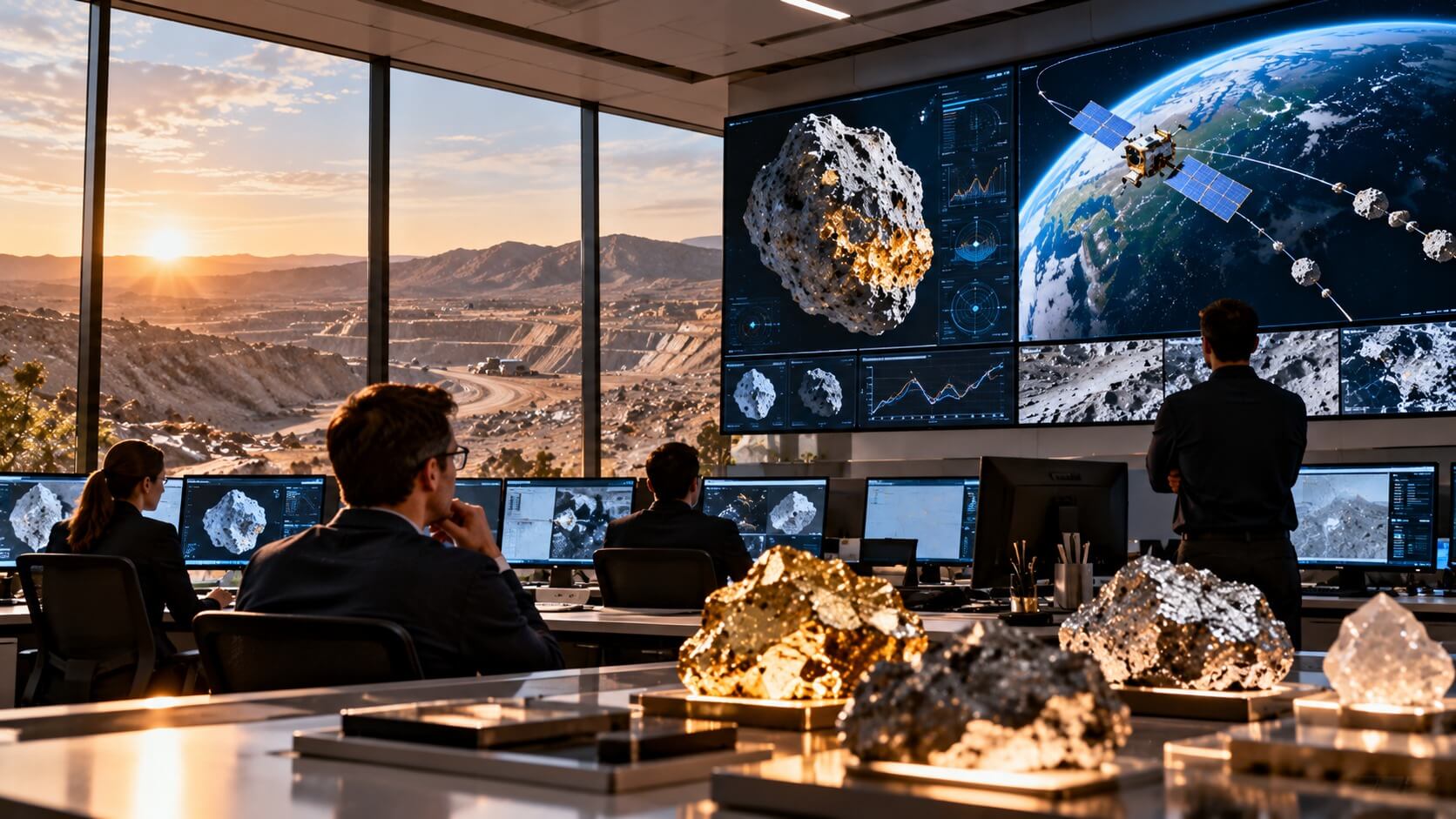
Yes, gold exists in space, including in some asteroid materials. Gold is a naturally occurring element formed through extreme cosmic events, and traces of it can be found in material that formed the planets, moons, and asteroids of our solar system.
However, finding gold in space is very different from discovering a deposit that can be mined profitably. Scientists know that asteroids contain metals, but the precise amount of gold in most individual asteroids remains unknown. The Moon also contains small quantities of gold, although there is currently no evidence of accessible lunar gold deposits that would support commercial mining.
For investors, the important distinction is between the presence of valuable materials and the ability to extract and sell them economically.
Where Does Gold in Space Come From?
Gold did not originate on Earth. Like many heavy elements, it was created through nuclear processes associated with extreme events in the universe.
One important source is the collision of neutron stars, incredibly dense objects left behind after certain massive stars collapse. These collisions can produce conditions that allow heavy elements, including gold, to form.
Some rare types of stellar explosions may also contribute to the production of heavy elements.
Over billions of years, material containing these elements became part of the gas and dust clouds from which new stars, planets, and smaller celestial bodies formed.
When our solar system developed approximately 4.6 billion years ago, some of this material became incorporated into Earth, the Moon, and asteroids.
This means gold is not unique to Earth. It is distributed throughout the solar system, although its concentration varies considerably between different objects.
Do Asteroids Really Contain Gold?
Yes. Gold and other precious metals occur in extraterrestrial materials, including certain meteorites associated with asteroids. However, the concentrations in individual asteroids are often poorly constrained. Iron and nickel are much better established as major components of some metal-rich asteroids.
However, asteroids differ greatly in composition. Some consist mainly of rocky materials, others contain substantial amounts of carbon-rich compounds, and some are dominated by metallic materials.
Scientists generally classify asteroids into several broad compositional groups.
Metallic Asteroids
Metal-rich asteroids are particularly interesting for potential mining operations.
They are often associated with high concentrations of iron and nickel. Depending on their composition and history, they may also contain smaller quantities of precious metals, including gold and platinum-group elements.
Some metallic asteroids may represent fragments of differentiated parent bodies disrupted by collisions during the early history of the solar system, although the origins and compositions of individual objects can be more complex.
These objects attract attention because their metal content could be significantly different from that of ordinary surface rocks on Earth.
However, a high concentration of iron and nickel does not automatically mean an asteroid contains economically attractive quantities of gold.
Rocky Asteroids
Rocky asteroids contain silicate minerals and varying amounts of metals.
Although they may contain gold and other valuable elements, their composition can make extraction more complicated. Metals may be distributed throughout the rock rather than concentrated in easily accessible deposits.
The presence of a valuable element does not necessarily mean it can be recovered efficiently.
Carbon-Rich Asteroids
Carbon-rich asteroids contain materials associated with the early solar system, including carbon-bearing compounds and, in some cases, water-bearing minerals.
These objects are especially interesting for scientific research and the potential extraction of water.
Their value for future space operations may come more from water and other useful materials than from precious metals.
How Much Gold Is in an Asteroid?
There is no reliable single answer because asteroids vary enormously in size and composition.
A small asteroid may contain only trace amounts of gold, while a much larger object could theoretically contain substantial quantities.
Scientists can estimate an asteroid's overall composition using observations, spectroscopy, spacecraft measurements, and comparisons with meteorites found on Earth.
However, these methods do not usually provide an exact measurement of the total gold contained in a particular asteroid.
Even when researchers identify a metal-rich object, several questions remain unanswered:
- What percentage of its mass consists of gold?
- Is the gold concentrated in particular areas or dispersed throughout the material?
- How much of it could be recovered using practical mining equipment?
- How much energy would extraction require?
- Would the recovered material be worth more than the cost of the operation?
These uncertainties make precise claims about the gold content of individual asteroids difficult to justify.
Can Scientists Estimate the Amount of Gold?
Scientists can develop estimates based on an asteroid's mass and assumed composition.
For example, if researchers have evidence that an asteroid contains certain metals, they can use models to estimate how much of those materials might be present.
But these calculations depend heavily on assumptions.
A small error in the estimated concentration of gold can produce a large difference in the total quantity when applied to an enormous asteroid.
An estimate of total metal content is therefore not equivalent to a verified mineral reserve.
On Earth, mining companies typically conduct extensive geological investigations before treating a deposit as commercially recoverable. Similar levels of confidence are generally unavailable for most asteroids.
Is There Gold on the Moon?
Gold has been detected in analyses of lunar materials at trace concentrations, but this is not evidence of a commercially mineable deposit.
The Moon contains a variety of elements found on Earth, including iron, titanium, aluminum, magnesium, and traces of precious metals.
Scientific analysis of lunar samples has helped researchers understand the Moon's composition and geological history.
However, the presence of gold in lunar rocks does not mean that commercially attractive gold deposits have been identified.
How Much Gold Is on the Moon?
The total amount of gold on the Moon is not known with sufficient precision to provide a reliable figure.
The Moon is an enormous geological body, so even very low average concentrations of gold could imply a substantial total quantity when considered across its entire mass.
But that theoretical quantity is not the same as an accessible deposit.
Much of the material could be distributed in extremely low concentrations or located deep below the surface.
For mining purposes, what matters is not the total amount of gold contained within the Moon but whether particular deposits are sufficiently concentrated, accessible, and economical to extract.
At present, there is no established commercial lunar gold-mining industry.
What Resources Are More Important on the Moon?
Although gold attracts attention, other lunar resources may have more practical applications.
Water ice is especially interesting because it could support astronauts and potentially provide ingredients for rocket propellant.
Oxygen-bearing minerals could eventually help produce oxygen for life support or industrial processes.
Iron, aluminum, and titanium could support manufacturing or construction if suitable extraction and processing technologies become available.
These resources may be useful even without being transported back to Earth.
That distinction matters because avoiding transportation costs could make local resource use more practical than returning precious metals to terrestrial markets.
What About Asteroid 16 Psyche?
Asteroid 16 Psyche is one of the best-known examples of a metal-rich asteroid.
Located in the main asteroid belt between Mars and Jupiter, Psyche has attracted scientific interest because observations suggest it contains substantial amounts of metal.
NASA launched its Psyche spacecraft in October 2023 to investigate the asteroid and learn more about its composition, structure, and geological history. The spacecraft is scheduled to arrive in 2029; the mission has not yet directly measured the asteroid at close range.
The mission is designed for scientific exploration, not commercial mining.
Is Psyche Really Worth Trillions of Dollars?
Popular reports have sometimes assigned extraordinary theoretical values to Psyche by multiplying assumed quantities of metals by their market prices on Earth.
These calculations should not be treated as realistic commercial valuations.
First, the asteroid's exact composition is not fully established. Its total metal content cannot simply be assumed to consist of precious metals such as gold or platinum.
Second, the cost of extracting and transporting material from the asteroid would be enormous with current technology.
Third, selling very large quantities of a metal could significantly change its market price.
An asteroid's theoretical material value is therefore not equivalent to the revenue a mining company could generate.
For a detailed explanation of asteroid valuations and why headline figures can be misleading, read How Much Is an Asteroid Worth? The Value of Space Resources Explained.
Could We Bring Gold From Asteroids Back to Earth?
In principle, yes. There is no known physical law preventing spacecraft from extracting material from an asteroid and transporting it to Earth.
However, the technical and economic challenges are substantial.
A commercial operation would need to locate a suitable asteroid, reach it, extract the desired material, process or concentrate it, and transport the product safely to Earth.
Each stage requires specialized equipment, energy, and reliable spacecraft systems.
Why Would Returning Gold Be Difficult?
The main challenge is not simply reaching an asteroid.
Mining equipment would need to operate in extremely low gravity, where conventional excavation methods may not work effectively.
The machinery would also need to function autonomously for extended periods, potentially far from Earth.
After extraction, the company would need to transport the material back to Earth and recover it safely.
All of these activities would add costs that terrestrial gold-mining operations do not face in the same form.
Would Asteroid Gold Be Cheaper Than Gold From Earth?
Not necessarily.
Earth already has established mining infrastructure, transportation networks, refining facilities, and global markets for gold.
A space-mining company would need to compete against these existing operations while paying for spacecraft, launch services, extraction systems, and material recovery.
Even if an asteroid contained a large quantity of gold, the company might not be able to recover it at a competitive cost.
The possibility of extracting gold from space is scientifically plausible, but its commercial attractiveness remains unproven.
Is SpaceX Planning to Mine Gold From Asteroids?
SpaceX is frequently associated with discussions about asteroid mining because of its reusable rocket technology and ambitious plans for space transportation.
Lower launch costs could eventually help make resource-extraction missions more practical.
However, SpaceX's established business focuses on launch services, spacecraft, satellite communications, and related infrastructure. These activities should not be confused with a demonstrated commercial program to mine gold from asteroids.
Elon Musk's interest in space exploration does not automatically establish that SpaceX intends to extract precious metals.
For a closer examination of SpaceX's documented activities and Musk's statements, read Is SpaceX Working on Asteroid Mining? What Elon Musk Has Actually Said and Done.
Could Asteroid Gold Change the Global Gold Market?
Potentially, but only if asteroid mining eventually becomes capable of delivering commercially significant quantities of gold to Earth.
Gold prices depend on supply, demand, investor behavior, central-bank activity, and broader economic conditions.
If space mining introduced a substantial new source of gold, the additional supply could influence market expectations and prices.
However, the outcome would depend on how much gold was delivered, how quickly production expanded, and how buyers responded.
A small amount of asteroid gold would not necessarily have a meaningful impact on the global market.
A much larger and sustained increase in supply could create greater pressure on prices, although the exact effect would be difficult to predict.
There is also an economic contradiction: if an asteroid-mining company dramatically increased the available supply of gold, it could reduce the market value of the very product it was trying to sell.
This is one reason why theoretical estimates of asteroid wealth should not be interpreted as forecasts of future mining profits.
What Does Gold in Space Mean for Investors?
For investors, the existence of gold in space is scientifically interesting, but it does not establish an immediate investment opportunity.
The most important question is whether companies can develop commercially viable methods to identify, extract, process, and transport valuable resources.
A company might successfully demonstrate asteroid exploration technology without ever generating revenue from precious metals.
Similarly, businesses involved in launch services, spacecraft manufacturing, or lunar exploration could benefit from increasing space activity without directly participating in gold extraction.
Investors should distinguish between three stages of development.
Scientific discovery: Researchers identify potentially valuable materials and improve their understanding of celestial bodies.
Technological demonstration: Companies test spacecraft, robotics, and extraction equipment to establish whether resources can be recovered.
Commercial production: Operators extract and sell materials at prices sufficient to cover their costs and support a sustainable business.
These stages are not interchangeable.
The discovery of a metal-rich asteroid does not prove that mining it is feasible, and a successful extraction demonstration does not automatically establish profitability.
For a broader explanation of the industry's current development and long-term prospects, read Is Space Mining Real? What Investors Should Know About Mining Asteroids and the Moon.
Is Gold the Most Valuable Resource in Space?
Not necessarily.
Gold is valuable on Earth because of its physical properties, industrial applications, use in jewelry, and role as a financial asset.
In space, however, a resource's value may depend more heavily on where it is needed and how difficult it is to transport from Earth.
Water could be extremely useful for a lunar base or a future refueling operation. Oxygen could support astronauts and industrial activities. Metals such as iron and aluminum could eventually provide materials for construction.
A resource that is relatively inexpensive on Earth might become economically important in space if producing it locally avoids substantial transportation costs.
This means the first successful space-mining businesses may not focus on precious metals at all.
They may instead supply practical materials to customers operating beyond Earth.
Is There Enough Gold in Space to Make Mining Worthwhile?
Gold exists beyond Earth, and some asteroids may contain substantial quantities of it. However, scientists do not yet have enough information to establish how much gold could be commercially recovered from most potential mining targets.
The existence of a resource is only the beginning of the economic calculation.
A viable mining operation must identify accessible deposits, develop reliable extraction technology, transport the resulting material, and sell it at a price that covers its costs.
For now, asteroid gold remains a potential long-term resource rather than an established source of commercial supply.
The more immediate opportunities in space-resource development may involve water, oxygen, and other materials that can support future missions without requiring transportation back to Earth.
For investors, the most meaningful developments will be successful extraction demonstrations, credible cost estimates, and evidence of actual customer demand—not enormous theoretical valuations based on the assumed metal content of distant asteroids.
Financial disclaimer: This article is for informational and educational purposes only and does not constitute investment advice. Space-related investments can be highly speculative and may result in substantial losses. Conduct independent research before making investment decisions.