
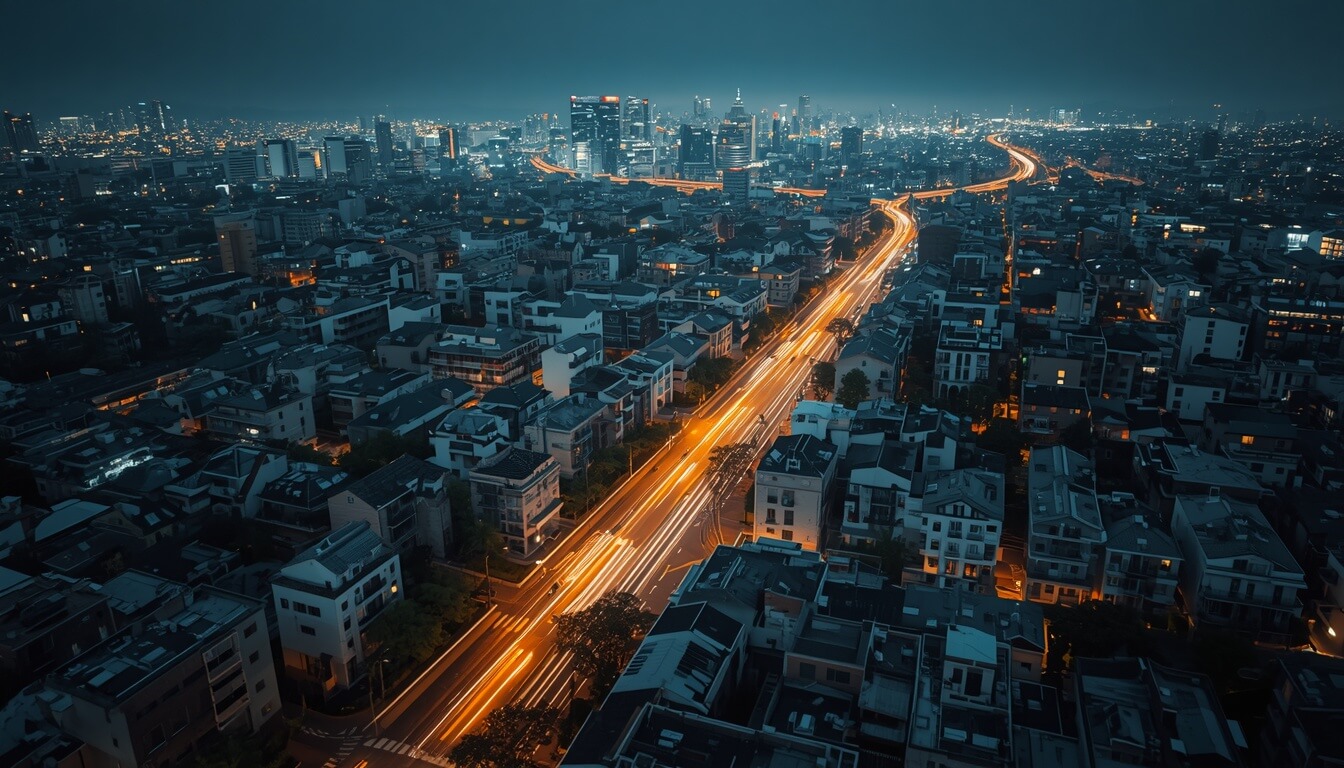
Urbanization is more than a demographic shift. As increasing numbers of people live in cities and metropolitan regions, the concentration of population changes how homes are built, how people move and how energy is produced and consumed.
The effects of this transformation can already be seen in major urban economies. Housing markets respond to population growth, transportation networks adapt to changing commuting patterns, and electricity systems face new forms of demand from buildings, vehicles and digital infrastructure.
These changes are closely connected. A new residential district requires roads and public transportation, while new transportation infrastructure can influence where people choose to live. The expansion of electric vehicles increases electricity demand, while the development of energy infrastructure can influence where new housing and industrial activity can be located.
The broader demographic transformation behind these trends is examined in The Global Urbanization Wave and the Future of Cities, while the infrastructure requirements created by urban growth are discussed in Why Infrastructure Investment Will Become Critical for Growing Cities.
Housing in an Increasingly Urban World
Housing is likely to be one of the most visible areas affected by continued urbanization.
When populations move toward cities, demand for residential space tends to increase in locations where employment, education, healthcare and other services are concentrated. If housing construction does not expand at a comparable pace, shortages can emerge.
The result can be higher rents, higher property prices or greater competition for available housing.
This dynamic is not limited to rapidly growing emerging-market cities. Established metropolitan areas can also experience housing shortages when population growth, employment concentration and limited land availability combine with constraints on new construction.
Urban housing demand is therefore influenced by several variables simultaneously. Population is one factor, but household size, income growth, migration, employment patterns and the location of jobs also matter. A city adding one million residents does not necessarily require the same type of housing as a city experiencing an increase in smaller households or higher-income professionals.
Density Could Become More Important
Urbanization can encourage higher-density development.
When land near employment centers becomes expensive or scarce, developers may build upward rather than outward. Apartment buildings, mixed-use developments and high-density neighborhoods can accommodate more residents within relatively limited geographic areas.
Higher density can provide economic advantages. More residents living near transportation networks can support frequent public transit services, while shorter distances between homes, workplaces and services can reduce the need for long journeys.
However, density also creates infrastructure requirements. Dense neighborhoods require adequate water, electricity, sewage, roads, public transportation and public services. If these systems are not expanded alongside construction, higher density can increase pressure on existing networks.
Urban planning therefore becomes increasingly important as population concentration rises.
The Continuing Role of Suburban Development
Urbanization does not necessarily mean that all population growth occurs in dense city centers. Metropolitan regions can expand through suburban development, satellite towns and new residential corridors.
Improved transportation can make it possible for people to live farther from central employment areas while maintaining access to jobs. Rail connections, highways and other infrastructure can therefore influence the geographic boundaries of metropolitan economies.
This creates a trade-off:
- Peripheral development can increase the amount of available residential land and potentially reduce some housing pressures.
- At the same time, lower-density development can increase infrastructure costs and transportation demand.
New neighborhoods require roads, utilities, schools and public services. Residents may also travel longer distances, increasing dependence on cars or requiring substantial investment in public transportation.
The future urban landscape is therefore likely to contain a mixture of dense central districts, suburban areas and increasingly connected satellite communities.
Transportation Demand Will Evolve
Transportation is one of the clearest areas where urbanization changes daily economic activity. More people living in metropolitan regions generally means more movement of people and goods. But the type and volume of transportation demand depend heavily on how cities are designed.
A compact city with extensive rail and public transportation networks can accommodate large populations with relatively high transit usage. A sprawling metropolitan region may generate substantially more road traffic and longer average journeys.
This makes transportation infrastructure an important determinant of urban efficiency.
Congestion can impose economic costs by increasing travel times, reducing productivity and making access to employment more difficult. For businesses, unreliable transportation can also complicate logistics and supply chains.
As urban populations increase, governments may therefore focus increasingly on expanding mass transit, improving existing networks and integrating different forms of mobility.
The Shift Toward Multimodal Mobility
The traditional distinction between private cars and public transportation is becoming less clear.
Urban mobility can increasingly involve combinations of trains, buses, bicycles, walking, ride-hailing services, shared vehicles and private cars. Digital platforms can help users combine these options, potentially making transportation networks more flexible.
The expansion of electric vehicles represents another important development. Electrification can change the environmental characteristics of urban transportation while also shifting part of the energy demand associated with mobility from liquid fuels toward electricity.
However, electric vehicles do not eliminate the need for transportation infrastructure. Roads still need to accommodate vehicles, while charging infrastructure needs to be deployed in homes, workplaces, parking facilities and public locations.
In dense urban environments, the availability of charging infrastructure can become particularly important because not every household has access to a private garage.
Public Transportation and Urban Density
The relationship between density and transportation works in both directions.
Dense populations can support public transportation because a large number of potential passengers are concentrated within relatively small areas. At the same time, high-quality transportation can encourage development around stations and major transit corridors.
This can produce transit-oriented development, where housing, offices and commercial services are concentrated around transportation networks.
Such development can reduce the distance between residents and public transportation and potentially support more efficient land use. However, the economic impact depends on local conditions. Building a railway or metro line does not automatically create a high-density urban environment. Planning regulations, land availability, housing costs and employment patterns all influence the outcome.
Energy Demand in Growing Cities
Urbanization is also closely linked to energy consumption.
Cities concentrate buildings, transportation systems, industrial facilities and commercial activity. As urban populations grow, energy demand can increase even when individual technologies become more efficient.
The composition of this demand is changing as well. Buildings increasingly rely on electricity for heating, cooling, lighting, appliances and digital systems. Transportation is gradually becoming more electrified. Industrial processes are also exploring greater use of electricity.
At the same time, digital infrastructure is expanding rapidly. Data centers, telecommunications networks and cloud computing facilities require large quantities of electricity and reliable power supplies. As cities become increasingly digital, these facilities become another component of urban energy demand.
Cooling Could Become a Major Factor
Climate and urbanization can interact through demand for cooling.
Large populations living in densely built environments can generate significant electricity demand for air conditioning, particularly in hot climates. Urban heat-island effects can further increase cooling requirements. Buildings, roads and other structures absorb and retain heat, potentially creating higher temperatures within dense urban areas than in surrounding regions.
This can create a feedback between urban development and electricity consumption:
- As temperatures rise, cooling demand can increase.
- Higher electricity demand can place additional pressure on power grids, particularly during periods of extreme heat.
- The ability of electricity systems to manage these peaks could therefore become increasingly important for urban resilience.
Electrification Changes the Urban Energy System
The growing electrification of transportation and buildings can significantly change the structure of energy demand.
A conventional city may consume large amounts of gasoline, diesel or natural gas across transportation and heating. A more electrified city could shift a greater share of this consumption toward electricity.
This creates both opportunities and challenges. Electricity can be generated from a diverse range of sources, including renewable energy, nuclear power, natural gas and other technologies. Greater electrification can therefore allow energy systems to change the sources supplying urban demand.
But the electricity grid must be capable of handling the additional load. Electric vehicles charging at similar times, for example, can create localized peaks in electricity demand. Large buildings can also generate substantial loads during periods of extreme heat or cold.
Smart charging, energy storage, demand management and grid modernization could become increasingly important tools for managing these changes.
Distributed Energy and the Future of Cities
Urban energy systems may also become more decentralized.
Rooftop solar, batteries, local energy systems and microgrids can allow buildings and neighborhoods to generate or store part of the energy they consume. These technologies will not replace centralized electricity networks, but they can complement them.
Distributed energy may be particularly useful in situations where grid resilience is important. A building equipped with solar generation and battery storage can potentially maintain some level of operation during a wider grid disruption, depending on system design.
For cities, the challenge will be integrating these distributed systems into broader electricity networks. This requires investment in grid management, digital monitoring and regulatory frameworks that allow different sources of generation and storage to operate efficiently.
Housing, Transportation and Energy Are Interconnected
One of the most important characteristics of urbanization is that these trends cannot be considered separately.
Housing decisions influence transportation demand. If new homes are constructed far from employment centers, commuting distances can increase. If housing is concentrated around efficient public transportation, residents may have more alternatives to private vehicles.
Transportation infrastructure can also influence housing markets. Areas connected to reliable rail or road networks can become more attractive for residents and businesses.
Energy infrastructure adds another layer. New residential districts require electricity connections, while electric vehicles increase demand for charging infrastructure. Commercial buildings and data centers can create large electricity loads, potentially influencing the development of local grids.
This means that urban planning increasingly requires coordination between land use, transportation and energy policy.
The Economic Implications
The transformation of urban demand creates opportunities across multiple industries. Construction companies, engineering firms, transportation operators, utilities, energy developers and technology providers can all participate in the expansion and modernization of urban systems.
At the same time, the scale of investment required can create significant financial and regulatory challenges. Cities need to balance affordability with infrastructure costs, economic development with environmental objectives and immediate demand with long-term planning.
The outcome will vary significantly between countries and metropolitan regions. Some cities may focus on expanding mass transportation and high-density housing. Others may continue to grow through suburban development and private vehicle use. Energy systems will also differ depending on local resources, regulation, climate and economic structure.
There is therefore unlikely to be a single global model for the future city.
The Long-Term Urban Transformation
The global urbanization process is ultimately changing the physical structure of economies.
As more people live in cities, housing becomes more important, transportation networks become more complex and electricity systems must accommodate new forms of consumption.
The most significant changes may occur not through one technological breakthrough but through the interaction of many systems.
A new rail line can influence housing development. Housing density can influence electricity demand. Electric vehicles can change transportation and grid requirements simultaneously. Digital infrastructure can create new economic activity while adding another source of electricity consumption.
These interactions make urbanization a long-term economic trend rather than simply a demographic statistic.
The cities that emerge over the coming decades will reflect decisions made today about land use, infrastructure, housing, transportation and energy.
Urbanization will therefore continue to reshape not only where people live, but also how they move, how they consume energy and how economic activity is organized.