
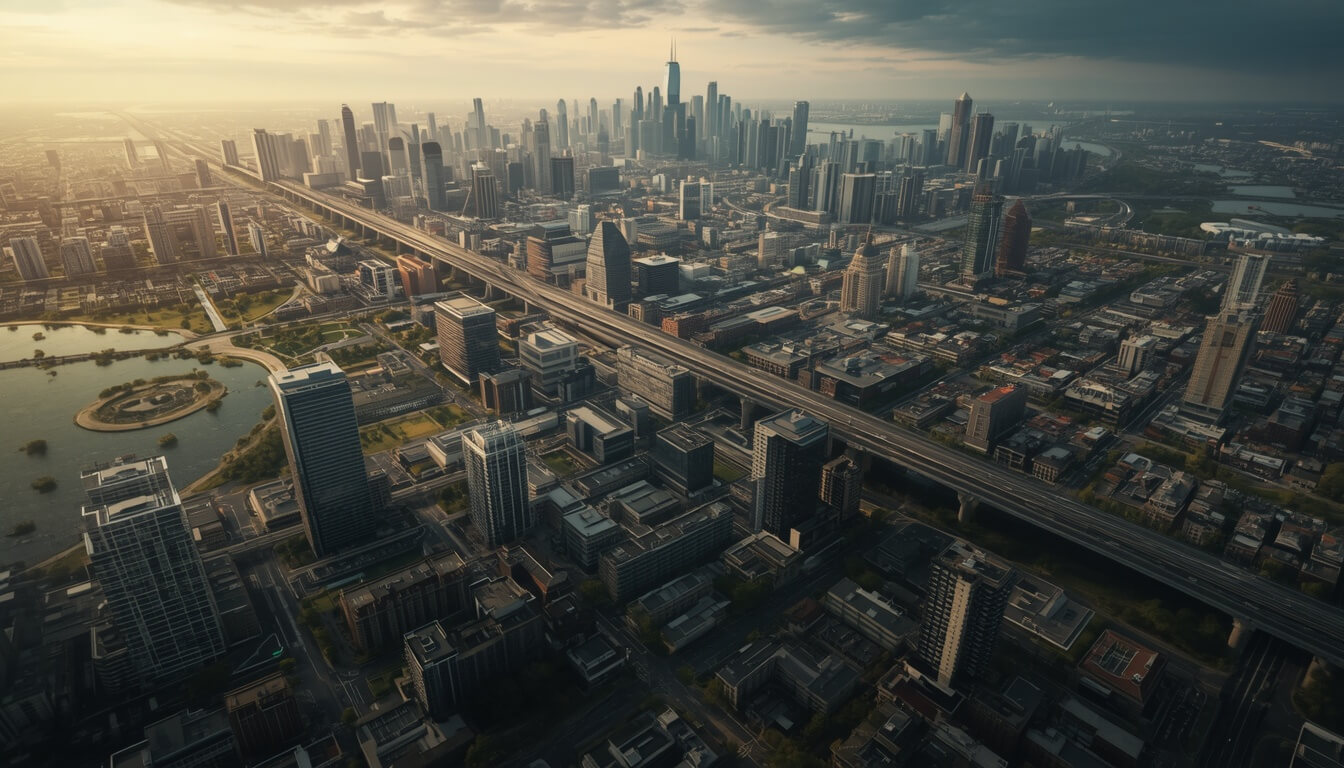
Urbanization is one of the most important long-term transformations shaping the global economy. For much of human history, most people lived in rural areas, with economic activity closely tied to agriculture and natural resources. Over the past two centuries, however, industrialization, technological development and structural changes in employment have steadily shifted populations toward cities.
Today, urbanization is no longer primarily a phenomenon affecting a small group of industrialized economies. It has become a global process involving Asia, Africa, Latin America and other rapidly developing regions. Cities are expanding both physically and economically, creating new centers of consumption, employment, innovation and infrastructure demand.
The scale of this transformation means that the future of cities will have consequences far beyond urban boundaries. As more people move into metropolitan areas, governments and businesses will have to adapt housing systems, transportation networks, energy infrastructure, water supplies and digital connectivity to increasingly concentrated populations.
The Global Shift Toward Urban Living
Urbanization is driven by several interconnected forces. Economic opportunity is one of the most important: cities tend to concentrate businesses, universities, financial institutions, industrial facilities and services, creating labor markets that can attract people from surrounding regions.
Migration from rural areas to cities has therefore been a recurring feature of economic development. As agricultural productivity increases, fewer workers are required to produce the same amount of food, while manufacturing and services create new employment opportunities in urban areas.
This process has already transformed the demographic structure of many countries. Large metropolitan regions have become economic hubs that can contain millions of residents and generate a substantial share of national economic output.
But the next phase of urbanization could look different from the industrial urbanization of the past. In many emerging economies, cities are expanding at a time when digital technologies, automation, electric transportation and distributed energy systems are developing rapidly. This creates opportunities to build new urban infrastructure around technologies that were not available to previous generations.
The result could be a more technologically integrated urban environment, but the transition will not necessarily be smooth.
Emerging Cities and the Next Phase of Growth
The most significant urban population growth in coming decades is expected to occur in emerging markets, particularly in Africa and Asia. Some cities are expanding faster than the infrastructure required to support their populations.
This creates a fundamental challenge. Population growth can increase economic activity, but inadequate infrastructure can limit the benefits of urbanization. Roads, public transportation, electricity grids, water systems, sanitation and housing all need to expand alongside the population.
The issue is therefore not simply how many people will live in cities, but whether urban systems can scale efficiently enough to accommodate them.
Infrastructure investment will consequently become an increasingly important part of the urbanization story. The relationship between demographic growth and physical infrastructure is explored in greater detail in Why Infrastructure Investment Will Become Critical for Growing Cities.
The challenge is particularly complex because urban infrastructure often has extremely long lifespans. A road, railway line, power network or water system built today may remain in operation for decades. Decisions made during periods of rapid population growth can therefore influence the structure and efficiency of a city for generations.
Megacities and Metropolitan Expansion
One visible consequence of global urbanization is the emergence and expansion of megacities — metropolitan areas with populations measured in the tens of millions, often extending far beyond the traditional boundaries of a single municipality.
Large metropolitan regions can generate significant economies of scale. Companies gain access to larger labor markets, consumers have access to more services, and infrastructure can potentially serve large populations more efficiently when development is well planned.
However, scale can also create significant problems:
- Commuting distances can increase as cities expand.
- Housing prices may rise in the most desirable areas.
- Roads and public transportation systems can become congested.
- Electricity and water demand can increase faster than existing networks were designed to accommodate.
Urban expansion can also create environmental pressures. More buildings require construction materials, more residents require energy and water, and larger transportation systems can increase resource consumption.
This means that the future of urbanization will depend not only on population growth but also on how cities organize that growth.
Density, Sprawl and the Structure of Cities
There is no single model for urban development. Some cities grow vertically, increasing residential and commercial density around existing infrastructure. Others expand horizontally, creating increasingly distant suburbs and satellite communities.
The two approaches present different trade-offs:
| Model | Advantages | Challenges |
|---|---|---|
| Higher density | Makes public transportation more viable; reduces distance between homes, workplaces and services. | Can increase pressure on housing, public spaces and infrastructure if poorly coordinated. |
| Urban sprawl | Provides more living space; can lower housing costs in peripheral areas. | Increases dependence on private vehicles; requires larger networks of roads, utilities and public services. |
The balance between density and expansion will therefore become an important planning question as cities continue to grow.
Technology may influence this balance. Remote work, digital services, autonomous transportation and improved public transit could change the relationship between where people live and where they work. However, technological improvements are unlikely to eliminate the economic advantages of physical proximity entirely.
Cities remain important precisely because they bring people, businesses, knowledge and infrastructure together.
Housing and the Cost of Urban Growth
Housing is likely to become one of the most visible consequences of continued urbanization.
When population growth outpaces the construction of homes, housing markets can experience persistent shortages. This can push prices and rents higher, particularly in areas where employment opportunities are concentrated.
The problem is not limited to rapidly growing developing cities. Established metropolitan areas can also experience housing constraints when land availability, planning regulations, construction costs or infrastructure capacity limit new development.
Housing affordability therefore depends on more than the number of homes being built. Transportation connections, access to employment, energy costs and the availability of public services all influence the economic value of urban land.
As cities expand, these factors will increasingly interact. New residential areas may only become attractive if they are connected to reliable transportation and utilities, while infrastructure projects can change the economic value of previously peripheral locations.
The result is a feedback loop between urban development and infrastructure investment.
Transportation and the Connected City
Transportation will also play a central role in determining how efficiently cities grow.
Traditional urban systems have often been designed around private vehicles, particularly in suburban environments. But increasing population density can make road expansion alone an inefficient solution to congestion.
Public transportation, rail networks, cycling infrastructure and pedestrian-oriented development can provide alternative ways of moving large populations through dense areas.
At the same time, technological changes are introducing new possibilities. Electric vehicles can reduce local emissions, while digital navigation and mobility platforms can improve the coordination of transportation services. Autonomous vehicles could eventually change how urban transportation systems operate, although their long-term impact remains uncertain.
The interaction between population growth, housing development and transportation is likely to be particularly important. If housing is built far from employment centers, commuting demand increases. If transportation improves, previously peripheral areas can become more accessible and economically attractive.
These dynamics demonstrate why urbanization cannot be analyzed through demographics alone.
Energy Demand in an Urbanizing World
Cities are also major centers of energy consumption. Residential buildings, commercial facilities, transportation systems, industrial activity and digital infrastructure all require electricity or other forms of energy.
As urban populations increase and economies become more digital, electricity demand could become an increasingly important constraint.
Electrification may intensify this trend. Electric vehicles, heat pumps, data centers and other technologies can shift energy consumption toward electricity even when they improve efficiency in other areas.
This creates new requirements for power generation, transmission and distribution networks. Cities may increasingly need resilient grids capable of managing variable renewable generation, battery storage and more complex patterns of electricity demand.
The broader consequences of urbanization for housing, mobility and energy demand are examined in How Urbanization Could Reshape Housing, Transportation and Energy Demand.
Cities as Engines of Economic Transformation
Despite the challenges, urbanization also creates significant economic opportunities.
Dense concentrations of people and businesses can support specialized services, innovation ecosystems and new forms of entrepreneurship. Universities, technology companies, financial institutions and creative industries often benefit from proximity to large pools of skilled workers and customers.
For emerging economies, successful urban development can therefore become an important component of economic transformation.
The challenge is ensuring that urban growth translates into productive economic activity rather than simply population concentration. That requires functioning institutions, reliable infrastructure, affordable housing and access to essential services.
Cities that can expand these systems efficiently may be better positioned to capture the economic benefits of urbanization.
The Long-Term Urban Transition
The global urbanization wave is not a single event but a multi-decade structural transition.
Population growth, migration, economic development and technological change are interacting to reshape the geography of human activity. Some cities will expand rapidly, while others will face slower growth or even population decline. Established metropolitan areas will have to modernize aging infrastructure, while emerging cities will need to build entirely new systems.
The central question is therefore not whether urbanization will continue, but how cities will manage it.
The decisions made today about land use, infrastructure, transportation, housing and energy can influence urban economies for decades. Understanding these connections is essential for assessing the future of cities and the industries that support them.
Urbanization is ultimately a story about concentration: more people, economic activity and infrastructure being brought together in increasingly complex metropolitan systems. The ability to manage that concentration will determine whether expanding cities become more productive and connected or increasingly constrained by congestion, housing shortages and infrastructure bottlenecks.
As the urban population continues to grow, infrastructure will become one of the defining factors shaping the next generation of cities.