
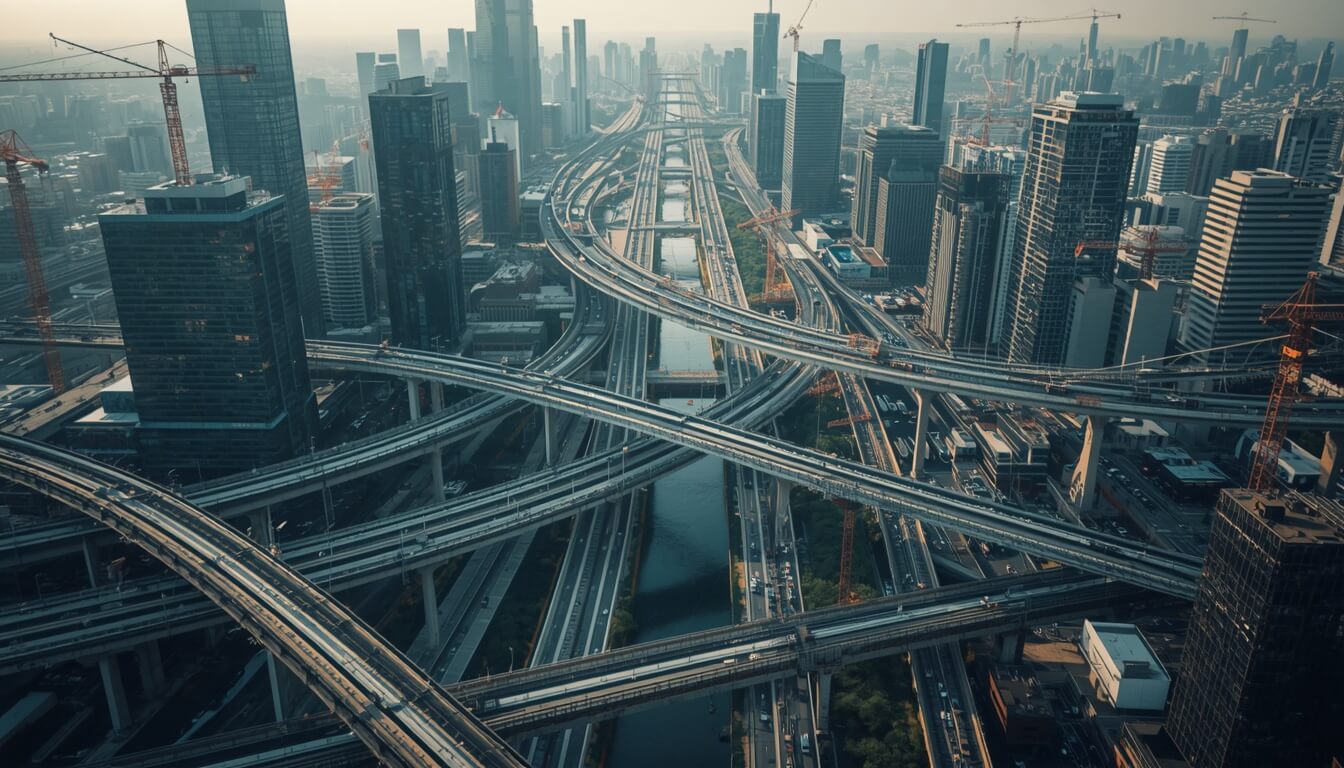
The future of cities will depend not only on how many people move into urban areas, but also on whether infrastructure can keep pace with that growth. Roads, railways, electricity networks, water systems, telecommunications, sanitation and public facilities form the physical foundation on which modern urban economies operate.
As urban populations expand, the pressure on these systems increases. A city can attract new businesses, workers and residents only if it can provide reliable transportation, energy, water, housing connections and digital infrastructure. When investment fails to keep pace with population growth, congestion, shortages and declining service quality can emerge.
This makes infrastructure investment one of the central economic issues associated with the global urbanization wave.
The demographic transformation behind this trend is examined in The Global Urbanization Wave and the Future of Cities. The next question is how this growth will translate into practical changes in housing, transportation and energy demand, which is explored in How Urbanization Could Reshape Housing, Transportation and Energy Demand.
Population Growth Creates Infrastructure Pressure
Urban infrastructure is generally built with a certain population, geographic area and level of economic activity in mind. When these variables change rapidly, existing systems can become insufficient.
A growing city may need thousands or millions of additional connections to electricity, water and sewage networks. More residents also mean more daily journeys, increasing demand for roads, buses, trains and other forms of transportation.
The challenge becomes particularly significant when population growth occurs faster than infrastructure expansion.
This mismatch can produce visible consequences. Roads become congested, public transportation becomes overcrowded, electricity networks operate closer to capacity and water systems face increasing demand. In some cities, informal settlements may expand faster than formal infrastructure can reach them.
Infrastructure investment therefore has a dual function. It must maintain existing systems while simultaneously creating additional capacity for future growth.
This distinction is important because infrastructure is not simply a response to urbanization. In many cases, it can also influence where and how urbanization occurs.
Infrastructure Can Shape Urban Development
A new railway line, highway, bridge or utility network can fundamentally change the economic geography of a metropolitan area.
Locations that were previously difficult to reach can become attractive for residential development, commercial activity and industrial investment. Improved transportation reduces travel times, while new utility connections make large-scale construction possible.
This can create a positive feedback loop:
- Infrastructure attracts development.
- Development increases land values and economic activity.
- The resulting growth generates additional demand for infrastructure.
However, the same process can create problems if investment is poorly coordinated. A new transportation corridor may encourage development in areas that later become difficult to serve with water, electricity or public services.
Long-term urban planning therefore needs to consider infrastructure as an interconnected system rather than a collection of individual projects.
Transportation Networks and Urban Productivity
Transportation is one of the clearest examples of the relationship between infrastructure and economic productivity.
Large cities depend on the ability of workers to move between residential areas and employment centers. Businesses also depend on transportation networks to move goods and access suppliers and customers.
When congestion becomes severe, travel times increase and the effective size of the labor market can shrink. A worker may technically live within the same metropolitan region as a potential employer but be unable to reach the workplace efficiently.
Public transportation can help address this problem by moving large numbers of people through limited urban space.
Rail systems, metro networks, buses and other forms of mass transit can become particularly important as population density increases. Their effectiveness, however, depends on network coverage, frequency, reliability and integration with other forms of transportation.
Future infrastructure investment may therefore focus increasingly on interconnected transportation systems rather than individual roads or isolated projects.
Electricity Infrastructure Is Becoming More Important
Energy infrastructure represents another major challenge.
Modern cities depend on electricity for almost every major economic activity. Buildings, factories, hospitals, communications networks, transportation systems and digital services all rely on reliable power.
At the same time, electrification is expanding the role of electricity in the economy. Electric vehicles can shift transportation energy demand toward electricity. Heat pumps can replace fossil-fuel heating in buildings. Industrial processes may increasingly use electricity instead of direct combustion. Data centers and digital infrastructure are also becoming significant sources of electricity demand.
This means that urban population growth is occurring alongside structural changes in how energy is consumed.
Electricity infrastructure therefore needs to expand not only in volume but also in flexibility. Power grids may need to accommodate renewable generation, battery storage, distributed energy resources and changing patterns of demand.
In some cities, the distribution network may become as important as the amount of electricity generated.
Water and Sanitation
Water infrastructure receives less attention in many economic discussions than transportation or energy, but it is fundamental to urban development.
Growing cities require reliable access to drinking water, wastewater treatment and drainage systems. These networks can be particularly difficult to expand because they are often buried underground and require large-scale engineering projects.
Climate-related risks can further complicate the problem. Heavy rainfall, flooding, droughts and changing water availability can place additional pressure on existing systems.
Infrastructure planning therefore increasingly needs to incorporate resilience as well as capacity. A system designed only to meet average demand may not be sufficient if extreme weather events become more disruptive or if population growth produces significant fluctuations in consumption.
Digital Infrastructure Becomes Urban Infrastructure
The definition of infrastructure is also changing. High-speed telecommunications networks, fiber-optic connections, mobile networks and data centers are increasingly essential components of urban economies.
Businesses depend on reliable digital connectivity for payments, cloud computing, logistics, communication and remote collaboration. Public administrations use digital systems for transportation, healthcare, utilities and government services.
Smart-city technologies can also connect physical infrastructure with digital monitoring systems. Sensors can track traffic, electricity consumption, water flows and other variables in real time.
This creates the possibility of managing infrastructure more efficiently. Transportation systems can use real-time information to adjust services according to demand, while electricity networks can use digital monitoring to identify congestion or failures.
However, greater digital dependence also creates new infrastructure requirements, including data centers, network capacity, cybersecurity and reliable electricity supplies.
The Challenge of Aging Infrastructure
Urban infrastructure investment is not only about building new systems. Many developed cities face a different challenge: aging infrastructure.
Bridges, tunnels, water networks, railways, electricity grids and public buildings can remain operational for decades, but eventually require maintenance, modernization or replacement.
This creates a potentially difficult investment equation. A city may need to spend substantial resources simply to maintain existing infrastructure while also investing in additional capacity for population growth and technological change.
Deferred maintenance can make this problem more expensive over time. Small failures can develop into major disruptions when aging systems are not adequately maintained.
For this reason, infrastructure spending needs to be considered across the entire lifecycle of an asset rather than focusing only on the initial construction cost.
The Financing Problem
Large infrastructure projects require substantial amounts of capital and often take many years to complete.
Governments remain central to infrastructure investment, particularly for projects with broad public benefits that may not generate sufficient direct financial returns for private investors. However, public budgets face competing priorities. Healthcare, education, pensions, defense and other public services also require funding.
Private capital can therefore play an important role through:
- Public-private partnerships
- Infrastructure funds
- Project finance
- Other long-term investment structures
The appropriate financing model depends on the type of infrastructure, the regulatory environment and the expected economic benefits.
One example of financial institutions helping to address infrastructure needs is the EIB and BNP Paribas €700 million guarantee initiative, which supports European manufacturers supplying equipment for electricity-grid expansion.
Long-term institutional investors may be attracted to infrastructure because some assets can generate relatively stable cash flows over extended periods. At the same time, infrastructure projects can involve regulatory, construction, political, environmental and demand-related risks.
Investment decisions therefore require careful assessment of both potential returns and long-term obligations.
Infrastructure and Housing Supply
Infrastructure investment also has a direct relationship with housing.
New residential construction requires access to roads, electricity, water, sewage, telecommunications and public transportation. A city may have sufficient land for new housing but still struggle to develop it if infrastructure capacity is inadequate.
This is particularly relevant in rapidly expanding metropolitan areas. Extending utilities and transportation networks to new neighborhoods can represent a significant portion of the total cost of urban development.
Infrastructure can therefore influence the affordability and geographic distribution of housing.
If investment is concentrated only in established central areas, housing development may remain constrained. If new infrastructure extends connectivity to peripheral areas, additional land can become economically viable for development.
However, expanding outward can also increase transportation requirements and infrastructure maintenance costs. The relationship between infrastructure and housing is therefore not necessarily straightforward.
Resilience Becomes a Strategic Requirement
Urban infrastructure must increasingly be designed to withstand disruptions.
Cities face risks ranging from extreme weather and flooding to power outages, cyber incidents and transportation failures.
A highly interconnected urban system can be efficient under normal conditions but vulnerable when one critical component fails. For example, a power outage can disrupt transportation, telecommunications, water pumping and commercial activity simultaneously.
Infrastructure resilience therefore involves redundancy, maintenance, emergency capacity and diversified systems.
Investment in resilience may not always produce an immediately visible economic return. A flood protection system, backup power network or reinforced bridge can appear unnecessary when no disruption occurs. Its value becomes clearer when it prevents a major interruption.
This creates a challenge for policymakers because infrastructure benefits often extend over periods much longer than political or budgetary cycles.
The Long-Term Economic Role of Infrastructure
Infrastructure investment should ultimately be viewed as an enabling layer for urban economic activity.
Businesses require transportation networks to move goods and workers. Households require utilities and housing connections. Digital industries require telecommunications and electricity. Public services depend on buildings, roads and networks that allow them to reach residents.
When these systems expand in coordination with population and economic growth, cities can potentially accommodate larger populations without proportional increases in congestion or service costs.
When investment falls behind demand, the opposite can occur. The resulting bottlenecks can affect productivity, housing affordability, commuting times and business investment.
This is why infrastructure is likely to become increasingly important as urbanization continues. The question is not simply how much cities will grow, but whether the physical and digital systems supporting them can grow at the same speed.
From Infrastructure to Everyday Urban Demand
The next stage of the urbanization story is increasingly visible at the household and business level.
Infrastructure decisions influence where homes can be built, how people commute, how much electricity buildings consume and where new commercial activity develops. Transportation networks affect housing markets, while electricity infrastructure influences industrial and digital expansion.
These connections mean that infrastructure investment does not operate in isolation. It creates a framework within which urban economies develop.
As cities continue to expand, the consequences will become increasingly visible in three areas: housing, transportation and energy.
Understanding these effects provides the next step in analyzing the long-term economic impact of urbanization.