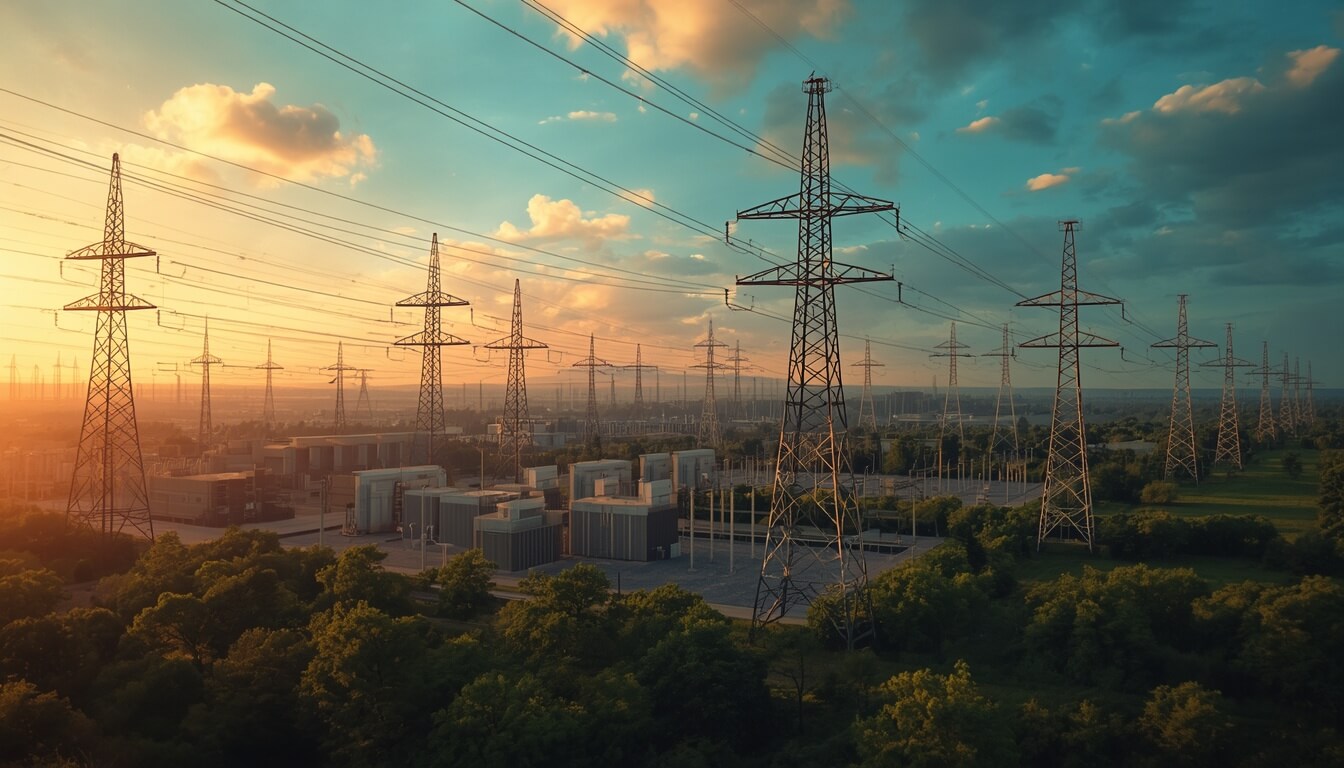
Europe's electricity infrastructure is becoming a major focus of industrial investment as the continent prepares for rising electricity demand, new renewable generation and the electrification of transport, heating and industry.
A new agreement between the European Investment Bank (EIB) and BNP Paribas illustrates the growing effort to channel financing toward the companies that manufacture the equipment needed to expand Europe's power networks.
On September 29, 2026, the two institutions signed an agreement that will support up to €700 million in bank guarantees for European electricity-grid component manufacturers. The EIB will provide up to €350 million in counter-guarantees, while BNP Paribas will commit an equivalent amount to build the guarantee portfolio. The operation is supported by the European Union's InvestEU programme.
The guarantees are expected to help mobilize as much as €2.8 billion in investment in the real economy. The transaction forms part of a broader €1.5 billion EIB package dedicated to developing, modernizing and strengthening European electricity grids.
Why Grid Manufacturers Need Financing
The investment challenge facing Europe's electricity system is not limited to building transmission and distribution lines.
A modern power network requires a large industrial supply chain producing transformers, cables, switchgear, substations and other specialized equipment. Manufacturers supplying these components often need to provide financial guarantees to customers before receiving payments or completing projects.
These guarantees can cover obligations such as advance payments and performance requirements contained in supply contracts.
The EIB's project documentation identifies the availability of these guarantees as an increasingly important constraint for power-grid equipment manufacturers. Growing order books can increase companies' financing requirements, while commercial banks may face concentration limits on their exposure to individual manufacturers.
The new EIB-BNP Paribas arrangement is designed to address that specific financing bottleneck.
Instead of providing a conventional loan directly to manufacturers, the EIB shares part of the risk associated with the guarantees issued by BNP Paribas. This increases the bank's capacity to provide guarantees to companies involved in the grid-equipment supply chain.
A €700 Million Guarantee Structure
The structure is based on risk sharing.
The EIB will provide up to €350 million in counter-guarantees. BNP Paribas will provide an equivalent €350 million commitment, allowing the bank to create a portfolio of guarantees worth up to €700 million for its clients.
The EIB estimates that this structure could ultimately support up to €2.8 billion of investment in the real economy.
That difference between the guarantee portfolio and the investment potentially mobilized is important. The €2.8 billion figure is not a €2.8 billion cash payment by the EIB or BNP Paribas. Instead, it represents the expected economic investment enabled by the risk-sharing structure.
This is one of the mechanisms through which development banks can use guarantees to mobilize additional private-sector financing.
Part of a Larger European Grid Programme
The BNP Paribas transaction is not an isolated initiative.
It forms part of the EIB's €1.5 billion Pan-EU Power Grid package, designed to support the expansion and modernization of electricity networks across the European Union and other InvestEU countries.
The EIB's framework is based on counter-guarantees that allow financial intermediaries to increase their ability to issue advance-payment and performance guarantees for manufacturers of power-grid equipment.
Other financial institutions are participating in similar operations.
- In September, the EIB and Crédit Agricole CIB announced a separate €600 million guarantee operation, consisting of €300 million in EIB counter-guarantees and an equivalent commitment from the French bank. That operation is expected to mobilize up to €2.4 billion in real-economy investment.
- In Italy, the EIB has also approved a €300 million operation with Intesa Sanpaolo designed to support guarantees for companies manufacturing equipment for the European power grid. The EIB estimates that this operation could support approximately €2.4 billion of total investment.
The various transactions show that the €1.5 billion envelope is being deployed through multiple banking partners rather than through a single financing operation.
Electricity Demand Is Changing the Infrastructure Equation
The underlying industrial challenge is linked to the transformation of Europe's electricity system.
Electrification is increasing the importance of electricity in sectors that historically depended more heavily on direct fossil-fuel consumption. Electric vehicles, heat pumps, industrial electrification, renewable generation and increasingly power-intensive digital infrastructure all create new requirements for the electricity network.
These changes are part of a wider trend examined in The Global Energy Demand Surge and the Challenge of Supplying It, which explores the growing pressure on energy supply as electricity consumption expands.
At the same time, renewable generation can be geographically separated from major centers of consumption.
Wind and solar installations therefore need transmission and distribution infrastructure capable of moving electricity across regions and connecting new generation capacity to consumers.
The EIB has previously highlighted the investment gap surrounding European electricity grids. It has cited International Energy Agency estimates that European annual grid investment would exceed $70 billion by 2025, approximately twice the level of a decade earlier. The bank has also noted the need to expand networks alongside renewable-energy deployment.
The broader infrastructure requirements of this transition are explored in The New Infrastructure Needed for a More Electricity-Intensive Economy, including the importance of upgrading power networks to support changing patterns of electricity generation and consumption.
The issue is therefore not simply how much electricity Europe can generate. It is also how efficiently and reliably that electricity can be transported and distributed.
Data Centers Add Another Layer of Demand
The rapid expansion of data centers introduces another source of electricity demand.
Artificial intelligence workloads require large computing clusters, and these facilities can consume substantial amounts of electricity. As data-center capacity expands, connections to the electricity grid become an increasingly important part of the infrastructure development process.
This challenge is examined further in Why AI Data Centers Are Becoming an Energy Infrastructure Problem, which looks at how expanding AI computing capacity is increasing pressure on electricity infrastructure.
This creates a relationship between two major investment themes: digital infrastructure and physical energy infrastructure.
A new data center may require computing equipment, servers and networking systems, but it also requires access to sufficient power and an electrical connection capable of supporting its operations.
The same principle applies to industrial facilities undergoing electrification.
As electricity becomes more important to economic activity, the physical network connecting generation and consumption becomes an increasingly significant component of the overall infrastructure system.
Transformers, Cables and Grid Equipment
The modernization of Europe's electricity network depends on a broad group of industrial manufacturers.
Transformers are essential for changing voltage levels as electricity moves through transmission and distribution systems. Cables connect generation facilities, substations and consumers. Switchgear and other electrical components are required to control, protect and manage the network.
The EIB's broader grid programme specifically targets manufacturers of these types of power-grid components.
In April 2026, the EIB also announced a €250 million guarantee with Commerzbank that could support up to €2 billion of investment in electricity grids in Germany and other EU member states. The operation was designed to strengthen supply chains for cables, transformers and other grid components while supporting the modernization and digitalization of electricity networks.
Taken together, these transactions show that European grid investment is reaching beyond utilities and network operators into the industrial companies that supply the equipment required to build the system.
The Financial Role of InvestEU
The European Union's InvestEU programme plays an important role in these transactions.
Its basic mechanism is to use public guarantees to reduce part of the risk associated with eligible investments and thereby encourage additional financing from financial institutions.
The EIB says the InvestEU Fund uses an EU budget guarantee to increase its risk-bearing capacity and mobilize additional public and private investment.
For the grid-manufacturing sector, this mechanism can be particularly relevant because companies may have substantial order books but still require additional guarantee capacity to execute those contracts.
In this sense, the financing constraint is not necessarily a lack of demand for grid equipment. It can instead be a question of how quickly manufacturers and their financial partners can support the contractual and working-capital requirements associated with that demand.
A Broader Industrial Investment Cycle
The EIB-BNP Paribas agreement provides a useful example of how the European energy transition is creating investment requirements at multiple levels.
The first layer is electricity generation, including renewable sources. The second is the transmission and distribution network required to move electricity. The third is the industrial supply chain producing cables, transformers and other grid equipment. Financial institutions then provide the loans, guarantees and risk-sharing mechanisms required to connect these layers.
This makes grid investment both an energy story and an industrial-finance story.
The €700 million BNP Paribas guarantee portfolio is only one part of the broader European programme, but its structure illustrates how public institutions and commercial banks are attempting to expand financing capacity without relying exclusively on direct public spending.
Europe's Grid Becomes a Strategic Infrastructure Market
Europe's electricity transition is therefore increasingly extending into the industrial companies behind the network itself.
The EIB and BNP Paribas agreement provides up to €700 million of guarantees, backed by €350 million of EIB counter-guarantees and an equivalent BNP Paribas commitment. The EIB estimates that the operation could help mobilize up to €2.8 billion in real-economy investment.
The initiative sits inside a €1.5 billion European grid package and follows similar agreements with other financial institutions, including Crédit Agricole CIB, Intesa Sanpaolo and Commerzbank.
For the European economy, the significance extends beyond any individual financing transaction. As electricity demand rises and generation becomes more distributed, the network connecting producers and consumers becomes an increasingly important piece of economic infrastructure.
The companies manufacturing the equipment for that network are consequently becoming a central part of the European electrification supply chain — and increasingly, a focus of institutional financing.