
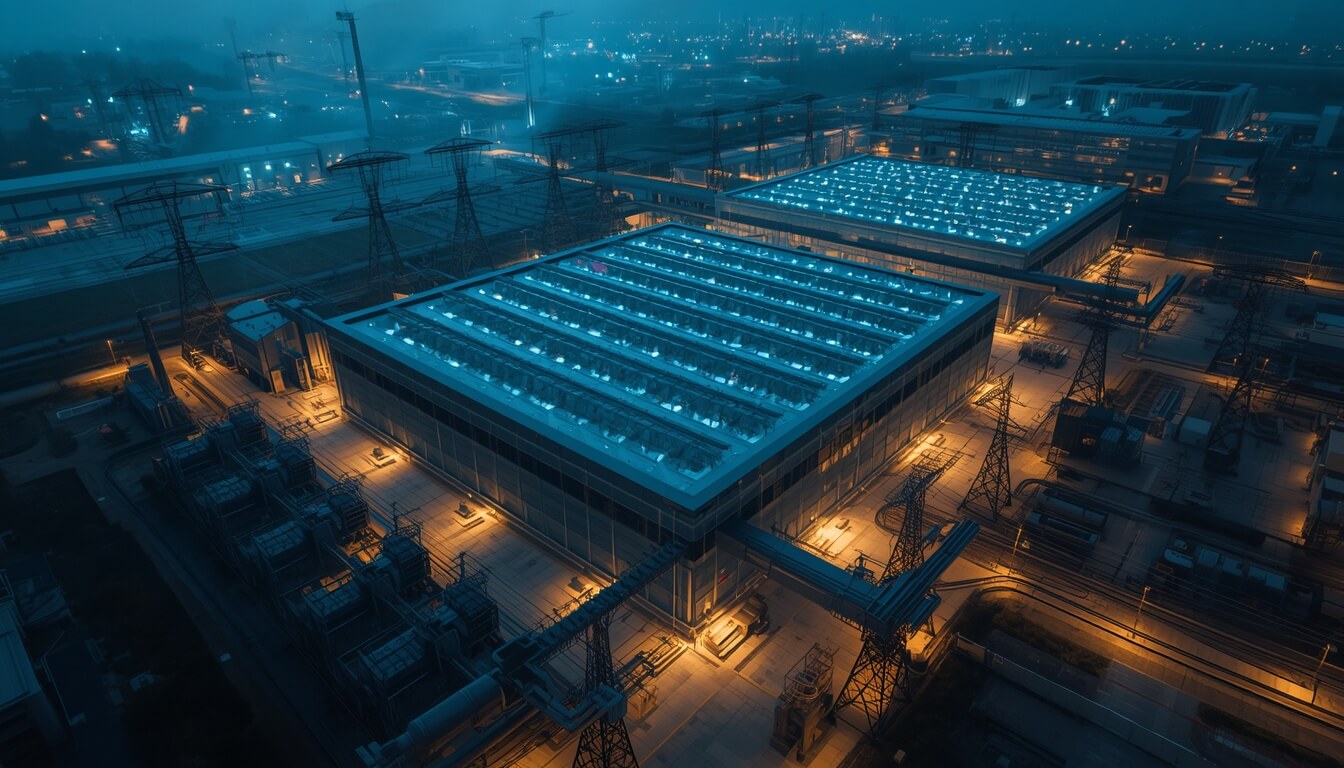
Artificial intelligence is creating a new challenge for the global electricity system. The rapid expansion of AI data centers is turning computing demand into a major infrastructure question: where will all the electricity come from, and how quickly can power systems deliver it?
The issue is not simply that data centers consume more electricity than they did in the past. AI workloads are creating very large and concentrated power demands that can appear in locations much faster than traditional electricity infrastructure can be expanded.
The International Energy Agency (IEA) reports that global data center electricity demand increased by 17% in 2025, while electricity consumption from AI-focused data centers increased by around 50%. The IEA expects total data center electricity consumption to roughly double by 2030, with electricity use from AI-focused data centers potentially tripling.
This makes energy infrastructure one of the central constraints on the expansion of AI computing.
AI is no longer purely a software or semiconductor story. It is increasingly a story about electricity, transformers, transmission lines, and generation capacity.
AI Data Centers Are Different From Ordinary Electricity Demand
Electricity systems have historically been designed around a broad collection of residential, commercial, and industrial consumers.
AI data centers introduce a different pattern.
A large AI campus can require hundreds of megawatts of electricity in a single location, with some proposed facilities reaching gigawatt-scale capacity. Unlike many traditional industrial loads, these facilities can also be built and expanded rapidly when compared with the time required to construct new transmission lines, substations, and generation capacity.
The US Department of Energy identified data centers as one of the factors contributing to rising electricity demand and highlighted the need for additional transmission infrastructure in its 2026 draft National Transmission Needs Study.
This creates a timing problem.
A technology company may be ready to deploy thousands of AI processors, while the local electricity network may not be ready to supply the required power.
The Grid Cannot Always Expand as Quickly as AI
Electricity infrastructure is capital-intensive and slow to develop.
New transmission lines can require lengthy planning, permitting, environmental reviews, land acquisition, construction, and connection procedures. Large generation projects can face similar timelines.
AI infrastructure is developing according to a different clock.
Companies want to deploy new computing capacity as quickly as possible because demand for AI services is expanding and hardware becomes outdated relatively quickly.
This mismatch between technology development and energy infrastructure can create bottlenecks.
The US Department of Energy noted in 2026 that grid capacity constraints and lengthy interconnection timelines are already hindering the rapid development of data centers. It also identified microgrids and co-located generation as potential approaches for supplying large loads more quickly than traditional grid expansion alone.
The problem therefore extends beyond the data center itself.
It becomes a question of whether the surrounding electricity system can keep pace.
Gigawatt-Scale Facilities Change the Equation
The scale of planned AI infrastructure makes the problem even more significant.
As explained in The Race to Build Gigawatt-Scale AI Data Centers, developers are increasingly considering campuses that can eventually require hundreds of megawatts or even gigawatts of electricity.
At that scale, an AI data center begins to resemble a major industrial electricity consumer.
A gigawatt of continuous power is a substantial load for any electricity system. Connecting such a facility may require new substations, transmission capacity, generation resources, and other grid upgrades.
The challenge becomes particularly difficult when several large projects are proposed in the same region.
A single data center may be manageable. Multiple large AI campuses can fundamentally change the expected electricity demand of an entire area.
Power Generation Is Becoming Part of the AI Strategy
As grid connections become a constraint, companies are looking at ways to obtain electricity outside the traditional model of simply connecting a new facility to the existing grid.
One approach is onsite generation.
Natural gas-fired generation is being considered for some US data center projects because it can potentially be deployed faster than major transmission infrastructure. The IEA reports that developers are pursuing onsite natural-gas generation partly because of slow grid connections.
Other projects are looking toward renewable energy, nuclear power, geothermal energy, batteries, and combinations of these technologies.
The technology sector accounted for around 40% of corporate renewable power purchase agreements signed in 2025, according to the IEA. The agency also reports that conditional agreements involving small modular nuclear reactors and data center operators have expanded significantly.
This means AI companies are increasingly becoming participants in the energy market rather than simply electricity customers.
Renewable Energy Helps, but Timing Matters
Renewable electricity can provide additional generation without the fuel costs and direct emissions associated with fossil-fuel generation. Solar and wind projects are therefore an important part of the growing energy supply for data centers.
However, the timing and location of generation matter.
A data center requires electricity continuously, while solar and wind output varies according to weather and time of day. Connecting renewable projects to large AI loads can therefore require transmission capacity, storage, grid balancing, or additional sources of firm power.
A company may also sign a long-term power purchase agreement for renewable electricity without that electricity necessarily being physically delivered directly from the renewable facility to the data center at every moment.
The broader electricity system still has to balance supply and demand continuously.
This makes AI's energy requirements a system-level problem rather than simply a question of how much renewable capacity companies purchase.
Nuclear Power Is Returning to the Conversation
The enormous and continuous electricity requirements of AI are also increasing interest in nuclear power.
Nuclear plants can provide large quantities of electricity continuously, making them potentially attractive for high-load facilities that require reliable power around the clock.
The IEA says the pipeline of conditional offtake agreements between data center operators and small modular reactor projects grew from 25 GW at the end of 2024 to 45 GW in 2026.
However, these agreements do not mean that 45 GW of new nuclear capacity is already operating or guaranteed to be built. Nuclear projects can involve long development timelines, regulatory requirements, financing challenges, and complex construction processes.
For AI developers, the attraction is therefore clear, but the practical timing remains an important consideration.
Transformers and Grid Equipment Are Another Bottleneck
Generating electricity is only part of the challenge.
Power must also be transported and transformed before it reaches the data center.
Large AI facilities can require substantial quantities of high-voltage equipment, transformers, switchgear, power electronics, and other grid components.
The IEA has highlighted tightening supply chains for transformers and other energy technologies as a constraint on the expansion of data center infrastructure. It also notes that the rapid increase in AI server power density is placing additional pressure on these supply chains.
This creates a second infrastructure race.
The world needs not only more electricity generation, but also more of the equipment required to move that electricity from where it is produced to where AI computing takes place.
Power Density Is Increasing Inside the Data Center
The energy problem also exists at the rack level.
AI processors are becoming increasingly powerful, and more computing capacity is being concentrated into smaller physical spaces.
According to the IEA, the power density of AI servers increased approximately elevenfold between 2020 and 2025, with further increases expected by 2027.
Higher power density creates additional demands for cooling and electrical distribution.
This is one reason AI data centers are increasingly designed around advanced cooling systems and high-capacity power infrastructure from the beginning.
The physical architecture of the data center is therefore directly connected to the electricity infrastructure surrounding it.
Could AI Data Centers Put Pressure on Electricity Prices?
Large new electricity loads can have broader economic consequences.
When a major data center connects to a local grid, utilities may need to invest in generation, transmission, substations, and distribution infrastructure.
Those investments have to be financed somehow.
The effect on electricity prices depends on the local market, regulatory structure, investment arrangements, available generation, and how the additional infrastructure costs are allocated.
The IEA notes that data centers can create particular affordability challenges because they are large, concentrated loads that can scale quickly and trigger new generation and grid investment. At the same time, the agency finds that rising electricity demand does not necessarily lead to higher prices when appropriate infrastructure and policies are in place.
The impact of AI data centers cannot be reduced to a simple assumption that more computing automatically means higher electricity prices everywhere. The outcome depends heavily on how electricity systems adapt.
Data Centers Could Also Become More Flexible
The relationship between AI data centers and electricity grids does not necessarily have to be one-way.
Large computing facilities may eventually be able to adjust some workloads according to electricity availability.
For example, certain AI training tasks may be more flexible than latency-sensitive services that need to respond immediately to users. If operators can shift some computing activity to periods when electricity is more abundant, data centers could potentially become more compatible with variable renewable generation.
Battery storage could provide another mechanism.
The IEA identifies onsite batteries as an increasingly important technology for AI data centers, particularly where rapid changes in computing demand create challenges for local power systems.
This creates the possibility of data centers becoming more sophisticated participants in electricity markets rather than purely inflexible consumers.
The Infrastructure Problem Is Bigger Than AI
AI is arriving at a time when electricity demand is already changing.
The IEA expects global electricity demand to grow substantially through 2030, driven by data centers, electric vehicles, cooling, industrial activity, and other forms of electrification.
AI therefore represents one component of a much broader transition toward an increasingly electricity-dependent economy.
The challenge is coordinating all of these demands.
If data centers, factories, electric vehicles, heating systems, and other loads expand simultaneously, electricity generation and transmission must expand accordingly.
This makes planning increasingly important.
AI Is Becoming an Energy Infrastructure Story
The rapid development of AI data centers demonstrates that artificial intelligence is no longer purely a software or semiconductor story.
The industry increasingly depends on physical infrastructure: land, buildings, cooling systems, transformers, transmission lines, generation capacity, and reliable electricity.
That connection creates both constraints and opportunities.
Companies that can secure computing hardware but cannot obtain sufficient electricity may face delays. Utilities and energy developers that can provide new generation and grid capacity may become increasingly important partners to the technology sector.
At the same time, the growth of AI could accelerate investment in technologies such as renewable generation, nuclear power, energy storage, microgrids, and grid modernization.
The central issue is therefore not simply whether AI consumes a lot of electricity. It is whether energy infrastructure can evolve quickly enough to support a new generation of computing.
The first stage of this transformation was the emergence of specialized AI data centers, as discussed in Why Artificial Intelligence Is Creating a New Data Center Industry.
The second stage is the construction of increasingly large computing campuses.
The third challenge is making sure the electricity system can support them.
AI may ultimately become one of the forces accelerating investment in the infrastructure needed to power the next generation of the digital economy.