
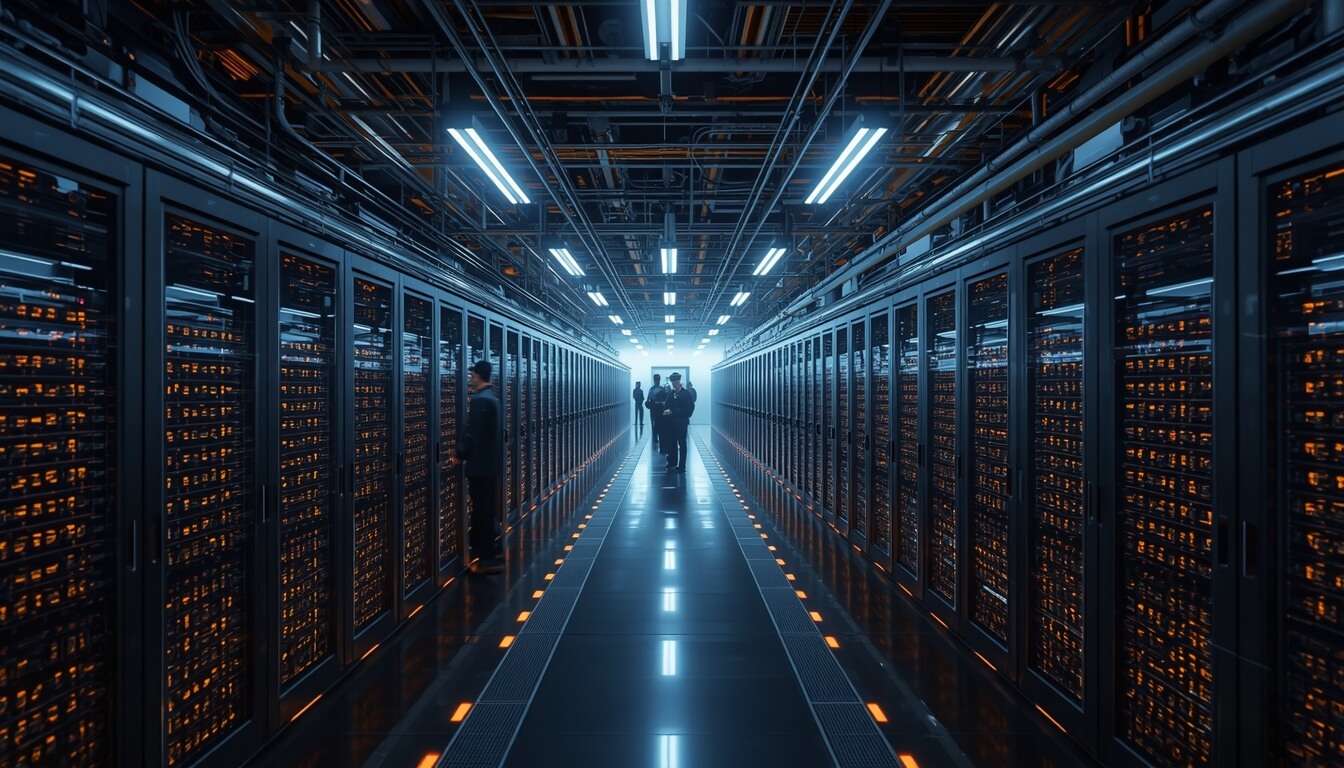
Artificial intelligence is changing more than software, search engines, and digital services. It is also reshaping the physical infrastructure behind the internet. As AI models become larger and more widely used, companies are investing in a new generation of data centers specifically designed to support the enormous computing requirements of artificial intelligence.
Traditional data centers were built primarily to host websites, enterprise applications, cloud services, databases, and conventional computing workloads. AI introduces a different set of requirements. Training and operating advanced AI models can require thousands of specialized processors working simultaneously, creating much higher demands for computing capacity, electricity, cooling, networking, and physical space.
This is helping create a distinct segment of the data center industry: AI data centers.
AI is turning the largest data centers from technology facilities into major industrial infrastructure projects, involving real estate, construction, semiconductors, electricity generation, transmission networks, and financial investment.
AI Is Changing What a Data Center Needs
A conventional data center can contain a wide range of servers performing different tasks. AI infrastructure, however, often depends on large clusters of high-performance accelerators, particularly GPUs and other specialized processors.
These systems are designed to perform massive numbers of calculations in parallel. That makes them highly effective for training large language models, processing images and video, running simulations, and supporting other AI applications.
The difference is significant at the infrastructure level. AI servers can consume substantially more power than conventional enterprise servers, while the computing equipment generates considerably more heat. As a result, simply placing new AI hardware inside an existing facility is not always practical.
Data center operators increasingly need to consider power availability, cooling technology, network architecture, building design, and the ability to expand capacity rapidly.
This is one reason AI is creating opportunities for specialized infrastructure developers rather than simply increasing demand for conventional data centers.
From Cloud Computing to AI Infrastructure
The growth of cloud computing already transformed the data center business. Large technology companies built enormous facilities to provide computing and storage capacity to customers around the world.
AI is extending this trend but introducing another layer of infrastructure intensity.
Companies developing advanced AI systems need access to enormous amounts of computing power. Cloud providers are responding by expanding facilities and installing increasingly dense computing clusters. At the same time, AI companies and other technology firms are looking for dedicated capacity that can support their own workloads.
The result is a growing ecosystem involving semiconductor manufacturers, cloud providers, data center developers, power companies, networking companies, cooling specialists, and construction firms.
The data center is therefore becoming less like a simple building filled with servers and more like a large-scale industrial facility.
Why Existing Data Centers May Not Be Enough
One of the biggest challenges is power density.
Traditional data center designs were not necessarily built to accommodate extremely large concentrations of AI accelerators. When thousands of high-performance processors operate together, the amount of electricity required by a relatively small physical area can become very large.
Cooling presents a related problem. Almost all electricity consumed by computing equipment eventually becomes heat that must be removed from the facility.
Air cooling has historically played a major role in data centers, but increasingly dense AI systems are encouraging operators to consider liquid cooling and other technologies capable of handling higher thermal loads.
This means that an AI data center can require substantially different engineering from a facility designed for traditional workloads.
The infrastructure challenge becomes even larger when operators want to build facilities with hundreds of megawatts of capacity or more. The next stage of this development is already moving toward extremely large projects, which is examined in The Race to Build Gigawatt-Scale AI Data Centers.
A New Market for Data Center Developers
The rapid expansion of AI computing is creating opportunities for companies that specialize in data center development.
Location has become particularly important. A site needs more than inexpensive land. Developers must consider access to:
- Electricity
- Transmission infrastructure
- Fiber-optic networks
- Water resources
- Permitting
- The ability to expand the facility over time
Access to electricity may become one of the most important factors.
A company can have access to advanced processors and sufficient capital, but without enough electrical capacity, those processors cannot be deployed at scale. This is turning relationships with utilities and power developers into an increasingly important part of data center development.
For developers, securing a site with sufficient future power availability can therefore be as important as the physical characteristics of the property itself.
The Infrastructure Supply Chain Is Expanding
The AI data center boom is also affecting a much broader industrial supply chain.
High-performance processors require advanced semiconductor manufacturing. Large AI clusters require high-speed networking equipment, specialized servers, power systems, transformers, cooling equipment, backup systems, and sophisticated monitoring technologies.
Construction itself can become a major undertaking.
Large facilities may require substantial amounts of steel, electrical equipment, generators, cooling systems, cabling, and other infrastructure. When multiple projects are developed simultaneously, shortages or delays in individual components can affect the entire construction schedule.
This creates opportunities across several industries, but it also introduces new bottlenecks.
The AI boom is therefore not simply a story about buying more computer chips. It is increasingly a story about building the physical infrastructure required to operate those chips continuously.
AI Data Centers and the Electricity Question
The growing scale of AI infrastructure also creates an important connection between technology and energy.
A traditional software company could expand its services primarily by adding servers or renting additional cloud capacity. AI infrastructure can require enormous amounts of physical electricity generation and transmission capacity.
As AI data centers become larger, their electricity consumption can become significant relative to the power systems serving their locations.
This raises questions about:
- Where new electricity will come from
- How quickly transmission infrastructure can be expanded
- Whether existing grids can accommodate large new industrial loads
These issues are becoming important enough that AI data centers are increasingly being discussed as part of the broader energy infrastructure system. The consequences of this shift are explored in Why AI Data Centers Are Becoming an Energy Infrastructure Problem.
A Structural Change in the Data Center Market
The development of AI data centers may represent a structural change rather than a temporary technology cycle.
Artificial intelligence is being integrated into search, software development, customer service, scientific research, cybersecurity, robotics, financial services, healthcare, and industrial applications. If these workloads continue to expand, demand for specialized computing infrastructure could remain strong for years.
At the same time, AI hardware is evolving rapidly. More powerful processors and increasingly sophisticated systems may increase computing capacity while also changing the requirements for cooling, networking, and power distribution.
Data center operators therefore have to design facilities that can accommodate technologies that may not even exist when construction begins.
This creates a difficult balance between building enough capacity to support future AI demand and avoiding infrastructure that becomes obsolete before it reaches full utilization.
From Computing Infrastructure to Industrial Infrastructure
The most important change may be conceptual.
Data centers were once primarily viewed as technology facilities. AI is increasingly turning the largest facilities into major industrial infrastructure projects.
Their development can involve real estate, construction, semiconductors, telecommunications, electricity generation, transmission networks, cooling technology, and financial investment.
That transformation explains why AI is creating a new data center industry rather than simply increasing demand for traditional facilities.
The next phase will depend on scale. As technology companies and infrastructure developers attempt to build increasingly powerful AI computing clusters, individual facilities may require hundreds of megawatts of electrical capacity and eventually reach gigawatt-scale ambitions. That race will determine how quickly AI infrastructure can expand and what physical resources it requires.