
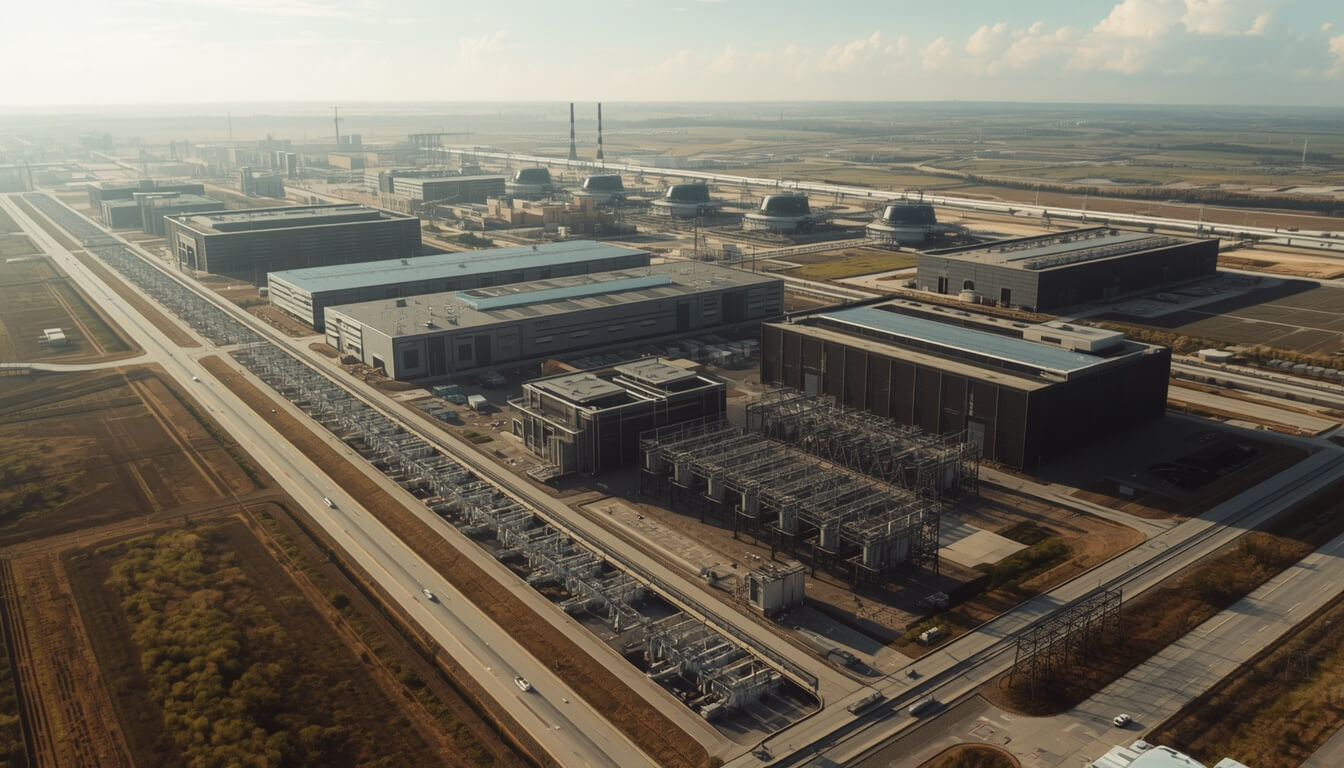
The artificial intelligence boom is creating a new kind of infrastructure race. Technology companies are no longer competing only to develop more capable AI models or secure the latest processors. They are also competing to build the physical facilities capable of running those systems at enormous scale.
The next generation of AI data centers is moving toward a measurement that was once associated primarily with power plants and large industrial facilities: the gigawatt.
A gigawatt is 1,000 megawatts of electrical power. At this scale, an AI data center campus can require electricity comparable to that consumed by a city. In September 2026, several large AI facilities were already approaching or exceeding the gigawatt threshold in planned or operational capacity. Epoch AI, for example, estimates that some of the largest facilities now have hundreds of megawatts of IT power, with the largest tracked sites approaching 1 GW.
This represents a major change in the physical scale of computing.
The gigawatt data center represents a shift in how computing infrastructure is designed, powered, and financed. At this scale, an AI campus is no longer just a technology project — it is an industrial infrastructure project.
Why AI Data Centers Are Becoming So Large
The primary driver is the amount of computing required by modern AI.
Training sophisticated models requires large numbers of accelerators operating together. Once a model has been trained, inference—the process of responding to users and generating outputs—can also require substantial computing capacity when millions of requests are processed simultaneously.
AI companies therefore need large clusters of processors connected by extremely fast networks.
Instead of adding a few servers at a time, operators are increasingly designing entire facilities around enormous computing clusters. The objective is to place large quantities of computing capacity in one location and provide the power, cooling, networking, and physical infrastructure needed to operate it continuously.
This explains why the data center itself is becoming an increasingly important part of AI development.
As discussed in Why Artificial Intelligence Is Creating a New Data Center Industry, AI workloads are changing the basic engineering requirements of data centers. Gigawatt-scale projects represent the next step in that transformation.
From Megawatts to Gigawatts
For decades, data center discussions commonly focused on facilities measured in tens of megawatts. The rapid expansion of AI is pushing some projects toward hundreds of megawatts and eventually gigawatt-scale campuses.
The distinction is important.
| Scale | What it represents |
|---|---|
| 100 MW facility | A substantial industrial project |
| 1 GW campus | A completely different approach to electricity procurement, transmission, construction, cooling, backup systems, and financing |
Research from Uptime Institute identified more than 350 publicly announced data center projects exceeding 100 MW since early 2021. Its analysis found that North America accounted for approximately 80% of the planned power capacity identified in 2025 proposals, with some of the largest projects designed as multi-gigawatt AI campuses.
Not every announced project will necessarily be completed at its original scale. Nevertheless, the size of the project pipeline demonstrates how dramatically expectations for AI infrastructure have changed.
The Race Is Also a Race Against Time
Scale is only one part of the competition.
AI technology is evolving rapidly, which creates pressure to bring infrastructure online as quickly as possible. A company that secures a large amount of computing capacity earlier can deploy new models and services without waiting for another facility to be completed.
This has created a construction race.
Large AI campuses require land, electrical equipment, transformers, cooling systems, networking infrastructure, buildings, and thousands of specialized components. Coordinating all of these elements is a major engineering and logistical challenge.
The International Energy Agency has noted that AI-focused data center capacity has more than tripled over an 18-month period, illustrating how quickly this infrastructure is being deployed.
The speed of construction is particularly notable because traditional energy and infrastructure projects often require years of planning and permitting.
AI infrastructure developers are therefore trying to compress construction schedules while simultaneously increasing the scale of individual facilities.
Power Has Become a Competitive Resource
The largest constraint may not be land or computing hardware. It may be electricity.
A gigawatt-scale data center needs access to an enormous and reliable power supply. Finding a suitable site therefore involves much more than identifying inexpensive real estate.
Developers must consider transmission capacity, grid connections, substations, electricity contracts, permitting, and the availability of additional power in the future.
A recent example is Google's 3.6-GW power agreement with Constellation Energy, which shows how major technology companies are securing large amounts of electricity to support the expansion of AI infrastructure.
This is changing how data center locations are evaluated.
A location with abundant land but insufficient electricity may be less useful than a more expensive site with immediate access to major transmission infrastructure.
The International Energy Agency estimates that global data center electricity consumption could roughly double from 485 TWh in 2025 to around 950 TWh by 2030, while electricity consumption from AI-focused data centers is expected to grow much faster than the overall data center market.
That growth makes access to power increasingly central to the economics of AI infrastructure.
Designing for High-Density Computing
The processors used for AI also create a cooling challenge.
Modern AI systems concentrate enormous computing capacity into relatively small physical spaces. As processor performance and rack density increase, more electricity is converted into heat that must be removed.
The IEA reports that the power density of AI servers increased roughly elevenfold between 2020 and 2025 and is expected to increase further by 2027.
This is encouraging data center operators to use more advanced cooling technologies.
Liquid cooling is becoming increasingly important because it can remove heat more efficiently from high-density computing systems than conventional air-based systems. Power distribution must also evolve because individual racks can require far more electricity than traditional enterprise equipment.
The result is a data center architecture increasingly designed around AI hardware from the beginning rather than adapted to it later.
Hyperscalers Are Building at Industrial Scale
The largest technology companies have the financial resources and demand necessary to support enormous infrastructure programs.
Cloud providers and AI companies are investing in dedicated campuses, long-term power arrangements, specialized computing clusters, and large-scale infrastructure partnerships.
Some projects are being developed as campuses rather than single buildings. This allows multiple facilities to share substations, cooling infrastructure, fiber connections, security systems, and other services.
The campus model also provides room for expansion.
Instead of building a single 200 MW facility and stopping, developers can establish a site capable of eventually supporting several hundred megawatts or more than one gigawatt.
This approach is particularly useful because AI demand is difficult to predict precisely. Building infrastructure in stages allows companies to expand as computing requirements become clearer.
The Economics of Gigawatt-Scale Computing
The financial requirements are equally significant.
A gigawatt-scale AI campus can involve billions of dollars of investment across buildings, electrical infrastructure, computing equipment, cooling systems, networking, and power supply.
The economics therefore depend on maintaining high utilization of the facility.
If expensive infrastructure sits unused, the capital cost becomes difficult to justify. If demand grows faster than expected, however, additional capacity can become extremely valuable.
This creates a delicate balance between speed and efficiency.
Companies must decide how much infrastructure to build today while anticipating the computing requirements of AI models that may be substantially different from today's systems.
A Global Infrastructure Race
The competition is not limited to the United States.
AI data center development is expanding across North America, Europe, and the Asia-Pacific region. A recent academic analysis found that more than 90% of projected AI computing capacity is concentrated across these three broad regions.
Different regions offer different advantages.
Some have abundant electricity or renewable energy resources. Others have established technology infrastructure, strong fiber networks, available land, or access to large consumer markets.
Governments are also increasingly examining how large data centers affect national infrastructure.
The European Union, for example, is moving toward greater transparency around data center energy and water efficiency as capacity expands to support AI.
The result is a competition involving not only technology companies but also governments, utilities, construction companies, real estate developers, and energy producers.
The Gigawatt Data Center Is Only the Beginning
The move toward gigawatt-scale facilities illustrates how quickly AI is transforming computing infrastructure.
What began as a requirement for more servers has become a much broader industrial challenge involving electricity, construction, cooling, networking, semiconductors, and real estate.
The scale is likely to continue increasing, but the physical limits are becoming increasingly important. Electricity generation and transmission cannot always expand as quickly as demand for new AI computing capacity.
That creates the central challenge for the next stage of the AI infrastructure race: building enough computing capacity while securing enough reliable energy to operate it.
The question is therefore no longer simply how many AI data centers companies can build. It is how quickly the surrounding energy infrastructure can grow with them.
That issue leads directly to the next part of the story: Why AI Data Centers Are Becoming an Energy Infrastructure Problem.