
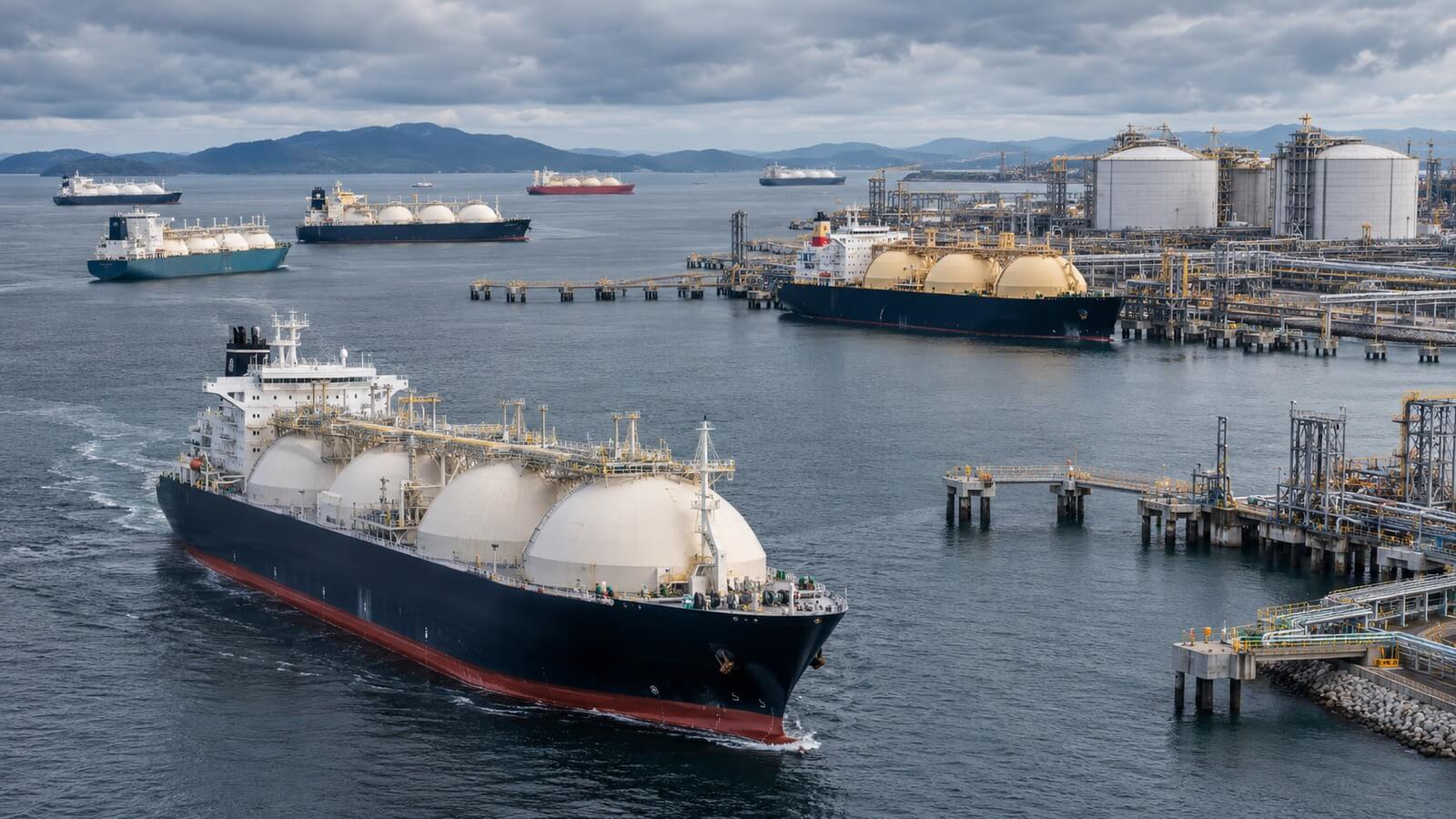
Mitsui O.S.K. Lines (MOL), NYK Line, and Nakilat are among the world's largest LNG carrier fleet owners and operators. Other major participants include Maran Gas Maritime, Seapeak, Kawasaki Kisen Kaisha (K Line), GasLog, and Knutsen.
However, determining who owns the largest LNG fleet is more complicated than counting ships. Some companies own vessels outright, others hold partial ownership through joint ventures, and some manage ships belonging to other businesses.
For investors, these distinctions matter because the number of vessels associated with a company does not necessarily reflect its economic ownership, revenue, or exposure to shipping market conditions.
Which Companies Have the Largest LNG Carrier Fleets?
A fleet comparison published by NYK Line in its 2025 investor materials identified MOL, NYK, and Nakilat as the three largest participants among the companies included in its analysis.
The figures cover vessels delivered by March 31, 2025, and include owned and managed ships. Jointly owned vessels are counted as one vessel for each participating company, regardless of ownership percentage.
| Company | LNG Carriers | Business Profile |
|---|---|---|
| Mitsui O.S.K. Lines (MOL) | 107 | Diversified Japanese shipping group |
| NYK Line | 89 | Diversified Japanese maritime operator |
| Nakilat | 69 | Qatar-based LNG shipping specialist |
| Seapeak | 50 | Specialized gas shipping company |
| Maran Gas Maritime | 47 | Specialized LNG carrier operator |
| K Line | 46 | Japanese shipping group |
| GasLog | 38 | Specialized LNG shipping business |
| MISC | 28 | Malaysian energy transportation group |
| Knutsen | 28 | Specialized maritime transportation group |
| Flex LNG | 13 | Publicly traded LNG carrier owner |
Data note: These are historical comparison figures as of March 31, 2025, not a current November 2026 ranking. They follow NYK's methodology, which includes owned and managed vessels. Fleet totals change as ships are delivered, sold, or transferred between operators.
The comparison highlights the scale of major industry participants, but it should not be interpreted as a ranking of vessels wholly owned by each company.
For a broader comparison of their business models and competitive advantages, read Major LNG Shipping Companies and How They Compete.
Who Owns the Most LNG Tankers?
MOL is among the largest LNG carrier fleet participants by vessel count, while Nakilat is one of the most important specialized owners of large-capacity LNG carriers.
The answer depends on how ownership is measured.
A shipping group may report vessels owned through joint ventures or managed on behalf of other investors. Another company may report only vessels in which it holds an ownership interest.
These reporting differences make direct comparisons difficult.
For example, MOL reported 102 LNG carriers at the end of June 2026 under its fleet reporting methodology. The company also outlined plans to expand to 111 LNG carriers by March 2027.
These figures reflect the company's defined fleet scope, including relevant joint-venture arrangements, rather than 102 vessels necessarily owned outright.
Meanwhile, Nakilat's investor information identifies a fleet of 69 LNG carriers, comprising wholly owned and jointly owned vessels.
The distinction is particularly important when comparing companies with different corporate structures.
What Is the Difference Between Owning and Operating an LNG Carrier?
In maritime transportation, vessel ownership and operation are not always handled by the same company.
Three roles are particularly important.
Vessel Owner
The vessel owner holds the legal ownership interest in the ship, either entirely or through a joint venture.
The owner generally provides capital to acquire or construct the vessel and receives economic benefits associated with its ownership interest.
Commercial Operator
The commercial operator arranges vessel employment, including charter agreements and customer relationships.
Depending on the arrangement, an operator may manage a ship's commercial activities without owning it outright.
Technical Manager
The technical manager oversees maintenance, crew management, safety procedures, and regulatory compliance.
A technical management company may supervise vessels belonging to multiple owners.
Consider a hypothetical LNG carrier jointly owned by two shipping companies. The vessel could be chartered to an energy producer under a long-term agreement and technically managed by a separate maritime services company.
Several businesses would participate in the vessel's operations, but their financial exposure and responsibilities would differ.
Why Do LNG Shipping Companies Use Joint Ventures?
LNG carriers require substantial capital investment, making joint ventures a common ownership structure.
Rather than financing an entire vessel independently, two or more companies may share the investment.
This arrangement offers several potential advantages:
- Shared capital requirements: Partners divide the investment needed to acquire a vessel.
- Risk diversification: Companies reduce their exposure to individual shipping assets.
- Commercial partnerships: Joint ventures can strengthen relationships with energy producers and shipping businesses.
- Access to expertise: Partners may contribute financing, technical management, or customer relationships.
- Fleet expansion: Companies can participate in more vessels without independently financing every ship.
However, joint ventures also make fleet statistics more difficult to interpret.
If two companies each own 50% of the same LNG carrier, both may include that vessel in their reported fleet counts.
Adding their reported totals would therefore double-count the ship.
For investors, the more meaningful questions are how much economic ownership each company holds and what income it receives from that investment.
Why Is Nakilat One of the Most Important LNG Fleet Owners?
Nakilat occupies a distinctive position because its shipping operations are closely connected to Qatar's natural gas export industry.
The company's established LNG fleet includes 69 carriers across three major vessel categories:
| Vessel Category | Number | Approximate Capacity per Vessel |
|---|---|---|
| Conventional LNG carriers | 24 | 145,000–174,000 m³ |
| Q-Flex carriers | 31 | 210,000–217,000 m³ |
| Q-Max carriers | 14 | 263,000–266,000 m³ |
Fleet composition based on Nakilat's published established-fleet information. Newbuilding programs will change the fleet mix as vessels enter service.
These large vessels give Nakilat substantial cargo-carrying capacity.
A Q-Max vessel can transport significantly more LNG per voyage than a conventional carrier, making Nakilat's fleet particularly relevant to large-scale export operations.
The company has also been expanding through agreements associated with QatarEnergy.
In November 2026, Nakilat announced the naming of seven new LNG carriers and two LPG/ammonia carriers. Five of those LNG carriers form part of a 25-vessel construction program linked to long-term charter agreements with QatarEnergy affiliates.
Vessel naming is an important construction milestone, but it does not necessarily mean every named ship has entered commercial service.
For investors, Nakilat demonstrates how a shipping company can combine large vessel capacity, long-term customer relationships, and fleet expansion linked to specific energy projects.
Why Does LNG Fleet Capacity Matter More Than Vessel Count?
Counting ships is useful, but it does not reveal how much LNG a fleet can transport.
LNG carrier capacity is generally measured in cubic meters, representing the volume of liquefied natural gas a vessel can carry.
Two companies with the same number of ships may have substantially different total cargo capacities.
Consider this simplified example:
| Fleet | Number of Ships | Average Capacity | Total Capacity |
|---|---|---|---|
| Fleet A | 20 | 170,000 m³ | 3.4 million m³ |
| Fleet B | 15 | 220,000 m³ | 3.3 million m³ |
Fleet A has five more vessels, but its total cargo capacity is only slightly greater than Fleet B's.
This illustrates why rankings based solely on vessel count can be misleading.
However, larger vessels are not automatically more profitable.
Commercial performance also depends on charter rates, port compatibility, operating expenses, financing costs, and vessel utilization.
A large carrier may transport more LNG per voyage, but its economics depend on customer demand and whether suitable terminals can accommodate it.
How Do Long-Term Charters Affect LNG Fleet Ownership?
Long-term charter agreements are central to the economics of many LNG shipping companies.
A charter contract allows a customer to use a vessel under agreed commercial terms.
These agreements are especially important because constructing an LNG carrier can require hundreds of millions of dollars.
A shipping company may secure a long-term charter before ordering a vessel, increasing confidence that it will generate revenue after delivery.
Contracted revenue can also support financing because lenders can assess expected future charter payments.
However, the economic benefits depend on the agreement's terms.
Important considerations include:
- The agreed daily charter rate.
- The remaining contract duration.
- The financial strength of the charter customer.
- Which party pays fuel and voyage expenses.
- Vessel availability and performance requirements.
- Options to extend or terminate the agreement.
A large fleet supported by long-term charters may generate relatively predictable revenue.
By contrast, substantial spot-market exposure can create greater earnings volatility.
Neither strategy guarantees superior investment returns. Outcomes depend on contracted rates, operating costs, and prevailing market conditions.
How Does Fleet Ownership Influence Shipping Company Profits?
Owning more LNG carriers can increase revenue potential, but it also creates additional costs and financial obligations.
Every vessel requires capital, maintenance, insurance, technical management, and periodic investment.
Shipowners may also carry significant debt associated with vessel construction or acquisition.
Consider two hypothetical companies:
| Characteristic | Company A | Company B |
|---|---|---|
| Owned vessels | 20 | 12 |
| Average fleet age | 15 years | 5 years |
| Charter coverage | Primarily short-term | Primarily long-term |
| Debt exposure | High | Moderate |
| Revenue visibility | More variable | More predictable |
Company A owns more vessels, but Company B may offer greater financial stability because of its contract coverage and financing structure.
These characteristics are illustrative, not actual company data.
The comparison demonstrates why fleet size should be evaluated alongside balance-sheet strength, charter economics, and vessel quality.
For a detailed examination of newbuilding prices, operating expenses, depreciation, and investment returns, see How Much Does an LNG Carrier Cost to Build and Operate?.
How Are LNG Carrier Fleets Expected to Change?
The ownership landscape is evolving as new LNG export projects create additional transportation requirements.
Companies are investing in vessels to support anticipated growth in international LNG trade.
For example, MOL has outlined plans to expand its LNG carrier fleet to 111 vessels by March 2027, compared with 102 at the end of June 2026.
NYK has also described a substantial LNG carrier newbuilding program, with its fleet expected to expand as additional ships enter service.
Nakilat's expansion program includes conventional LNG carriers and larger vessels associated with Qatar's energy development plans.
These projects demonstrate significant industry investment, but fleet growth creates both opportunities and risks.
New vessels increase transportation capacity and may support future charter revenue.
However, if deliveries outpace growth in LNG transportation demand, the market may experience excess shipping capacity.
That imbalance can put downward pressure on charter rates, especially for vessels without long-term employment agreements.
Fleet expansion should therefore be evaluated against LNG production schedules, expected cargo volumes, and vessel delivery timing.
For a broader examination of global fleet size, newbuilding orders, deliveries, and capacity growth, read How Many LNG Carriers Are in the Global Fleet?.
What Should Investors Examine When Comparing LNG Fleet Owners?
Investors evaluating LNG shipping companies should look beyond the number of vessels associated with each business.
Several indicators provide a clearer picture of economic ownership and financial exposure.
| Indicator | Why It Matters |
|---|---|
| Wholly owned vessels | Shows ships fully controlled through ownership |
| Jointly owned vessels | Reveals shared investment exposure |
| Total fleet capacity | Measures potential LNG transportation volume |
| Average vessel age | Influences maintenance costs and competitiveness |
| Charter coverage | Indicates future revenue visibility |
| Debt and financing | Shows financial obligations associated with fleet ownership |
| Newbuilding commitments | Identifies future capital requirements and growth plans |
| Customer concentration | Highlights dependence on major charter counterparties |
These indicators are particularly important when comparing diversified maritime groups with specialized LNG carrier owners.
A diversified company may operate a large LNG fleet while generating much of its overall earnings from other shipping businesses.
A specialized owner may have fewer vessels but provide investors with more direct exposure to LNG charter economics.
Financial results also depend on accounting treatment. Jointly owned vessels may contribute through equity-method earnings rather than being fully consolidated into revenue and operating expenses.
Consequently, fleet rankings should never replace an examination of company financial statements.
Who Leads the LNG Carrier Ownership Market?
MOL, NYK, and Nakilat remain central participants in global LNG carrier ownership and operations, although reported fleet counts reflect different ownership and management arrangements.
MOL and NYK benefit from scale, maritime expertise, and international partnerships. Nakilat stands out for its substantial cargo capacity, specialized LNG focus, and commercial connections with Qatar's export industry.
Other operators, including Maran Gas Maritime, Seapeak, GasLog, and Knutsen, contribute significant capacity to the global market.
For investors, the critical distinction is between the number of vessels a company reports and the financial benefits it actually receives from those ships.
Ownership percentages, charter agreements, financing arrangements, and fleet efficiency can matter more than a company's position in a fleet ranking.
For wider industry context, including how LNG transportation works, global trade patterns, and shipping economics, explore LNG Shipping Industry: Companies, Ships and Market Economics.
Ultimately, fleet size provides useful context, but economic ownership and sustainable cash flow are more meaningful measures of investment quality.
Disclaimer: This article is for informational and educational purposes only and does not constitute financial or investment advice. LNG shipping investments involve market, operational, financing, and regulatory risks. Investors should conduct independent research and verify current company disclosures before making investment decisions.