
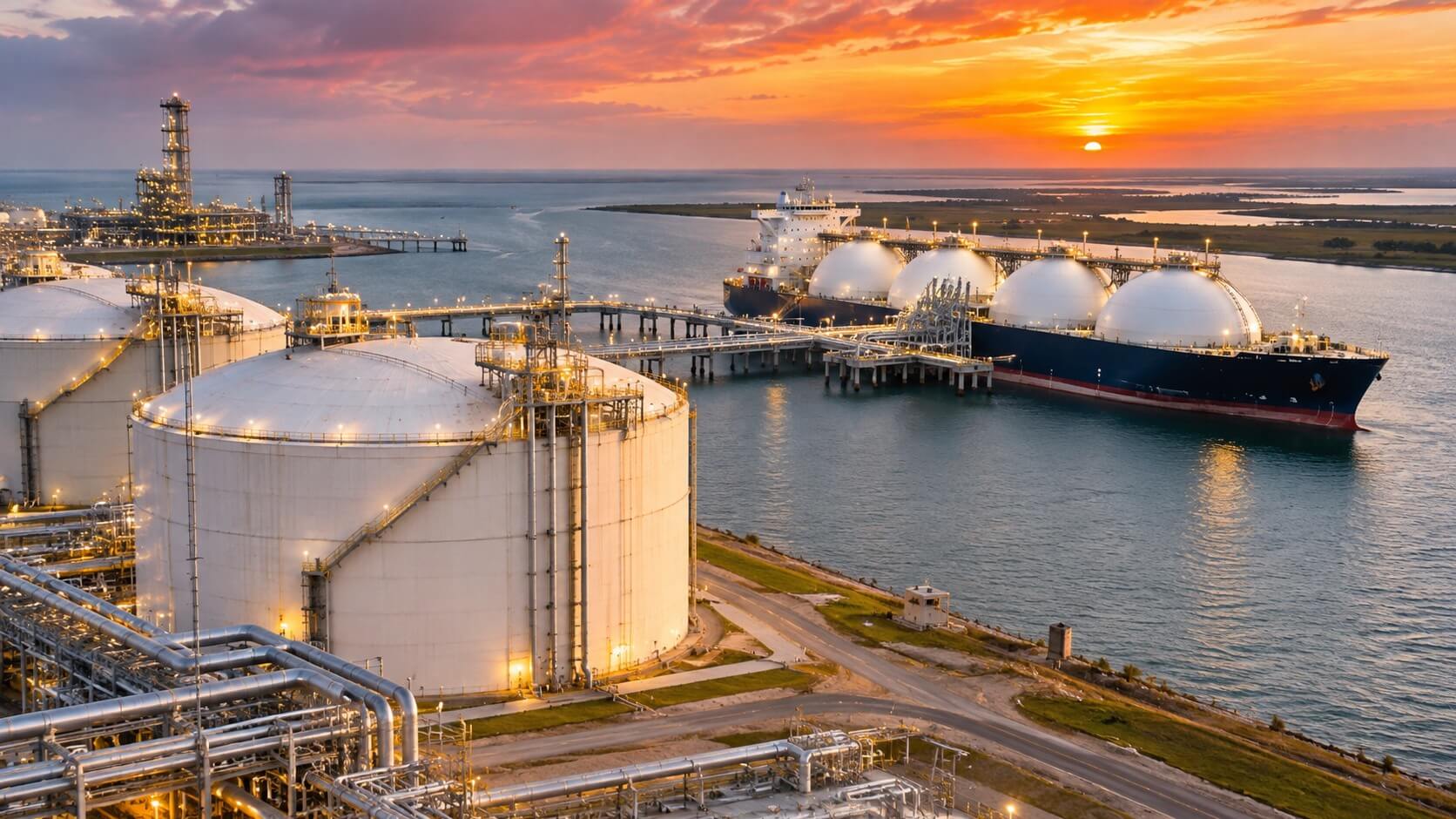
Cheniere Energy is the largest established liquefied natural gas (LNG) exporter in the United States by combined operating liquefaction capacity. Its Sabine Pass facility in Louisiana and Corpus Christi complex in Texas make it a leading participant in American LNG exports.
Other major US LNG companies include Venture Global, Sempra, Freeport LNG, and the ExxonMobil-QatarEnergy partnership behind Golden Pass LNG.
These businesses differ in operating capacity, ownership structures, expansion strategies, and exposure to international LNG prices. For investors, identifying the largest exporter is only the starting point: cash flow, debt, contracts, and construction risks also determine investment attractiveness.
Who Are the Biggest LNG Export Companies in the United States?
The US LNG industry includes established export operators, infrastructure developers, diversified energy companies, and specialized joint ventures.
The following table identifies major participants as of 2026. It is not a strict ranking by actual LNG shipments.
| Company | Major US LNG facilities | Role in the industry |
|---|---|---|
| Cheniere Energy (NYSE: LNG) | Sabine Pass, Corpus Christi | Leading established LNG exporter |
| Venture Global (NYSE: VG) | Calcasieu Pass, Plaquemines | Major exporter expanding production capacity |
| Sempra (NYSE: SRE) | Cameron LNG, Port Arthur LNG | Infrastructure investor and project developer |
| Freeport LNG | Freeport LNG | Major independent terminal operator |
| ExxonMobil (NYSE: XOM) | Golden Pass LNG | Integrated energy company and joint-venture investor |
| QatarEnergy | Golden Pass LNG | International LNG producer and infrastructure investor |
| Kinder Morgan (NYSE: KMI) | Elba Island LNG | Natural gas transportation and LNG infrastructure |
| Berkshire Hathaway Energy | Cove Point LNG | Energy infrastructure owner and operator |
Company rankings depend on the measurement used. Nominal liquefaction capacity, actual cargo shipments, contracted LNG sales, and economic ownership can produce different results.
Some businesses directly operate terminals, while others participate through joint ventures or own supporting infrastructure.
For an overview of the complete supply chain, see US LNG Exporters and Terminals: How the Industry Works.
1. Cheniere Energy: The Largest Established US LNG Exporter
Cheniere Energy operates two major American LNG export complexes: Sabine Pass in Louisiana and Corpus Christi in Texas.
Together, these facilities provide substantial operating capacity and access to international natural gas markets.
Sabine Pass LNG
Sabine Pass began exporting LNG in 2016 and became one of the foundations of the US LNG export industry's expansion.
The facility operates six liquefaction trains, which are industrial production units that cool natural gas into liquid form.
According to the US Energy Information Administration (EIA), Sabine Pass had approximately 3.6 billion cubic feet per day (Bcf/d) of nominal liquefaction capacity in September 2026.
Nominal capacity describes expected sustainable production under specified operating conditions. It differs from peak capacity, which represents higher output achievable under favorable conditions.
Sabine Pass was the largest US LNG export facility by nominal capacity at that time.
Corpus Christi LNG
Cheniere's second major complex is located near Corpus Christi, Texas.
The facility expanded through its Stage 3 development, which added new liquefaction trains.
On August 28, 2026, Cheniere completed the seventh and final train in that expansion.
The EIA reported that Corpus Christi reached approximately 3.1 Bcf/d of nominal capacity, making it the second-largest US LNG export facility by that measurement in September 2026.
Combined, Sabine Pass and Corpus Christi represented approximately 6.7 Bcf/d of nominal liquefaction capacity following completion of Stage 3.
This operating scale supports Cheniere's position among established American exporters.
Why Cheniere matters to investors
Unlike companies depending primarily on future projects, Cheniere has substantial operating infrastructure and an established commercial portfolio.
Long-term LNG agreements support revenue visibility, although financial results still depend on contractual terms, operating reliability, financing expenses, and market conditions.
Investors should distinguish cash flow from existing facilities from the capital required for future expansions.
Cheniere's leadership in operating capacity does not automatically make its shares the best investment. Stock valuation, debt, free cash flow, and growth expectations remain important.
2. Venture Global: A Major Competitor Expanding US LNG Capacity
Venture Global has become a significant American LNG exporter through large-scale projects along the Louisiana Gulf Coast.
Its principal facilities include Calcasieu Pass and Plaquemines LNG.
Calcasieu Pass LNG
Calcasieu Pass began exporting LNG in 2022.
The facility uses a modular liquefaction design, with standardized production equipment intended to support efficient construction and project development.
However, modular construction does not eliminate commissioning difficulties, operational disruptions, or disputes involving commercial obligations.
Investors should evaluate actual production, contract performance, and operating costs rather than relying exclusively on the project's construction approach.
Plaquemines LNG
Plaquemines LNG is a major expansion of Venture Global's export operations.
The facility began producing LNG in late 2024 and increased shipments as additional production units became available.
By September 2026, the EIA reported that Plaquemines was exporting at full capacity.
Its development demonstrates how newer operators can become major industry participants by bringing substantial liquefaction infrastructure into service.
What makes Venture Global different?
Venture Global's investment profile is closely tied to rapid capacity development and the transition of new projects into commercial operation.
This strategy offers growth opportunities but also creates construction, financing, commissioning, and contractual risks.
Investors should monitor facility utilization, project completion, customer disputes, debt obligations, and the timing of commercial cash generation.
Rapidly increasing LNG shipments does not necessarily translate into equally rapid profit growth when expenses and financial obligations are rising.
3. Sempra Infrastructure: LNG Development Through Major Partnerships
Sempra is a diversified North American energy infrastructure company with significant interests in LNG export facilities.
Its major LNG involvement includes Cameron LNG in Louisiana and Port Arthur LNG in Texas.
Cameron LNG
Cameron LNG is an established export facility operated through a partnership involving major energy and infrastructure investors.
Sempra participates through ownership interests rather than owning the entire terminal independently.
This distinction matters because a company's economic share of a facility may differ from the facility's total production capacity.
Port Arthur LNG
Port Arthur LNG is a major development project in Texas.
Its planned production capacity represents potential future growth, but construction-stage facilities should not be treated as equivalent to fully operating terminals.
Construction schedules, financing, customer contracts, and project costs determine when the investment can begin generating commercial revenue.
Why Sempra is different from pure LNG companies
Sempra operates across a broader energy infrastructure portfolio, including regulated utility businesses.
Consequently, its financial performance depends on more than LNG exports.
Investors should examine the contribution of LNG projects to consolidated earnings alongside utility operations, infrastructure spending, debt, and other financial commitments.
Sempra therefore provides a different form of LNG exposure from companies focused primarily on liquefaction and export operations.
4. Freeport LNG: A Major Independent Export Terminal
Freeport LNG operates a large liquefaction and export facility on the Texas Gulf Coast.
The terminal has three liquefaction trains and supplies LNG to international markets.
Its operations illustrate why production reliability is essential when evaluating LNG infrastructure.
Why terminal reliability matters
LNG facilities depend on complex industrial equipment, storage systems, and continuous operations.
Unexpected shutdowns can interrupt shipments, reduce available capacity, and create financial consequences for operators and customers.
A terminal's nominal capacity therefore does not guarantee equivalent export volumes every year. Maintenance, equipment availability, and operational disruptions influence actual production.
Freeport LNG is privately held, meaning investors cannot directly purchase shares in the operator through a conventional publicly traded Freeport LNG stock.
Nevertheless, its performance can affect natural gas suppliers, transportation companies, and international LNG trading markets.
5. ExxonMobil and QatarEnergy: The Golden Pass LNG Partnership
Golden Pass LNG is a major Texas export project owned through a joint venture between QatarEnergy and ExxonMobil.
The partnership combines the resources of two large international energy companies.
Golden Pass entered the export market in 2026
Golden Pass began exporting LNG in April 2026.
According to the EIA, the facility exported less than 0.2 Bcf/d on average between April and June 2026 as its initial production capacity was being brought online.
Output was expected to increase as additional liquefaction capacity became available.
This illustrates the difference between planned terminal capacity and actual exports during commissioning.
New facilities can require months to increase production toward their intended operating levels, depending on equipment readiness and operational performance.
What Golden Pass means for ExxonMobil
Golden Pass expands ExxonMobil's participation in LNG infrastructure and international natural gas markets.
However, ExxonMobil also operates substantial oil production, refining, chemical, and other energy businesses.
Its financial results therefore cannot be evaluated through LNG exports alone.
For shareholders, Golden Pass represents one component of a diversified energy portfolio rather than concentrated exposure to US LNG terminal operations.
6. Other Important US LNG Infrastructure Operators
Several additional businesses contribute to American LNG exports through transportation infrastructure, terminal ownership, and new developments.
Kinder Morgan
Kinder Morgan operates extensive natural gas pipeline infrastructure and participates in Elba Island LNG in Georgia.
Its operations demonstrate how increasing LNG exports can support pipeline transportation demand even for companies that are not among the largest LNG sellers.
Reliable pipeline access is essential because export terminals require consistent natural gas deliveries.
Berkshire Hathaway Energy
Berkshire Hathaway Energy is associated with Cove Point LNG in Maryland, an important example of American LNG infrastructure outside the Gulf Coast.
Investors can obtain indirect exposure through Berkshire Hathaway, but LNG represents only a small part of its broader collection of businesses.
NextDecade
NextDecade (NASDAQ: NEXT) is developing Rio Grande LNG in Texas.
Unlike operators with mature export facilities, its investment profile depends heavily on project execution, construction spending, financing, customer commitments, and eventual commercial operations.
Planned production capacity should not be included as operating capacity when comparing current exporters.
How Do the Largest US LNG Export Facilities Compare?
LNG facilities are commonly compared by nominal liquefaction capacity, measured in billion cubic feet per day or million metric tons per year.
As of September 2026, the EIA identified Sabine Pass as the largest US LNG export facility by nominal capacity, followed by Corpus Christi after its Stage 3 expansion.
| LNG facility | Location | Major company | Position in the market |
|---|---|---|---|
| Sabine Pass | Louisiana | Cheniere Energy | Largest by nominal capacity in September 2026 |
| Corpus Christi | Texas | Cheniere Energy | Second-largest by nominal capacity in September 2026 |
| Plaquemines | Louisiana | Venture Global | Major expanding export complex |
| Freeport | Texas | Freeport LNG | Established large-scale export terminal |
| Cameron | Louisiana | Sempra-led partnership | Established large-scale export terminal |
| Calcasieu Pass | Louisiana | Venture Global | Established LNG export operation |
| Golden Pass | Texas | ExxonMobil and QatarEnergy | New export facility ramping up in 2026 |
This comparison identifies major facilities and their industry roles rather than providing a precise ranking of monthly production.
Actual shipments depend on utilization, maintenance, commissioning, pipeline deliveries, and commercial arrangements.
A facility with greater nominal capacity may export less LNG than a smaller terminal during periods of maintenance or operational disruption.
For a more detailed capacity comparison, see What Is the Largest LNG Export Plant in the US?.
Why Are Most Major LNG Exporters Located Along the Gulf Coast?
Louisiana and Texas dominate American LNG export infrastructure because they combine access to natural gas supplies with established transportation networks and industrial ports.
The Gulf Coast offers several advantages:
- Proximity to major natural gas-producing regions.
- Extensive pipeline systems.
- Deepwater ports and marine infrastructure.
- Established energy-sector suppliers and contractors.
- Access to international shipping routes.
These conditions support both existing operators and developers planning new terminals.
However, geographical concentration also creates risks. Hurricanes, coastal flooding, pipeline disruptions, and regional infrastructure constraints can affect multiple facilities.
Rapid construction activity can also increase competition for specialized workers, equipment, and pipeline capacity.
Investors should consider these regional advantages and vulnerabilities when comparing export projects.
For a detailed geographical overview, see Where Are LNG Export Terminals Located in the US?.
How Do LNG Exporters Compete for International Customers?
US LNG exporters compete through pricing, contract flexibility, supply reliability, shipping access, and their ability to serve different international markets.
Customers include utilities, energy trading companies, industrial businesses, and national energy companies.
Long-term contracts versus spot sales
Many LNG projects depend on long-term sales or liquefaction agreements to support financing and provide revenue visibility.
These contracts may include fixed fees, commodity-linked pricing formulas, or combinations of both.
Spot sales involve LNG sold for shorter-term delivery and can be more directly exposed to international market prices.
Consequently, two companies exporting similar volumes may generate different earnings depending on their contract structures and exposure to commodity prices.
Why international infrastructure matters
Exporters also depend on receiving infrastructure in destination markets.
Customers need suitable import terminals, storage facilities, and connections to domestic gas networks.
Countries lacking sufficient receiving capacity may be unable to import substantial LNG volumes even when additional natural gas supplies would be useful.
The importance of international receiving facilities is explained in Which Countries Have LNG Terminals and Why Do They Matter?.
Does Being the Largest LNG Exporter Make a Company the Best Investment?
No. The largest LNG exporter is not necessarily the most attractive LNG stock. Operating scale can provide advantages, but investment returns also depend on profitability, debt, growth expectations, and the price paid for shares.
Large exporters may benefit from established customer relationships, operating experience, and economies of scale. However, they can also face substantial financing obligations and expensive expansion programs.
Smaller companies may offer greater growth potential while carrying more concentrated operational and construction risks.
Operating cash flow
Compare cash generated by existing facilities with the funding required for future projects.
An established exporter with reliable operating cash flow has a different financial profile from a developer awaiting commercial production.
Debt and financing costs
High borrowing costs can reduce the benefits of increasing export capacity.
Investors should examine debt levels, interest expenses, repayment obligations, and future capital requirements.
Contract quality
Long-term contracts can support predictable revenue, but their value depends on pricing formulas, duration, customer creditworthiness, and payment obligations.
Expansion spending
Additional liquefaction trains may increase future revenue potential while introducing construction risk and higher capital commitments.
Growth projects should be evaluated according to their expected economic returns rather than announced production capacity alone.
Stock valuation
Even a successful LNG company can deliver disappointing investment returns if its shares already reflect overly optimistic growth expectations.
The central question is whether the company's realistic future cash generation justifies its market valuation.
What Could Change the Ranking of US LNG Exporters?
American LNG export capacity continues to expand, potentially changing the relative positions of established operators and newer developers.
According to the EIA, US LNG exports averaged 17.4 Bcf/d during the first half of 2026, approximately 23% higher than in the corresponding period of 2025.
Several factors could influence future company rankings:
- New terminal completions: Additional operating liquefaction trains can increase export capacity.
- Facility utilization: Maintenance and operating reliability determine how much LNG terminals actually export.
- Construction schedules: Delays can affect when new production enters the market.
- International contracts: Customer commitments influence project financing and commercial viability.
- Corporate transactions: Partnerships, acquisitions, and asset sales can change ownership exposure.
- Global demand: International purchasing patterns influence actual LNG shipments and commercial opportunities.
Future rankings based on capacity may differ from those based on actual shipments, revenue, or ownership interests.
Investors should not treat proposed expansion projects as guaranteed production growth.
Which US LNG Exporters Matter Most for Investors?
Cheniere Energy remains a leading example of an established American LNG exporter, supported by its large Sabine Pass and Corpus Christi operations.
Venture Global is another major participant, with substantial export infrastructure and a growing production portfolio.
Sempra, ExxonMobil, Kinder Morgan, and Berkshire Hathaway provide different forms of LNG exposure through joint ventures, infrastructure ownership, and diversified energy operations.
Freeport LNG is an important independent terminal operator, although its shares are not directly available through public stock markets.
Investors should distinguish three questions:
- Which company operates the most LNG export capacity today?
- Which companies have credible opportunities to expand future capacity?
- Which businesses can convert their LNG operations into sustainable cash flow and attractive shareholder returns?
These questions can produce different answers.
For retail investors, understanding the differences between established exporters, developing projects, and diversified infrastructure companies is more valuable than relying on company size alone.
Disclaimer: This article is for informational and educational purposes only and does not constitute financial or investment advice. LNG-related investments involve commodity price, operational, regulatory, construction, and financial risks. Investors should conduct independent research before making investment decisions.