
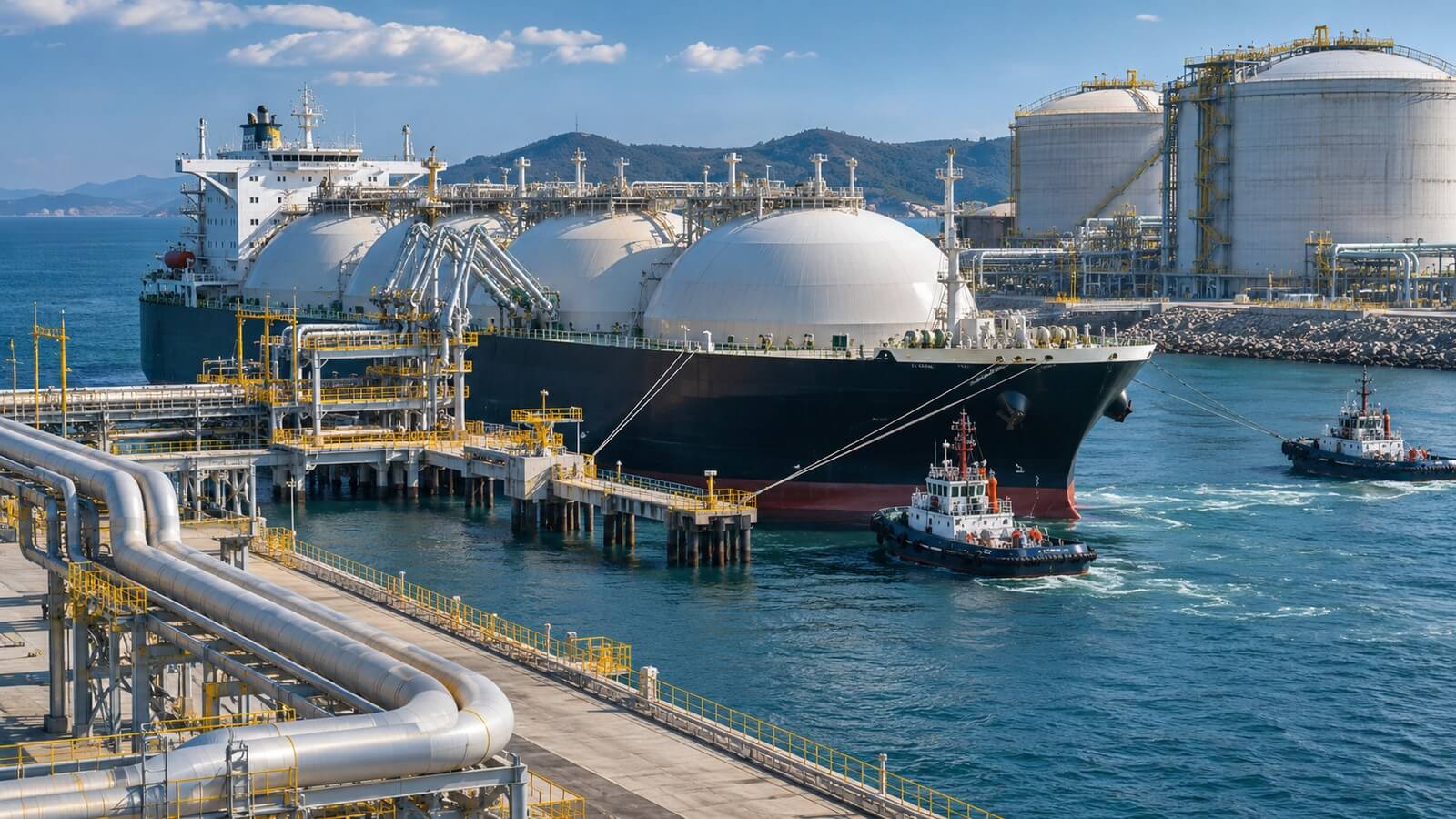
A modern LNG carrier typically costs approximately $245 million to $250 million to build, based on 2026 market prices for standard large vessels with around 174,000 cubic meters of cargo capacity. Operating expenses can add another $15,000 to $17,000 per day, excluding financing, depreciation, and certain voyage costs.
For investors, the construction price is only the starting point. An LNG carrier's profitability depends on charter revenue, operating expenses, debt financing, vessel utilization, and its value over the operating life.
These factors explain why LNG shipping companies can generate substantial revenue while facing significant financial risks, particularly when charter rates decline or new vessels enter an oversupplied market.
How Much Does a New LNG Carrier Cost?
The construction price of an LNG carrier depends on vessel size, propulsion technology, shipyard availability, equipment specifications, and the timing of the order.
According to Clarksons Research data reported in November 2026, the benchmark newbuilding price for a 174,000-cubic-meter LNG carrier declined from approximately $248 million in January 2026 to $245 million in October.
The decline was modest, and LNG carriers remain among the most expensive commercial vessels.
| Vessel Type | Indicative Construction Cost | Important Consideration |
|---|---|---|
| Modern 174,000 m³ LNG carrier | Approximately $245 million | October 2026 benchmark newbuilding price |
| Comparable newbuilding contracts | Approximately $245–250 million | Actual prices vary by shipyard and specifications |
| Larger specialized LNG carriers | Project-specific | Capacity, design, and equipment influence pricing |
| Older secondhand LNG carriers | Highly variable | Age, propulsion technology, and charter employment matter |
These figures are market benchmarks, not guaranteed transaction prices. Individual contracts can differ substantially depending on vessel specifications and commercial terms.
For example, a shipowner ordering several identical carriers may negotiate different pricing from a company purchasing a single specialized vessel.
Why Are LNG Carriers So Expensive?
LNG carriers are more technically complex than conventional cargo ships because they transport natural gas at extremely low temperatures.
Natural gas becomes liquid when cooled to approximately minus 162 degrees Celsius, or minus 260 degrees Fahrenheit.
At this temperature, it occupies roughly 600 times less space than in gaseous form, making large-scale maritime transportation practical.
Maintaining these conditions requires specialized equipment and engineering.
Advanced Cargo Containment Systems
LNG carriers use specially designed tanks to store liquefied natural gas safely.
These tanks require advanced insulation and materials capable of withstanding extremely low temperatures.
Cargo containment systems contribute significantly to the vessel's construction cost.
Specialized Propulsion Systems
Modern LNG carriers frequently use efficient propulsion technologies capable of consuming natural gas as fuel.
These systems improve energy efficiency and help manage gas that naturally evaporates from the cargo during transportation.
Advanced propulsion equipment can increase upfront construction costs while potentially reducing fuel consumption and operating expenses over time.
Safety and Regulatory Requirements
LNG transportation requires sophisticated monitoring, safety, and emergency systems.
Vessels must comply with international maritime regulations and technical standards, creating additional construction and maintenance requirements.
These demands help explain why LNG carrier construction is concentrated among shipyards with specialized engineering expertise.
How Much Does It Cost to Operate an LNG Carrier?
Operating expenses are a major consideration for LNG shipping companies because vessels require continuous maintenance, qualified crews, insurance, and specialized technical management.
Actual costs vary according to vessel age, management practices, insurance expenses, and operating conditions.
Flex LNG, a publicly traded LNG carrier owner, provides a useful real-world example.
In its second-quarter 2026 financial results, Flex LNG reported average vessel operating expenses of approximately $16,260 per day.
For the first six months of 2026, average operating expenses were approximately $16,108 per day.
These figures represent reported vessel operating expenses divided by available vessel days. They do not include every cost associated with owning and financing a carrier.
Typical LNG Carrier Operating Expenses
| Expense Category | What It Includes |
|---|---|
| Crew | Salaries, training, travel, and personnel costs |
| Maintenance | Routine repairs, spare parts, and equipment servicing |
| Insurance | Hull coverage and liability protection |
| Technical management | Operational supervision and vessel administration |
| Compliance | Safety inspections and regulatory requirements |
| Dry-docking | Periodic inspections and major maintenance work |
Fuel, port expenses, and canal charges may be paid by different parties depending on the charter agreement.
Under many time-charter arrangements, the charterer pays major voyage expenses, while the shipowner remains responsible for vessel operating costs.
This distinction is essential when comparing shipping company financial statements and evaluating operating margins.
What Does an LNG Carrier Cost to Operate Annually?
Using an illustrative daily operating cost of $16,000, annual vessel operating expenses would be:
$16,000 × 365 = $5.84 million per year.
This calculation assumes a constant daily operating cost throughout the year.
It excludes debt service, depreciation, corporate overhead, and certain voyage expenses.
A shipowner may therefore spend substantially more than $5.84 million annually after accounting for all financial obligations.
For a fleet of 10 comparable vessels, the same daily operating expense would translate into approximately $58.4 million in annual vessel operating costs.
This illustrates why relatively small changes in daily expenses can materially affect profitability across a large LNG fleet.
How Much Revenue Can an LNG Carrier Generate?
LNG carriers primarily generate revenue through charter agreements.
These contracts allow energy producers, commodity traders, or other customers to use vessels under agreed commercial terms.
Revenue depends on the daily charter rate and the number of revenue-generating days.
Consider a hypothetical LNG carrier operating under a time charter at $80,000 per day.
If the vessel generates revenue for 350 days annually, gross charter revenue would be:
$80,000 × 350 = $28 million.
Now compare three hypothetical charter-rate scenarios.
| Daily Charter Rate | Annual Revenue at 350 Days |
|---|---|
| $50,000 | $17.5 million |
| $80,000 | $28 million |
| $110,000 | $38.5 million |
These figures are illustrative scenarios, not current market quotations or forecasts.
The difference between the lowest and highest scenarios is $21 million in annual gross charter revenue for a single vessel.
This demonstrates how strongly charter rates influence shipping company earnings.
How Much Profit Can an LNG Carrier Make?
Gross charter revenue should not be confused with net profit.
To understand vessel economics, investors must consider operating expenses, financing costs, and other obligations.
Consider a simplified hypothetical example involving a $245 million LNG carrier.
| Financial Item | Annual Amount |
|---|---|
| Gross charter revenue | $28.00 million |
| Vessel operating expenses | -$5.84 million |
| Illustrative corporate overhead allocation | -$0.60 million |
| Illustrative annual interest expense | -$7.00 million |
| Cash remaining before principal repayments, major capital spending, and taxes | $14.56 million |
This example is deliberately simplified and does not represent an actual LNG shipping company.
The $14.56 million figure is neither accounting net income nor free cash flow. It excludes principal repayments, depreciation, certain maintenance investments, possible additional voyage expenses, and taxes.
It demonstrates that a vessel can generate substantial charter revenue while its owner still faces significant financial commitments.
How Does Financing Affect LNG Carrier Economics?
Shipping companies do not always finance the entire construction cost of a vessel with their own cash.
They may use bank loans, leasing arrangements, or other forms of debt to fund part of the investment.
Consider a hypothetical $245 million LNG carrier financed with 60% debt and 40% equity.
| Financing Component | Amount |
|---|---|
| Vessel purchase price | $245 million |
| Debt financing (60%) | $147 million |
| Equity investment (40%) | $98 million |
Borrowing allows a shipping company to acquire a vessel without providing the entire purchase price upfront.
However, debt creates interest expenses and scheduled repayment obligations.
Higher interest rates can increase financing costs for companies with floating-rate debt that is not fully hedged.
Leverage also increases financial risk when charter revenue declines.
A heavily indebted company may face pressure during weak shipping markets even when its vessels remain operational.
Investors should examine debt maturities, interest rates, available liquidity, and the ability to meet scheduled repayments.
How Long Does It Take to Recover the Cost of an LNG Carrier?
There is no universal payback period for an LNG carrier.
The answer depends on charter revenue, operating expenses, financing costs, maintenance investments, and eventual resale value.
A simplified calculation can illustrate the relationship between vessel cost and operating cash generation.
Suppose a $245 million carrier generates $28 million in annual charter revenue and incurs $5.84 million in annual operating expenses.
The difference is approximately $22.16 million before financing, corporate overhead, major capital spending, and taxes.
Dividing the construction price by this amount produces a simplified payback period of approximately 11.1 years.
However, this is not a realistic forecast of the time required to recover an investor's capital.
It excludes financing obligations, periods without employment, changing charter rates, major maintenance expenses, and the vessel's residual value.
Actual investment returns require a comprehensive cash-flow analysis over the carrier's operating life.
How Does Depreciation Affect LNG Carrier Profitability?
Depreciation is an accounting expense that allocates a vessel's cost over its estimated useful life.
It reduces reported accounting profit without representing a new cash payment each year.
For example, suppose a shipping company purchases a carrier for $245 million, expects to operate it for 30 years, and estimates a residual value of $25 million.
Using straight-line depreciation, the annual accounting expense would be:
($245 million - $25 million) ÷ 30 = approximately $7.33 million per year.
This is a hypothetical example. Actual shipping companies apply their own accounting estimates and depreciation policies.
Depreciation matters because LNG carriers are expensive assets that age and may become less competitive as technology improves.
However, depreciation alone does not determine the cash available for debt repayments or shareholder distributions.
Investors should evaluate both accounting earnings and cash-flow measures.
How Much Is a Full LNG Tanker Worth?
The market value of an LNG carrier and the value of its cargo are separate considerations.
A vessel's value depends on its age, condition, propulsion technology, charter contracts, and prevailing prices for comparable ships.
The cargo's value depends on the quantity of LNG transported and the market price of natural gas.
For example, a modern 174,000-cubic-meter LNG carrier can transport a substantial quantity of natural gas, but the cargo's market value changes with regional gas prices and commercial contract terms.
A ship carrying LNG worth tens of millions of dollars does not automatically become worth that amount in addition to its own market price.
The vessel and cargo frequently belong to different commercial parties.
Under a time charter, the shipowner may earn transportation revenue while the charter customer retains ownership of the LNG cargo.
For investors, this distinction matters because LNG shipping companies generally earn money from transportation services rather than directly benefiting from increases in the market value of the gas carried.
Are Secondhand LNG Carriers Cheaper Than New Ships?
Secondhand LNG carriers may cost less than newly constructed vessels, but their market values depend on several factors.
Important considerations include:
- Vessel age and remaining useful life.
- Propulsion technology and fuel efficiency.
- Maintenance history and technical condition.
- Existing charter contracts.
- Current demand for LNG transportation.
- Availability and pricing of new vessels.
Older carriers may face higher maintenance costs and weaker demand, particularly when newer ships offer better fuel efficiency.
However, a secondhand vessel with a favorable long-term charter can remain economically attractive.
Conversely, purchasing an inexpensive carrier without secured employment may expose an investor to significant market risk.
The purchase price must therefore be evaluated alongside expected future cash flow.
Why Do LNG Carrier Costs Differ Between Shipping Companies?
Two LNG shipping companies can operate similar vessels but report different costs and financial results.
Several factors explain these differences.
Fleet Age
Older vessels may require more maintenance and consume more fuel than newer carriers.
However, modern ships may involve higher acquisition costs and larger financing commitments.
Fleet Size
Larger operators may benefit from purchasing power, shared technical management resources, and established supplier relationships.
However, fleet size alone does not guarantee lower costs.
Financing Structure
Companies with lower borrowing costs or less debt may retain more cash after meeting financing obligations.
Charter Agreements
Long-term charters can provide revenue visibility, while short-term agreements create greater exposure to market-rate fluctuations.
Operational Efficiency
Effective maintenance, reliable technical management, and limited vessel downtime can improve financial performance.
For investors comparing operators, Major LNG Shipping Companies and How They Compete examines how business models, fleet strategies, and charter agreements influence competition.
How Does Fleet Ownership Influence Investment Returns?
Ownership structure affects how much capital a company invests and the financial exposure it assumes.
A shipping company may own a vessel outright or share ownership through a joint venture.
Joint ventures allow businesses to participate in additional vessels while sharing investment costs and financial risks.
However, owning a smaller percentage of a carrier generally means receiving a corresponding share of its economic benefits, subject to contractual arrangements.
This creates an important distinction between reported fleet size and actual invested capital.
A company associated with 50 LNG carriers does not necessarily have the same financial exposure as another business that wholly owns 50 vessels.
For a closer examination of ownership structures, joint ventures, and fleet capacity, read Who Owns the Largest LNG Carrier Fleets?.
What Are the Biggest Financial Risks of Owning LNG Carriers?
LNG carrier ownership involves substantial capital commitments and exposure to changing shipping market conditions.
Several risks deserve particular attention.
Declining Charter Rates
When available vessel capacity exceeds transportation demand, charter rates may decline.
Companies with substantial spot-market exposure can experience significant revenue fluctuations.
Newbuilding Oversupply
Ships ordered during periods of strong demand may enter service years later, when market conditions are less favorable.
If too many carriers are delivered within a short period, competition can intensify.
Project Delays
New LNG carriers are sometimes ordered in anticipation of future liquefaction projects.
If those projects are delayed, vessels may become available before the expected cargoes require transportation.
Interest Rate and Refinancing Risk
Shipping companies frequently use debt financing, making interest expenses and refinancing conditions important to financial stability.
Technological Obsolescence
Improvements in propulsion efficiency and evolving environmental requirements can reduce the competitiveness of older vessels.
Counterparty Risk
Long-term charter agreements depend on customers meeting their financial and contractual obligations.
These risks explain why an expensive fleet does not necessarily represent a financially strong shipping business.
What Should Investors Monitor in LNG Carrier Economics?
Investors evaluating LNG shipping companies should focus on the relationship between vessel investment costs and the cash those vessels can generate.
Several indicators are particularly useful.
| Indicator | Why It Matters |
|---|---|
| Newbuilding prices | Influence the capital required for fleet expansion |
| Daily charter rates | Determine revenue potential per vessel |
| Operating expenses | Reduce cash generated by shipping activities |
| Fleet utilization | Shows how effectively vessels generate revenue |
| Contract duration | Provides visibility into future employment |
| Debt and interest costs | Influence financial risk and cash available to investors |
| Vessel age | Affects maintenance requirements and competitiveness |
| Residual value | Influences long-term investment economics |
These indicators should be evaluated together rather than individually.
For example, a company with high charter revenue may still generate weak cash flow if debt payments and capital expenditures are substantial.
Similarly, low operating expenses offer limited benefit when vessels cannot secure profitable employment.
To understand how new vessel deliveries affect shipping capacity and charter rates, explore How Many LNG Carriers Are in the Global Fleet?.
Are LNG Carriers Profitable Investments?
LNG carriers can generate substantial revenue over their operating lives, particularly when supported by reliable charter agreements and disciplined financing.
However, profitability is not guaranteed.
At approximately $245 million for a modern large vessel, the initial investment is significant. Operating expenses, debt obligations, maintenance, and future charter rates determine whether the carrier produces attractive financial returns.
Long-term charter contracts can reduce revenue uncertainty, but they do not eliminate operational, financing, or counterparty risks.
Investors should also consider broader shipping market conditions, including new vessel deliveries, LNG export growth, and changes in global transportation demand.
For a complete industry overview covering shipping companies, carrier fleets, global trade, and investment economics, read LNG Shipping Industry: Companies, Ships and Market Economics.
The central investment question is not simply how much an LNG carrier costs, but whether it can generate sufficient sustainable cash flow over its useful life to justify its construction price, financing obligations, and associated risks.
Disclaimer: This article is for informational and educational purposes only and does not constitute financial or investment advice. LNG shipping investments involve market, operational, financing, and regulatory risks. Investors should conduct independent research before making investment decisions.