
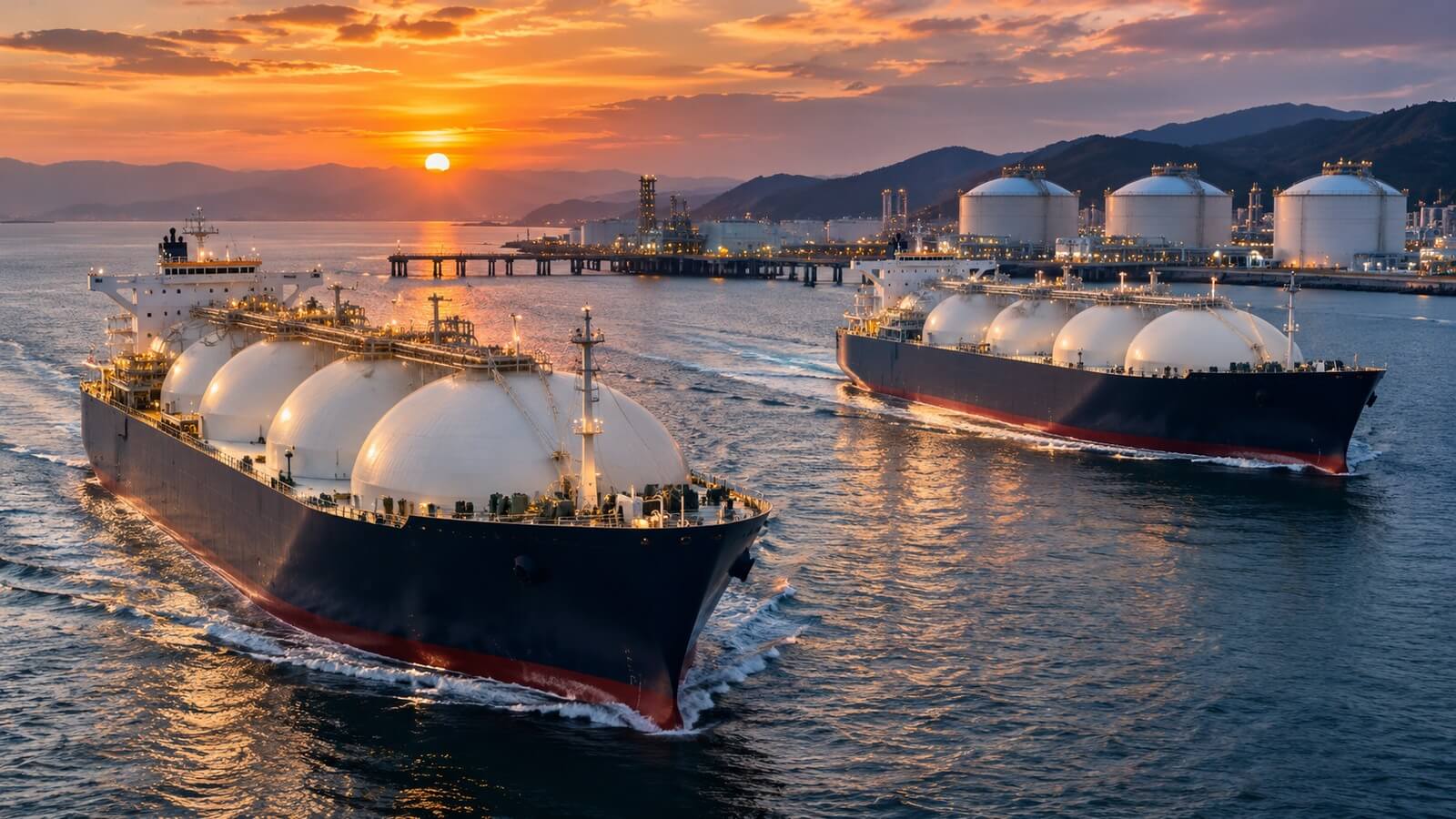
The LNG shipping industry connects natural gas producers with customers worldwide through specialized vessels called liquefied natural gas (LNG) carriers. These ships transport natural gas in liquid form across oceans, allowing countries to purchase energy from suppliers without direct pipeline connections.
For investors, LNG shipping is a distinct segment of the energy industry. Shipping companies earn revenue by chartering vessels to energy producers, commodity traders, and utilities. Their financial performance depends on charter contracts, fleet utilization, operating expenses, financing costs, and the balance between vessel supply and transportation demand.
Global LNG trade reached approximately 428 million metric tons in 2025, according to industry figures published in 2026. However, growing LNG trade does not automatically translate into higher shipping profits. New vessel deliveries, shipping distances, and charter rates are equally important.
How Does the LNG Shipping Industry Work?
Liquefied natural gas is natural gas cooled to approximately minus 162 degrees Celsius (minus 260 degrees Fahrenheit). At this temperature, it becomes liquid and occupies roughly 600 times less space than in its gaseous state.
This reduction in volume makes long-distance maritime transportation commercially practical.
The LNG supply chain generally involves five stages:
- Natural gas production: Gas is extracted from underground reservoirs and transported to processing facilities.
- Liquefaction: Export terminals cool natural gas into liquid form.
- Marine transportation: Specialized LNG carriers transport cargoes between export and import terminals.
- Regasification: Import facilities convert LNG back into gaseous form.
- Distribution: Natural gas enters pipelines supplying power plants, industrial facilities, and other customers.
Shipping companies primarily participate in the transportation stage, providing the vessels and services connecting international LNG markets.
This distinction matters because natural gas producers, export terminal operators, and shipping companies have different revenue models and financial risks, even though they participate in the same supply chain.
How Do LNG Shipping Companies Make Money?
LNG shipping companies generally earn revenue through charter agreements. A charter allows a customer to use a vessel for an agreed period or voyage.
Two important commercial arrangements are time charters and voyage-based employment.
Long-Term Time Charters
Under a time charter, a customer pays an agreed daily rate to use a vessel for a specified period.
Contracts may extend for several years, particularly when ships are assigned to major LNG production projects.
Long-term charters provide greater revenue visibility and can help shipowners obtain financing for expensive vessels.
However, contracted revenue does not eliminate risk. Profitability still depends on operating expenses, debt payments, vessel availability, and the financial strength of the customer.
Spot and Short-Term Charters
Other vessels operate under shorter agreements or participate in the spot charter market, where rates respond to current transportation demand and vessel availability.
When demand exceeds available shipping capacity, charter rates may rise sharply. When too many vessels compete for cargoes, rates can decline.
Companies with substantial long-term contract coverage may generate more predictable cash flow, while operators exposed to spot rates can experience larger earnings fluctuations.
Investors should therefore evaluate contract duration and rate exposure rather than assuming all LNG shipping companies benefit equally from industry growth.
Which Companies Operate in LNG Shipping?
The LNG shipping industry includes publicly traded shipowners, private maritime groups, energy companies, and specialized fleet operators.
Important industry participants include:
- Flex LNG: A publicly traded LNG carrier owner focused on modern vessels and chartering activities.
- Cool Company: An LNG shipping business operating modern carriers under different commercial arrangements.
- Golar LNG: A company with substantial exposure to floating LNG production infrastructure, making its business model different from a conventional carrier owner.
- Nakilat: A major Qatar-based LNG shipping company associated with large-scale transportation and long-term energy projects.
- MOL and NYK Line: Diversified Japanese shipping groups with significant LNG transportation activities.
These companies should not be compared solely by fleet size. Their business models differ in vessel ownership, contract duration, financing, fleet management, and exposure to other maritime activities.
For example, a smaller fleet of modern vessels operating under profitable long-term contracts may generate more stable cash flow than a larger fleet exposed to weaker charter rates.
Investors comparing listed operators, business models, and competitive advantages can explore Major LNG Shipping Companies and How They Compete.
Who Owns the World's LNG Carrier Fleets?
LNG carrier ownership is distributed among specialized shipping companies, maritime investment groups, energy companies, and joint ventures.
Three roles are important to distinguish:
- Vessel owner: The company or entity that legally owns the ship.
- Commercial operator: The business responsible for arranging vessel employment and charter contracts.
- Technical manager: The organization responsible for maintenance, crewing, and day-to-day vessel management.
These responsibilities can belong to different organizations.
For example, a carrier may be owned by a maritime investment company, chartered to an energy producer, and technically managed by a specialized shipping operator.
Fleet size can also be measured by vessel count or total cargo-carrying capacity, usually expressed in cubic meters.
A company operating fewer large, modern carriers may control more transportation capacity than another company with a greater number of smaller vessels.
For a closer examination of fleet ownership, vessel capacity, and the distinction between owners and operators, see Who Owns the Largest LNG Carrier Fleets?.
How Much Does an LNG Carrier Cost?
LNG carriers are among the most expensive commercial vessels because they require specialized cargo containment systems, sophisticated propulsion equipment, and technology capable of maintaining extremely low temperatures.
A modern large LNG carrier can cost hundreds of millions of dollars to build. The final price depends on cargo capacity, shipyard availability, propulsion technology, equipment specifications, and construction contract timing.
Newbuilding prices are only one component of vessel ownership costs.
Shipowners must also consider:
- Financing costs and interest payments.
- Crew salaries and training.
- Insurance and regulatory compliance.
- Maintenance and periodic dry-docking.
- Fuel consumption and vessel efficiency.
- Administrative and fleet management expenses.
- Depreciation and eventual resale value.
Ultimately, a carrier's economics depend on the revenue it generates relative to these costs throughout its operating life.
A Simple LNG Carrier Revenue Example
Consider a hypothetical LNG carrier earning a charter rate of $80,000 per day.
If the vessel generates charter revenue for 350 days during a year, its annual gross charter revenue would be:
$80,000 × 350 = $28 million.
This represents gross charter revenue, not profit.
Operating expenses, financing, maintenance, administration, and other obligations must still be considered. The result also depends on the charter structure and which expenses are paid by the customer.
If the same vessel earned only $50,000 per day for 350 days, annual gross charter revenue would fall to $17.5 million.
That $10.5 million difference illustrates how charter rates can materially affect a shipowner's financial performance.
Investors interested in construction prices, operating expenses, financing, and potential returns can read How Much Does an LNG Carrier Cost to Build and Operate?.
How Large Is the Global LNG Shipping Fleet?
The global LNG carrier fleet has expanded alongside new liquefaction terminals, import facilities, and international trade routes.
Industry figures published in 2026 indicate that the broader LNG vessel fleet reached approximately 899 vessels at the end of 2025. However, reported totals vary depending on vessel classifications and minimum cargo capacity thresholds.
Some industry datasets count only conventional LNG carriers above a specified capacity, while broader statistics may include additional vessel categories.
These differences should be considered when comparing fleet estimates.
Modern LNG carriers commonly have cargo capacities of approximately 170,000 to 180,000 cubic meters, although smaller and substantially larger vessels also operate.
Fleet growth depends on several factors:
- New LNG export projects requiring transportation capacity.
- Orders placed with specialized shipyards.
- Delivery schedules for vessels under construction.
- Retirement or reduced employment of older, less efficient carriers.
- Changes in shipping distances and voyage durations.
More vessels do not necessarily create a stronger shipping market.
If fleet capacity grows faster than transportation demand, charter rates can decline. Conversely, limited vessel availability during periods of strong demand can support higher rates.
This balance between vessel supply and shipping demand is one of the industry's most important economic indicators.
For fleet statistics, newbuilding deliveries, vessel capacity, and shipping market implications, explore How Many LNG Carriers Are in the Global Fleet?.
Which Countries Drive LNG Shipping Demand?
LNG shipping demand depends on where natural gas is produced, where it is consumed, and how far cargoes must travel.
The United States, Qatar, and Australia are among the world's largest LNG exporters, supplying customers across multiple regions.
Major importing markets are concentrated in Asia and Europe, where LNG supports electricity generation, industrial production, and energy security.
Asia's Role in LNG Transportation
China, Japan, South Korea, and India are important LNG importing markets.
Asian demand depends on industrial activity, electricity consumption, domestic gas production, competing fuels, and government energy policies.
Changes in regional purchases can influence cargo availability, voyage patterns, and shipping requirements.
Europe's Role in Global LNG Trade
Europe has become an important destination for seaborne natural gas as countries diversify their energy supplies.
European LNG imports rose substantially in 2025, reflecting changes in pipeline supply and regional energy requirements.
For shipping companies, the geographical distribution of demand matters because a voyage from the United States to Europe occupies a vessel for a different period than a voyage from the United States to East Asia.
Why Shipping Distance Matters
Two LNG trade scenarios can involve identical cargo volumes but require different amounts of shipping capacity.
Longer voyages keep vessels occupied for more days, including return journeys and possible waiting periods at ports.
Consequently, shipping demand depends not only on cargo volumes but also on distance traveled, commonly measured through tonne-mile demand.
A shift toward longer routes can increase the need for vessels even without a proportional increase in global LNG consumption.
For a detailed examination of importing countries, regional demand, and trade routes, read Which Countries Drive Global LNG Shipping Demand?.
What Determines LNG Shipping Charter Rates?
LNG charter rates reflect the relationship between available vessel capacity and demand for transportation.
Several factors influence these rates.
1. LNG Export Volumes
Higher export volumes can increase the number of cargoes requiring transportation.
However, the effect on charter rates depends on how much vessel capacity is available.
2. New Vessel Deliveries
New carriers increase shipping capacity.
If vessels enter service before associated LNG production projects become operational, the market may temporarily experience oversupply.
3. Voyage Distances
Longer routes increase the time ships spend transporting cargoes, reducing their availability for additional voyages.
4. Seasonal Demand
Natural gas consumption can increase during cold winters or periods of high electricity demand.
These seasonal changes can influence LNG purchasing and short-term shipping requirements.
5. Geopolitical Disruptions
Trade restrictions, maritime security concerns, and disruptions near strategic shipping passages can alter routes and vessel availability.
These events may increase transportation costs, but they can also reduce cargo volumes or disrupt commercial activity.
6. Vessel Efficiency
Modern LNG carriers generally have more efficient propulsion systems and lower fuel consumption than many older vessels.
Fuel efficiency and emissions performance can influence charter demand, particularly as environmental requirements evolve.
Why Can LNG Trade Grow While Shipping Profits Fall?
Growth in global LNG trade does not necessarily mean higher profits for LNG shipping companies.
Global LNG trade expanded in 2025, yet the shipping market experienced pressure from additional vessel deliveries and uneven transportation demand.
This reflects a common challenge in capital-intensive shipping industries: investment decisions are made years before new vessels enter service.
Shipowners may order carriers when demand forecasts appear favorable, but market conditions can change before delivery.
The following scenarios illustrate how different conditions affect LNG shipping economics.
| Market Condition | Possible Effect on LNG Shipping |
|---|---|
| LNG trade grows faster than available vessel capacity | Higher utilization and potential support for charter rates |
| Vessel capacity grows faster than LNG transportation demand | More competition and potential pressure on charter rates |
| Major export projects are delayed | Ships may enter service before expected cargoes become available |
| Average shipping distances increase | More vessel time may be required to transport the same cargo volume |
| Older vessels become less competitive | Modern carriers may gain a commercial advantage |
These relationships explain why investors should evaluate both global LNG market fundamentals and the financial characteristics of individual shipping companies.
What Should Investors Look for in LNG Shipping Stocks?
Investing in LNG shipping requires more than predicting whether global natural gas consumption will increase.
The most useful indicators combine commercial performance, financial strength, and vessel market conditions.
Contract Coverage
Investors should examine how much of a company's available vessel capacity is covered by existing charter agreements.
Long-term contracts provide revenue visibility, while vessels approaching charter expiration may face uncertainty when negotiating new rates.
Fleet Age and Efficiency
Fleet age affects maintenance requirements, fuel efficiency, and competitiveness.
Modern vessels may attract stronger customer demand, although they can also carry substantial financing obligations.
Debt and Financing
LNG carriers require large upfront investments, making debt financing important for many shipowners.
Investors should evaluate debt maturities, interest expenses, liquidity, and the ability to meet financial obligations during weaker market conditions.
Cash Flow and Capital Spending
Accounting earnings do not always reveal how much cash remains after operating expenses, financing commitments, and vessel investments.
Free cash flow, future capital expenditure, and debt repayments are particularly important when assessing dividend sustainability.
Customer Concentration
Some LNG shipping businesses depend on a relatively small number of major charter customers.
Long-term relationships with financially strong counterparties can be valuable, but concentrated customer exposure creates additional risk.
Fleet Expansion Strategy
Ordering new vessels can support future revenue growth but also creates financing commitments and exposure to market conditions when ships are delivered.
Investors should examine whether new carriers already have charter agreements and how construction will be financed.
Does LNG Shipping Have a Future?
LNG shipping has potential long-term growth opportunities because international natural gas trade depends on specialized transportation infrastructure.
Additional liquefaction capacity under development in the United States and other exporting countries could support future demand for carriers.
However, the industry's outlook depends on more than export capacity.
Several risks remain important:
- Vessel oversupply: Excessive new ship deliveries can reduce charter rates.
- Project delays: LNG export terminals may enter service later than expected.
- Environmental regulation: Emissions requirements may increase costs or encourage fleet modernization.
- Energy transition: Renewable energy, electrification, and government policies could influence long-term natural gas demand.
- Geopolitical risk: Conflicts and trade restrictions can disrupt cargo flows.
- Financial conditions: Interest rates and access to capital influence vessel ownership economics.
Natural gas may continue to play an important role in electricity generation, industrial activity, and energy security, although demand growth will vary by region.
For shipping companies, favorable conditions generally combine sustained transportation demand, disciplined fleet expansion, reliable charter customers, and manageable financing costs.
For a more detailed assessment of future demand, oversupply risks, environmental regulation, and investment considerations, see Does LNG Shipping Have a Future? Growth and Industry Risks.
How to Evaluate the LNG Shipping Market Going Forward
The LNG shipping industry provides the transportation capacity connecting natural gas producers with customers separated by oceans.
Its investment characteristics differ from those of natural gas producers and LNG export terminal operators.
For investors monitoring the industry, five questions are particularly useful:
- How quickly is global LNG trade expanding?
- How many new LNG carriers are scheduled to enter service?
- Are average shipping distances increasing or decreasing?
- What proportion of shipping company revenue is protected by long-term contracts?
- Can individual companies generate sustainable cash flow after financing costs and capital expenditures?
These questions help distinguish broad industry growth from the financial performance of individual shipping businesses.
LNG shipping may benefit from expanding international energy trade, but profitability ultimately depends on vessel supply, charter economics, financial discipline, and the changing geography of global LNG demand.
Disclaimer: This article is for informational and educational purposes only and does not constitute financial or investment advice. Shipping stocks involve market, operational, and financial risks. Investors should conduct independent research before making investment decisions.