
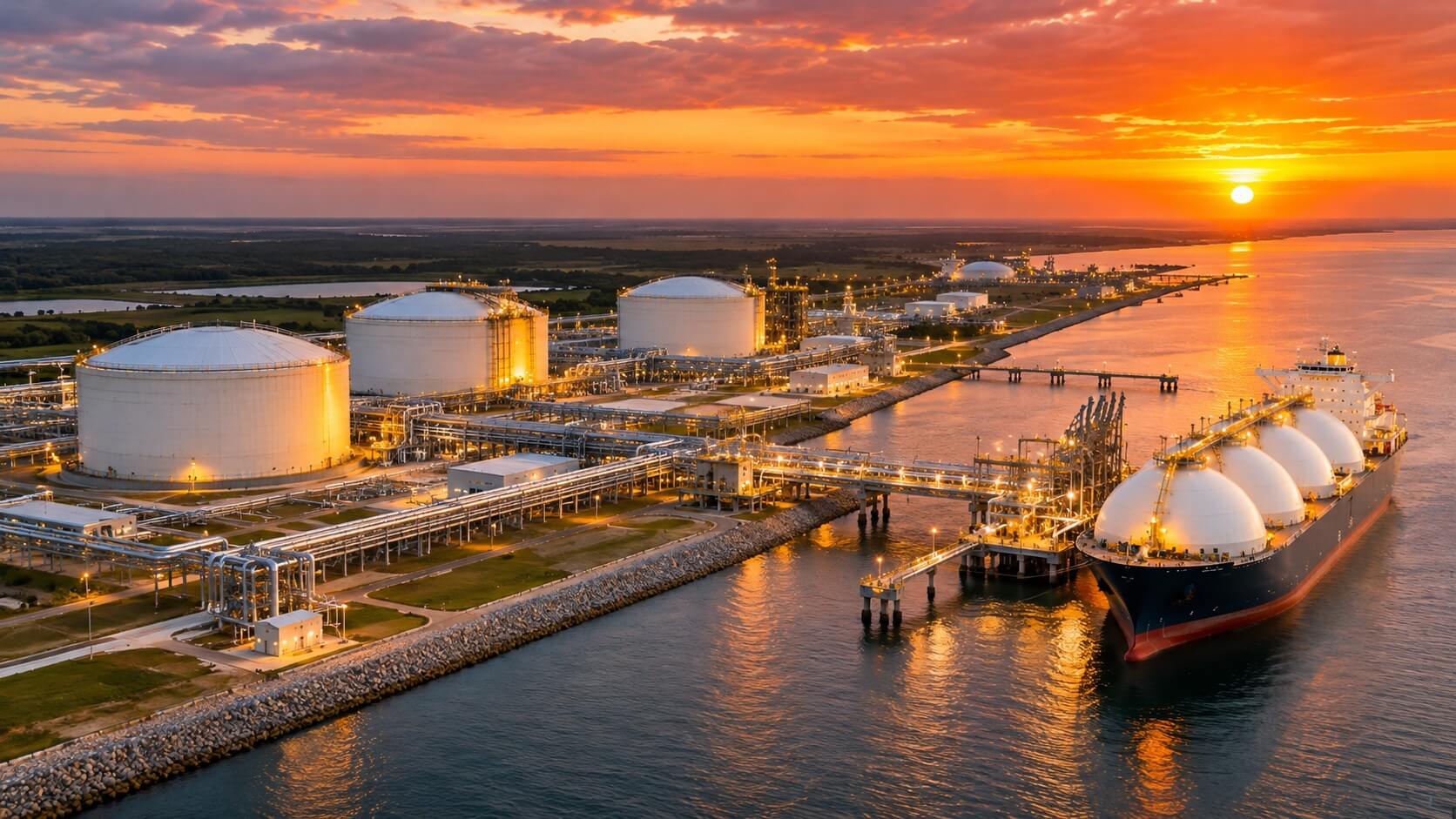
More than 50 countries and markets worldwide have liquefied natural gas (LNG) import or export infrastructure. Major LNG exporters include the United States, Qatar, Australia, Russia, Malaysia, and Nigeria. Leading importing markets include China, Japan, South Korea, India, and several European countries.
These terminals allow natural gas to move between countries that are not connected by pipelines, supporting international energy trade.
Export terminals cool natural gas into liquid form and load it onto specialized ships. Import terminals receive LNG and generally convert it back into gas for electricity generation, heating, and industrial use.
Some countries operate both types of facilities, while others primarily import or export LNG. For investors, this infrastructure determines which markets can participate in international gas trade and where new energy investment opportunities may develop.
Which Countries Have LNG Terminals?
LNG terminals operate across North America, South America, Europe, Asia, Africa, the Middle East, and Oceania.
Countries generally participate as LNG exporters, importers, or both, depending on their natural gas resources, infrastructure, and energy requirements.
| Country or Market | Main LNG Role | Why It Matters |
|---|---|---|
| United States | Major exporter | Large liquefaction capacity and domestic natural gas production |
| Qatar | Major exporter | Extensive gas resources and expanding export infrastructure |
| Australia | Major exporter | Important supplier to Asian markets |
| Russia | Exporter | Significant LNG production and international trade exposure |
| Malaysia | Exporter | Established supplier to Asian buyers |
| Nigeria | Exporter | Major African LNG production |
| China | Major importer | Large natural gas market and extensive receiving infrastructure |
| Japan | Major importer | Long-established LNG demand and import facilities |
| South Korea | Major importer | Significant dependence on imported natural gas |
| India | Importer | Industrial demand and developing gas infrastructure |
| Taiwan | Importer | LNG demand for electricity generation |
| France | Importer | Important European LNG receiving capacity |
| Spain | Importer | Extensive regasification infrastructure |
| Germany | Importer | Receiving infrastructure supporting supply diversification |
| United Kingdom | Importer | Established LNG receiving facilities |
| Türkiye | Importer | Pipeline and LNG supply diversification |
| Egypt | Importer and exporter | Changing domestic gas balance and LNG trade |
| Brazil | Importer | LNG supports electricity generation and supply flexibility |
This table provides representative examples rather than a complete inventory of countries with LNG infrastructure.
Exporting countries need access to natural gas supplies and liquefaction facilities. Importing countries require receiving terminals, pipeline connections, and customers capable of purchasing the delivered gas.
What Is the Difference Between LNG Import and Export Terminals?
The main difference is their function: export terminals convert natural gas into LNG for transportation, while import terminals receive LNG and generally convert it back into gas for domestic distribution.
LNG Export Terminals
Export terminals are typically located in countries with substantial natural gas production or reliable pipeline access to gas supplies.
Their operations include:
- Receiving natural gas through pipelines.
- Processing and cooling gas into liquid form.
- Storing LNG in insulated tanks.
- Loading LNG onto specialized carriers.
- Supplying international customers under commercial agreements.
Liquefaction requires specialized industrial equipment and substantial energy. Large export projects can cost billions of dollars, making reliable gas supplies and long-term customer commitments important to their economics.
LNG Import Terminals
Import terminals receive LNG transported by ship from overseas suppliers.
Their main functions include:
- Unloading LNG carriers.
- Storing LNG before distribution.
- Warming LNG back into gaseous form through regasification.
- Delivering natural gas into domestic pipeline networks.
These facilities allow countries to access international gas supplies without direct pipeline connections to producing regions.
Why the Distinction Matters
Export and import terminals can have different revenue models.
Exporters may earn liquefaction fees or revenue from LNG sales. Import terminal operators may receive fees for unloading, storage, and regasification services.
Investors should therefore distinguish infrastructure operators earning contracted fees from companies exposed more directly to natural gas and LNG market prices.
Which Countries Have the Largest LNG Export Infrastructure?
The United States, Qatar, and Australia are among the world's leading LNG exporters. Other established suppliers include Russia, Malaysia, and Nigeria.
United States
The United States has become the world's leading LNG exporter, supported by extensive domestic natural gas production and pipeline infrastructure.
Major export facilities are concentrated along the Gulf Coast, particularly in Louisiana and Texas.
Important terminals include Sabine Pass, Corpus Christi, Plaquemines, Cameron, Freeport, and Calcasieu Pass.
These facilities connect American gas production with international customers through large-scale liquefaction and shipping operations.
The geographical distribution of American export facilities is examined in Where Are LNG Export Terminals Located in the US?.
Qatar
Qatar is a major LNG exporter with production centered on the North Field, one of the world's largest natural gas reservoirs.
Its Ras Laffan industrial complex contains extensive liquefaction, storage, and shipping infrastructure.
Qatar is expanding production through major development projects intended to increase future export capacity.
Its large gas resources, integrated facilities, and long-term customer relationships make it an important competitor to American LNG suppliers.
Australia
Australia operates major LNG export facilities in Western Australia, the Northern Territory, and Queensland.
Important projects include Gorgon, Wheatstone, North West Shelf, Ichthys, and Queensland Curtis LNG.
Australia has established commercial relationships with Asian importing countries, including Japan, South Korea, and China.
Its proximity to these markets can reduce shipping distances compared with exporters located farther away. However, operating costs, domestic gas policies, and development expenses also influence competitiveness.
Russia
Russia operates LNG export facilities associated with Sakhalin and Arctic gas developments.
Its LNG industry faces geopolitical and commercial challenges, including international sanctions, shipping restrictions, financing constraints, and limitations on access to certain technologies.
These factors can affect existing operations and the development of additional export capacity.
Malaysia and Nigeria
Malaysia is an established LNG supplier to Asian markets, with major export infrastructure in Bintulu.
Nigeria is an important African LNG exporter, with major liquefaction facilities on Bonny Island.
Both countries demonstrate how LNG infrastructure allows natural gas producers to reach international customers beyond regional pipeline networks.
Which Countries Have the Largest LNG Import Infrastructure?
Major LNG import networks are concentrated in countries with substantial natural gas demand and limited domestic production or pipeline supply options.
China, Japan, South Korea, India, and Taiwan are important Asian importing markets.
China
China operates extensive LNG receiving infrastructure along its coastline, including facilities in Guangdong, Zhejiang, Jiangsu, Shanghai, and other coastal regions.
LNG supplements domestic gas production and pipeline imports.
Actual import volumes depend on industrial demand, electricity consumption, international prices, and the availability of alternative gas supplies.
China's large receiving network provides flexibility, but installed import capacity does not guarantee full terminal utilization.
Japan
Japan has one of the world's most established LNG import systems.
With limited domestic natural gas resources, the country has relied on LNG imports for decades to support electricity generation, industrial consumption, and regional gas distribution.
Demand is influenced by nuclear power availability, renewable electricity production, energy efficiency, and economic conditions.
Its mature infrastructure and established buyers make Japan an important market for long-term LNG supply contracts.
South Korea
South Korea operates major LNG receiving terminals serving power plants, industrial facilities, and heating demand.
The country depends heavily on imported energy, making diversified supply relationships important for energy security.
Seasonal temperatures, nuclear generation, and electricity demand influence its LNG requirements.
India
India operates LNG receiving facilities at locations including Dahej, Hazira, and Kochi.
Imported gas supports industrial production, fertilizer manufacturing, city gas distribution, and other activities.
Future demand growth depends on LNG affordability, domestic production, and the expansion of pipelines connecting import terminals with customers.
Taiwan
Taiwan relies on LNG imports for electricity generation and industrial activity.
Its receiving infrastructure is important for energy security because the market depends heavily on imported fuels.
Electricity demand, infrastructure investment, and energy policy influence future import requirements.
Which European Countries Have LNG Terminals?
Many European countries operate LNG receiving terminals to diversify natural gas supplies and reduce dependence on individual pipeline routes.
Important markets include France, Spain, the Netherlands, Italy, Germany, Poland, Belgium, the United Kingdom, and Türkiye.
France
France operates several LNG receiving terminals, including Dunkirk, Montoir-de-Bretagne, and facilities in Fos.
These terminals support domestic consumption and connections with broader European gas markets.
Spain
Spain has one of Europe's most extensive LNG regasification networks.
Major facilities include Barcelona, Cartagena, Huelva, Bilbao, Sagunto, and Mugardos.
Spain has substantial receiving capacity relative to domestic consumption. However, limited pipeline connectivity with other European markets can restrict the amount of imported gas transported beyond the country.
Netherlands
The Netherlands operates LNG infrastructure including the Gate terminal in Rotterdam and floating receiving capacity at Eemshaven.
These facilities support Dutch gas demand and provide additional supply flexibility for neighboring European markets.
Italy
Italy operates LNG receiving infrastructure including Adriatic LNG offshore from the Veneto coast, Panigaglia, and floating regasification facilities.
LNG provides an alternative supply source alongside pipeline imports and domestic production, helping diversify the country's natural gas supplies.
Germany
Germany developed additional LNG receiving capacity after the sharp reduction in Russian pipeline gas deliveries.
Floating storage and regasification units have played an important role because they can provide import capacity without requiring every component of a permanent onshore terminal.
However, installed receiving capacity should be distinguished from actual LNG imports and terminal utilization.
Poland and the United Kingdom
Poland operates the Świnoujście LNG terminal, supporting diversification of natural gas supplies.
The United Kingdom has established receiving infrastructure, including South Hook, Dragon, and the Isle of Grain terminal.
These facilities provide access to international LNG markets and additional supply flexibility.
What Are Floating LNG Terminals?
Floating storage and regasification units, known as FSRUs, are specialized vessels that receive LNG, store it, and convert it back into gaseous form.
The gas is then delivered to shore through suitable pipeline connections.
Why Countries Use FSRUs
Floating terminals can provide several advantages:
- Potentially faster deployment than permanent onshore terminals.
- Flexibility when developing new import infrastructure.
- Reduced need for certain types of land-based construction.
- Additional receiving capacity during energy supply disruptions.
- Opportunities to serve markets with changing natural gas demand.
However, FSRUs still require suitable ports, pipeline connections, safety systems, and regulatory approvals.
They are not automatically cheaper or more suitable than permanent terminals in every location.
Where Are FSRUs Used?
Floating LNG infrastructure has been deployed in countries including Germany, Italy, Pakistan, Bangladesh, and Brazil.
These facilities can be particularly useful when governments or energy companies need additional import capacity within a relatively short period.
For investors, FSRUs create opportunities for specialized vessel owners, infrastructure operators, and energy service providers.
Where Is the World's Largest LNG Export Complex?
Ras Laffan Industrial City in Qatar is one of the world's largest LNG production and export complexes.
It contains extensive natural gas processing, liquefaction, storage, and marine infrastructure supporting Qatar's international LNG trade.
However, identifying the world's largest LNG plant requires a clear definition of what is being measured.
Comparisons may refer to:
- An individual liquefaction train.
- A single LNG export terminal.
- A multi-terminal industrial complex.
- Total nominal production capacity.
- Actual annual LNG exports.
These measurements are not interchangeable.
Ras Laffan contains multiple LNG production facilities within a broader industrial complex. Comparing the entire complex with one American export terminal can therefore be misleading.
Investors should verify whether reported capacity represents one facility, several production trains, or an entire industrial hub.
Why Do LNG Terminals Matter to International Energy Trade?
LNG terminals allow natural gas to move between markets without direct pipeline connections, creating additional flexibility in international energy trade.
Energy Supply Diversification
Import terminals allow countries to purchase natural gas from multiple overseas suppliers rather than relying entirely on one producing country or pipeline route.
This can improve energy security, although it does not eliminate exposure to global prices or supply disruptions.
Access to New Markets
Export terminals allow natural gas producers to sell energy to overseas customers.
Access to international markets can create additional commercial opportunities compared with relying exclusively on domestic gas demand.
Greater Trading Flexibility
Some LNG cargoes can be redirected between destinations when contractual arrangements permit.
This provides flexibility that fixed pipeline routes generally cannot offer. However, shipping costs, contracts, and available receiving capacity limit how freely cargoes can move.
Infrastructure Investment
LNG trade supports investment in pipelines, storage tanks, liquefaction equipment, ports, specialized carriers, and regasification facilities.
These activities create business opportunities across several segments of the energy industry.
How Does LNG Terminal Capacity Affect Global Demand?
Building LNG terminals does not automatically increase natural gas consumption. Importing countries also need customers willing and able to purchase the gas.
For example, a country may develop additional receiving capacity to improve energy security while using only part of that capacity during periods of weak demand or high LNG prices.
Import Capacity Versus Actual Imports
Import capacity measures the maximum volume of LNG that receiving facilities can potentially handle under specified operating conditions.
Actual imports measure the LNG delivered and purchased over a given period.
The difference can be substantial, particularly when infrastructure is built to provide flexibility rather than operate continuously at full capacity.
Export Capacity Versus Actual Shipments
Export capacity measures the potential production of liquefaction facilities.
Actual shipments depend on equipment reliability, natural gas availability, customer contracts, shipping conditions, and international demand.
For investors, terminal utilization is often as important as installed capacity. A facility operating consistently at high utilization may have a different financial profile from one with substantial unused capacity.
Which Countries Buy the Most LNG?
The largest individual LNG importing markets are concentrated in Asia.
Based on full-year 2025 trade patterns, China, Japan, South Korea, India, and Taiwan were among the leading individual LNG importers.
Europe also represents a major source of demand, although its imports are distributed across multiple countries.
Why Asia Is Important
Asian LNG demand is supported by electricity generation, industrial activity, and limited domestic natural gas resources in several major economies.
However, consumption patterns differ. Japan has a mature LNG market, while India's future demand depends partly on infrastructure expansion and affordability.
China's purchases can also change with domestic production, pipeline imports, and international prices.
Why Europe Is Important
European countries have increased their use of LNG to diversify natural gas supplies, creating an important market for US exporters.
However, European import demand remains sensitive to gas storage inventories, weather, industrial consumption, renewable electricity production, and energy policy.
The differences between global import rankings and the countries purchasing American LNG are examined in Which Countries Buy the Most LNG?.
How Do LNG Terminals Create Opportunities for US Exporters?
Additional LNG receiving infrastructure overseas can expand the number of markets accessible to American exporters.
However, new import capacity creates commercial opportunities only when customers have sufficient demand, suitable pipeline connections, and the ability to pay for delivered LNG.
Established American Exporters
Cheniere Energy operates major LNG export facilities at Sabine Pass and Corpus Christi.
Venture Global has developed significant export infrastructure in Louisiana, while companies including Sempra and ExxonMobil participate in major LNG projects.
These businesses have different ownership structures and revenue models.
Some earn revenue through long-term liquefaction agreements, while others have greater exposure to LNG sales, infrastructure ownership, or broader energy operations.
Why Global Infrastructure Matters
New receiving terminals can encourage international buyers to negotiate additional long-term LNG supply contracts.
Such agreements may support financing for American export projects.
However, US companies compete with exporters from Qatar, Australia, and other producing countries.
Delivered prices, shipping costs, reliability, and contractual terms influence which suppliers win business.
For a comparison of major American LNG companies, see Who Are the Largest LNG Exporters in the US?.
What Are the Main Risks of Building LNG Terminals?
LNG infrastructure requires substantial capital investment and faces several commercial and operational risks.
Construction Costs
Large terminals require specialized equipment, engineering services, and extensive supporting infrastructure.
Labor shortages, equipment prices, and construction delays can increase project costs and reduce expected returns.
Regulatory Requirements
LNG facilities must comply with environmental, safety, and permitting requirements.
Approval delays or changes in regulations can affect project schedules and financing.
Demand Uncertainty
A terminal may enter service when international LNG demand is weaker than expected.
Lower utilization or unfavorable commercial conditions can reduce investment returns.
Commodity Price Exposure
Some LNG businesses are directly exposed to domestic natural gas and international LNG prices.
Others earn more predictable infrastructure fees. The degree of market exposure depends on contract structures and business models.
Operational Disruptions
Equipment failures, maintenance problems, severe weather, and shipping disruptions can interrupt operations at both import and export terminals.
Long-Term Energy Transitions
Renewable energy expansion, nuclear power development, efficiency improvements, and changing government policies may affect future natural gas consumption.
Investors should evaluate whether expected demand and contracted revenue justify the cost of new infrastructure.
How Could the Global LNG Terminal Network Change?
Global LNG infrastructure continues to develop as countries respond to changing energy demand, supply security concerns, and international trade relationships.
Several trends may influence future investment:
- Export capacity expansion: The United States and Qatar are developing additional LNG production infrastructure.
- New importing markets: Countries with growing energy requirements may invest in receiving terminals and gas distribution networks.
- Floating infrastructure: FSRUs may provide alternatives to permanent onshore terminals where conditions are suitable.
- Exporter competition: Additional liquefaction capacity can increase competition for international customers.
- Energy security: Governments may support LNG infrastructure to diversify supply sources.
- Electricity generation changes: Renewable energy, nuclear power, and other technologies may alter future gas demand.
These developments create opportunities but also uncertainty. More terminals do not necessarily mean that LNG consumption, utilization, or industry profits will increase at the same rate.
Why LNG Terminals Matter for Investors
LNG terminals connect natural gas producers with international consumers and make long-distance gas trade possible.
The United States, Qatar, and Australia are among the leading exporting countries, while China, Japan, South Korea, India, and European markets represent major sources of import demand.
Export terminals provide access to international customers. Import terminals allow countries to diversify natural gas supplies. Floating facilities add flexibility in suitable markets.
For investors, the most important consideration is not simply how many terminals a country operates.
The financial value of LNG infrastructure depends on reliable gas supplies, sufficient customer demand, competitive costs, commercial contracts, and sustainable cash flow.
Understanding the global terminal network helps explain how international energy demand, infrastructure development, and LNG-related investment opportunities are connected.
Disclaimer: This article is for informational and educational purposes only and does not constitute financial or investment advice. LNG-related investments involve commodity price, operational, construction, regulatory, geopolitical, and financial risks. Investors should conduct independent research before making investment decisions.