
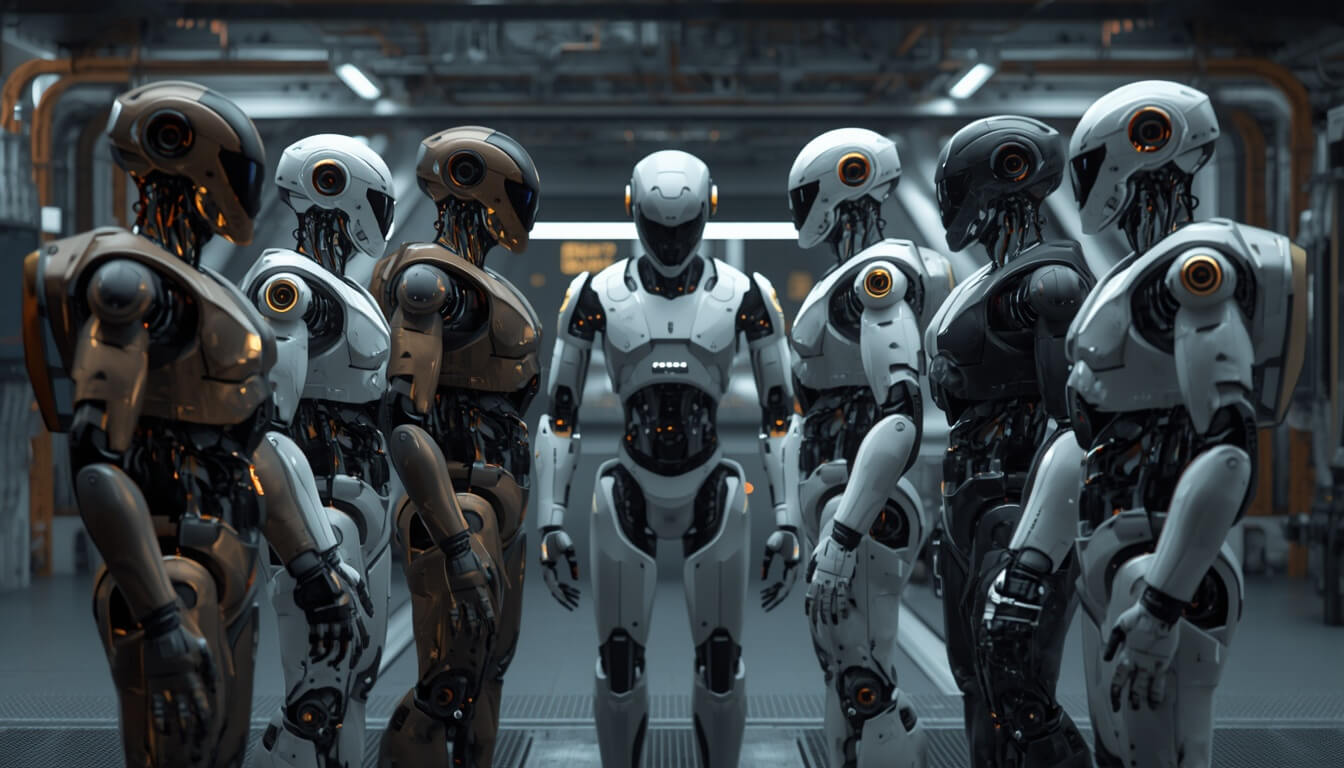
The humanoid robotics industry is entering a new phase in which several companies are moving beyond laboratory demonstrations and attempting to develop robots for real-world commercial deployment. Tesla, Figure and Agility Robotics are among the companies receiving significant attention, but they represent different approaches to the same fundamental challenge: turning a humanoid robot into a useful industrial product.
The competition is not simply about which robot can walk more naturally, lift more weight or perform the most impressive demonstration. The larger question is how each company combines robotics hardware, artificial intelligence, manufacturing, software and commercial deployment.
That distinction matters because humanoid robots are potentially more complex than conventional industrial machines. They must operate in environments designed for humans, interact with objects of different shapes and sizes, maintain balance, navigate dynamic spaces and potentially work alongside people.
The companies developing them therefore face both a technological challenge and an industrial one.
Tesla's Vertical Approach
Tesla entered the humanoid robotics field with Optimus, a project that connects robotics with the company's existing expertise in electric vehicles, batteries, electronics, artificial intelligence and large-scale manufacturing.
This combination is important because many of the technologies required by a humanoid robot overlap with capabilities already developed for other products. Electric motors, power electronics, batteries, embedded computing, manufacturing automation and computer vision are all relevant to both automotive and robotic systems.
Tesla has also developed large-scale production infrastructure for vehicles, giving it experience with complex manufacturing systems.
The company's approach has consequently attracted attention not only because of the robot itself but because of the possibility of applying automotive manufacturing principles to humanoid robotics.
However, adapting those capabilities to a fundamentally different machine is not straightforward. A vehicle operates primarily on four wheels and has relatively predictable mechanical interfaces. A humanoid robot contains many independently controlled joints and must maintain dynamic balance while manipulating objects. Its mechanical and software requirements are therefore substantially different.
Tesla still needs to demonstrate that its manufacturing infrastructure can be adapted to produce humanoid robots at commercially meaningful volumes. The potential advantage is that Tesla does not need to build every industrial capability from scratch. Its existing experience could provide a foundation for scaling if the underlying robotic technology becomes sufficiently mature.
Figure's Focus on General-Purpose Robotics
Figure has taken a different route, focusing specifically on humanoid robotics and the development of general-purpose machines.
The company has positioned its robots as systems capable of performing useful tasks in environments such as factories and warehouses. Figure's strategy has also emphasized the integration of robotics with artificial intelligence, particularly the ability of robots to perceive environments, understand instructions and execute physical actions.
This reflects a broader change in robotics. Historically, robots were often designed around predefined tasks. A machine might repeatedly weld a particular component or move an object between two fixed locations.
General-purpose humanoid robots aim for something more flexible. Instead of designing a separate machine for every task, companies are attempting to create a common hardware platform that can be trained or instructed to perform multiple activities.
If this approach works, the economic implications could be significant. A customer would not necessarily need to purchase a different robot for every individual task. The same platform could potentially be adapted to different workflows through software.
That creates a strong connection between robotics and artificial intelligence. The value of the robot would depend not only on its physical capabilities but also on the intelligence controlling those capabilities.
Figure's development therefore illustrates how the humanoid robotics market is increasingly becoming an intersection between traditional robotics and the rapidly evolving field of embodied AI.
Agility Robotics and the Industrial Warehouse
Agility Robotics represents another important approach.
Its Digit humanoid robot has been developed with industrial logistics and material-handling environments in mind. Warehouses are particularly interesting for humanoid robotics because they contain many repetitive tasks while also requiring robots to operate in spaces designed around human workers.
A warehouse can contain shelves, containers, conveyor systems and workstations that already assume human dimensions and movement patterns. A humanoid robot could potentially operate within these environments without requiring the complete redesign associated with specialized automation.
Agility's emphasis on logistics highlights an important principle for the entire sector: successful humanoid robots may initially emerge through relatively specific commercial applications rather than immediately becoming universal machines.
A robot does not need to perform every possible human task to have commercial value. If it can reliably perform a sufficiently valuable set of warehouse activities, customers may already have an economic reason to deploy it. This could allow manufacturers to increase production volumes while continuing to improve the robot's capabilities.
Three Different Paths Toward Scale
Tesla, Figure and Agility illustrate three different starting points for the humanoid robotics industry.
- Tesla brings experience in manufacturing, batteries, electric motors and artificial intelligence.
- Figure is focused directly on developing a general-purpose humanoid platform and combining robotics with increasingly sophisticated AI systems.
- Agility has emphasized industrial deployment, particularly logistics and warehouse applications.
These differences are significant because there is no established formula for commercial humanoid robotics. The industry is still determining which combination of hardware, software and business model will prove most effective.
Some companies may attempt to build highly general-purpose robots from the beginning. Others may focus on a smaller number of economically attractive tasks and gradually expand capabilities. Neither approach has yet established a universal industry standard. The competition therefore remains open at the technological and commercial levels.
Hardware Is Only One Part of the Platform
One of the most important developments in humanoid robotics is the increasing importance of software.
The physical robot provides the mechanical platform, but software determines how that platform interprets its environment and responds to it. Modern humanoid systems can combine cameras, force sensors, joint sensors and other inputs to construct a representation of the surrounding environment. AI models can then help interpret that information and determine appropriate actions.
This creates a feedback cycle between hardware and software:
- Better sensors provide better data.
- Better models can interpret that data more effectively.
- Improved control systems can convert decisions into more precise movements.
At the same time, real-world deployments generate additional data that can potentially be used to improve future versions of the system. This makes scale particularly important. If thousands of robots are operating in factories and warehouses, their combined experience could produce a much larger dataset than a company could obtain from a small fleet of experimental machines.
That does not automatically guarantee better performance, because collecting useful training data and converting it into improved models remains technically difficult. Nevertheless, large-scale deployment could become an important source of competitive advantage.
The Importance of Manufacturing
The differences between Tesla, Figure and Agility also highlight a broader issue: the ability to design a robot is not the same as the ability to manufacture it economically.
A humanoid robot contains numerous precision components. Actuators, gearboxes, motors, batteries, sensors and electronic systems must work together reliably. At low production volumes, manufacturers can tolerate more manual assembly and specialized processes. At high volumes, those processes must become increasingly standardized and automated.
This is where companies with manufacturing experience could potentially have a different set of advantages from companies whose primary expertise is robotics research.
But manufacturing scale introduces its own risks. Companies must establish supplier networks, secure component availability, maintain quality control and develop testing procedures capable of identifying failures before robots reach customers.
The manufacturing system therefore becomes part of the product.
For a deeper examination of why production capacity may become as important as the robot's technical design, see Why Manufacturing Capacity Could Matter as Much as Robot Design.
The First Customers May Shape the Industry
Another major variable is the identity of the first large customers.
Industrial companies are unlikely to adopt humanoid robots simply because the technology is impressive. They need evidence that robots can perform useful work at an acceptable total cost.
This places considerable importance on pilot programs. A company may initially deploy a small number of robots in a controlled environment. Performance can then be measured across operating hours, task completion, intervention rates, maintenance requirements and safety.
Successful deployments could gradually expand. This creates a potential pathway toward mass adoption:
prototype → pilot project → limited deployment → fleet deployment → large-scale production
Each step requires a different type of capability. The prototype demonstrates technical feasibility. The pilot demonstrates that the system can work outside a laboratory. Fleet deployment tests reliability and operational management. Mass production ultimately determines whether the technology can become economically significant.
This progression explains why the competition cannot be judged solely by public demonstrations. A robot completing a complex task on video provides evidence of technical capability, but it does not by itself establish manufacturing economics or long-term commercial viability.
Business Models Could Also Diverge
The companies developing humanoid robots may not necessarily rely on the same commercial model.
Some may sell robots directly to customers. Others could offer robots through leasing arrangements or robotics-as-a-service contracts, in which customers pay for access to robotic capacity rather than purchasing the hardware outright.
The distinction could affect adoption. A high upfront purchase price may represent a significant barrier for some customers. A service model could instead convert the investment into an operating expense tied to actual deployment.
For manufacturers, however, service models require additional capabilities. The company may need to finance the robots, maintain them, provide software updates and manage replacement parts over their operational lives. This transforms the business from equipment manufacturing into fleet management.
As a result, the eventual industry structure could look different from traditional industrial robotics.
Competition Beyond the Three Companies
Tesla, Figure and Agility are only part of a much larger ecosystem. Other established robotics companies, automotive manufacturers, technology companies and startups are also exploring humanoid systems.
The competitive landscape could therefore become increasingly fragmented before consolidation begins. Different companies may specialize in different parts of the value chain. Some could develop robot hardware. Others may focus on AI models, actuators, sensors or manufacturing components.
Strategic partnerships could become important if no single company can efficiently control the entire stack. The eventual market may consequently contain several hardware platforms connected to a broader ecosystem of software and component suppliers. This would be similar to other technology industries in which a small number of platforms coexist while numerous specialized suppliers operate around them.
What Will Define the Next Phase?
The most important question for humanoid robotics is gradually changing.
At the beginning of the industry, the key question was whether a machine could walk, balance and manipulate objects. Today, increasingly capable prototypes are demonstrating that many of these technical problems can be addressed.
The next questions are more industrial:
- Can robots operate reliably for long periods?
- Can they perform economically valuable tasks?
- Can their software generalize beyond carefully controlled demonstrations?
- Can the machines be manufactured in large quantities?
- Can supply chains support production?
- Can customers integrate fleets of robots into existing operations?
- And can the economics justify widespread deployment?
The answers will likely emerge gradually rather than through a single breakthrough.
Tesla, Figure and Agility illustrate different approaches to the same transition. Their technologies and strategies are evolving, and the commercial environment remains uncertain.
What is becoming increasingly clear, however, is that the humanoid robotics race is not only a race to build a better robot.
It is a race to build an entire industrial system around the robot.
From Robotics Competition to Industrial Competition
The companies that eventually establish significant positions in humanoid robotics will need to connect several capabilities that have traditionally existed in separate industries.
Robotics requires mechanical engineering. Artificial intelligence requires computing infrastructure and data. Mass production requires factories and supply chains. Commercial deployment requires customer relationships and operational support.
The intersection of these capabilities could determine the structure of the emerging market.
That is why manufacturing deserves to be treated as a central component of the competition rather than a secondary consideration. The history of industrial technology repeatedly demonstrates that scaling production can change the economics of a technology. Humanoid robotics may be entering the same transition.
The central challenge is no longer simply creating a machine that looks and moves like a human. It is creating a machine that can be produced, deployed, maintained and improved at industrial scale.
That is the question explored in the final article of this cluster, Why Manufacturing Capacity Could Matter as Much as Robot Design.