
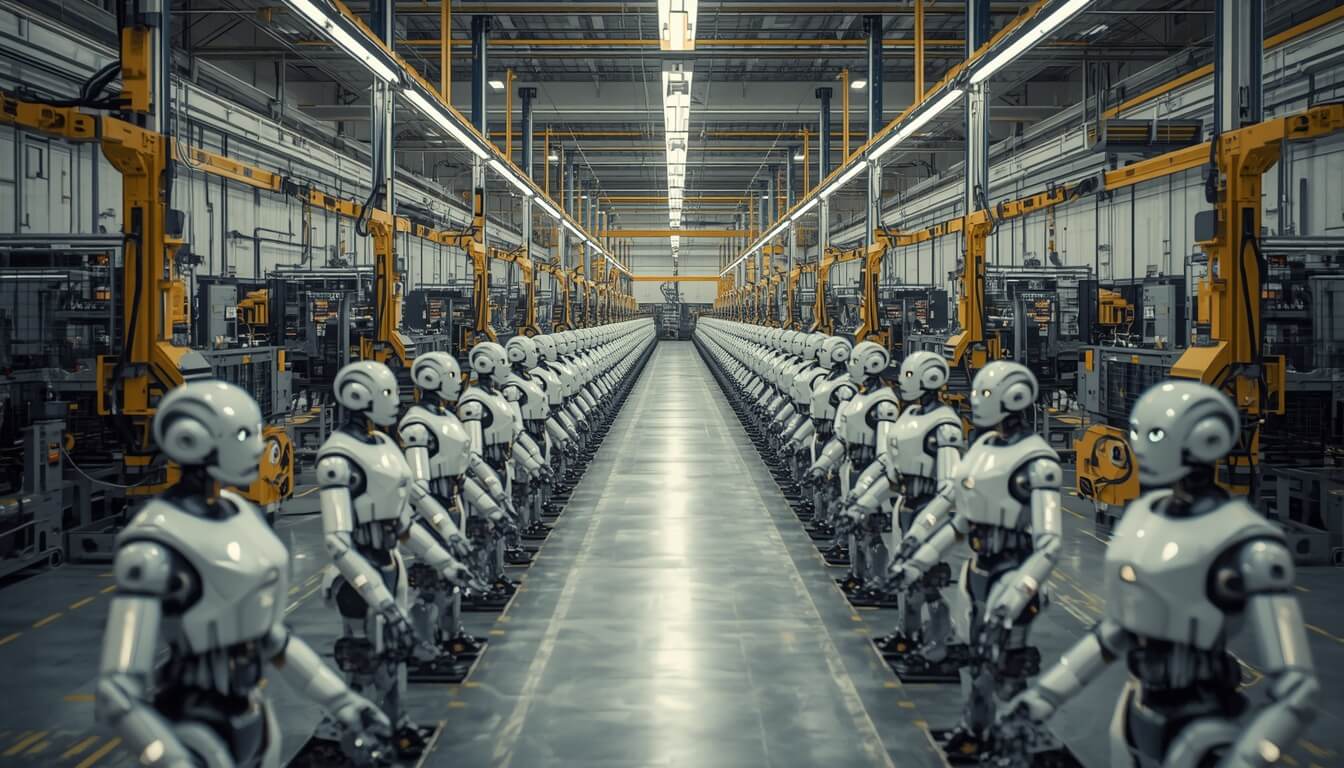
Humanoid robots are moving from research laboratories into a new phase of technological development. Companies are building increasingly capable machines that can walk, manipulate objects, interact with their surroundings and perform tasks designed for environments originally built for humans.
Yet demonstrating that a humanoid robot can perform a task is very different from creating an industry capable of producing millions of useful robots.
That distinction is becoming increasingly important.
The next stage of competition in humanoid robotics may depend less on whether a company can demonstrate an impressive prototype and more on whether it can transform that prototype into a reliable, manufacturable and economically viable product. The challenge is therefore expanding from robotics engineering into manufacturing, supply chains, software deployment, maintenance and distribution.
The industry is entering a race to solve this broader problem.
From Prototype to Industrial Product
Humanoid robotics has historically been constrained by the difficulty of combining mechanical systems, sensors, computing, artificial intelligence and control software into a machine that can operate reliably in the physical world.
A successful prototype can demonstrate that the underlying technology works. An industrial product requires something much more demanding.
A commercial robot must be repeatable to manufacture, durable enough for extended operation, safe around people, serviceable when components fail and affordable for the customer.
It also needs software that can be updated and improved without requiring a complete redesign of the machine.
This creates a significant gap between research capability and industrial scalability.
A laboratory may build a small number of sophisticated robots using highly specialized components and substantial human intervention. A manufacturing operation must eventually produce large numbers of substantially identical machines while maintaining quality and controlling costs.
That transition could determine which companies become long-term participants in the humanoid robotics industry.
Why Humanoid Robots Are Different
Humanoid robots have a particular potential advantage because human environments are already designed around the human body.
Factories, warehouses, offices and many other workplaces contain doors, shelves, stairs, tools, workstations and vehicles designed for people. A robot with a broadly human-like physical configuration could potentially operate in these environments without requiring every facility to be redesigned.
This is one reason companies are investing in bipedal robots with two arms and human-like manipulation capabilities.
However, reproducing the basic shape of a human is relatively straightforward compared with reproducing the flexibility, balance and dexterity of a human worker. A humanoid robot may require numerous motors and actuators, sophisticated sensing systems, high-performance batteries, embedded computing and complex software. Every additional component introduces potential manufacturing and reliability challenges.
The result is a difficult engineering equation: the robot must become capable enough to perform useful tasks without becoming so complex and expensive that large-scale production becomes impractical.
Artificial Intelligence Changes the Equation
Recent advances in artificial intelligence are changing the potential economics of humanoid robotics.
Traditional industrial robots are generally designed to perform highly structured and repetitive tasks. Their operating environment can be carefully controlled, and their movements can be programmed with considerable precision. Humanoid robots are being developed for a different model.
Instead of programming every movement individually, companies are increasingly exploring systems in which robots learn from demonstrations, sensor data, simulations and large collections of real-world experiences. Vision-language-action models and other forms of embodied AI could allow robots to generalize their behavior across different tasks and environments.
If successful, this approach could make a single hardware platform useful for a much broader range of activities. A robot might begin with a limited number of industrial applications and gradually acquire additional capabilities through software updates.
That would potentially change the economics of the industry: hardware could become a platform on which increasingly capable software is deployed.
But software alone does not solve the manufacturing problem. A highly capable AI system still needs millions of physical machines on which to operate.
The Manufacturing Challenge
The central question for the emerging industry is therefore not simply who can build a humanoid robot.
It is who can build large numbers of humanoid robots reliably and economically.
Manufacturing capacity involves much more than assembling the final machine. Companies need suppliers capable of producing motors, gearboxes, actuators, batteries, sensors, control electronics and structural components at the required volumes. They also need production facilities, quality-control systems, testing equipment and logistics networks.
Some components may initially be sourced from specialist suppliers. Over time, however, companies could increasingly seek control over strategically important parts of the supply chain. This is particularly relevant for actuators and other components that determine the robot's movement, precision and durability.
If demand increases rapidly, shortages in a single critical component could constrain the entire production system. The same principle applies to batteries, computing hardware and sensors.
The ability to manufacture one thousand robots does not automatically imply the ability to manufacture one hundred thousand. Production systems often encounter new bottlenecks as volumes increase.
This is why manufacturing strategy could become one of the defining competitive factors in the sector. For a closer look at how companies are approaching this competition, see Tesla, Figure, Agility and the Competition for Humanoid Robotics.
Distribution Is the Other Half of the Problem
Even a large manufacturing capacity does not guarantee commercial success.
Humanoid robots will need customers and deployment environments. Companies must determine whether robots will be sold directly, leased, offered through robotics-as-a-service models or integrated into broader automation contracts.
The economics of deployment could vary significantly between industries. Factories may value robots that can perform repetitive material-handling tasks for long periods. Warehouses could prioritize mobility and object manipulation. Other industries may require more sophisticated interaction with humans and unpredictable environments.
This means the first scalable humanoid robot industry may not emerge from a single universal application. Instead, companies could begin with narrow commercial use cases where the economic case is easier to demonstrate. Once production volumes increase and hardware costs decline, robots could gradually expand into more complex applications.
This creates a potential feedback loop:
- More robots in the field generate more operational data.
- More data can improve software.
- Better software can increase the number of tasks robots can perform.
- More applications can increase demand, which can justify greater manufacturing investment and potentially lower unit costs.
Scale Could Become a Competitive Moat
Humanoid robotics may therefore develop characteristics similar to other advanced technology industries in which scale creates structural advantages.
A company producing a large number of robots can potentially spread research and development costs across more units. It may negotiate better terms with suppliers, invest more heavily in automated manufacturing and accumulate more operational data.
Large-scale deployment can also create a service ecosystem. Technicians need to maintain robots. Software platforms need to manage fleets. Customers need monitoring and support systems. Spare parts need to be available. Robots may require regular software updates and hardware replacements.
The industry could consequently evolve from selling individual machines toward operating large robotic fleets. This would make manufacturing capacity important, but not sufficient on its own. Companies would need to coordinate hardware, software, infrastructure and customer operations.
The Importance of Reliability
Another major barrier to scale is reliability.
A prototype that works for a demonstration is not necessarily suitable for an industrial environment operating thousands of hours per year.
Industrial customers generally care about uptime, maintenance requirements, safety and predictable performance. A robot that performs exceptionally well but requires frequent intervention could be less useful than a somewhat less capable machine that operates consistently.
Reliability also affects the economics of deployment. If a robot needs frequent repairs, specialized technicians and expensive replacement components, the total cost of ownership can remain high even if the initial purchase price falls.
For this reason, the evolution of humanoid robotics will involve a gradual shift in engineering priorities. Demonstrating what a robot can do will remain important, but demonstrating how reliably it can do it repeatedly may become equally important.
A New Industrial Competition
The emerging humanoid robotics market is therefore broader than a competition between robot designs.
It is becoming a competition between complete industrial systems.
Companies need advanced robotics technology, artificial intelligence, manufacturing expertise, supply-chain access, capital and distribution capabilities. They also need enough commercial demand to justify scaling production.
The companies currently developing humanoid robots are approaching this challenge from different starting points. Some have deep experience in automotive manufacturing. Others come from robotics research, artificial intelligence or industrial automation. Their strategies may consequently differ substantially.
The critical question is whether any company can combine these capabilities into a system that supports sustained mass production.
That question leads directly to the next stage of the industry analysis: comparing the strategies of the companies attempting to build leading humanoid platforms. Tesla, Figure, Agility and the Competition for Humanoid Robotics examines how these approaches differ and what each company brings to the emerging market.
Manufacturing May Matter as Much as Design
The history of technology contains many examples in which the winning product was not necessarily the first or most technically ambitious invention.
Industrialization often changes the competitive landscape. Once a technology reaches a certain level of maturity, the ability to manufacture it repeatedly, reduce costs, maintain quality and distribute it widely can become as important as the original engineering breakthrough.
Humanoid robotics may follow a similar trajectory.
The industry is still at an early stage, and it remains uncertain which technical approaches will ultimately prove commercially viable. Many current systems are still being tested, and the economics of large-scale deployment have not yet been established across most applications.
Nevertheless, the direction of competition is becoming clearer.
The central challenge is shifting from Can a humanoid robot work? toward Can a humanoid robot become an industrial product?
That distinction could define the next decade of robotics.
The companies that succeed in this transition will need to solve not just the problem of building intelligent machines, but the much larger problem of producing, deploying and supporting them at scale. The industrial side of this equation is explored in greater detail in Why Manufacturing Capacity Could Matter as Much as Robot Design.
The race to build humanoid robots may ultimately be decided not inside a robotics laboratory, but across factories, supply chains and deployment networks capable of turning an advanced machine into a mass-produced industrial technology.