
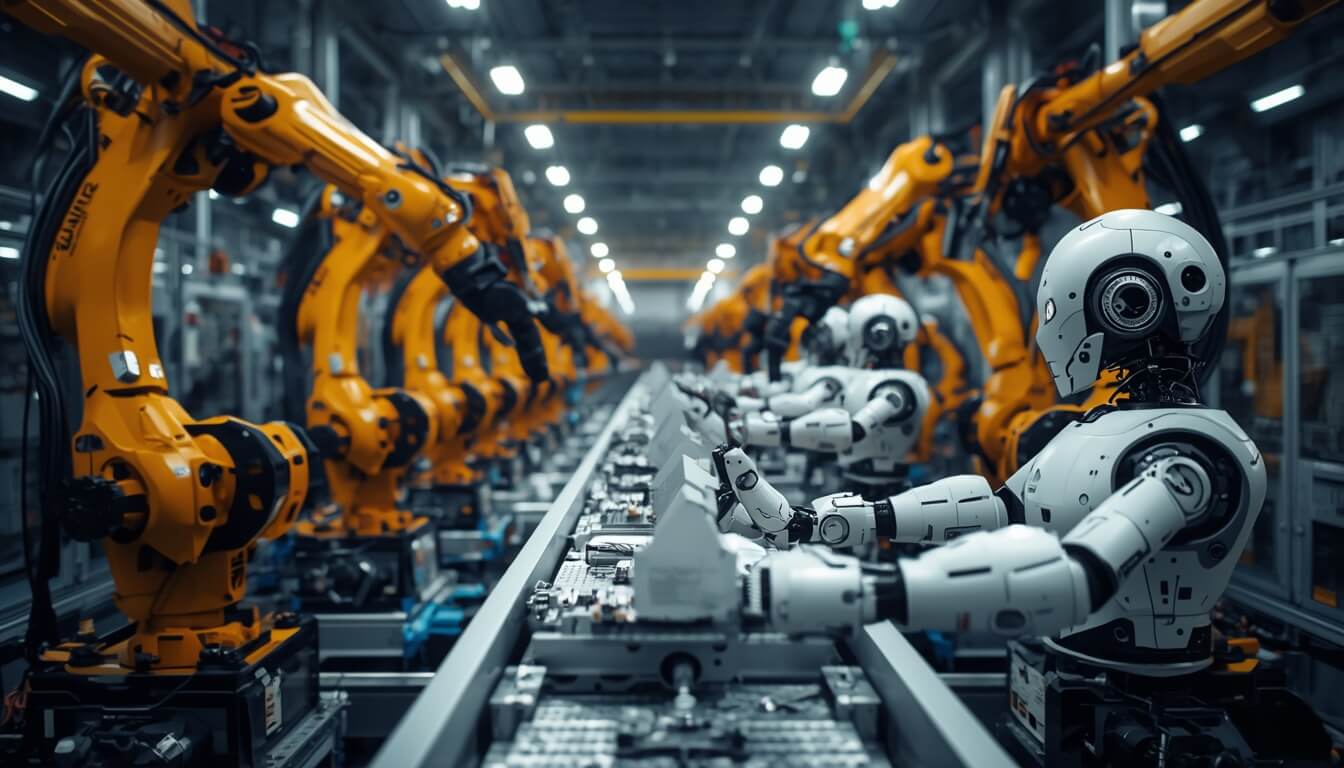
The humanoid robotics industry is often presented as a competition between machines.
Companies demonstrate robots walking, climbing stairs, carrying objects, manipulating tools and responding to instructions. Engineers compete to improve dexterity, battery life, balance, perception and artificial intelligence. These capabilities are essential, but they represent only one part of the challenge.
The next stage of humanoid robotics may depend on a less visible question: how many robots can a company actually build?
Producing a sophisticated prototype is fundamentally different from establishing a manufacturing system capable of producing tens of thousands or eventually millions of machines. The transition requires factories, suppliers, standardized components, automated assembly, quality control, testing infrastructure and distribution networks.
For this reason, manufacturing capacity could become as important to humanoid robotics as robot design itself.
The Difference Between a Prototype and a Product
A prototype is designed to demonstrate possibilities.
It can be assembled using specialized components, manual processes and engineering teams capable of adjusting individual machines. If a component is difficult to obtain or an assembly step takes several hours, the company can often tolerate the problem while the technology remains experimental.
Mass production operates under very different constraints. A commercial robot needs to be manufactured repeatedly with predictable quality and cost. Thousands of units must perform substantially the same way, while production times and component costs need to remain under control.
This creates a fundamental transition:
prototype engineering → product engineering → manufacturing engineering → mass production
Each stage introduces new problems. A robot that works extremely well as an individual machine may still require substantial redesign before it becomes suitable for automated manufacturing. This is particularly important for humanoid robots because they contain many moving components and complex mechanical systems.
The Actuator Problem
One of the most important manufacturing challenges is the actuator.
Humanoid robots require numerous actuators to move their joints. These systems combine motors, gearing, electronics and control mechanisms, and they must provide a combination of power, precision, durability and efficiency. The number of actuated joints means that a humanoid robot can contain many more mechanically active components than simpler robotic systems.
If a single robot requires dozens of sophisticated actuators, scaling production can quickly become a supply-chain problem.
A manufacturer planning to build 100,000 robots needs millions of individual components. Production capacity therefore depends not only on the robot manufacturer's own factory but also on the ability of suppliers to increase their output.
This creates a potential bottleneck. A company may have sufficient assembly capacity but still be unable to increase robot production because a critical component supplier cannot deliver enough units. The same issue can occur with sensors, batteries, power electronics, processors and precision mechanical components.
Supply Chains Become Strategic
As humanoid production scales, supply chains could become increasingly important strategic assets.
Companies need reliable sources for critical components and must decide which parts to manufacture internally and which to purchase from external suppliers. Vertical integration can provide greater control over production, but it also requires additional capital and manufacturing expertise. External sourcing can reduce the need for internal infrastructure but may create dependence on suppliers whose capacity is outside the company's direct control.
The optimal balance is unlikely to be identical for every company. Some manufacturers may attempt to produce critical components themselves. Others may rely heavily on specialist suppliers.
Partnerships and long-term procurement agreements could become increasingly important as production volumes rise. This is one reason why the industrial competition surrounding humanoid robots may extend far beyond the companies whose names appear on the robots themselves.
Manufacturing Scale Can Change Unit Economics
Scale matters because manufacturing costs are not necessarily fixed.
Factories can become more efficient as production volumes increase. Automated processes can replace manual assembly. Workers can specialize in particular production stages. Component suppliers can invest in larger facilities when demand becomes predictable.
Large production volumes can also justify investments that would not make economic sense at low volumes. A company producing a few hundred robots may rely on relatively manual assembly. A company targeting hundreds of thousands of units could justify highly automated production lines, specialized tooling and extensive testing systems.
This creates a potential scale effect:
- Lower manufacturing costs can make robots economically attractive to more customers.
- Greater demand can justify higher production volumes.
- Higher volumes can then support additional investments in manufacturing efficiency.
The process could become self-reinforcing if the underlying technology proves commercially useful. But scale can also work in the opposite direction. If demand remains limited, large factories may operate below capacity, making the economics of production less attractive. The relationship between manufacturing capacity and demand is therefore critical.
Reliability Is a Manufacturing Problem Too
Reliability is often discussed as an engineering issue, but at large scale it becomes a manufacturing issue as well.
A company producing a small number of robots can inspect each machine extensively. A large fleet requires standardized quality-control systems. Every robot must leave the factory with components operating within defined tolerances. Motors, sensors, batteries, electronics and mechanical joints must all meet specifications.
The company also needs automated or semi-automated testing procedures. A manufacturing line capable of producing thousands of robots per month is only useful if those robots meet consistent quality standards.
This means production data becomes increasingly important. Factories can monitor failure rates, component performance and production deviations. That information can be used to identify recurring problems and modify manufacturing processes.
Over time, the factory itself becomes a source of engineering knowledge.
The Factory Becomes Part of the Technology
In many advanced technology industries, the manufacturing process eventually becomes an important part of the competitive advantage. Two companies may use similar underlying technologies but achieve very different production costs because their manufacturing systems are different.
The same could happen with humanoid robots. A company might design an excellent robot but struggle to manufacture it efficiently. Another company might have a slightly different design that is easier to assemble, service and scale. The second company could potentially reach larger production volumes even if its initial robot appears less technically ambitious.
This is why design for manufacturing may become increasingly important. Engineers cannot optimize the robot only for performance. They must also consider:
- how components are assembled;
- how easily parts can be replaced;
- how many unique components are required;
- how much automation can be used;
- how robots can be tested;
- how the supply chain can support production;
- and how manufacturing costs change with volume.
The robot is therefore increasingly becoming a manufacturing system as much as a mechanical product.
Distribution Could Become the Next Bottleneck
Even if manufacturing capacity expands successfully, another challenge remains: getting robots into the hands of customers.
Humanoid robots are likely to require installation, software integration, maintenance and technical support. Customers may need systems that can monitor fleets, schedule tasks, detect failures and deploy software updates.
This means the commercial infrastructure surrounding the robot could become almost as important as the machine itself. A manufacturer selling thousands of robots may eventually need regional service networks and inventories of replacement components. It may also need software platforms capable of managing large fleets.
The business therefore becomes more complex as the number of deployed robots increases.
From Individual Robots to Robot Fleets
The economics of humanoid robotics may ultimately be based on fleets rather than individual machines.
A customer operating a large warehouse or factory may deploy dozens or hundreds of robots. Managing those robots becomes a separate technological problem. Companies need to know which machines are operational, which require maintenance and which are performing particular tasks. Software could coordinate robot fleets, distribute new capabilities and monitor performance.
This introduces another potential advantage of scale. A company with a large installed base can develop extensive operational experience. It can observe how robots behave across different environments and identify common failure modes. The resulting information can feed back into both software and hardware development.
This creates a cycle:
more production → more deployments → more operational data → improved systems → greater commercial usefulness → more demand
Whether this cycle develops will depend on the economics and reliability of the technology, but it illustrates why early industrial scale could become strategically important.
Manufacturing Capacity and Artificial Intelligence
Humanoid robotics also creates an unusual relationship between physical manufacturing and artificial intelligence.
AI systems can improve through data, while robots can generate data through physical interaction with the world. A larger fleet could therefore potentially produce a larger volume of useful operational information.
For example, robots deployed in different warehouses may encounter different object shapes, lighting conditions, floor layouts and task sequences. Those experiences can potentially contribute to improved perception, planning and control systems.
However, more data does not automatically produce better AI. Data must be collected, filtered, labeled or otherwise structured, and incorporated into models effectively.
Nevertheless, the combination of physical scale and software improvement could create an important feedback mechanism. A company that successfully deploys a large fleet could potentially gain both manufacturing experience and real-world robotics data.
Capital Requirements Could Rise Quickly
Scaling humanoid production will also require significant capital.
Factories, tooling, testing equipment and component inventories require upfront investment. Companies must often spend money before they receive revenue from the eventual sale or deployment of the robots. This creates a financial challenge.
Manufacturers need to determine how quickly to expand production without creating excessive unused capacity. Building a factory capable of producing 500,000 robots per year is very different from building one capable of producing 10,000. The larger facility may reduce costs if demand materializes, but it also exposes the company to greater capital requirements if adoption develops more slowly than expected.
This makes production planning particularly important during the early stages of the industry.
The Importance of Standardization
Another potential factor is standardization.
If humanoid robotics develops around common components, interfaces and software systems, manufacturers may benefit from an increasingly mature supplier ecosystem. Standardized components can potentially reduce costs and make replacement parts easier to obtain.
However, companies may also prefer proprietary designs to differentiate their products. The industry therefore faces a balance between specialization and standardization. Too much customization can make production expensive. Too much standardization could limit differentiation.
The eventual balance will likely depend on how quickly the market grows and how many competing platforms survive.
Why Robot Design Still Matters
Manufacturing capacity should not be interpreted as a replacement for technological innovation.
A robot still needs to be capable of performing economically valuable tasks. Poor dexterity, insufficient battery life, limited autonomy or unreliable movement cannot be solved simply by building more units. Manufacturing scale becomes meaningful only after the underlying product reaches a sufficient level of usefulness.
The relationship is therefore complementary:
- Robot design determines what the machine can do.
- Manufacturing determines how efficiently the machine can be produced.
- Software determines how effectively its capabilities can evolve.
- Distribution determines how widely those capabilities can be deployed.
The long-term industry will depend on all four.
Different Companies, Different Industrial Advantages
This is also why the approaches of Tesla, Figure, Agility and other humanoid robotics companies deserve to be examined separately.
A company with extensive automotive manufacturing experience may have advantages in production engineering and supply-chain management. A robotics-focused company may have advantages in mechanical design and embodied AI. An industrial automation company may have stronger relationships with factories and logistics operators. A technology company may bring computing infrastructure and AI capabilities.
The eventual market could therefore reward combinations of capabilities rather than a single technical breakthrough. For an examination of the companies currently pursuing these different approaches, see Tesla, Figure, Agility and the Competition for Humanoid Robotics.
The Industrialization Test
The humanoid robotics industry is approaching an important test.
The first phase was largely about proving that increasingly sophisticated robots could walk, manipulate objects and operate in real-world environments. The next phase is about proving that those robots can become products.
That requires more than impressive demonstrations. A commercially scalable system must combine reliable hardware, capable AI and control software, repeatable manufacturing, resilient supply chains, competitive unit economics, customer integration, maintenance infrastructure and sufficient demand.
The companies that can combine these elements may be positioned differently from companies that excel in only one area. This does not mean manufacturing will determine the industry by itself. Technical capabilities remain fundamental. But as the technology matures, production and deployment constraints could become increasingly visible.
From Robotics Technology to Industrial Infrastructure
The broader significance of humanoid robotics may ultimately come from the transformation of physical labor rather than from the robot itself.
If humanoid machines become reliable and economically viable, they could potentially operate across multiple industries without requiring completely new physical environments. Factories, warehouses and other workplaces could gradually incorporate robotic fleets alongside human workers.
But reaching that stage requires industrial infrastructure:
- Factories need to produce the machines.
- Suppliers need to produce their components.
- Software systems need to manage fleets.
- Service networks need to maintain them.
- Customers need to integrate them into existing operations.
- Capital needs to finance the expansion.
This is why the race in humanoid robotics should not be understood purely as a competition to build the most advanced robot. It is a competition to build a scalable ecosystem around the robot.
The Emerging Industrial Race
The three articles in this cluster point to the same structural transition from different directions.
The first question is whether humanoid robots can become sufficiently capable to perform useful tasks outside controlled demonstrations. The Race to Build the First Scalable Humanoid Robot Industry examines that transition from prototype technology toward a potential industrial market.
The second question concerns the companies attempting to make that transition. Tesla, Figure, Agility and other developers bring different combinations of robotics expertise, artificial intelligence, manufacturing capabilities and commercial relationships.
The third question is what happens after the prototype works. That is where manufacturing becomes critical.
A robot that can be demonstrated once is a technological achievement. A robot that can be produced thousands of times, operate reliably, receive software updates, be serviced economically and generate enough value for customers is something different: an industrial product.
Humanoid robotics is still too early for the eventual structure of the market to be known. Production volumes, costs, technical capabilities and customer adoption are all evolving. But one principle is already becoming increasingly relevant.
The industrialization of humanoid robotics will require more than building intelligent machines. It will require building the infrastructure capable of producing and deploying them at scale.
The companies competing in this market are therefore not only designing robots. They are attempting to build the factories, supply chains, software systems and commercial networks that could determine whether humanoid robotics becomes a niche technology or a major industrial platform.