
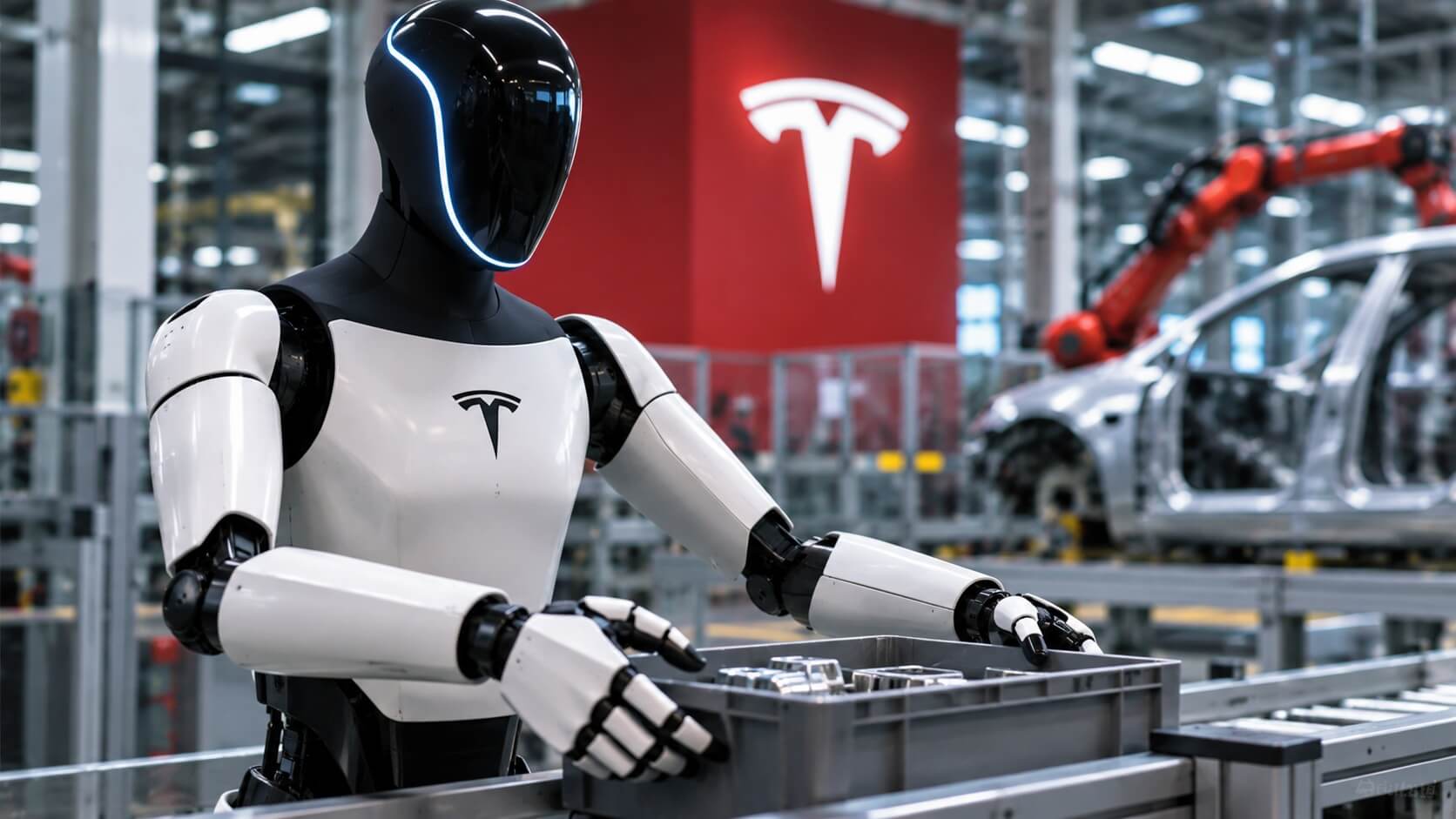
Yes, Elon Musk is developing humanoid robots through Tesla's Optimus program. Optimus is a general-purpose humanoid robot designed to perform physical tasks in factories and, potentially, homes and other human environments.
Tesla has demonstrated Optimus walking, manipulating objects, and performing selected tasks. The company's long-term ambition is to develop robots that can perform useful physical work at scale.
However, Optimus remains an emerging robotics project rather than an established, large-scale commercial business. Demonstrations of robotic capabilities do not prove that the machines can perform a wide range of tasks independently, reliably, and economically over extended periods.
For investors, Optimus represents a potentially important expansion of Tesla's business beyond electric vehicles, batteries, and energy products.
The opportunity could be substantial if Tesla develops a reliable general-purpose robot and manufactures it at competitive costs.
But there is a significant difference between technological potential and proven financial value.
Understanding what Optimus can actually do, what Tesla still needs to demonstrate, and how humanoid robotics could affect its business is essential before assigning investment value to the project.
What Is Tesla Optimus?
Tesla Optimus, also known as the Tesla Bot, is a humanoid robot development program introduced by Tesla in 2021.
The project aims to create a machine capable of performing physical activities in environments designed for humans.
Unlike conventional industrial robots, which are often fixed in place and programmed for specific repetitive tasks, Optimus is intended to become a more flexible robotic platform.
Its humanlike structure includes a torso, two arms, hands, and legs.
This design is meant to allow the robot to navigate human environments and interact with tools, objects, and equipment.
Tesla's long-term vision includes applications such as moving materials, handling objects, supporting manufacturing operations, and eventually assisting with everyday activities.
However, these ambitions should not be confused with capabilities already established in routine commercial use.
The project combines several areas of technology:
- Artificial intelligence for interpreting surroundings and controlling actions.
- Cameras and sensors for environmental perception.
- Electric motors and actuators for movement.
- Robotic hands for manipulating objects.
- Batteries and power electronics for mobile operation.
- Software systems for coordinating physical tasks.
The objective is to integrate these technologies into a robot that can eventually perform useful work with limited human intervention.
What Can Tesla Optimus Actually Do?
Tesla has publicly demonstrated several Optimus capabilities, including walking, maintaining balance, manipulating objects, and performing selected physical activities.
These demonstrations show progress in robotic engineering.
However, their significance depends on how the tasks were performed.
A robot completing a task under controlled conditions is not equivalent to a robot independently completing the same task across thousands of unpredictable real-world situations.
Walking and Maintaining Balance
Optimus has demonstrated bipedal movement.
Walking on two legs requires continuous coordination between motors, joints, sensors, and control software.
The robot must adjust its movements to maintain balance as its weight shifts.
This is important because human-designed workplaces contain spaces and equipment that may be difficult for larger wheeled machines to navigate.
However, walking ability alone does not establish commercial usefulness.
The robot must also move safely, efficiently, and reliably while performing productive tasks.
Picking Up and Handling Objects
Optimus has demonstrated object manipulation using robotic arms and hands.
Manipulation is one of the most important capabilities for a general-purpose humanoid robot.
Factories and warehouses contain numerous tasks involving boxes, components, containers, and tools.
A useful humanoid must identify an object, approach it, position its hands, apply the correct gripping force, and move it without damaging the object or losing balance.
These actions become much more difficult when objects vary in shape, weight, texture, and position.
A robot that successfully handles one familiar object may still struggle with unfamiliar materials.
Performing Factory-Related Tasks
Tesla has shown Optimus performing selected activities relevant to industrial environments.
These include movements and manipulation tasks that could eventually support manufacturing operations.
Factories are a logical development environment because tasks can often be standardized and monitored.
Tesla also has access to its own production facilities, potentially allowing it to test robotic systems within existing industrial operations.
However, a demonstration inside a factory does not automatically mean the robot is operating as an economically productive autonomous worker.
Investors should look for evidence of sustained operation, useful output, reliability, and the amount of human assistance required.
Interacting With People
Optimus has also appeared in public demonstrations involving human interaction.
These demonstrations can help illustrate the robot's physical design and potential applications.
But investors should distinguish between autonomous behavior, scripted routines, and remotely assisted operation.
Remote operation can be useful for collecting training data and developing robotic capabilities.
It does not necessarily indicate that the robot can perform the same activities independently.
The degree of autonomy matters because a robot that requires continuous human control cannot deliver the same economic benefits as one capable of completing useful work on its own.
Is Tesla Optimus Fully Autonomous?
Optimus has demonstrated increasing robotic capabilities, but full general-purpose autonomy should not be assumed.
Autonomy exists on a spectrum.
A robot may independently perform a familiar task in a controlled environment while requiring assistance when conditions change.
Another system may follow predefined instructions without understanding how to handle unexpected situations.
A genuinely flexible humanoid robot would need to recognize unfamiliar objects, plan appropriate actions, adapt to changing surroundings, and recover from mistakes.
These capabilities are difficult to achieve consistently.
For example, moving a box from one location to another may appear simple.
But real workplaces introduce variations in box dimensions, placement, surrounding obstacles, and human activity.
The robot must respond correctly without requiring extensive reprogramming.
Tesla's progress should therefore be evaluated through measurable task performance rather than assumptions about general intelligence.
The most important question is how much useful work Optimus can complete independently under realistic operating conditions.
How Does Tesla Optimus Use Artificial Intelligence?
Artificial intelligence is central to Tesla's humanoid robotics ambitions.
Optimus needs software capable of interpreting information from cameras and sensors, selecting actions, and controlling physical movement.
Tesla has experience developing AI systems for vehicle perception and automated driving.
Some concepts are relevant to robotics because both applications require machines to interpret the physical world.
However, the problems are not identical.
A vehicle primarily navigates roads and responds to traffic conditions.
A humanoid robot must also balance on two legs, manipulate objects, interact with tools, and coordinate numerous joints.
Learning From Demonstrations
One approach to developing robotic intelligence involves training systems using examples of physical tasks.
These examples may come from human demonstrations, robot operation, or simulated environments.
The goal is to help the robot learn how actions relate to visual information and physical outcomes.
For instance, training data could help a robot learn how to approach and grasp different objects.
But successful training does not guarantee that the robot will handle every unfamiliar situation.
Robotic systems must still be tested for reliability and safety.
Why Physical AI Is Different
AI systems that generate text or analyze images do not face the same physical consequences as robots.
A humanoid robot operates in the real world.
An incorrect movement can damage equipment, drop an object, or injure someone.
This makes reliability especially important.
The robot must combine perception, decision-making, and physical control while responding quickly to changing conditions.
For investors, progress in robotic AI could become a competitive advantage, but only if it translates into better practical performance.
Why Is Elon Musk Investing in Humanoid Robots?
Elon Musk has presented humanoid robotics as a potentially important long-term opportunity for Tesla.
The underlying idea is that physical labor represents an enormous economic activity.
If robots eventually perform a meaningful portion of useful physical tasks, demand could extend across manufacturing, logistics, services, and households.
Tesla's ambition is to develop a general-purpose platform rather than a machine designed for only one activity.
The Potential Economic Opportunity
Factories and warehouses employ people to perform numerous repetitive or physically demanding tasks.
A capable humanoid robot could potentially support some of these activities.
If the same robot could perform several different tasks, businesses might gain flexibility compared with purchasing separate specialized machines.
However, the theoretical size of the labor market does not equal the addressable market for humanoid robots.
Many tasks require capabilities that current robots cannot reliably provide.
Other activities may be performed more efficiently by conventional automation.
The economic opportunity depends on which tasks robots can actually perform at competitive costs.
Why Tesla Could Have an Advantage
Tesla has several existing capabilities that may be relevant to humanoid robotics.
These include experience with electric motors, batteries, power electronics, AI computing, software development, and large-scale manufacturing.
Tesla also operates factories where it can test potential industrial applications.
These capabilities could reduce certain barriers to developing and producing robots.
However, they do not guarantee success.
Manufacturing a reliable humanoid robot involves specialized challenges, particularly robotic manipulation, mechanical durability, and safe physical interaction.
The company must demonstrate that its existing expertise can be translated into commercially useful robotic products.
How Much Will Tesla Optimus Cost?
Tesla has discussed ambitious future cost and pricing objectives for Optimus.
Elon Musk has suggested that humanoid robots could eventually be produced or sold at prices in the tens of thousands of dollars if manufacturing reaches sufficiently large volumes.
However, a future price target is not an established commercial selling price.
The actual economics will depend on component costs, manufacturing efficiency, software, maintenance, and production scale.
A general-purpose humanoid robot requires numerous mechanical and electronic systems.
Robotic hands and actuators can be particularly demanding because they must combine precision, strength, efficiency, and durability.
Tesla may be able to reduce costs through design improvements and manufacturing scale.
But the company must first establish that the robot can perform commercially valuable work.
Why Price Alone Is Not Enough
Imagine a future Optimus robot selling for $30,000.
That would be an illustrative scenario, not a verified market price.
Whether the robot represents good value would depend on its capabilities.
A robot that performs useful tasks independently for many hours could potentially justify its cost.
A robot that requires constant supervision or frequent maintenance might not.
For businesses, the relevant measure is the cost of productive work.
That includes purchase price, maintenance, electricity, software, repairs, downtime, and human assistance.
For a broader comparison of humanoid robot prices and ownership costs, see How Much Does a Humanoid Robot Cost? Prices and What You Get.
When Will Tesla Optimus Be Available?
Tesla has discussed ambitious development and production timelines for Optimus.
However, projected timelines should not be confused with confirmed widespread commercial availability.
There are several stages between developing a functioning prototype and selling large numbers of commercially reliable robots.
Internal Factory Deployment
A company can initially test robots within its own facilities.
This allows engineers to collect operational data, identify failures, and improve the system.
Internal deployment can be valuable even before a robot becomes commercially available.
However, it does not necessarily establish external customer demand.
Limited Commercial Deployment
The next stage may involve selected customers operating robots in defined environments.
These deployments can help determine whether the technology delivers measurable productivity benefits.
Important indicators include task completion rates, operating hours, maintenance requirements, and customer willingness to pay.
Large-Scale Commercial Availability
Widespread availability requires more than manufacturing capacity.
Tesla would need to support customers with software, repairs, replacement parts, safety procedures, and reliable product performance.
Demand must also be sufficient to justify production expansion.
Household Availability
Home environments are considerably less predictable than controlled industrial workplaces.
A household robot may encounter children, pets, fragile objects, stairs, and unfamiliar situations.
These conditions create additional safety and autonomy requirements.
For that reason, general-purpose household adoption could develop more slowly than selected industrial applications.
For a broader discussion of realistic industry adoption scenarios, see When Will Humanoid Robots Be Widely Available? What to Expect.
How Many Optimus Robots Has Tesla Produced?
Tesla's humanoid robotics production plans have attracted substantial attention.
However, investors should distinguish between several different measures.
Prototypes built: Robots manufactured for engineering, development, and demonstrations.
Internal deployments: Robots placed in Tesla facilities for testing or operational activities.
Commercial deliveries: Robots supplied to external customers under commercial arrangements.
Productive operating units: Robots performing useful work consistently over time.
These figures are not interchangeable.
A company might produce numerous development units without generating meaningful commercial revenue.
Similarly, a robot operating in a factory may still be part of an engineering program rather than a mature commercial deployment.
Tesla's production targets should be treated as forward-looking plans until supported by reported results.
Investors should prioritize verified production and deployment information over promotional forecasts.
The most meaningful evidence will come from actual output, operating reliability, customer demand, and financial performance.
Could Tesla Optimus Replace Human Workers?
Humanoid robots could eventually automate selected physical tasks currently performed by people.
However, replacing an entire human job is much more complicated than automating one activity.
A worker may perform numerous tasks throughout the day.
Some are repetitive and predictable.
Others require judgment, adaptation, communication, or delicate physical manipulation.
A humanoid robot might become capable of handling certain activities without being able to perform the full range of responsibilities associated with a position.
Tasks That May Be Easier to Automate
Structured activities are generally more suitable for early automation.
Examples include moving materials, transporting containers, and handling standardized objects in controlled environments.
These tasks can often be monitored and repeated under relatively predictable conditions.
Tasks That Remain Difficult
Unpredictable environments create more complex challenges.
A robot may struggle with unfamiliar objects, delicate materials, crowded spaces, or situations requiring human judgment.
Physical interaction with people also introduces significant safety considerations.
The likely economic impact is therefore more complicated than a simple replacement of workers by robots.
Businesses may use humanoid systems to automate particular activities, support employees, or reorganize workflows.
The outcome will depend on technology, costs, regulation, and how companies choose to deploy automation.
How Does Optimus Compare With Other Humanoid Robots?
Tesla is not the only company developing advanced humanoid systems.
Several competitors are pursuing different approaches.
| Company | Robot | Development emphasis |
|---|---|---|
| Tesla | Optimus | General-purpose robotics and potential manufacturing scale |
| Boston Dynamics | Atlas | Advanced physical mobility and industrial robotics |
| Figure AI | Figure humanoids | AI-driven manipulation and general-purpose tasks |
| Agility Robotics | Digit | Warehouse and logistics operations |
| Apptronik | Apollo | Industrial humanoid applications |
| Unitree Robotics | G1 and H1 | Research, development, and humanoid hardware |
These platforms cannot be ranked reliably using promotional demonstrations alone.
A robot that moves impressively may not be the most productive in an industrial environment.
Similarly, a robot performing a narrow warehouse task reliably may deliver more immediate commercial value than a more ambitious general-purpose platform.
Tesla's potential advantage is its manufacturing experience and broader technology ecosystem.
But competitors may achieve advantages through specialized applications, partnerships, hardware design, or robotics software.
The eventual commercial leaders may not be the companies generating the most attention today.
For a practical comparison of the leading platforms, see The Leading Humanoid Robots Today: A Practical Comparison.
Could Optimus Become a Major Source of Revenue for Tesla?
Optimus could potentially become a meaningful business if Tesla successfully commercializes the technology.
However, the financial outcome depends on several uncertain variables.
These include the number of robots sold, average selling prices, manufacturing costs, service revenue, and operating margins.
A simplified scenario illustrates the relationship.
| Hypothetical annual sales | Average selling price | Annual hardware revenue |
|---|---|---|
| 10,000 robots | $30,000 | $300 million |
| 100,000 robots | $30,000 | $3 billion |
| 500,000 robots | $30,000 | $15 billion |
| 1,000,000 robots | $30,000 | $30 billion |
These figures are purely illustrative and are not Tesla forecasts.
They assume every unit is sold at the same price and exclude discounts, services, returns, and other adjustments.
Revenue is also not the same as profit.
Manufacturing expenses, research and development, warranty costs, support, and additional operating costs would affect profitability.
Selling one million robots annually would require substantial manufacturing capacity and customer demand.
It would also require a product capable of delivering economic value at scale.
The table demonstrates how volume could influence revenue, but it does not establish that these sales levels are achievable.
How Could Optimus Affect Tesla Stock?
Optimus could influence Tesla's valuation through expectations about future revenue, profitability, and long-term growth.
Investors often assign value to businesses based partly on anticipated future earnings.
If the market believes humanoid robotics could become a large and profitable industry, Tesla's involvement may affect how investors evaluate the company.
However, expectations can move much faster than actual commercial results.
The Bullish Scenario
In an optimistic scenario, Tesla develops reliable humanoid robots capable of performing valuable work.
Manufacturing costs decline as production increases.
Commercial customers adopt the technology, and Tesla establishes a profitable robotics business.
Under these conditions, Optimus could create an additional revenue stream and potentially strengthen Tesla's long-term growth prospects.
The Moderate Scenario
In a more gradual scenario, Optimus becomes useful for selected industrial tasks but requires years of development before achieving broad commercial adoption.
Revenue grows slowly, and the company continues investing heavily in engineering and production.
The project may create long-term value without becoming a dominant contributor to Tesla's near-term financial performance.
The Bearish Scenario
In a less favorable scenario, technical challenges, high operating costs, competition, or limited customer demand prevent widespread adoption.
Tesla could continue spending on development without generating sufficient returns.
Investors who previously assigned substantial value to Optimus might then revise their expectations.
These scenarios illustrate possible outcomes rather than predictions.
The stock market may also reflect Optimus expectations before the company reports meaningful robotics revenue.
What Are the Biggest Risks for Tesla Optimus?
Several risks could affect the project's commercial success.
Technical Complexity
General-purpose humanoid robotics requires advanced movement, manipulation, perception, and decision-making.
Progress in one area does not guarantee success across the entire system.
Reliability and Safety
A commercial robot must operate safely around people and equipment.
Unexpected movements, falls, mechanical failures, and software errors could create significant risks.
Manufacturing Costs
High component costs or manufacturing difficulties could prevent Tesla from achieving its intended pricing objectives.
Competition
Other companies may develop more reliable, specialized, or economical robotic platforms.
Tesla's manufacturing experience does not guarantee leadership in every aspect of robotics.
Commercial Demand
Customers may prefer conventional automation if it performs the same tasks more efficiently.
A technologically capable humanoid robot may still struggle to attract buyers if its economic benefits are insufficient.
Valuation Risk
Tesla's share price may reflect expectations about future businesses that have not yet generated substantial profits.
If expectations exceed eventual results, investors could experience losses even if the technology continues improving.
What Should Tesla Investors Monitor?
Investors evaluating Optimus should focus on measurable progress.
| Indicator | Why it matters |
|---|---|
| Verified commercial deployments | Demonstrates movement beyond prototypes and testing |
| Autonomous task performance | Indicates how independently robots can work |
| Productive operating hours | Helps assess real-world usefulness |
| Reliability and maintenance | Affects operating costs and customer satisfaction |
| Manufacturing costs | Influences pricing and potential margins |
| External customer orders | Provides evidence of market demand |
| Recognized robotics revenue | Shows actual commercial contribution |
| Profitability | Determines whether the business creates sustainable financial value |
These indicators are more informative than the appearance of a robot or the number of views generated by a demonstration video.
Investors should also evaluate Optimus alongside Tesla's established businesses.
Tesla remains exposed to developments in electric vehicles, energy storage, manufacturing, competition, regulation, and broader financial markets.
Optimus is only one part of the company's overall investment case.
Is Tesla Optimus a Real Business Opportunity or Just Hype?
Tesla Optimus is a real robotics development program with demonstrated technological progress.
The broader economic opportunity is also plausible.
Machines capable of performing useful physical work could eventually create demand across multiple industries.
However, the scale and profitability of that opportunity remain uncertain.
The most important distinction is between what Optimus has demonstrated, what Tesla intends to achieve, and what customers may eventually be willing to pay for.
A successful robotics business requires more than a capable prototype.
It requires reliable products, scalable manufacturing, competitive operating costs, customer demand, and sustainable margins.
For investors, Optimus should be evaluated as a potentially significant but still uncertain long-term opportunity—not as a guaranteed future source of Tesla profits.
The decisive milestone will come when Tesla demonstrates that its humanoid robots can perform economically valuable work consistently and generate measurable commercial returns.
Disclaimer: This article is for informational and educational purposes only and does not constitute financial or investment advice. Company plans, production targets, and future financial scenarios are subject to uncertainty. Investing in stocks and emerging technologies involves risks, including the potential loss of capital. Investors should conduct independent research before making investment decisions.