
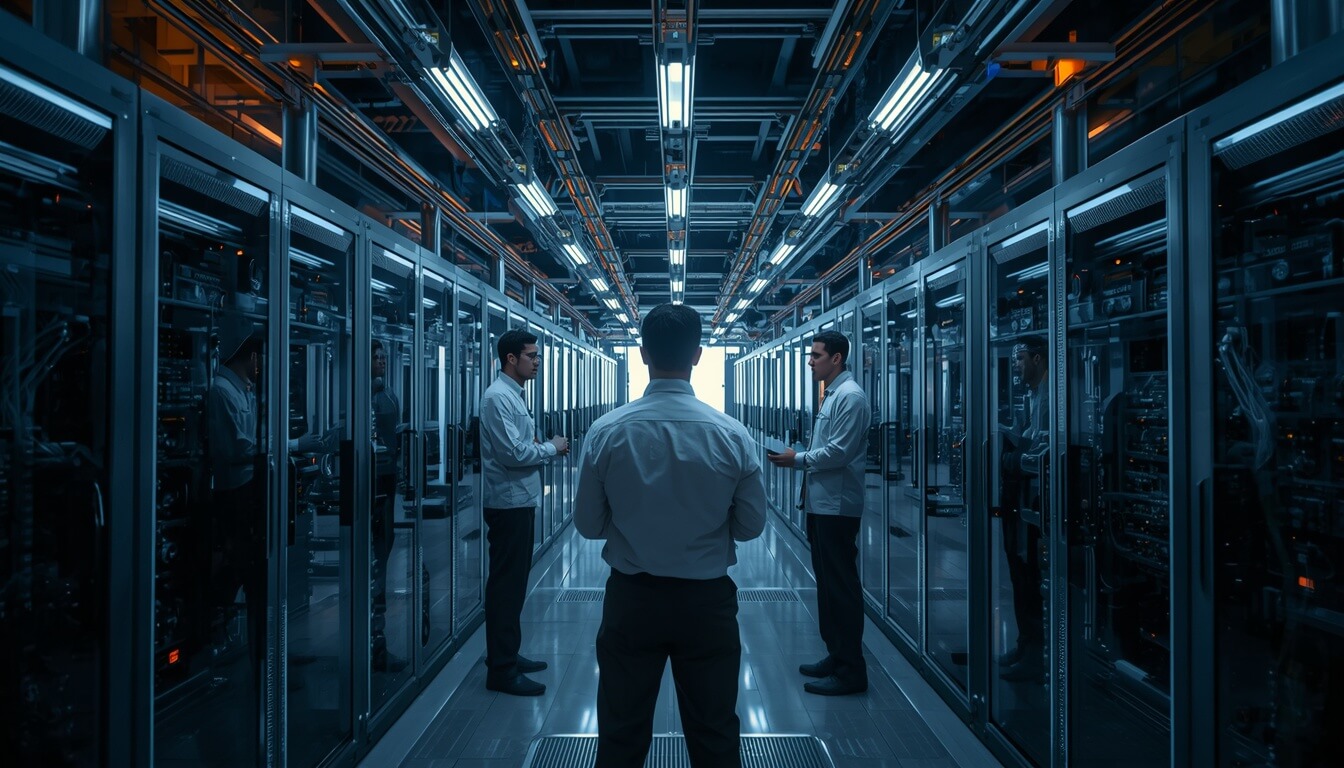
The companies building AI infrastructure extend far beyond the businesses creating chatbots and AI models.
Behind the AI boom is a large supply chain providing the chips, networking equipment, servers, data centers, cooling systems, electrical equipment, and power needed to run artificial intelligence at scale.
For investors, some of the most important companies in this ecosystem include NVIDIA and Broadcom in computing and networking, Vertiv in power and cooling infrastructure, and Eaton in electrical equipment. Cloud giants such as Microsoft, Amazon, Alphabet, and Meta are also spending heavily to expand the data center capacity needed for AI.
The important point is that there is no single “AI infrastructure company.” Different businesses control different parts of the physical system.
NVIDIA: The Computing Engine Behind the AI Boom
NVIDIA is the most visible company in AI infrastructure because its GPUs have become central to training and running many advanced AI systems.
The company’s role goes beyond individual chips.
NVIDIA increasingly sells complete computing platforms combining GPUs, networking technology, interconnects, software, and systems designed to allow huge numbers of processors to work together.
The scale of AI demand is visible in its financial results.
NVIDIA generated $215.9 billion in total revenue in fiscal 2026, up 65% from the previous year. Its Data Center business produced a record $62.3 billion of revenue in the fourth quarter alone, an increase of 75% year over year.
Those numbers show why AI infrastructure has become such a large investment theme. Companies are spending extraordinary amounts of money simply to obtain the computing capacity required for increasingly powerful models.
A recent example is SpaceX, which is reportedly seeking $40 billion to buy Nvidia AI chips, highlighting the enormous financing requirements behind advanced AI computing.
But GPUs cannot operate alone. They need networking, servers, electricity, cooling, and buildings around them.
That is why the infrastructure opportunity quickly expands beyond NVIDIA.
Broadcom: Connecting and Customizing AI Computing
Broadcom occupies another important position in the AI infrastructure supply chain.
As AI clusters become larger, thousands of processors need to communicate rapidly. Networking technology becomes essential because expensive computing hardware loses efficiency if information cannot move between processors quickly enough.
Broadcom supplies AI networking technology while also developing custom AI accelerators for large customers.
The growth has been substantial.
Broadcom reported $16.7 billion in AI semiconductor revenue during its third quarter of fiscal 2026, up 221% from the previous year. The company said demand for both custom AI accelerators and networking remained very strong.
This highlights a broader shift within AI infrastructure.
Not every large technology company necessarily wants exactly the same computing architecture. Some hyperscalers and major AI operators are developing custom processors designed for their own workloads.
That creates a market not only for standard GPUs, but also for companies capable of designing specialized chips and the networking systems connecting them.
For investors, Broadcom demonstrates how the AI infrastructure opportunity can spread into parts of the semiconductor industry that receive less consumer attention than the AI applications themselves.
Vertiv: Keeping AI Data Centers Powered and Cool
Installing thousands of powerful AI processors creates another problem: they consume large amounts of electricity and generate enormous amounts of heat.
That is where companies such as Vertiv enter the picture.
Vertiv provides critical digital infrastructure including power management and thermal management systems used in data centers.
AI is making these systems increasingly important because computing density is rising.
A traditional data center can often rely heavily on conventional air cooling. High-density AI racks can require more sophisticated thermal systems, including liquid cooling technologies capable of removing heat directly from high-performance computing equipment.
Demand for this infrastructure has accelerated sharply.
Vertiv reported that organic orders in the fourth quarter of 2025 increased approximately 252% from the same period a year earlier. The company identified hyperscale and colocation data centers as major drivers and pointed to strong demand related to AI infrastructure.
In July 2026, Vertiv also announced an expansion of manufacturing capacity for AI-ready cooling equipment, with plans to double chiller production capacity at one European facility by the end of the year.
The investment illustrates an important part of the AI buildout: buying additional computing chips often creates additional spending elsewhere.
More GPUs can mean more power equipment.
More power means more heat.
More heat means greater demand for cooling.
AI infrastructure therefore creates a chain of connected investment requirements.
Eaton: Supplying the Electrical Infrastructure
Electricity is becoming one of the biggest constraints facing AI data centers.
The challenge is not simply generating enough electricity. Data centers need equipment capable of safely receiving, controlling, distributing, and protecting enormous electrical loads.
Eaton is one of the companies supplying that layer.
Its products include switchgear, power distribution systems, backup power equipment, and other electrical technologies used by data centers and utilities.
AI-related demand is already affecting the company’s business.
In the first quarter of 2026, Eaton reported that the twelve-month rolling average of orders in its Electrical Americas segment increased 42%, driven by data center momentum. The company also reported 48% year-over-year backlog growth across its Electrical sector.
Eaton has responded by expanding manufacturing.
In April 2026, the company announced an investment of more than $30 million in a new Nebraska facility designed to increase production of medium-voltage switchgear. Eaton specifically connected the expansion to rising demand associated with AI data centers.
This is a good example of how the AI infrastructure boom reaches companies that might not traditionally be considered technology stocks.
AI cannot scale simply because better software exists. Physical electrical infrastructure must also scale.
The Cloud Giants Are Building the AI Factories
Another group sits at the center of the AI infrastructure buildout: hyperscale cloud companies.
Microsoft, Amazon, Alphabet, and Meta operate some of the world’s largest data center networks. These companies are investing heavily in additional computing capacity to support their own AI products as well as customers using their cloud platforms.
Their role is different from that of suppliers such as NVIDIA or Vertiv.
A chip company sells computing hardware.
A cooling company helps keep that hardware operating.
A hyperscaler combines many of these components into enormous computing facilities and then uses that infrastructure to deliver cloud and AI services.
These companies are therefore both buyers and builders of AI infrastructure.
They purchase chips, servers, networking systems, electrical equipment, and cooling technology while financing the construction and expansion of data centers.
For investors, this distinction matters because the economics are different.
Suppliers may benefit directly from a surge in infrastructure orders, while hyperscalers must spend enormous amounts of capital before knowing exactly how much future revenue that infrastructure will generate.
AI Infrastructure Is a Supply Chain, Not a Single Industry
The easiest way to understand the companies building AI infrastructure is to think of the market as a chain.
At one end are semiconductor companies providing the computing engines.
Then come networking technologies that connect those processors.
Servers package the hardware into usable computing systems.
Data centers provide the physical buildings.
Cooling companies manage the heat.
Electrical equipment companies distribute power inside the facility.
Utilities and energy producers supply the electricity.
Construction and engineering companies help build the facilities and grid connections required to make everything work.
This means investors looking for AI exposure do not necessarily have to focus only on companies whose products contain the words “artificial intelligence.”
Some of the companies benefiting from AI spending may manufacture equipment that has existed for decades.
What has changed is the scale of demand.
If you want to understand why AI requires all of these physical layers in the first place, What Infrastructure Does AI Actually Need? Data Centers, Chips, and Power explains how the pieces fit together.
Which Parts of AI Infrastructure Could Benefit Most?
There is no simple answer because bottlenecks can move.
During one stage of the buildout, advanced chips may be difficult to obtain.
Later, the limiting factor could become networking equipment, cooling systems, transformers, electricity, land, or grid connections.
That matters because shortages can shift economic value through the supply chain.
A component that represents a relatively small percentage of a data center’s total cost can suddenly become extremely important if the entire project cannot operate without it.
Electrical equipment provides a useful example.
A company may have billions of dollars available for AI processors, but those processors cannot generate revenue if the facility cannot obtain enough electricity or if critical power-distribution equipment delays construction.
The same logic applies to cooling.
As AI racks become more powerful, thermal management becomes increasingly important to the performance and reliability of the entire facility.
Investors therefore need to look beyond headline AI spending and ask a more useful question:
Where are the real bottlenecks in the infrastructure chain?
Companies supplying scarce or difficult-to-replace components may have stronger pricing power and more durable demand than companies selling products that can easily be substituted.
Not Every AI Infrastructure Company Will Be a Winner
Rapid demand growth can make an industry attractive, but it can also create dangerous expectations.
When investors believe a company will benefit enormously from AI, its stock price can rise faster than its actual earnings.
That means a strong business can still become a poor investment if the valuation assumes unrealistic future growth.
Competition is another concern.
High margins attract new suppliers. Large technology companies are also developing more of their own hardware, potentially changing relationships with traditional vendors.
Technology can shift quickly as well. A new generation of processors may require different networking, cooling, or power architectures.
And perhaps the biggest uncertainty is whether today’s enormous infrastructure spending will eventually produce enough AI revenue to justify the investment.
This is why investors should distinguish between two questions:
Will AI infrastructure spending grow?
and
Will a particular company generate attractive returns from that growth?
Those are not the same thing.
The first may be true while the second depends on competition, margins, valuation, execution, customer concentration, and many other factors.
What Should Investors Watch?
Rather than simply searching for companies labeled as AI infrastructure plays, investors can look for evidence that AI demand is actually affecting the underlying business.
Order growth can show whether customers are committing money.
Backlogs can indicate future demand, although they do not guarantee revenue.
Revenue growth can show whether orders are converting into sales.
Margins help reveal whether companies have pricing power or are simply competing aggressively for business.
Capital spending also matters because suppliers may need to build factories and increase production before they can satisfy demand.
Finally, customer concentration deserves attention. Some AI infrastructure suppliers depend heavily on a relatively small number of hyperscalers and major technology companies.
That can produce enormous growth when those customers are spending aggressively, but it can also create vulnerability if investment plans change.
The Bigger Investment Story Behind AI
The companies building AI infrastructure reveal something important about the current AI boom.
Artificial intelligence is not purely a software revolution.
It is also driving a massive expansion of physical computing infrastructure.
NVIDIA and Broadcom provide critical computing and networking technology. Vertiv supplies systems that help power and cool increasingly dense data centers. Eaton provides electrical infrastructure needed to distribute enormous amounts of power. Hyperscalers assemble these technologies into enormous computing platforms.
And behind all of them sits an even broader ecosystem involving utilities, energy producers, semiconductor manufacturers, construction companies, equipment suppliers, and data center operators.
That creates many potential ways for investors to gain exposure to AI infrastructure.
But exposure alone does not guarantee investment success.
Rapid growth, huge capital requirements, changing technology, intense competition, and high valuations can create significant risks alongside the opportunity. Those issues are explored in The Risks of Investing in AI Infrastructure Nobody Talks About.
The key for investors is to understand where each company sits in the infrastructure chain, what problem it solves, and whether demand for that solution can translate into sustainable profits.
This article is for informational purposes only and does not constitute investment advice. Investing involves risk, including the possible loss of principal.