
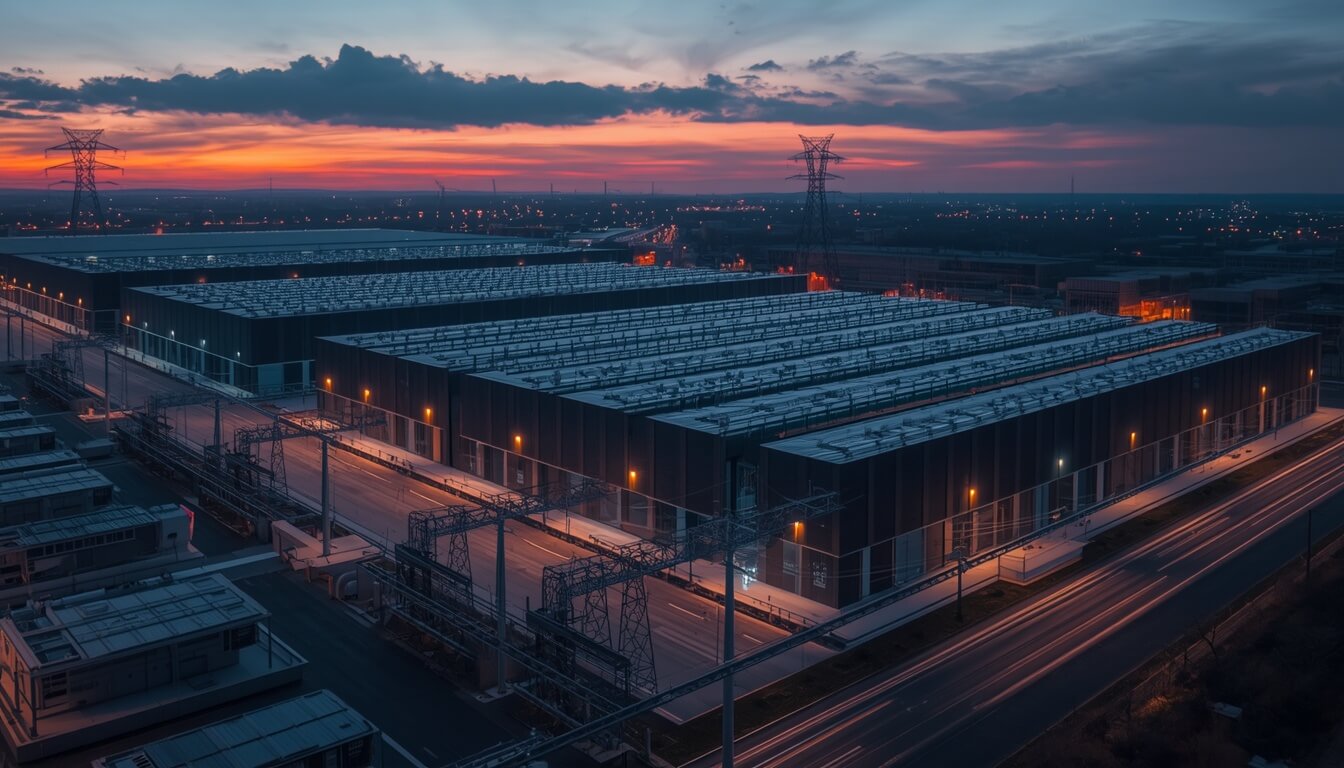
Artificial intelligence may feel like software, but the AI boom is being built on a massive amount of physical infrastructure.
Every time an AI model is trained or millions of people use an AI assistant, the work ultimately happens on real machines inside data centers. Those machines need advanced chips, high-speed networking, enormous amounts of electricity, cooling systems, storage, and connections to the power grid.
In simple terms, modern AI infrastructure has several essential layers:
- advanced computing chips;
- servers and data centers;
- high-speed networking;
- electricity and grid infrastructure;
- cooling systems;
- data storage.
Without those physical systems, even the most advanced AI model cannot operate at scale.
Understanding this infrastructure is increasingly important for investors because the AI investment story extends far beyond the companies developing AI models. A much larger ecosystem is supplying the equipment, facilities, energy, and technology required to keep those models running.
Why Does AI Need So Much Infrastructure?
Traditional software mostly follows instructions written by programmers. Modern AI models work differently: they learn patterns from enormous amounts of data and then perform huge numbers of calculations when generating answers, images, video, code, or other outputs.
That creates two major computing workloads.
The first is training. This is the process of building an AI model by processing large datasets and repeatedly adjusting the model until it becomes better at performing its task.
The second is inference. This happens after the model has been trained. Every time someone asks an AI chatbot a question, generates an image, or uses an AI feature inside another application, computing infrastructure is needed to produce the result.
Training can require extremely concentrated computing power, while inference becomes increasingly important as AI reaches more users and applications.
That means the infrastructure challenge is not simply building a powerful AI system once. Companies must also build enough capacity to serve potentially hundreds of millions of interactions after the model is deployed.
Chips Are the Computing Engines Behind AI
At the center of AI infrastructure are specialized processors.
Traditional data centers rely heavily on CPUs, or central processing units. CPUs remain important, but many modern AI workloads are better suited to accelerators such as GPUs because these processors can perform large numbers of calculations in parallel.
This makes advanced AI chips one of the most important pieces of the infrastructure stack.
The scale of the shift can be seen in NVIDIA’s business. The company reported approximately $193.7 billion in Data Center revenue for fiscal 2026, up from about $115.2 billion the previous year.
That growth illustrates how quickly spending on accelerated computing has expanded.
The scale of the investment required is also visible in SpaceX's reported plan to raise $40 billion to purchase Nvidia AI chips, illustrating how access to financing is becoming a crucial part of expanding AI computing capacity.
But the chip itself is only one part of the system.
AI processors must be installed in servers, connected to other processors, supplied with electricity, cooled, and linked to storage and networking equipment. Thousands of powerful chips working together can effectively become one enormous computing system.
This is why the AI infrastructure opportunity extends well beyond semiconductor companies.
Investors interested in the businesses supplying these different layers can explore The Companies Building AI Infrastructure: What Investors Should Know.
Why Are Data Centers So Important for AI?
A data center is essentially the physical home of computing infrastructure.
Inside a modern facility are rows of racks containing servers, processors, networking equipment, storage systems, power equipment, and cooling technology.
AI is changing the design requirements of these facilities.
Traditional cloud workloads might distribute computing demand across many conventional servers. Advanced AI systems can instead concentrate enormous computing power into relatively small areas.
That creates much higher power density.
According to the International Energy Agency, the power density of AI servers increased roughly elevenfold between 2020 and 2025 and could rise another fourfold by 2027.
For data center operators, that changes the problem dramatically.
A building cannot simply be filled with additional AI servers indefinitely. The facility must be capable of delivering enough electricity to those machines and removing the heat they generate.
As a result, the availability of power and cooling capacity can become just as important as the availability of computing hardware.
Electricity Is Becoming a Critical Part of the AI Story
AI infrastructure consumes large amounts of electricity because processors operate continuously while performing computationally intensive tasks.
The scale is becoming significant.
Global data center electricity consumption was estimated at roughly 415 terawatt-hours in 2024. The International Energy Agency projects that consumption could reach around 945 terawatt-hours by 2030 in its base case.
That would more than double data center electricity demand in only six years.
AI is expected to be one of the main forces behind that increase.
The impact could be particularly important in the United States. The IEA expects data centers to account for almost half of the growth in U.S. electricity demand through 2030.
This changes how investors should think about AI infrastructure.
The AI boom is not only creating demand for chips and servers. It can also create demand for electricity generation, transmission infrastructure, substations, transformers, backup power systems, and other equipment required to deliver reliable power to data centers.
In some regions, access to electricity may become one of the biggest constraints on new AI capacity.
Why Does AI Need Specialized Cooling?
Almost all the electricity consumed by computing equipment eventually becomes heat.
As more powerful processors are packed into increasingly dense server racks, removing that heat becomes a major engineering challenge.
Traditional data centers have often relied heavily on air cooling. But extremely dense AI systems can require more advanced approaches, including liquid cooling, where coolant is brought much closer to the components producing the heat.
Cooling matters for two reasons.
First, processors cannot operate reliably if temperatures become too high.
Second, cooling itself consumes energy and requires additional infrastructure.
According to the IEA, servers account for around 60% of electricity demand in modern data centers on average, although the percentage varies considerably depending on the type of facility. The remainder includes systems such as cooling, storage, networking, and other supporting infrastructure.
That means an AI data center is not simply a warehouse filled with chips. It is an integrated industrial system designed to supply electricity, move data, control temperatures, and keep expensive computing equipment operating continuously.
Networking Connects Thousands of AI Chips
One powerful processor can perform enormous numbers of calculations, but the largest AI models require many processors working together.
Those processors must communicate extremely quickly.
This makes high-speed networking another essential layer of AI infrastructure.
If thousands of GPUs are performing different parts of the same workload, slow communication between them can reduce the efficiency of the entire system. The network therefore needs to move huge amounts of data between servers with very low delays.
The importance of networking is already visible in industry results. NVIDIA reported that its Data Center networking revenue increased 142% in fiscal 2026, driven partly by growing demand for systems connecting large clusters of AI processors.
For investors, this highlights an important point: increasing demand for AI computing does not translate only into increasing demand for GPUs.
More computing capacity can also require more switches, optical components, cables, networking equipment, and other technologies that allow those processors to function together.
AI Also Needs Massive Storage Systems
AI systems require access to enormous quantities of data.
During training, models may process datasets containing text, images, video, software code, scientific information, or other forms of digital content. That information must be stored somewhere and delivered quickly enough to keep expensive processors working efficiently.
Storage therefore forms another layer of the infrastructure stack.
Large AI environments may use combinations of high-performance storage for data that needs to be accessed rapidly and lower-cost storage for information that does not require the same speed.
The key issue is balance.
There is little value in installing extremely expensive AI processors if they spend too much time waiting for data. Storage and networking infrastructure must be capable of feeding information into the computing system fast enough to avoid bottlenecks.
The Power Grid May Be One of AI’s Biggest Physical Constraints
Building an AI data center requires more than buying land and installing servers.
The facility also needs access to enormous amounts of reliable electricity.
That can require new substations, transmission lines, transformers, power-generation capacity, and grid connections. These projects often move much more slowly than the technology industry.
A new generation of computing hardware can arrive within months. Major electrical infrastructure can take years to plan, permit, manufacture, and build.
This difference in timelines creates a potential bottleneck.
The IEA has warned that supply chains for equipment such as transformers and gas turbines have tightened as data center development accelerates. Grid connections and regulatory approvals can also delay projects.
This is why location is becoming strategically important.
The best location for an AI data center may increasingly be determined not simply by cheap land or proximity to customers, but by whether enough electricity can actually be delivered to the site.
AI Infrastructure Is Becoming an Entire Industrial Ecosystem
When people think about artificial intelligence, they often focus on AI models or the applications consumers use.
The physical infrastructure underneath those applications is much broader.
A simplified AI infrastructure chain looks like this:
Semiconductors → servers → networking → data centers → cooling → electricity → grid infrastructure
Each layer depends on the others.
More AI chips require more servers. More servers require larger or denser data centers. Higher computing density requires stronger cooling. More computing capacity requires more electricity. Higher electricity demand may require additional grid and generation infrastructure.
This creates a chain reaction of investment.
The International Energy Agency reported that capital spending by five major technology companies exceeded $400 billion in 2025 and was expected to increase substantially again in 2026, with data center investment playing a major role.
The scale of that spending helps explain why AI has become more than a software trend. It is increasingly becoming a major physical infrastructure cycle.
What Does AI Infrastructure Mean for Investors?
For investors, the most important takeaway is that the AI economy has multiple layers.
AI model developers may attract much of the attention, but the companies providing the infrastructure underneath them can participate in the same expansion.
Potential beneficiaries can exist across semiconductors, networking, electrical equipment, cooling, construction, data centers, utilities, energy generation, and other supporting industries.
However, rising infrastructure spending does not automatically make every company exposed to AI a good investment.
Large capital cycles can produce overbuilding. Competition can reduce margins. New generations of chips can make existing equipment less valuable. Electricity constraints can delay data centers. Customers can reduce spending if expected AI demand fails to materialize.
Those issues are explored further in The Risks of Investing in AI Infrastructure Nobody Talks About.
The central idea is simpler: artificial intelligence is not floating somewhere in the cloud.
Behind every AI model is a physical chain of chips, servers, networks, buildings, cooling systems, and power infrastructure. As AI adoption grows, expanding that chain may become one of the largest technology infrastructure projects of the coming decade.
This article is for informational purposes only and does not constitute investment advice. Investing involves risk, including the possible loss of principal.