
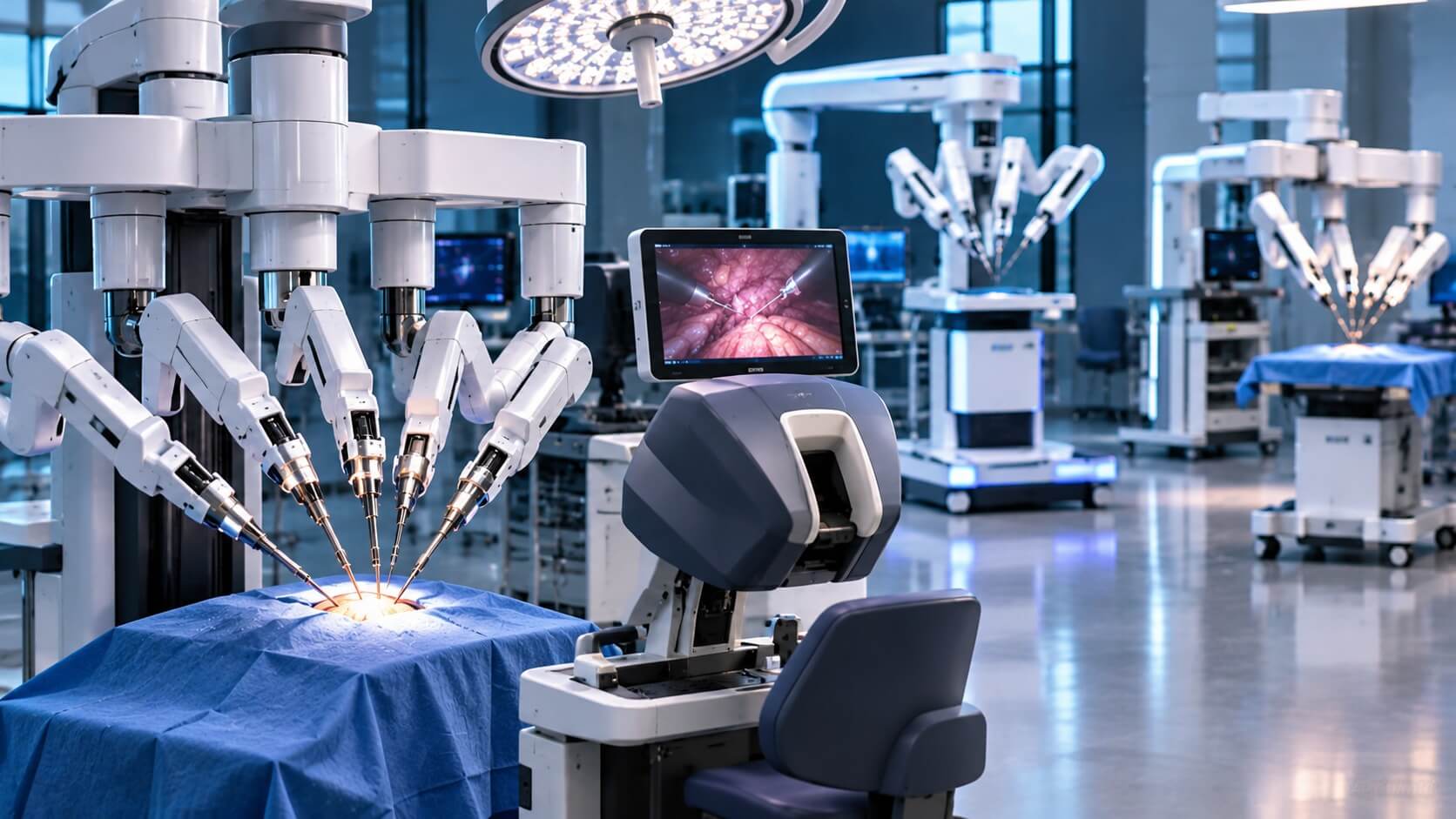
Intuitive Surgical is the leading company in robotic-assisted soft-tissue surgery, thanks to its da Vinci surgical systems, established hospital relationships, and large installed equipment base.
However, the surgical robotics industry is not controlled by a single company across every medical specialty. Stryker is a major competitor in orthopedic robotics, while Medtronic, Zimmer Biomet, Johnson & Johnson, and other manufacturers are developing or commercializing robotic platforms for different surgical applications.
For investors, understanding the leading surgical robotics companies requires looking beyond the robots themselves. The most important differences involve market position, recurring revenue, hospital adoption, clinical applications, and the ability to turn technological innovation into sustainable profits.
Who Is the Leader in Surgical Robotics?
Intuitive Surgical (NASDAQ: ISRG) is widely recognized as the dominant established manufacturer in robotic-assisted soft-tissue surgery.
Its da Vinci platform is used in a range of minimally invasive procedures, including urology, gynecology, and general surgery.
The company's competitive position comes from more than its technology.
Intuitive Surgical has developed an ecosystem involving robotic equipment, surgical instruments, training programs, maintenance services, and relationships with healthcare institutions.
This creates several advantages.
Hospitals that purchase a robotic platform must also invest in training surgeons and operating room staff. They may develop workflows around the equipment and establish programs that depend on its continued availability.
Replacing an established system can therefore involve significant financial and operational costs.
Intuitive Surgical also benefits from recurring revenue generated by instruments, accessories, and services associated with its installed systems.
For investors, this business model is particularly important because revenue can grow through increasing surgical activity, not just through the sale of additional robots.
The company's position is strongest in soft-tissue robotic surgery. It should not automatically be described as the leader in every category of surgical robotics.
For a deeper explanation of its technology and business model, see Who Makes the Da Vinci Surgical Robot? Inside Intuitive Surgical.
What Are the Biggest Surgical Robotics Companies?
Several publicly traded medical technology companies have significant involvement in surgical robotics.
Their products serve different medical specialties, so a direct ranking based on total corporate revenue would be misleading.
| Company | Stock ticker | Major robotic platform | Main focus |
|---|---|---|---|
| Intuitive Surgical | NASDAQ: ISRG | da Vinci | Soft-tissue surgery |
| Stryker | NYSE: SYK | Mako | Orthopedic surgery |
| Medtronic | NYSE: MDT | Hugo | Soft-tissue surgery |
| Zimmer Biomet | NYSE: ZBH | ROSA | Orthopedic surgery |
| Johnson & Johnson | NYSE: JNJ | OTTAVA (development) | Soft-tissue surgery |
These companies differ considerably in business structure.
Intuitive Surgical is particularly concentrated on robotic-assisted surgery and related technologies.
Stryker, Medtronic, Zimmer Biomet, and Johnson & Johnson operate broader medical technology businesses.
As a result, surgical robotics may represent a much smaller portion of their overall revenue.
This distinction matters for investors seeking direct exposure to the industry.
A diversified healthcare company may benefit from robotic surgery growth without its stock performance being driven primarily by that segment.
1. Intuitive Surgical: The Established Leader in Soft-Tissue Robotics
Intuitive Surgical is best known for its da Vinci robotic-assisted surgical systems.
These platforms allow surgeons to control specialized instruments while viewing the surgical area through advanced imaging systems.
The technology is particularly associated with minimally invasive procedures.
The company has developed several generations of the da Vinci platform, improving imaging, instrument capabilities, ergonomics, and system functionality.
Its Ion platform also extends the company's technology into robotic-assisted bronchoscopy, a procedure used to examine and access areas inside the lungs.
Why Is Intuitive Surgical So Successful?
Three characteristics help explain its competitive position.
Established hospital adoption
The company has spent years developing relationships with hospitals and surgical teams.
An established customer base can support repeat equipment purchases, upgrades, and continued instrument demand.
Recurring revenue
Instruments and accessories are required for many procedures performed using da Vinci systems.
As surgical activity increases, demand for these products can grow.
Training and experience
Surgeons and hospital staff must learn how to use robotic systems effectively.
Experience with a particular platform can make switching to another manufacturer's technology more complicated.
These advantages can create barriers for competitors, although they do not eliminate competition.
What Should Investors Watch?
Important indicators include procedure growth, installed systems, instrument revenue, operating margins, and the adoption of newer platforms.
Investors should also examine valuation.
A company can be an industry leader while still representing a risky investment if its stock price assumes exceptionally strong future growth.
2. Stryker: A Major Player in Orthopedic Robotics
Stryker is one of the most important companies in orthopedic robotic surgery.
Its Mako robotic-arm assisted system is used in procedures such as knee and hip replacement.
Unlike da Vinci, which is primarily associated with soft-tissue surgery, Mako helps surgeons plan and perform orthopedic procedures involving joint replacement.
The technology can assist with surgical planning, implant positioning, and controlled bone preparation.
Why Is Mako Important?
Orthopedic surgery presents a different commercial opportunity from soft-tissue robotic surgery.
Hospitals and surgeons must consider not only the robotic equipment but also the implants and other products used during procedures.
Stryker's position in orthopedic implants creates opportunities to integrate robotic technology with its existing medical device business.
This relationship can help support demand for the company's broader orthopedic product portfolio.
What Makes Stryker Different From Intuitive Surgical?
Intuitive Surgical derives much of its business from robotic-assisted surgical technology and its related ecosystem.
Stryker operates across multiple medical technology categories, including orthopedic implants, medical equipment, and other surgical products.
Robotics is therefore part of a larger business.
For investors, this offers diversification but reduces the degree to which the company's financial performance depends specifically on surgical robotics.
3. Medtronic: A Major Competitor in Robotic Surgery
Medtronic is one of the world's largest medical technology companies and has invested in robotic-assisted surgery through its Hugo platform.
Hugo is designed for minimally invasive soft-tissue procedures.
It competes in a category historically dominated by Intuitive Surgical.
One distinguishing characteristic is its modular architecture, which uses separate robotic arm units rather than the same physical configuration found in some competing systems.
This approach may provide flexibility in operating room setup, although actual advantages depend on hospital workflows and clinical requirements.
Can Medtronic Challenge Intuitive Surgical?
Medtronic has several potential advantages.
It already serves hospitals around the world and has established distribution networks, technical support operations, and relationships with surgeons.
These capabilities may help the company introduce robotic systems into existing customer relationships.
However, developing a capable robotic platform is only the beginning.
Medtronic must also demonstrate clinical value, secure regulatory authorizations for intended uses, train surgical teams, and build a commercially sustainable installed base.
Its competitive success will depend on actual adoption and procedure volumes rather than technological specifications alone.
What Should Investors Watch?
Investors should monitor regulatory milestones, commercial installations, procedure adoption, and management disclosures about the robotic surgery business.
Because Medtronic operates across numerous healthcare categories, the impact of surgical robotics on its overall financial performance may develop gradually.
4. Zimmer Biomet: Robotics for Joint Replacement
Zimmer Biomet is another important company in orthopedic robotic surgery.
Its ROSA platform supports certain orthopedic procedures, including knee replacement.
The system helps surgeons with planning and guidance during operations.
Zimmer Biomet's robotics strategy is closely connected to its established orthopedic implant business.
Why Does This Matter?
Joint replacement surgery involves more than the surgical procedure itself.
Hospitals and surgeons also choose implants, instruments, planning systems, and supporting technologies.
A manufacturer that supplies both implants and robotic assistance can potentially create a more integrated offering.
This may strengthen relationships with orthopedic surgeons and healthcare institutions.
However, integration does not guarantee that hospitals will select a particular robotic platform.
Clinical performance, costs, surgeon preferences, and competing products remain important.
What Should Investors Watch?
Investors can examine how robotics supports the company's orthopedic franchise, whether adoption improves its competitive position, and whether technology investments contribute to sustainable financial performance.
Robotic system installations alone do not reveal whether the strategy is profitable.
5. Johnson & Johnson: A Potential Future Competitor
Johnson & Johnson is a major healthcare company with extensive surgical technology operations.
Through its MedTech business, the company has invested in the development of the OTTAVA robotic surgical platform.
OTTAVA is intended to support robotic-assisted soft-tissue surgery.
Unlike established commercial platforms with large installed bases, a development-stage system must still progress through the necessary regulatory and commercialization steps.
Why Is Johnson & Johnson Important?
Johnson & Johnson has substantial financial resources, surgical technology experience, and relationships with healthcare providers.
These capabilities could support the development and eventual commercialization of robotic surgery technology.
However, the company's size does not guarantee success in this market.
The technology must demonstrate appropriate safety, effectiveness, usability, and economic value.
Regulatory authorization, commercial availability, and hospital adoption are separate milestones.
Investors should distinguish between the potential of a development program and revenue generated by an established commercial platform.
What Should Investors Watch?
Important developments include clinical evaluations, regulatory submissions and decisions, product availability, and eventual hospital adoption.
The financial impact on Johnson & Johnson would also need to be considered relative to the size of its broader healthcare business.
Are There Other Surgical Robotics Companies?
Yes. The industry extends beyond the largest publicly traded manufacturers.
Several specialized companies and emerging competitors are developing robotic systems for particular surgical applications.
Examples include:
CMR Surgical
A privately held company known for its Versius robotic surgical platform, designed for minimally invasive procedures.
Asensus Surgical
Known for the Senhance surgical system and its work on digital and robotic surgical technologies. The company was acquired by KARL STORZ in 2024 and is no longer an independently traded public company.
Globus Medical
A publicly traded medical technology company with robotic navigation and surgical guidance technology, particularly in spine surgery.
PROCEPT BioRobotics
A publicly traded company focused on robotic-assisted technology for treating benign prostatic hyperplasia, a condition involving enlargement of the prostate.
These businesses demonstrate that surgical robotics is not one uniform market.
A company specializing in spine surgery may face different competitors, purchasing decisions, and growth opportunities from a company developing systems for abdominal procedures.
For investors, identifying the precise surgical specialty is essential when evaluating market share and growth potential.
Who Are the Top Three Surgical Robotics Companies?
There is no single universally accepted ranking of the top three surgical robotics companies across every surgical specialty.
The answer depends on how leadership is measured.
If the focus is established robotic-assisted soft-tissue surgery, Intuitive Surgical holds a particularly strong position.
If orthopedic robotics is included, Stryker and Zimmer Biomet become important participants.
Medtronic is also a significant competitor in soft-tissue robotics, although its commercial position must be evaluated separately from that of more established platforms.
A practical way to understand the industry is to separate the companies by their areas of strength:
| Surgical category | Important companies |
|---|---|
| Soft-tissue robotic surgery | Intuitive Surgical, Medtronic |
| Orthopedic robotic surgery | Stryker, Zimmer Biomet |
| Spine surgery and navigation | Globus Medical |
| Specialized urological robotics | PROCEPT BioRobotics |
| Emerging soft-tissue platforms | Johnson & Johnson, CMR Surgical |
This approach is more informative than ranking companies solely by total revenue or brand recognition.
What Makes a Surgical Robotics Company a Market Leader?
Market leadership involves more than having the most technologically advanced robot.
Several factors determine whether a company can build a lasting competitive position.
Installed Systems
The number of robotic systems installed in hospitals provides an indication of commercial reach.
However, installations alone do not measure how frequently the equipment is used.
Surgical Procedure Volume
Procedure volume shows actual utilization.
A company with a large installed base and growing procedure volumes may have opportunities to increase recurring revenue from instruments and accessories.
Clinical Evidence
Hospitals need confidence that robotic technology provides appropriate clinical outcomes.
Strong evidence can support adoption, while uncertain benefits may limit demand.
Surgeon Training
Training programs and surgeon experience are important because surgical technology must be integrated into clinical practice.
An established training ecosystem can strengthen customer relationships.
Financial Performance
Revenue growth must eventually translate into sustainable profitability or cash generation.
A company may gain market share while still struggling with high development costs, manufacturing expenses, or weak margins.
Hospital Economics
Robotic systems must make financial sense for the hospitals purchasing them.
A technically impressive platform may struggle if acquisition costs, maintenance, and instruments make procedures too expensive.
For a detailed explanation of equipment pricing and operating expenses, see How Much Does a Surgical Robot Cost? A Practical Breakdown.
Why Is Competition Increasing in Surgical Robotics?
Surgical robotics is attracting competition because manufacturers see opportunities to expand the use of robotic assistance across different procedures and healthcare settings.
Established medical technology companies may use their existing customer relationships to introduce new platforms.
Specialized manufacturers may target narrower applications where they believe robotics can deliver measurable advantages.
Competition can develop around several factors:
- Equipment acquisition prices.
- Instrument and accessory costs.
- Surgical capabilities.
- Ease of training.
- Operating room compatibility.
- Clinical outcomes.
- Maintenance and technical support.
- Availability across different surgical specialties.
Greater competition could benefit hospitals by increasing product choice and potentially improving affordability.
For manufacturers, however, competition can create pricing pressure and increase spending on research, development, and commercialization.
The overall surgical robotics market may grow while individual companies experience declining market share.
This is an important distinction for investors.
Is Intuitive Surgical's Dominance at Risk?
Intuitive Surgical's established position provides meaningful competitive advantages, particularly in soft-tissue surgery.
Its installed equipment base, surgeon training programs, and recurring revenue ecosystem create barriers that new competitors must overcome.
However, those advantages do not make its position permanent.
Competing manufacturers may introduce systems with different capabilities, pricing structures, or operating room configurations.
Hospitals may also become more willing to evaluate alternatives as robotic surgery becomes more familiar.
A major competitive change would likely require more than a new robot receiving regulatory authorization.
Competitors must demonstrate clinical performance, reliability, economic value, and the ability to support hospitals over time.
For investors, the most useful indicators are changes in procedure growth, hospital purchasing patterns, pricing, and recurring revenue rather than product announcements alone.
Which Surgical Robotics Stocks Offer the Most Direct Exposure?
Not all publicly traded surgical robotics companies provide the same degree of exposure to the industry.
Intuitive Surgical (ISRG) is among the clearest examples of a company whose business is closely tied to robotic-assisted surgery.
Stryker (SYK) provides exposure to orthopedic robotics within a broader medical technology business.
Medtronic (MDT) offers exposure to robotic surgery development and commercialization alongside numerous other medical device categories.
Zimmer Biomet (ZBH) combines orthopedic implants with robotic-assisted technologies.
Johnson & Johnson (JNJ) provides more diversified healthcare exposure, with surgical robotics representing only one area of its MedTech investments.
Globus Medical (GMED) and PROCEPT BioRobotics (PRCT) provide exposure to more specialized surgical technology markets.
These differences influence how investors should interpret company performance.
A diversified medical technology company may report strong overall results even if its robotics division grows slowly.
A more robotics-focused company may be more sensitive to changes in surgical procedure volumes, equipment demand, and competitive conditions.
Direct industry exposure can also mean greater concentration risk.
How Should Investors Compare Surgical Robotics Companies?
A useful comparison considers both the competitive position of the technology and the economics of the underlying business.
| Factor | Question for investors |
|---|---|
| Market position | Is the company an established leader or an emerging competitor? |
| Surgical specialty | Which procedures does its technology support? |
| Installed base | How many systems are commercially deployed? |
| Procedure growth | Is utilization increasing? |
| Recurring revenue | How much revenue comes from instruments and services? |
| Regulatory status | Where and for which uses is the system authorized? |
| Profitability | Does the business generate sustainable margins and cash flow? |
| Valuation | How much future growth is already reflected in the stock price? |
No single indicator determines whether a company is an attractive investment.
An established manufacturer may offer stronger commercial visibility but trade at a demanding valuation.
An emerging competitor may have significant growth potential but face greater regulatory, financial, and adoption risks.
Investors should also avoid assuming that a company's total medical technology revenue represents its surgical robotics revenue.
What Investors Should Remember About Surgical Robotics Market Leaders
Intuitive Surgical remains the clearest established leader in robotic-assisted soft-tissue surgery, supported by its da Vinci platform, commercial ecosystem, and recurring revenue model.
Stryker and Zimmer Biomet are important companies in orthopedic robotics, while Medtronic is working to expand its position in soft-tissue robotic surgery.
Johnson & Johnson and specialized manufacturers add another layer of potential competition.
For investors, the industry's leaders cannot be identified by technological reputation alone.
The most important factors are commercial adoption, surgical utilization, clinical evidence, hospital economics, recurring revenue, and profitability.
A growing surgical robotics market can create opportunities for multiple manufacturers, but it does not guarantee that every participant will generate attractive investment returns.
For a broader explanation of how the industry operates, what drives its growth, and the risks investors should understand, read Surgical Robotics: How the Industry Works and What Investors Should Know.
Disclaimer: This article is for informational and educational purposes only and does not constitute financial or investment advice. Investing involves risk, including the possible loss of principal. Company products, regulatory status, and market positions may change over time.