
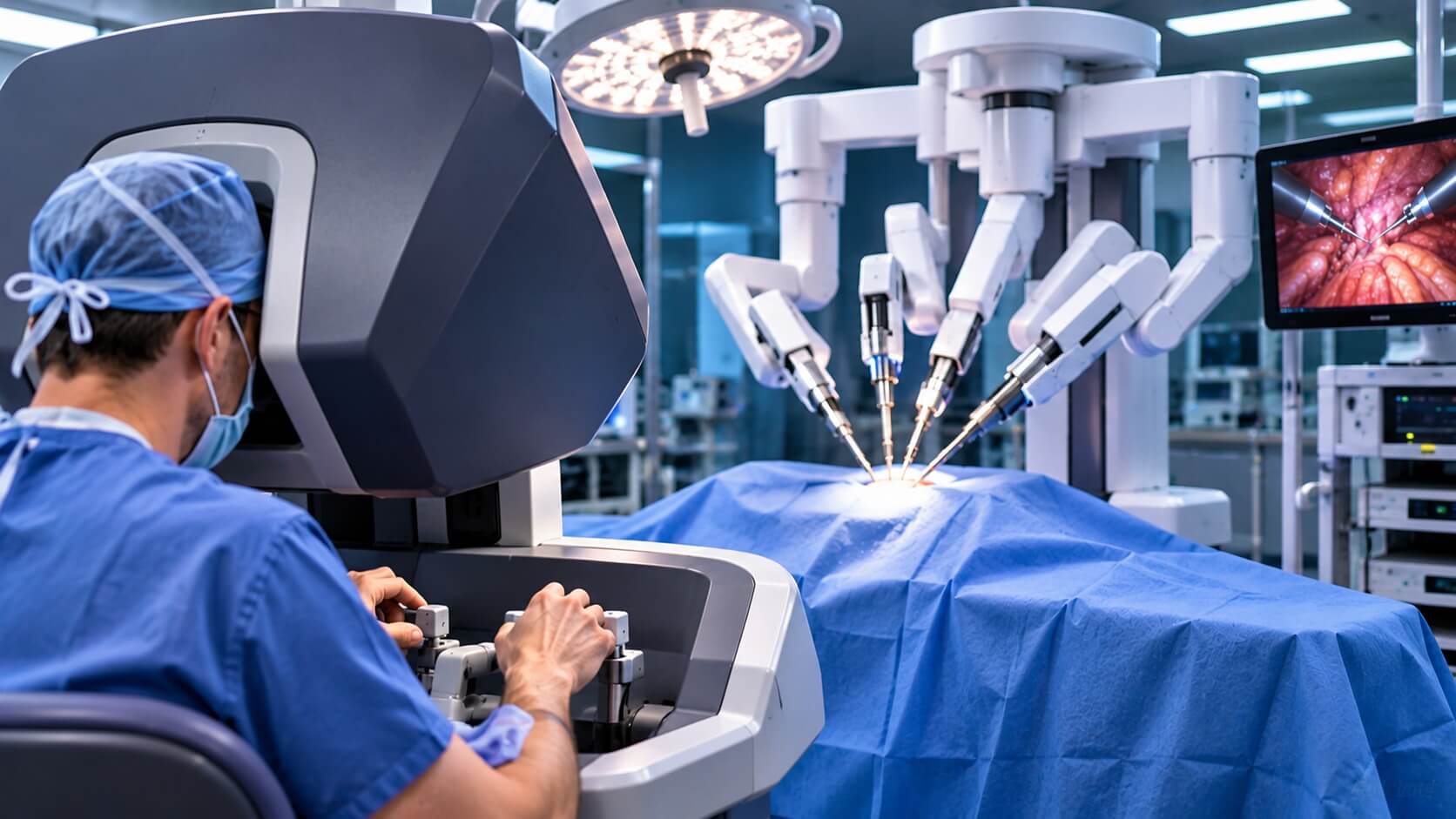
The da Vinci surgical robot is manufactured by Intuitive Surgical (NASDAQ: ISRG), an American medical technology company headquartered in Sunnyvale, California. Intuitive Surgical develops robotic-assisted surgical systems that help surgeons perform minimally invasive procedures using advanced instruments, imaging technology, and precise movement controls.
The da Vinci platform is one of the most established robotic surgery technologies in the world. It is used in hospitals for procedures involving urology, gynecology, general surgery, and other specialties.
For investors, Intuitive Surgical is particularly interesting because its business extends beyond selling expensive robotic equipment. The company also generates recurring revenue from instruments, accessories, and services associated with surgical procedures.
Understanding how the da Vinci system works, why hospitals purchase it, and how Intuitive Surgical makes money helps explain the company's position in the surgical robotics industry.
What Company Makes the Da Vinci Surgical Robot?
The da Vinci surgical system is developed and manufactured by Intuitive Surgical, Inc., commonly known as Intuitive.
The company was founded in 1995 and is publicly traded on the Nasdaq stock exchange under the ticker ISRG.
Intuitive Surgical specializes in technologies designed to support minimally invasive medical procedures.
Its best-known product is the da Vinci robotic-assisted surgical platform, although the company also develops other medical technologies, including the Ion robotic-assisted bronchoscopy system.
The company operates in the medical technology sector rather than the industrial robotics industry.
Its customers are primarily hospitals and healthcare organizations that purchase or lease surgical systems and use them to perform medical procedures.
Intuitive Surgical is widely recognized as a leader in robotic-assisted soft-tissue surgery.
However, it is not the only manufacturer of surgical robots. Other companies develop systems for orthopedic surgery, spinal procedures, and competing minimally invasive surgical applications.
For a comparison of the major manufacturers, see The Leading Surgical Robotics Companies: Who Dominates the Market.
What Is the Da Vinci Surgical Robot?
The da Vinci surgical system is a robotic-assisted platform that allows a surgeon to control specialized instruments during minimally invasive operations.
Despite being called a robot, the system does not independently perform surgery.
The surgeon controls the instruments throughout the procedure and remains responsible for surgical decisions.
A typical da Vinci system includes three main components.
Surgeon Console
The surgeon console is where the surgeon controls the robotic instruments.
The surgeon views the surgical area through a high-definition three-dimensional imaging system and uses hand controls and foot pedals to operate the instruments.
The system translates these movements into controlled actions inside the patient's body.
Patient-Side Equipment
The patient-side equipment contains robotic arms that hold the camera and surgical instruments.
The instruments enter the body through small incisions and are controlled by the surgeon.
Their articulated design can provide a greater range of movement than some conventional laparoscopic instruments.
Vision and Imaging System
The imaging system provides a magnified view of the surgical area.
Detailed visualization helps surgeons identify anatomical structures and perform delicate movements.
The combination of imaging, instrument control, and robotic assistance is central to the da Vinci platform.
How Does the Da Vinci Robot Perform Surgery?
During a robotic-assisted procedure, the surgical team prepares the patient and positions the robotic equipment.
The surgeon then operates the instruments from the console.
The robotic system translates the surgeon's hand movements into instrument movements.
It can also filter certain unintended hand movements and scale larger hand motions into smaller movements.
These capabilities may be useful when operating in confined anatomical spaces.
However, robotic assistance does not eliminate the need for surgical experience.
The surgeon must still understand the patient's anatomy, make clinical decisions, and respond to complications.
Other members of the surgical team remain essential for positioning instruments, assisting during the operation, monitoring the patient, and managing equipment.
Does the Da Vinci Robot Use Artificial Intelligence?
The da Vinci platform incorporates sophisticated software and computer-assisted controls.
Newer surgical technologies may also include features that support data analysis, imaging, and workflow improvement.
However, computer-assisted surgery should not be confused with fully autonomous surgery.
The da Vinci system does not independently decide how to operate on a patient.
The surgeon remains in control.
For investors, this distinction is important because future AI capabilities may improve surgical technology without necessarily replacing human surgeons.
What Types of Surgery Use the Da Vinci Robot?
The da Vinci platform is used across several surgical specialties.
Its applications depend on the particular system, regulatory authorization, hospital capabilities, and surgeon training.
Urologic Surgery
One of the best-known applications is robotic-assisted prostate surgery.
Surgeons may use the da Vinci system during radical prostatectomy, a procedure involving removal of the prostate.
Robotic assistance can help surgeons work within the confined space of the pelvis.
Other urologic applications may involve certain kidney procedures.
Gynecologic Surgery
Robotic-assisted systems can be used in selected gynecologic procedures, including some hysterectomies.
The suitability of robotic surgery depends on the patient's condition and the clinical circumstances.
General Surgery
Da Vinci systems are used in certain general surgical procedures, including selected hernia repairs and colorectal operations.
Robotic assistance may offer advantages in complex minimally invasive procedures requiring precise instrument movement.
Thoracic Surgery
Some robotic-assisted procedures involve structures within the chest.
The technology can support minimally invasive approaches in selected thoracic operations.
Not every patient or procedure benefits equally from robotic assistance.
Clinical outcomes depend on the operation, patient characteristics, surgeon experience, and available alternatives.
Why Is the Da Vinci Surgical System So Popular?
The da Vinci platform became widely adopted because it offers capabilities that can support minimally invasive surgery.
Its popularity also reflects Intuitive Surgical's long-term investment in training, technology development, and hospital relationships.
Several factors help explain its commercial success.
Advanced instrument control
Robotic instruments can provide precise movements and flexibility within confined surgical spaces.
Three-dimensional visualization
The surgeon receives a detailed view of the operating area.
Established training programs
Intuitive Surgical has developed educational resources and training programs that help surgical teams learn how to use its systems.
Broad clinical applications
The platform supports multiple types of procedures, allowing some hospitals to use the equipment across several surgical specialties.
Established hospital relationships
Hospitals that have invested in robotic surgery programs may continue using and upgrading their existing technology.
These advantages help explain why Intuitive Surgical has developed a strong competitive position.
However, widespread adoption does not mean robotic surgery is automatically superior to conventional minimally invasive surgery for every procedure.
Hospitals must evaluate clinical evidence, costs, and patient outcomes.
What Is the Latest Da Vinci Surgical Robot?
Intuitive Surgical has developed several generations of the da Vinci platform.
One of its most important recent developments is the da Vinci 5, which received FDA clearance in March 2024.
The platform builds on earlier da Vinci technology with improvements in computing capabilities, imaging, ergonomics, and surgical system functionality.
One notable feature is force feedback technology, designed to provide surgeons with information about the forces applied through instruments.
This represents an important development because traditional robotic-assisted surgery has often relied heavily on visual feedback rather than direct tactile sensation.
The da Vinci 5 also introduces capabilities intended to support workflow efficiency and surgical data collection.
However, technological improvements do not automatically establish superior clinical outcomes.
The benefits of new features must be evaluated through clinical experience and appropriate evidence.
Does the Da Vinci 5 Replace Older Systems?
Not immediately.
Hospitals may continue using earlier generations of da Vinci equipment depending on their clinical requirements, budgets, and replacement schedules.
New surgical systems are expensive, and healthcare organizations typically evaluate whether an upgrade provides sufficient value.
For Intuitive Surgical, the introduction of a new platform can create opportunities for equipment sales and customer upgrades.
At the same time, the timing of those purchases depends on hospital capital spending decisions.
How Much Does a Da Vinci Surgical Robot Cost?
Da Vinci surgical systems represent major capital investments for hospitals.
Depending on the model, configuration, and purchasing agreement, the acquisition price can reach approximately $1 million to several million dollars.
Newer and more advanced configurations may command higher prices.
However, the equipment purchase is only one component of the total cost.
Hospitals must also consider:
- Installation and operating room preparation.
- Surgeon and staff training.
- Maintenance and technical support.
- Instruments and accessories.
- Equipment upgrades.
- Financing or leasing arrangements.
- Operating room utilization.
These expenses can influence whether a hospital decides to purchase a robotic platform.
Why Does the Cost Matter?
Hospitals must determine whether the technology provides sufficient clinical, operational, or strategic benefits.
A hospital performing a large number of robotic procedures may spread fixed equipment costs across more operations.
A facility with low utilization may find it more difficult to justify the investment.
For Intuitive Surgical, hospital spending decisions influence equipment revenue, while procedure volumes influence demand for instruments and accessories.
For a broader explanation of robotic equipment prices and operating expenses, see How Much Does a Surgical Robot Cost? A Practical Breakdown.
How Does Intuitive Surgical Make Money?
Intuitive Surgical's business model combines robotic equipment sales with recurring revenue generated after systems are installed.
This structure is one of the company's most important financial characteristics.
1. Robotic System Sales
Hospitals purchase or lease da Vinci surgical systems.
These transactions generate substantial revenue, but equipment sales can fluctuate because hospitals do not replace expensive systems every year.
Capital spending decisions, product launches, and replacement cycles can influence sales.
2. Instruments and Accessories
Robotic-assisted procedures require specialized instruments and accessories.
Certain instruments have limited permitted uses and must eventually be replaced.
As procedure volumes increase, hospitals generally need additional instruments and accessories.
This creates recurring revenue tied to surgical activity.
For investors, procedure growth can therefore be particularly important.
A growing installed base is useful, but increasing utilization of existing systems can also support revenue expansion.
3. Service Contracts
Robotic surgical equipment requires maintenance, technical support, and related services.
Intuitive Surgical generates revenue from service arrangements associated with its systems.
These relationships can continue over multiple years.
4. Other Robotic Technologies
The company also develops and commercializes other technologies, including Ion.
Ion is used for robotic-assisted bronchoscopy, helping physicians navigate within the lungs to reach certain areas for diagnostic procedures.
This provides Intuitive Surgical with exposure to an additional area of medical technology beyond its core da Vinci surgical business.
Why Is Recurring Revenue Important for Intuitive Surgical?
Recurring revenue can make a medical technology business less dependent on selling new equipment.
Consider a simplified example.
A hospital purchases a robotic surgical system.
The manufacturer receives revenue from that equipment transaction.
Over the following years, the hospital performs procedures using the system.
Those procedures require instruments and accessories, while the equipment may also generate service revenue.
The manufacturer can therefore continue generating revenue from the installed system without selling the hospital another robot.
This relationship creates an economic connection between installed equipment and surgical activity.
For investors, three indicators become particularly important:
- Installed systems: How many robotic platforms are deployed?
- Procedure volumes: How frequently are those systems used?
- Recurring revenue: How much revenue comes from instruments, accessories, and services?
These indicators provide a more complete view of the business than equipment sales alone.
However, recurring revenue is not guaranteed.
Procedure growth can slow, competitors can introduce alternatives, and hospitals may seek lower operating costs.
What Gives Intuitive Surgical a Competitive Advantage?
Intuitive Surgical benefits from several characteristics that can make competition difficult.
Established Installed Base
Hospitals using da Vinci systems have already invested in equipment, training, and operating room workflows.
These investments can make switching to another platform expensive and complicated.
Surgeon Familiarity
Surgeons trained on da Vinci technology may prefer working with familiar equipment.
Changing platforms can require additional training and adjustments to established surgical practices.
Instruments and Services Ecosystem
The company's business includes products and services that support continued use of installed systems.
This creates ongoing relationships with hospitals.
Experience and Clinical Adoption
Intuitive Surgical has accumulated substantial commercial experience in robotic-assisted surgery.
An established clinical presence can be valuable when hospitals evaluate technology investments.
Financial Resources
An established business can generate resources for research, product development, customer support, and commercial expansion.
However, these advantages do not guarantee permanent market leadership.
Competitors may introduce technologies that improve affordability, flexibility, or clinical capabilities.
Who Competes With the Da Vinci Surgical Robot?
Several companies are developing or commercializing robotic systems that may compete with da Vinci in selected surgical applications.
Medtronic
Medtronic's Hugo robotic-assisted surgery system is designed for minimally invasive soft-tissue procedures.
Its modular architecture provides an alternative equipment configuration.
CMR Surgical
The privately held company develops the Versius robotic surgical platform.
Its system is designed for minimally invasive surgery and offers another approach to robotic operating room equipment.
Johnson & Johnson
Johnson & Johnson has been developing its OTTAVA robotic surgical platform.
Its commercial potential depends on regulatory progress, product availability, and hospital adoption.
These companies face substantial challenges when competing with an established manufacturer.
A new platform must demonstrate clinical performance, reliability, appropriate regulatory authorization, and economic value.
Hospitals must also be willing to invest in new equipment and train surgical teams.
For investors, competition is important because it may influence equipment prices, recurring revenue, market share, and profitability.
Is Intuitive Surgical a Good Investment?
Intuitive Surgical provides relatively direct exposure to the robotic-assisted surgery industry.
Its business benefits from an established installed base, recurring revenue opportunities, and the potential for continued procedure growth.
However, an attractive business does not automatically mean its stock is attractively priced.
Investors must consider both the company's operating performance and its market valuation.
Potential Investment Strengths
Recurring revenue model
Instrument, accessory, and service revenue can grow alongside surgical activity.
Established market position
The da Vinci platform has a substantial commercial presence in soft-tissue robotic surgery.
Long-term adoption opportunities
Additional hospitals, surgical procedures, and geographic markets may provide opportunities for expansion.
Product development
New generations of surgical systems may support equipment upgrades and additional clinical capabilities.
Important Investment Risks
Valuation risk
Strong expectations for future growth may already be reflected in the share price.
Competition
Alternative robotic platforms could challenge Intuitive Surgical's market position.
Hospital spending constraints
Hospitals may delay expensive equipment purchases during periods of financial pressure.
Regulatory and clinical risks
Medical devices are subject to regulatory oversight, and product problems or disappointing clinical outcomes can affect commercial performance.
Procedure growth uncertainty
Slower adoption or weaker utilization could reduce expected recurring revenue growth.
For investors, the central question is not simply whether robotic surgery will become more common.
It is whether Intuitive Surgical can continue converting adoption into profitable growth at a valuation that offers an appropriate balance of potential return and risk.
What Financial Metrics Should Investors Watch?
Several financial and operating indicators can help evaluate Intuitive Surgical.
| Metric | Why It Matters |
|---|---|
| Worldwide procedure growth | Indicates demand for robotic-assisted procedures |
| Installed da Vinci systems | Measures the commercial equipment base |
| System placements | Shows new installations and replacement activity |
| Instruments and accessories revenue | Reflects recurring demand from surgical activity |
| Service revenue | Indicates ongoing customer relationships |
| Gross margin | Helps evaluate profitability and cost pressures |
| Operating expenses | Shows spending on research, commercialization, and support |
| Free cash flow | Measures cash generation after capital expenditures |
These metrics should be evaluated together.
For example, rising system installations may be encouraging, but low utilization could limit recurring instrument revenue.
Strong procedure growth may support sales, but profitability can still be affected by manufacturing costs, pricing, and research spending.
Investors should also distinguish between growth generated by existing systems and growth associated with new equipment installations.
Both can contribute to the business, but they have different economic implications.
What Is the Future of the Da Vinci Surgical Robot?
The future of da Vinci technology will likely be influenced by continued improvements in surgical systems, software, imaging, and workflow efficiency.
Newer platforms may provide surgeons with additional information and more sophisticated instrument controls.
Intuitive Surgical may also seek to expand robotic-assisted surgery into additional procedures and healthcare settings where clinical evidence and economics support adoption.
However, several challenges remain.
Hospitals must justify the cost of robotic equipment.
Surgeons need appropriate training.
Competing manufacturers are developing alternative platforms.
Healthcare providers and insurers increasingly need evidence that advanced technologies provide meaningful clinical or economic benefits.
Artificial intelligence may become more important in surgical planning, imaging, and data analysis, but the introduction of AI features does not mean robots will independently perform surgery.
For investors, the most meaningful developments will be those that translate into higher utilization, sustainable revenue growth, improved profitability, and stronger competitive positioning.
Why Intuitive Surgical Matters to the Surgical Robotics Industry
Intuitive Surgical is the company behind the da Vinci surgical robot and one of the most important manufacturers in robotic-assisted surgery.
Its position reflects decades of technology development, hospital adoption, surgeon training, and investment in a comprehensive surgical ecosystem.
The company's business model is especially notable because it combines expensive equipment with recurring instrument, accessory, and service revenue.
This means its financial performance depends not only on how many robots hospitals purchase but also on how frequently those systems are used.
For investors, Intuitive Surgical provides an important example of how medical technology innovation can become a commercial business with long-term customer relationships.
However, its future performance will depend on competition, clinical outcomes, hospital economics, product development, and stock valuation.
Understanding these factors is essential when evaluating the company and the wider robotic surgery industry.
For a broader perspective on the market, its growth drivers, business models, and investment risks, read Surgical Robotics: How the Industry Works and What Investors Should Know.
Disclaimer: This article is for informational and educational purposes only and does not constitute financial, investment, or medical advice. Investing involves risk, including the possible loss of principal. Medical decisions should be discussed with qualified healthcare professionals.