
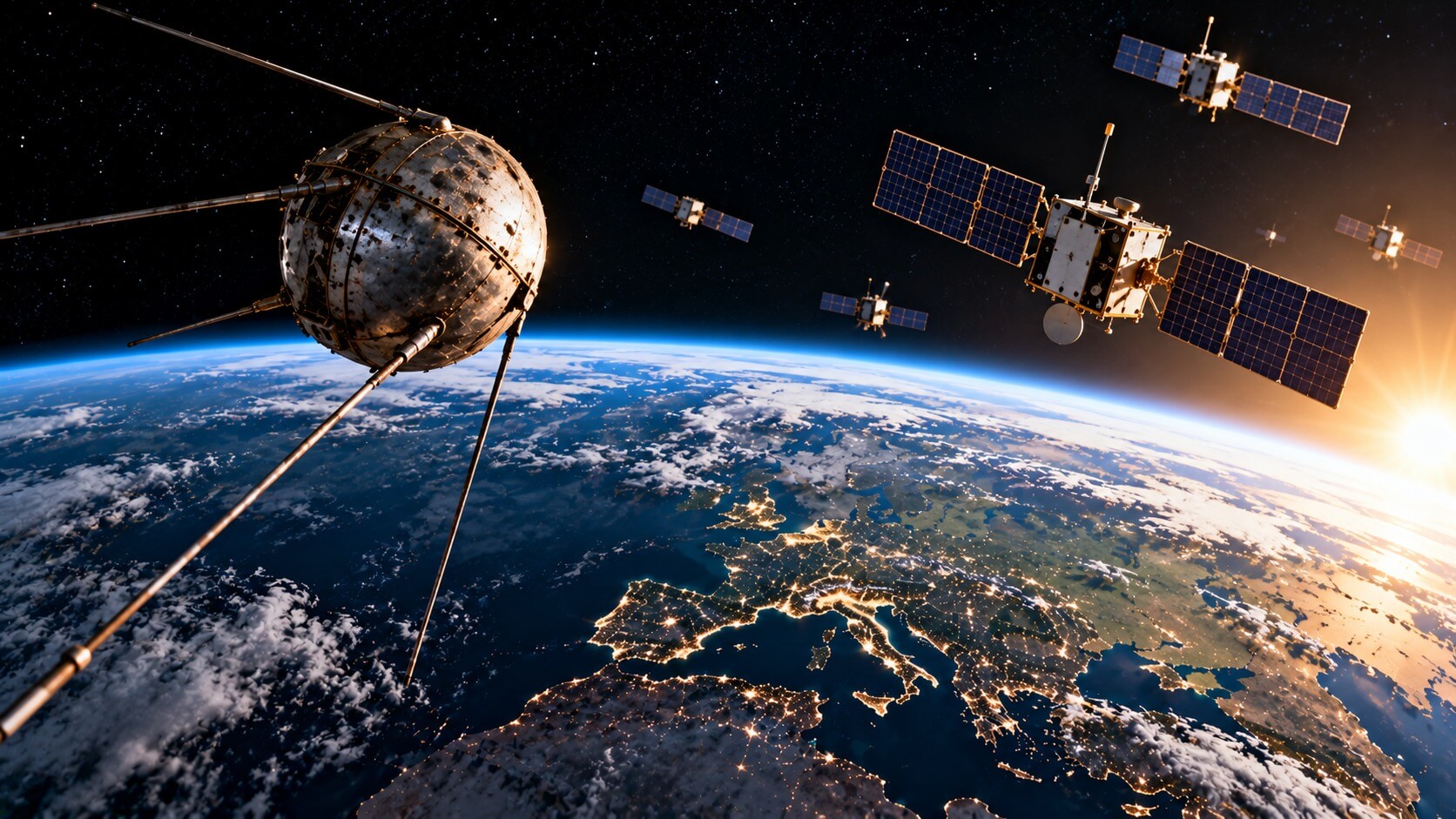
The Oldest Satellites Still in Orbit — and the Ones We've Lost
Some satellites launched decades ago are still orbiting Earth, even though they no longer perform their original missions. Others have operated far longer than initially expected, while many spacecraft have failed, lost contact with operators, or become inactive in orbit.
These cases reveal an important distinction: a satellite can remain in space long after it stops working. Being in orbit does not necessarily mean a spacecraft is operational, transmitting data, or providing a useful service.
For the space industry, satellite longevity matters because spacecraft replacement is expensive, failures can disrupt services, and inactive satellites contribute to orbital debris risks.
For investors, the history of long-lived and lost satellites also illustrates the technical and financial challenges involved in building and operating space infrastructure.
What Is the Oldest Satellite Still in Orbit?
The answer depends on what qualifies as a satellite and whether it must still be operational.
Vanguard 1, launched by the United States on March 17, 1958, is widely recognized as the oldest artificial satellite still orbiting Earth.
It was the second successful American satellite and the first satellite powered by solar cells.
Vanguard 1 was designed to test spacecraft technology and study aspects of the space environment. Observations of its orbit also contributed to scientific understanding of Earth's shape and the upper atmosphere.
The spacecraft stopped communicating with ground stations in 1964. Nevertheless, it has remained in orbit for more than six decades after its mission ended.
This makes it a remarkable example of the difference between a satellite's operational lifetime and its orbital lifetime.
Although Vanguard 1 no longer transmits scientific data, its continued presence demonstrates how long an object can remain in orbit when atmospheric drag is insufficient to bring it down quickly.
Why Is Vanguard 1 Still in Space?
Vanguard 1 follows an elliptical orbit that reaches substantially higher altitudes than many modern low Earth orbit satellite constellations.
Atmospheric drag gradually reduces a satellite's orbital energy, but the effect generally becomes weaker at higher altitudes.
As a result, Vanguard 1 has remained in orbit far longer than many spacecraft operating closer to Earth.
Its small size and relatively simple design also make it a notable milestone in the history of space technology.
Vanguard 1 is not an example of a satellite that has operated continuously for nearly seven decades. It is an example of a spacecraft that has remained in orbit for that long.
Which Historic Satellites Helped Shape Modern Spaceflight?
Some early satellites remained in orbit long after their missions ended, while others introduced technologies that made modern Earth observation possible.
These examples are important for different reasons, and they should not be confused with spacecraft that remained operational for decades.
Explorer 1
Explorer 1 was the first successful American satellite, launched on January 31, 1958.
It played an important role in early space science, contributing to the discovery of the radiation belts surrounding Earth, now known as the Van Allen belts.
The spacecraft stopped transmitting on May 23, 1958, after its batteries were exhausted.
However, Explorer 1 remained in orbit until March 31, 1970, when it reentered Earth's atmosphere.
Its operational mission lasted only a few months, but its orbital lifetime extended for more than twelve years.
Explorer 1 illustrates how a satellite can complete its mission while continuing to orbit Earth for many years afterward.
TIROS-1
TIROS-1, launched on April 1, 1960, was the first successful weather satellite.
It demonstrated that spacecraft could provide valuable observations of cloud patterns and support the development of satellite meteorology.
Its operational mission lasted approximately 78 days, but its contribution to weather observation was significant.
TIROS-1 helped establish the foundations of satellite-based weather monitoring, which later became an essential part of modern forecasting systems.
Its importance comes from demonstrating the practical value of observing Earth from orbit, not from remaining operational for decades.
Landsat Satellites
The Landsat program provides a different example of satellite longevity and continuity.
Beginning with Landsat 1 in 1972, the program has collected decades of observations of Earth's land surface.
Its historical record supports research into agriculture, forests, urban development, water resources, and environmental change.
Individual Landsat spacecraft have had different operating lifetimes, and some have exceeded their original design expectations.
The program's broader value comes from maintaining observations across generations of satellites.
For Earth observation, continuity can be more important than keeping one spacecraft operating indefinitely.
A sequence of satellites that collects compatible measurements over many years can provide a more useful long-term record than a single satellite with a very long life but limited coverage.
What Happens When a Satellite Is Lost in Space?
A satellite may be described as lost when its operators can no longer communicate with it or control it sufficiently to carry out its intended mission.
However, the term can also be used for spacecraft destroyed during launch, unable to reach their intended orbit, or rendered unusable by technical failures.
A lost satellite is therefore not necessarily a spacecraft that has physically disappeared.
Several different failures can interrupt a mission.
Communication Failure
Satellites rely on radio links to receive commands and transmit information.
A hardware failure, damaged antenna, electrical problem, or malfunctioning onboard computer can interrupt these communications.
Sometimes engineers can restore contact. In other cases, the spacecraft remains unreachable.
Power System Failure
Satellites depend on electrical power to operate their instruments, computers, communications equipment, and thermal control systems.
Many use solar panels and batteries.
If a critical power system fails, a satellite may stop functioning even though its structure remains intact and continues orbiting Earth.
Propulsion Problems
Some satellites need propulsion to maintain their intended orbit, avoid collisions, or perform end-of-life disposal maneuvers.
A propulsion failure can prevent these activities.
Depending on the orbit, the spacecraft might remain in space for years or decades, even if it can no longer provide its intended service.
Unexpected Technical Problems
Spacecraft operate in a challenging environment that includes radiation, extreme temperature variations, and exposure to the space environment.
Components can degrade over time, and failures may occur even when a satellite has been designed and tested carefully.
A lost satellite is not necessarily destroyed. It may simply have stopped responding while continuing to travel along its orbit.
Famous Examples of Lost or Failed Satellites
The history of spaceflight includes spacecraft that stopped operating, disappeared from communications, or failed to achieve their intended missions.
These cases should not all be described as satellites permanently lost in orbit. Some eventually reentered the atmosphere, while others remain in space.
Vanguard 1: Silent but Still in Orbit
Vanguard 1 stopped communicating with Earth in 1964.
Despite its loss of communications, it remains the oldest artificial satellite still orbiting Earth.
Its story demonstrates that operational failure and physical disappearance are two different events.
Explorer 1: Mission Complete, Then Reentry
Explorer 1 stopped transmitting in May 1958.
It remained in orbit until March 1970, when atmospheric drag eventually caused it to reenter Earth's atmosphere.
Its mission was over long before its orbital journey ended.
Satellites That Fail Before Reaching Their Intended Orbit
Not every satellite reaches its planned operational orbit successfully.
Launch vehicle failures, deployment problems, and spacecraft malfunctions can prevent missions from working as intended.
In these cases, a satellite may be lost shortly after launch, enter an unusable orbit, or fail to deploy its instruments properly.
The financial consequences can be significant, particularly when the spacecraft represents a substantial portion of a company's available capital.
Why Do Some Satellites Last Longer Than Others?
Satellite lifetimes depend on several technical and environmental factors.
Orbit Altitude
Altitude strongly influences how long a satellite remains in orbit after its mission ends.
Satellites in lower orbits generally experience more atmospheric drag than spacecraft in higher orbits.
As a result, a satellite in a sufficiently low orbit may reenter relatively quickly after losing the ability to maintain its trajectory.
A spacecraft at a higher altitude may remain in space for decades or longer.
Orbital lifetime also depends on factors such as atmospheric conditions, spacecraft shape, mass, and orbital eccentricity.
Design and Components
A satellite's operational lifespan depends on its electronics, power systems, propulsion, communications equipment, and other components.
Radiation exposure, material degradation, and mechanical failures can limit its useful life.
A well-designed spacecraft may continue operating beyond its original mission expectations, but no satellite is immune to failure.
Fuel and Propulsion
Satellites that require orbital adjustments need sufficient propulsion capability.
When fuel runs low, an operator may have fewer options for maintaining the spacecraft's orbit or performing disposal maneuvers.
Some satellites are designed to operate without frequent propulsion, while others depend on regular adjustments.
Mission Requirements
A satellite may stop operating because its technology becomes outdated, even if its hardware remains functional.
For example, a newer spacecraft may offer better imaging resolution, more efficient communications, or improved data processing.
In these cases, retirement can be a business or operational decision rather than the result of a physical failure.
What Happens to Satellites That Stop Working?
The outcome depends on the satellite's orbit, condition, and disposal capabilities.
Some inactive satellites gradually descend because of atmospheric drag and eventually reenter Earth's atmosphere.
Others can be moved into a designated disposal orbit if they remain controllable and have the necessary capabilities.
Spacecraft in higher orbits may remain there for a very long time.
Inactive satellites are a concern because they can collide with operational spacecraft and contribute to orbital debris.
A collision can produce fragments that create additional hazards for other satellites.
This is why operators are increasingly expected to consider end-of-life disposal when designing and licensing missions.
How Have Satellite Disposal Rules Changed?
For many years, the 25-year guideline was widely used as a reference for removing retired spacecraft from protected low Earth orbit regions.
However, this historical guideline should not be confused with a universal legal requirement applying to every satellite.
More recent rules and standards have introduced shorter disposal periods for certain missions.
In the United States, the Federal Communications Commission adopted a requirement for covered spacecraft operating in or passing through low Earth orbit below 2,000 kilometers and planning uncontrolled atmospheric reentry.
These spacecraft must complete disposal as soon as practicable and no later than five years after the end of their missions, subject to the applicable rule and transition provisions.
The European Space Agency also introduced updated Space Debris Mitigation Requirements, reducing the maximum disposal phase in protected low Earth orbit from 25 years to five years for covered ESA missions.
ESA's requirements additionally emphasize collision avoidance, disposal reliability, and measures that can facilitate the removal of failed spacecraft.
These developments do not establish a single five-year rule for every spacecraft worldwide.
Requirements vary according to jurisdiction, mission type, orbit, and disposal method.
For satellite operators, stricter standards can influence propulsion design, fuel reserves, spacecraft reliability, and replacement planning.
For a closer explanation of orbital disposal and atmospheric reentry, see Satellite Reentry Rules Explained: From the 25-Year Guideline to New Standards.
Why Satellite Longevity Matters for Earth Observation
Earth observation depends on collecting information consistently over time.
Satellites monitor changes in forests, agricultural fields, cities, coastlines, and other parts of the planet.
A spacecraft that operates reliably for many years can help maintain valuable records and reduce the frequency of replacement missions.
However, long operational life is not the only objective.
Earth observation companies must also consider image quality, revisit frequency, coverage, data delivery, and the ability to collect information under different conditions.
A company might prefer to replace an older satellite with a newer model that delivers better results, even if the older spacecraft remains functional.
Continuity also matters at the constellation level. Operators can preserve service by replacing individual satellites and distributing observations across multiple spacecraft.
For a broader explanation of Earth observation, how it works, and why it matters to the space economy, see Earth Observation Explained: What It Is, How It Works and Why Investors Should Care.
For a broader look at the satellite infrastructure supporting this industry, see How Many Earth Observation Satellites Are There? A Look at the Growing EO Market.
What Satellite Failures Mean for Investors
Satellite failures can affect a company's finances, operations, and reputation.
The impact depends on the spacecraft's importance, the availability of backup satellites, insurance coverage, and the cost of replacing lost capabilities.
Investors evaluating satellite operators should consider several factors.
Replacement costs: How much capital is required to replace spacecraft that fail or reach retirement?
Fleet redundancy: Can other satellites maintain service if one spacecraft stops operating?
Insurance: What risks are covered, and what losses remain the company's responsibility?
Operational reliability: Does the company have a track record of maintaining its spacecraft and delivering services?
Capital requirements: Can the business finance new satellites without placing excessive pressure on its balance sheet?
Customer commitments: Could a satellite failure interrupt contracts or reduce customer confidence?
A satellite failure does not automatically mean a company will suffer a major financial loss. The impact depends on the scale of the incident and the company's ability to manage it.
Likewise, a long-lived satellite does not automatically make its operator a successful investment.
The relevant question is whether the company can provide reliable services at a sustainable cost.
Will Satellites Last Longer in the Future?
Satellite technology continues to evolve, and improvements in components, power systems, manufacturing, and spacecraft design may help extend operational lifetimes in some applications.
At the same time, the industry is moving toward larger constellations that may replace individual spacecraft more frequently.
This creates two different approaches.
Some operators prioritize long-lived satellites that deliver services over extended periods.
Others use fleets of smaller spacecraft that can be upgraded and replaced as technology improves.
Neither approach is universally superior. The appropriate strategy depends on the mission, operating costs, customer requirements, and the time needed to deploy replacement spacecraft.
For Earth observation businesses, maintaining consistent data quality and reliable coverage may be more important than maximizing the lifespan of every individual satellite.
The Difference Between Surviving in Orbit and Staying Useful
The oldest satellites demonstrate how long human-made objects can remain in space after their original missions have ended.
Vanguard 1 remains in orbit despite having stopped transmitting decades ago.
Explorer 1, by contrast, eventually reentered Earth's atmosphere after its mission had ended.
TIROS-1 demonstrated the potential of weather satellites during a relatively short operational mission, while the Landsat program illustrates the value of maintaining observations across generations of spacecraft.
These examples show why satellite age, operational status, and orbital lifetime must be considered separately.
For the modern space industry, the challenge is not simply to build satellites that last a long time. It is to operate reliable systems, replace spacecraft when necessary, and manage inactive satellites responsibly.
For investors, satellite longevity and failure rates are important elements of the industry's economics, but they must be evaluated alongside customer demand, revenue, replacement costs, and financial sustainability.
Disclaimer: This article is for informational and educational purposes only and does not constitute financial or investment advice. Investments in space-related companies involve technological, operational, and financial risks, including the potential loss of capital. Conduct independent research before making investment decisions.