
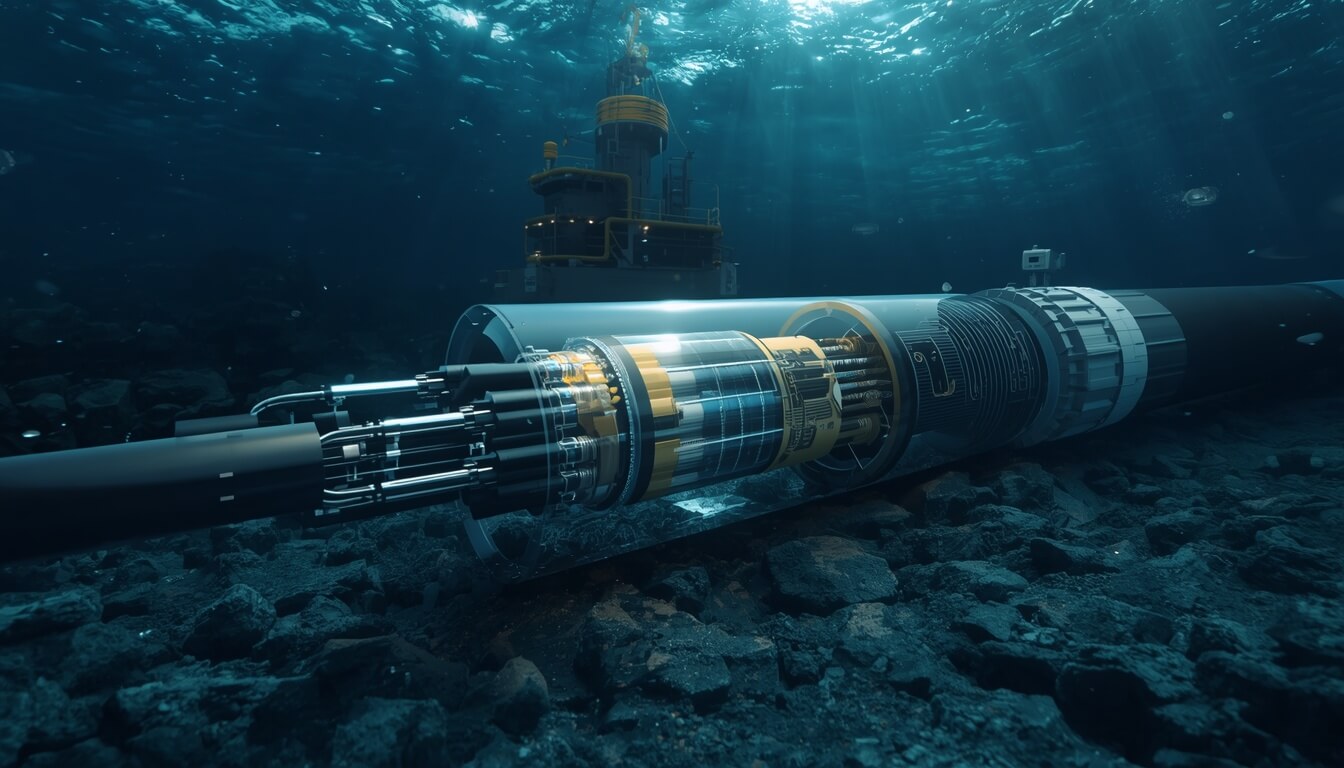
Thousands of kilometers of cable lie beneath the world's oceans, carrying enormous quantities of digital information between continents. From the outside, a submarine cable may appear to be a relatively simple piece of infrastructure. In reality, modern systems combine optical engineering, electrical power systems, specialized materials, marine technology, and sophisticated network equipment.
Understanding this technology explains how the global internet can move data across oceans with extremely high capacity and reliability.
The first article in this group, Why Submarine Cables Are Critical to the Global Internet, examined why this infrastructure has become so important. This article focuses on what actually happens inside a submarine cable system and how the technology works.
A submarine cable is not a single technology. It is a combination of optical fibers, repeaters, power systems, protective structures, branching units, landing stations, and specialized marine engineering — all working together across thousands of kilometers of ocean.
Fiber Optics at the Core
The fundamental technology is optical fiber.
Instead of transmitting information as electrical signals through copper wires, modern submarine systems transmit data using pulses of light through extremely thin strands of glass. The glass is engineered so that light remains confined within the fiber as it travels over long distances.
Digital information can be encoded into these optical signals and transmitted at extremely high speeds.
A modern submarine cable can contain multiple fiber pairs, with each pair providing separate transmission paths. Increasing the number of fiber pairs is one way engineers can increase the overall capacity of a system. Other improvements come from advances in optical transmission technology, including better modulation, wider optical spectrum, and more sophisticated terminal equipment.
The evolution from copper-based systems to fiber optics represented a major change in submarine communications. The first long-haul fiber-optic submarine cable, TAT-8, entered service across the Atlantic in 1988.
What Is Inside a Submarine Cable?
The optical fibers are only one part of the cable.
A submarine cable has to survive an environment that can include extreme water pressure, difficult seabed conditions, fishing activity, ship anchors, and the mechanical stresses involved in installation and repair.
The internal fiber structure is therefore surrounded by several protective layers. Depending on where the cable is deployed, its construction can include:
- Optical fibers
- Strength members
- A metallic conductor used to provide electrical power
- Insulation
- Protective armor
Deep-ocean cables can be relatively small because the seabed in deep water is generally less exposed to human activities such as anchoring and fishing. Cables installed closer to shore often require additional protection and may be buried beneath the seabed.
This means that the same submarine system can use different cable designs along different sections of its route.
Repeaters Keep the Signal Moving
One of the most important components of a long-distance submarine system is the repeater.
As light travels through optical fiber, the signal gradually loses strength. A transoceanic cable can extend for thousands of kilometers, so simply sending an optical signal from one landing station to another is not sufficient.
Repeaters are therefore installed at intervals along the cable.
Modern repeaters use optical amplification technology to restore the strength of the signal without converting the entire transmission into an electrical signal. According to the International Cable Protection Committee, modern repeater technology uses erbium-doped optical fiber sections that are energized to amplify incoming light.
This is an important engineering principle: the system has to restore optical power while preserving the information encoded in the signal.
The repeaters themselves are subsea devices designed to operate continuously under high pressure for many years.
How Do Subsea Repeaters Get Power?
Although the information travels through the cable as light, the repeaters need electrical power.
A submarine cable therefore contains a conductive element that allows electrical power to travel from the shore toward the subsea equipment. The power is supplied from cable landing stations using specialized power-feeding equipment.
The International Cable Protection Committee describes Power Feed Equipment as a high-voltage DC power supply used to provide power to submarine cable systems.
This creates an unusual combination of technologies inside the same infrastructure: optical fibers carry the information, while an electrical power system supplies the equipment that maintains the optical signal.
The engineering challenge becomes more complex as cable systems become longer and incorporate more fiber pairs and subsea components.
Branching Units Connect Multiple Destinations
Not every submarine cable simply connects two landing stations.
Some systems include branching units that allow a main cable route to connect to additional landing points. A branching unit can divide traffic between a main trunk and a branch leading toward another destination.
This architecture makes it possible for one submarine system to serve several geographic markets rather than operating as a simple point-to-point connection.
Branching technology has also evolved. Modern systems can incorporate more flexible optical switching architectures, allowing operators to manage how capacity is distributed between different routes.
The result is a network that can be designed around multiple landing points, rather than a single straight line across the ocean.
Cable Landing Stations
The submarine section is only part of the complete system.
At each end of a cable, the underwater infrastructure connects to a cable landing station on land. The landing station contains equipment that interfaces the submarine system with terrestrial networks.
Submarine Networks describes the landing station as the point where submarine cable traffic is connected to terrestrial or local networks, with submarine line terminal equipment handling the transition between the subsea and terrestrial systems.
This means the complete path of a data transmission can be thought of as a chain:
Data center or terrestrial network → cable landing station → submarine cable → subsea optical equipment → cable landing station → terrestrial network
The submarine cable is therefore one component of a much larger infrastructure system.
How Cables Are Installed on the Ocean Floor
Building the cable is only half the challenge. It also has to be installed along a carefully selected route.
Before deployment, operators survey the seabed to understand its geography and geological characteristics. The route has to account for water depth, seabed conditions, existing infrastructure, environmental considerations, and human activities.
Cable ships then carry the cable and gradually release it as they follow the planned route.
In shallow waters, additional protection can be necessary because human activities create greater risks. Burial beneath the seabed can help protect cables from anchors and fishing equipment. In deeper water, cables can often be laid directly on the seabed.
The installation process therefore combines telecommunications engineering with marine surveying and specialized ship operations.
Designing for Capacity
Increasing submarine cable capacity is not simply a matter of making the cable physically larger.
Engineers can increase capacity through several technologies, including additional fiber pairs, improved optical transmission, more efficient modulation formats, and the use of broader optical spectrum.
Newer systems are increasingly designed around Space Division Multiplexing, or SDM, architectures. Instead of relying exclusively on pushing more capacity through each individual fiber, SDM can increase the number of spatial transmission paths within the cable.
This approach is particularly relevant as demand for international bandwidth continues to increase.
Some recent systems are already being designed with very large numbers of fiber pairs and increasingly sophisticated optical architectures. For example, the Unitirreno system in the Mediterranean is designed with 24 fiber pairs and an open architecture intended to support scalable optical services.
Open Cable Architecture
Another important development concerns the separation between the subsea infrastructure and the equipment installed at the landing station.
In an open cable architecture, the wet plant and terrestrial terminal equipment can be treated as separate components. This can give network operators greater flexibility when upgrading terminal technology.
The basic submarine cable and repeaters can remain in place while improvements to the equipment at the landing station increase the usable capacity of the existing fiber infrastructure.
This becomes particularly valuable because replacing a transoceanic cable is a major marine engineering project, while upgrading equipment on land can be considerably more manageable.
Why the Technology Matters for the Next Generation of Connectivity
The technology behind submarine cables is evolving alongside the applications that depend on them.
Cloud computing, video services, international business networks, data centers, and artificial intelligence are all increasing the importance of high-capacity connections between regions.
The next challenge is therefore not simply maintaining today's cable network but expanding its capacity while improving resilience, efficiency, and geographic diversity.
Artificial intelligence could become an important part of this next phase. Large AI systems require increasingly powerful data centers, and those facilities need high-capacity connections to other data centers, cloud infrastructure, and users.
That creates a potential new source of demand for subsea infrastructure, which is the subject of the final article in this group: Why AI Could Increase Demand for Submarine Cables.
A Network Built From Multiple Technologies
The world's submarine cable network is not a single technology.
It is a combination of optical fibers, repeaters, power systems, protective structures, branching units, landing stations, terrestrial networks, specialized cable ships, and increasingly advanced transmission equipment.
The remarkable aspect of the system is how these different technologies work together over thousands of kilometers of ocean.
What users experience as an almost instantaneous digital connection between continents is ultimately supported by physical infrastructure engineered to operate continuously in one of the most demanding environments on Earth.