
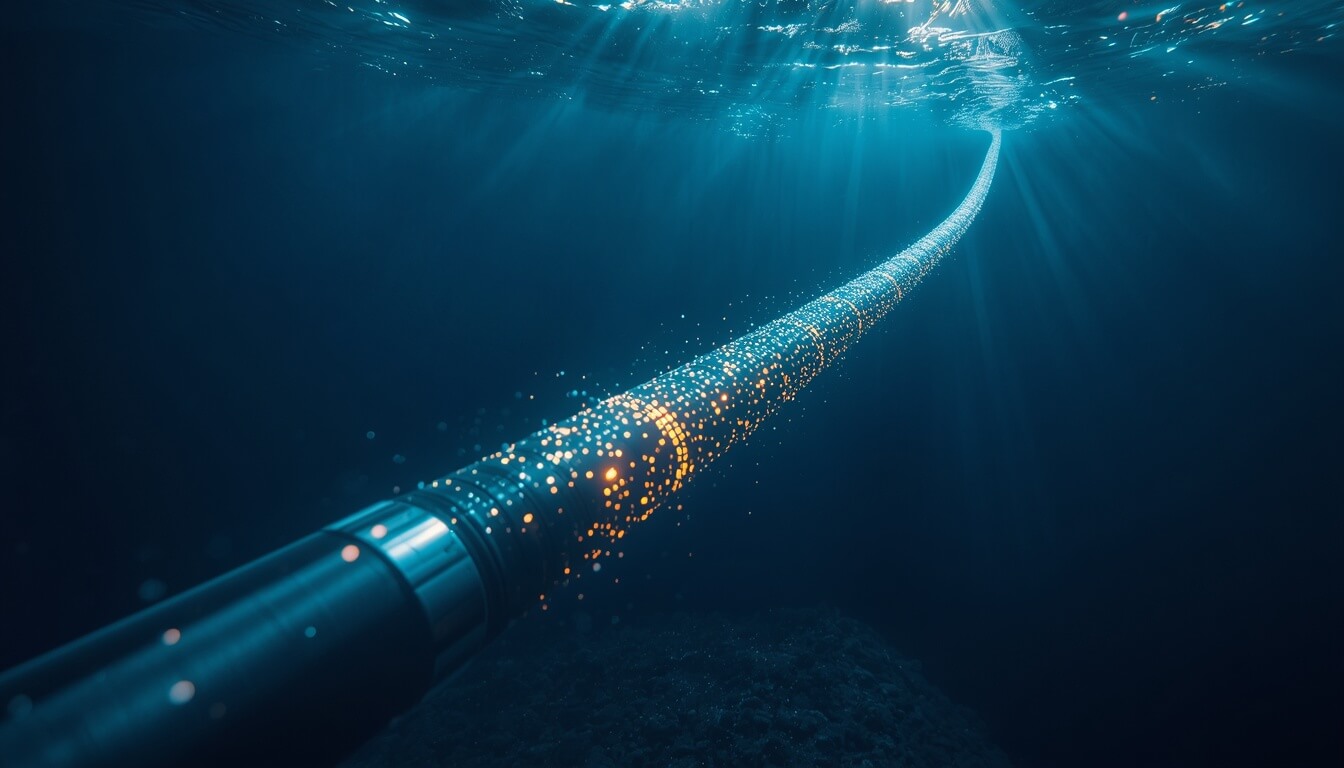
When people think about the infrastructure behind the internet, they often imagine data centers, satellites, mobile networks, and fiber-optic connections running through cities. Yet a large part of the world's digital communication depends on infrastructure that is almost invisible: thousands of kilometers of submarine cables crossing the oceans.
These cables connect continents and carry enormous volumes of internet traffic between countries. Whenever someone sends an email across the Atlantic, accesses a website hosted on another continent, joins an international video call, or connects to a cloud service located overseas, submarine cables may be part of the journey.
The global internet therefore depends not only on software and data centers, but also on a physical network beneath the world's oceans.
The internet may appear to exist almost entirely in the cloud, but much of that cloud still depends on physical cables lying thousands of meters beneath the sea.
The Hidden Infrastructure of the Internet
The modern internet is a distributed system made up of many different networks. Data can travel through terrestrial fiber-optic networks, mobile infrastructure, satellites, and other communication systems. For long-distance connections between continents, however, submarine fiber-optic cables play a particularly important role.
These cables are designed to transmit digital information as pulses of light through optical fibers. Because fiber optics can carry extremely large quantities of data at very high speeds, submarine cables provide the capacity required by modern international communications.
Their importance becomes easier to understand when considering how interconnected the global economy has become. Cloud computing platforms, financial institutions, technology companies, governments, media organizations, and multinational businesses all depend on international data connections.
The physical network supporting those connections is therefore an important part of the digital economy.
For a deeper look at how these systems actually work, The Technology Behind the World's Submarine Cable Network examines the engineering and technology used to move data across oceans.
Why Satellites Cannot Simply Replace Submarine Cables
Satellites are an important part of global communications, particularly in areas where terrestrial infrastructure is difficult or expensive to build. They can also provide connectivity to remote locations and support communications when conventional infrastructure is unavailable.
However, satellite connectivity and submarine cables serve different roles.
| Infrastructure | Primary role | Best suited for |
|---|---|---|
| Submarine cables | Enormous bandwidth across major international routes | Continuous, high-volume data transmission between fixed points |
| Satellites | Radio links between ground stations and spacecraft | Mobility, remote areas, specialized applications |
This distinction is becoming increasingly important as global data consumption continues to grow.
A Network Connecting the Major Digital Hubs
Submarine cables form an international network connecting many of the world's major economic and technological centers.
Cable routes cross the Atlantic and Pacific Oceans and connect Europe, North America, Asia, Africa, the Middle East, and other regions. Some systems are designed to connect specific countries or regions, while others form part of broader international networks.
The result is not one single global cable but a complex collection of independently operated systems.
This structure also provides an important degree of redundancy. If one cable becomes unavailable, traffic can potentially be redirected through other routes. The effectiveness of this redundancy depends on the availability and capacity of alternative infrastructure, but multiple cable systems can help reduce the impact of individual failures.
What Happens When a Cable Is Damaged?
Despite their importance, submarine cables operate in a difficult environment.
Cables can be damaged by anchors, fishing activity, underwater landslides, earthquakes, and other events. Damage does not necessarily cause an entire country to lose internet access, because traffic may be rerouted through other systems. However, when several cables serving the same region are affected, the consequences can become more significant.
Repairing a submarine cable is also considerably more complicated than repairing a conventional terrestrial fiber connection.
Specialized cable ships are required to locate damaged sections, recover the cable from the seabed, repair or replace the affected section, and return it to the ocean floor. The process can take time, particularly when weather, water depth, or geographic conditions make operations difficult.
This illustrates an important characteristic of the internet: although users experience it as a largely virtual environment, much of its infrastructure remains physical.
The Economic Importance of Submarine Cables
The importance of submarine cables extends beyond consumer internet access.
Financial markets depend on rapid international communication. Banks and payment companies exchange information between different countries. Cloud providers operate data centers in multiple regions and need reliable connections between them. Businesses increasingly use internationally distributed applications and storage systems.
A disruption to an important cable route can therefore affect more than ordinary web browsing. It can influence the performance and resilience of services that support international commerce.
For companies operating globally, network redundancy and geographic diversity have consequently become important infrastructure considerations.
The Next Phase of Cable Demand
The role of submarine cables could become even more important as global demand for computing and data transmission increases.
Cloud computing has already changed the way organizations use digital infrastructure. Streaming, connected devices, software services, and increasingly sophisticated applications are generating enormous amounts of data that must move between users, networks, and data centers.
Artificial intelligence could add another layer to this demand.
Large AI systems require substantial computing infrastructure, and their development is increasingly concentrated in large data centers. As these facilities expand and become more geographically distributed, the connections between them can become increasingly important.
The potential relationship between AI infrastructure and submarine connectivity is explored in Why AI Could Increase Demand for Submarine Cables.
A Physical Foundation for a Digital World
Submarine cables rarely receive the same public attention as smartphones, cloud platforms, or artificial intelligence systems. Yet they provide one of the physical foundations on which these technologies depend.
Their importance comes from a combination of scale, capacity, geographic reach, and the ability to continuously transport enormous volumes of information between continents.
As the digital economy expands, the infrastructure beneath the oceans becomes increasingly relevant to the future of global connectivity.