
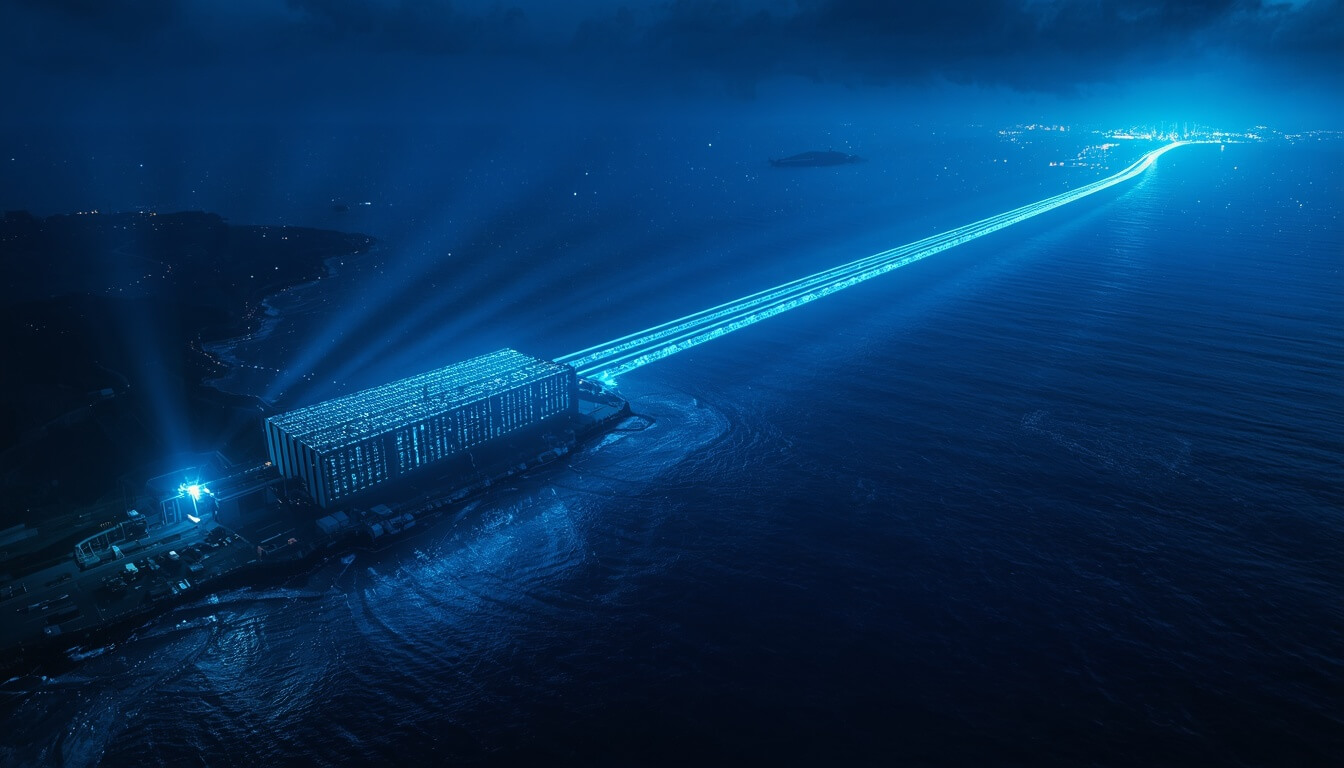
Artificial intelligence is changing the infrastructure required to build and operate digital services. The expansion of large language models, AI applications, cloud computing, and increasingly powerful data centers is creating new requirements for computing capacity and network connectivity.
While much of the attention surrounding AI focuses on GPUs, data centers, electricity, and advanced semiconductor technology, another part of the infrastructure could become increasingly important: the global network of submarine fiber-optic cables.
Submarine cables already form a fundamental part of international connectivity. AI does not replace that role. Instead, the growth of AI workloads could increase the amount of data that needs to move between data centers, cloud platforms, businesses, and users across different geographic regions.
The first article in this series, Why Submarine Cables Are Critical to the Global Internet, examined the importance of submarine cables to global connectivity. The second, The Technology Behind the World's Submarine Cable Network, explained the technology that allows these systems to carry enormous volumes of data across oceans.
The next question is how the growth of AI could influence the future demand for this infrastructure.
AI infrastructure is broader than computing hardware. It includes electricity, data centers, cooling, terrestrial fiber, cloud platforms, network exchanges — and the submarine cables that connect them across oceans.
AI Requires More Than Computing Power
Training and operating advanced AI systems requires large amounts of computing power.
Modern AI models can involve thousands of processors working together. These processors must exchange data at very high speeds, making networking an essential part of AI infrastructure.
The OECD has identified networking as a critical component of AI infrastructure, noting that training large models requires thousands of GPUs to work in parallel while continuously exchanging data. It also highlights the importance of fiber networks, Internet Exchange Points, and submarine cables for distributed AI infrastructure.
This creates an important relationship between computing and connectivity.
A data center may contain enormous computing capacity, but that capacity still needs to communicate with other systems. Data may need to move between different facilities, cloud platforms, regions, and end users.
As AI infrastructure becomes more geographically distributed, the network connecting those locations becomes increasingly important.
The Rise of AI Data Centers
AI is also changing the physical structure of the data center industry.
Traditional cloud infrastructure already relies on large facilities distributed across different geographic regions. AI adds another layer because the computing requirements of large models can be concentrated in specialized, high-density facilities.
Companies building AI infrastructure therefore have to consider not only where they can obtain electricity and construct data centers, but also how those facilities will connect to the rest of the world.
This is particularly relevant when an AI hub is located far from major existing connectivity centers.
A new data center can potentially increase demand for international fiber capacity if it needs to exchange large quantities of information with facilities in other countries.
In this context, submarine cables become part of the broader infrastructure equation.
AI Can Increase Data Movement Between Regions
One important distinction is between the amount of computing performed by an AI system and the amount of data that must cross international networks.
Not every AI operation requires international data transmission. Many workloads can be processed locally within a data center or within a single geographic region.
However, large AI companies increasingly operate distributed infrastructure. Different facilities can perform different functions, while cloud services and applications may serve users across multiple countries.
Training, model development, data management, cloud services, and inference can therefore involve several interconnected locations.
The OECD notes that AI's growing need for global data-center networks is contributing to increased demand for backbone infrastructure, including submarine cables.
This does not mean every AI query will generate a corresponding increase in submarine traffic. Rather, the expansion of AI infrastructure creates additional requirements for high-capacity connections between the locations where computing and data are concentrated.
Hyperscalers Are Already Major Cable Investors
The connection between AI and submarine infrastructure can also be seen in the investment behavior of the largest technology companies.
Large cloud and technology companies have become major investors in submarine cable infrastructure. According to OECD analysis, the four largest hyperscalers accounted for 71% of used international capacity in 2024, compared with 10% in 2014.
The same analysis describes substantial investments by major technology companies in submarine cables, terrestrial fiber, cloud infrastructure, and data centers.
This reflects a broader change in the internet's architecture.
Instead of relying exclusively on telecommunications operators for international connectivity, some technology companies increasingly participate directly in the infrastructure connecting their own data centers and services.
AI can reinforce this trend because the scale of computing infrastructure makes high-capacity and reliable connectivity more strategically important for companies operating global AI platforms.
From Traditional Routes to AI Connectivity Hubs
The geography of data centers is also changing.
AI infrastructure does not necessarily need to be concentrated in the same locations that historically served as the largest internet hubs. New data center clusters can emerge where companies have access to electricity, land, cooling resources, favorable regulation, and suitable network infrastructure.
When these new clusters develop, connectivity has to expand with them.
Recent submarine cable projects illustrate this trend. The industry is increasingly discussing networks designed to connect emerging data center and AI hubs with established connectivity centers.
Submarine Networks has reported that AI workloads are contributing to new investment and that the growth of AI infrastructure is influencing the design of regional subsea networks.
The result could be a more distributed international network rather than one based primarily around a small number of traditional hubs.
Capacity Is Only Part of the Equation
AI could increase demand for submarine cables not only because of total bandwidth requirements, but also because of the characteristics of the connections required.
Large-scale AI workloads can be sensitive to network performance. When multiple computing clusters cooperate, latency, reliability, and available capacity can influence how efficiently resources can be used.
This makes geographic diversity important.
A company operating several AI facilities may want multiple independent routes between them. If one route becomes unavailable, traffic can potentially be redirected through another.
The OECD has highlighted the importance of resilient and diverse communication infrastructure, while noting that submarine cables are a critical component of international connectivity.
For AI infrastructure, therefore, simply having enough theoretical capacity may not be sufficient. The location and diversity of that capacity can also matter.
New Cable Projects Could Follow AI Infrastructure
The expansion of AI data centers could create incentives for new submarine cable projects.
A new AI hub can increase demand for international connectivity, particularly if it is located in a region where existing subsea capacity is limited.
| Project | Route or scope | AI context |
|---|---|---|
| APX East | Sydney – San Diego | Presented in the context of Australia's growing AI infrastructure and international connectivity needs |
| Fibre in Gulf | Seven countries in the Middle East | Designed to provide high-capacity connectivity to hyperscalers, data centers, AI providers, businesses, and telecommunications operators |
These projects illustrate how AI infrastructure can become one of several factors supporting new submarine cable investment.
AI Could Change Where Cables Are Built
The impact of AI may therefore extend beyond simply increasing the amount of traffic carried by existing cables.
It could also influence where new cables are built.
If major AI clusters develop in new geographic locations, network operators may have incentives to create direct routes connecting those locations to other computing centers and international markets.
This could result in new landing stations, additional cable branches, alternative ocean routes, and greater geographic diversity.
Over time, the map of submarine infrastructure could increasingly reflect the geography of global computing infrastructure.
The Importance of Resilience
More dependence on digital infrastructure also increases the importance of resilience.
Submarine cables can be damaged by accidental events, natural phenomena, and other causes. The OECD estimates that around 150 submarine cable faults occur globally each year and notes that accidental damage from fishing vessels and ship anchors accounts for a significant share of disruptions.
For AI services, connectivity interruptions could become an additional infrastructure risk when workloads depend on communication between geographically separated facilities.
This creates an incentive to develop networks with multiple routes and sufficient spare capacity.
Redundancy is therefore not simply a telecommunications concern. It can become part of the broader design of AI infrastructure.
A New Infrastructure Layer for the AI Economy
The growth of artificial intelligence is often described as a race to build more powerful chips and larger data centers. But AI infrastructure is broader than computing hardware.
It includes electricity generation and transmission, data centers, cooling systems, terrestrial fiber, cloud platforms, network exchanges, and submarine cables.
As AI computing becomes increasingly distributed across countries and regions, the connections between these facilities can become an important infrastructure requirement.
Submarine cables are unlikely to be driven exclusively by AI. Consumer internet traffic, cloud computing, video services, enterprise applications, financial services, and other digital activities will continue to generate international bandwidth demand.
AI is instead another major source of pressure on an already essential infrastructure layer.
Looking Beyond Bandwidth
The long-term impact of AI on submarine cables may therefore involve more than simply installing cables with greater capacity.
The industry may need to consider where AI computing is located, how different data centers communicate, how much redundancy is required, and how international networks can adapt as new digital hubs emerge.
The result could be a gradual evolution of the global submarine network from a system primarily designed around traditional telecommunications and internet traffic into infrastructure increasingly integrated with the geography of cloud computing and AI.
The physical cables beneath the oceans may remain largely invisible to the people using AI services every day. Yet as artificial intelligence becomes more dependent on globally distributed computing, these cables could become an increasingly important part of the infrastructure connecting the AI economy.