
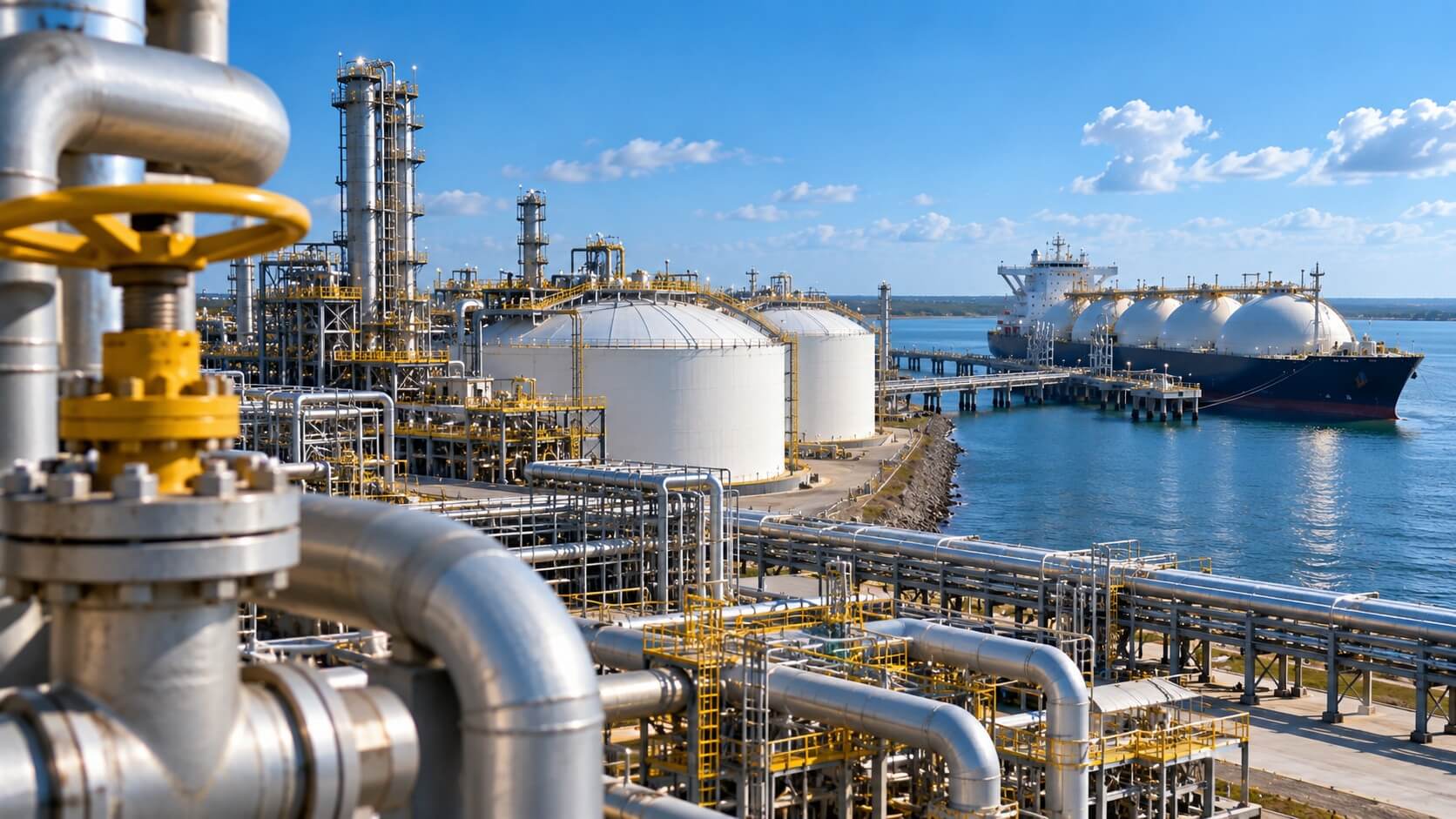
Most US liquefied natural gas (LNG) export terminals are located along the Gulf Coast, primarily in Louisiana and Texas. These states dominate American LNG exports because they offer access to major natural gas supplies, extensive pipeline networks, deepwater ports, and established energy infrastructure.
Major facilities include Sabine Pass, Cameron LNG, Calcasieu Pass, and Plaquemines in Louisiana, along with Corpus Christi, Freeport, and Golden Pass in Texas.
Export terminals also operate in Maryland and Georgia. Alaska has a historically important LNG export facility, while additional large projects are under development along the Gulf Coast.
For investors, terminal location influences natural gas transportation costs, shipping economics, construction requirements, operational risks, and future expansion opportunities.
Where Are the Major US LNG Export Terminals?
American LNG export infrastructure is concentrated in coastal regions with access to natural gas pipelines and international shipping routes.
The following table identifies major facilities and development projects as of 2026.
| LNG terminal | State | Location | Major operator or developer |
|---|---|---|---|
| Sabine Pass LNG | Louisiana | Cameron Parish | Cheniere Energy |
| Cameron LNG | Louisiana | Hackberry | Cameron LNG / Sempra |
| Calcasieu Pass LNG | Louisiana | Cameron Parish | Venture Global |
| Plaquemines LNG | Louisiana | Plaquemines Parish | Venture Global |
| Corpus Christi LNG | Texas | Corpus Christi area | Cheniere Energy |
| Freeport LNG | Texas | Quintana Island | Freeport LNG |
| Golden Pass LNG | Texas | Sabine Pass area | ExxonMobil / QatarEnergy |
| Cove Point LNG | Maryland | Lusby | Berkshire Hathaway Energy |
| Elba Island LNG | Georgia | Savannah | Kinder Morgan |
| Kenai LNG | Alaska | Nikiski | Historical LNG export facility |
| Port Arthur LNG | Texas | Port Arthur area | Sempra Infrastructure |
| Rio Grande LNG | Texas | Brownsville area | NextDecade |
Important: These facilities do not all have the same operating status. Some are established commercial terminals, others are commissioning additional production capacity, and some remain under construction. Kenai is included for its historical significance rather than as a major current exporter.
Consequently, the number of US LNG terminals depends on whether a count includes operating facilities, smaller installations, projects under construction, and proposed developments.
For an explanation of how terminals connect with producers and international customers, see US LNG Exporters and Terminals: How the Industry Works.
Why Are Most US LNG Terminals in Louisiana and Texas?
Louisiana and Texas offer a combination of natural gas availability, established industrial infrastructure, and access to international shipping.
Access to major natural gas supplies
The Gulf Coast is connected to major producing regions, including the Haynesville Shale in Louisiana and Texas and the Permian Basin in Texas and New Mexico.
Interstate pipelines also deliver gas from other parts of the country.
Because liquefaction facilities require large, continuous gas supplies, reliable pipeline connections are essential. Terminals located near existing infrastructure may avoid some of the costs associated with developing entirely new transportation networks.
Established energy infrastructure
The Gulf Coast has supported oil, natural gas, refining, and petrochemical operations for decades.
Its industrial network includes pipelines, storage facilities, marine terminals, specialized contractors, and experienced energy-sector workers.
These resources can support LNG development, although new export projects still require substantial capital investment.
Access to international shipping
Gulf Coast terminals connect directly to the Gulf of Mexico and international shipping routes serving Europe, Latin America, and Asia.
Some shipments to Asia can travel through the Panama Canal when vessel dimensions, transit availability, and operating conditions permit. Others use alternative routes.
Shipping distance, vessel availability, and route restrictions influence transportation costs and the competitiveness of American LNG.
Opportunities for expansion
Existing terminals can sometimes expand by adding liquefaction trains, the industrial units that convert natural gas into liquid form.
Such expansions may reuse storage tanks, marine facilities, pipelines, and supporting infrastructure.
However, additional production capacity still requires financing, regulatory approvals, construction, and commissioning.
LNG Export Terminals in Louisiana
Louisiana is a major center of American LNG exports, with several large facilities concentrated in its southwestern coastal region and near the Mississippi River.
Sabine Pass LNG
Sabine Pass LNG is located in Cameron Parish in southwestern Louisiana, near the Texas border.
Operated by Cheniere Energy, the facility began exporting LNG in 2016 and operates six liquefaction trains.
Its access to regional pipelines and Gulf Coast shipping infrastructure supports large-scale international exports.
Sabine Pass is one of the largest established LNG export complexes in the United States.
Cameron LNG
Cameron LNG is located near Hackberry in southwestern Louisiana.
The facility operates three liquefaction trains through a partnership involving Sempra and other international energy companies.
Its location near Sabine Pass illustrates the concentration of major LNG infrastructure in southwestern Louisiana, where pipelines, ports, and industrial services support multiple exporters.
Calcasieu Pass LNG
Calcasieu Pass LNG is another major export facility in Cameron Parish.
Developed by Venture Global, it began exporting LNG in 2022.
The project uses a modular liquefaction design with multiple standardized production units.
Calcasieu Pass demonstrates how newer developers have entered the American LNG market alongside established operators.
Plaquemines LNG
Plaquemines LNG is located in southeastern Louisiana near the mouth of the Mississippi River.
Developed by Venture Global, the facility began producing LNG in late 2024 and expanded export operations during 2025 and 2026.
Its location provides access to Gulf shipping routes and regional natural gas infrastructure.
Plaquemines represents a substantial addition to American LNG capacity and illustrates the importance of commissioning schedules, operating performance, and commercial contracts when evaluating major energy developments.
LNG Export Terminals in Texas
Texas combines substantial natural gas production with extensive pipeline networks and major industrial ports.
Its LNG export facilities extend along the Gulf Coast from the Louisiana border toward South Texas.
Corpus Christi LNG
Corpus Christi LNG is operated by Cheniere Energy near Corpus Christi, Texas.
The facility expanded substantially through its Stage 3 development.
In August 2026, Cheniere completed the seventh and final liquefaction train associated with that expansion.
According to the US Energy Information Administration (EIA), Corpus Christi reached approximately 3.1 billion cubic feet per day of nominal liquefaction capacity following the expansion.
This made it one of the country's largest LNG export facilities.
Its South Texas location provides access to regional natural gas transportation systems and international shipping routes.
Freeport LNG
Freeport LNG is located on Quintana Island near Freeport, Texas.
The terminal operates three liquefaction trains and supplies international natural gas markets.
Freeport illustrates the importance of operational reliability. Equipment failures, unexpected shutdowns, and maintenance can reduce exports even when substantial production capacity is installed.
Investors should therefore distinguish a terminal's designed capacity from the LNG volumes it actually ships.
Golden Pass LNG
Golden Pass LNG is located near Sabine Pass in southeastern Texas.
The facility is a joint venture between QatarEnergy and ExxonMobil.
Golden Pass began exporting LNG in April 2026, initially at relatively low volumes while its production equipment was being commissioned.
Its planned capacity is intended to make it a major contributor to American LNG exports as additional production units become operational.
The project demonstrates how large international energy companies participate in US LNG infrastructure through joint ventures.
Port Arthur LNG
Port Arthur LNG is a major export development in southeastern Texas led by Sempra Infrastructure.
The project is intended to add substantial liquefaction capacity.
Unlike established commercial terminals, facilities under construction must complete development and commissioning before generating their intended operating revenue.
For investors, planned production capacity should not be treated as current operating capacity.
Rio Grande LNG
Rio Grande LNG is being developed by NextDecade near Brownsville, Texas.
Its South Texas location provides access to Gulf shipping routes and regional natural gas transportation infrastructure.
The project's financial prospects depend on construction costs, financing arrangements, long-term customer agreements, and successful completion of its production facilities.
LNG Export Terminals Outside the Gulf Coast
Although Louisiana and Texas dominate American LNG exports, facilities in Maryland and Georgia also serve international markets. Alaska has an important historical role.
Cove Point LNG — Maryland
Cove Point LNG is located in Lusby, Maryland, along the Chesapeake Bay.
Originally developed as an LNG import terminal, it was later converted to support exports.
Its Atlantic Coast location provides access to international shipping routes without requiring vessels to depart from the Gulf Coast.
Cove Point demonstrates how existing energy infrastructure can be adapted as market conditions change.
Elba Island LNG — Georgia
Elba Island LNG is located near Savannah, Georgia, and is associated with Kinder Morgan.
The facility uses multiple smaller liquefaction units and has a history connected to LNG imports before its conversion to export operations.
Its location provides access to Atlantic shipping routes and southeastern US natural gas infrastructure.
Kenai LNG — Alaska
The Kenai LNG facility near Nikiski, Alaska, played an important role in the early development of American LNG exports.
It began shipping LNG to Japan in 1969, decades before the modern Gulf Coast export expansion.
However, its historical operations, subsequent inactivity, and changing development plans distinguish it from the large commercial export complexes operating in Louisiana and Texas.
Kenai should therefore be treated separately when counting active US LNG export terminals.
How Many LNG Export Terminals Does the US Have?
The number depends on which facilities and development stages are included.
Industry counts may cover:
- Established commercial LNG export terminals.
- New facilities commissioning production equipment.
- Smaller or specialized export operations.
- Projects under construction.
- Proposed facilities awaiting investment decisions or approvals.
These categories should not be combined without explanation.
A project with regulatory approval may not yet be under construction. Similarly, a terminal shipping its first LNG cargoes may still be operating below its designed capacity.
For investors, separating operating capacity, capacity under construction, and proposed capacity provides a more meaningful picture than a single terminal count.
What Makes One LNG Terminal Larger Than Another?
LNG terminals are generally compared by their liquefaction capacity, which measures how much natural gas they can convert into LNG.
Two common measurements are:
- Bcf/d: Billion cubic feet of natural gas per day.
- MTPA: Million metric tons of LNG per year.
These measurements are related, although conversions depend on gas composition and energy content.
A facility with more liquefaction trains may have greater production capacity, but individual trains can differ substantially in size.
Nominal capacity versus peak capacity
Nominal capacity represents expected sustainable production under specified operating conditions.
Peak capacity describes a higher output level that may be achievable under favorable conditions.
Actual exports can differ from both measurements because of maintenance, equipment availability, and supply constraints.
According to the EIA, Sabine Pass had approximately 3.6 Bcf/d of nominal capacity in September 2026, compared with approximately 3.1 Bcf/d at Corpus Christi following its Stage 3 expansion.
These figures illustrate the scale of modern American LNG infrastructure.
For a detailed facility comparison, see What Is the Largest LNG Export Plant in the US?.
How Does Natural Gas Reach LNG Export Terminals?
Export terminals require continuous natural gas deliveries through pipeline networks.
Gas is produced in underground formations, processed to meet transportation requirements, and delivered to liquefaction facilities.
At the terminal, it undergoes additional treatment and cooling before being stored and loaded onto specialized carriers.
Pipeline infrastructure
Pipelines connect production regions with export terminals.
A large LNG complex may require several billion cubic feet of natural gas per day when operating at full capacity.
Insufficient pipeline capacity can therefore restrict exports even when liquefaction equipment is available.
Storage and loading facilities
After liquefaction, LNG is stored in insulated tanks and transferred to specialized ships through marine loading equipment.
Ports must accommodate vessel movements, navigation requirements, and industrial safety procedures.
Why infrastructure integration matters
Natural gas production, processing, pipelines, liquefaction, storage, and shipping must operate as a connected system.
Disruptions at any stage can reduce export volumes.
For investors, a project with access to existing infrastructure may have different construction costs and development risks from one requiring extensive new pipelines and port facilities.
Who Owns and Operates US LNG Export Terminals?
Major American LNG facilities are owned and operated by a combination of publicly traded companies, private businesses, and international joint ventures.
Cheniere Energy operates Sabine Pass and Corpus Christi, while Venture Global operates major facilities in Louisiana.
Sempra participates through infrastructure investments and partnerships. ExxonMobil and QatarEnergy are involved in Golden Pass.
Kinder Morgan and Berkshire Hathaway Energy have interests in facilities outside the Gulf Coast.
These companies provide different forms of investment exposure.
Some earn revenue directly from LNG liquefaction and exports. Others participate through ownership interests, pipeline transportation, or diversified energy operations.
Private operators such as Freeport LNG also play important roles but are not directly available as publicly traded stocks.
For a closer company comparison, see Who Are the Largest LNG Exporters in the US?.
Why Does Terminal Location Matter for LNG Investors?
Geography affects construction costs, transportation expenses, operational reliability, and future expansion opportunities.
Two terminals with similar production capacity may have different financial characteristics because of their locations.
Natural gas transportation costs
Facilities connected to established pipeline networks may have more options for obtaining natural gas.
Projects requiring new pipeline construction can face additional costs, permitting requirements, and delays.
Shipping economics
Distance to international customers influences shipping time and transportation expenses.
An Atlantic Coast terminal may have different delivery economics for European markets than a Gulf Coast facility.
Actual costs also depend on vessel availability, shipping routes, fuel prices, and contractual arrangements.
Weather exposure
Many US LNG terminals operate in coastal regions exposed to hurricanes and severe storms.
Extreme weather can interrupt production, damage infrastructure, and restrict shipping activity.
Expansion opportunities
Some locations provide room for additional liquefaction trains, storage tanks, and marine infrastructure.
Other sites face constraints involving land availability, pipelines, ports, or environmental requirements.
Regulatory requirements
Major LNG projects require approvals and compliance with environmental and safety regulations.
Permitting conditions can influence development costs and construction schedules.
Investors should evaluate these location-specific factors alongside the potential revenue generated by each facility.
What Are the Main Risks of Concentrating LNG Terminals on the Gulf Coast?
The concentration of LNG infrastructure in Louisiana and Texas offers significant economic advantages but also creates regional vulnerabilities.
Hurricanes and coastal flooding
Severe storms can interrupt terminal operations, damage equipment, and restrict marine transportation.
Even facilities without direct physical damage may be affected by disruptions to nearby pipelines, ports, or electrical systems.
Pipeline bottlenecks
Rapid growth in LNG capacity increases demand for natural gas transportation.
If pipeline construction fails to keep pace, terminals may face supply constraints or higher transportation expenses.
Construction competition
Several large projects being developed simultaneously can compete for skilled workers, specialized equipment, and contractors.
This competition can increase construction costs and contribute to schedule delays.
Environmental and regulatory challenges
Coastal LNG projects can face environmental reviews, permitting disputes, and legal challenges that affect development schedules.
Operational concentration
When a substantial share of national export capacity is located in one region, major regional disruptions can affect overall US LNG shipments.
These risks should be considered alongside the Gulf Coast's infrastructure advantages.
For a detailed discussion, see What Are the Main Risks of LNG Export Projects?.
Where Could New US LNG Terminals Be Built?
Future American LNG development is likely to remain concentrated along the Gulf Coast because of its natural gas supplies, pipeline networks, industrial infrastructure, and shipping access.
Texas and Louisiana already contain major projects at different development stages.
However, proposed facilities should not be treated as guaranteed future production.
Before beginning commercial operations, projects generally require regulatory approvals, financing, construction agreements, customer commitments, and successful commissioning.
Some developments may be delayed, redesigned, or canceled.
Investors should distinguish three categories:
- Operating terminals: Facilities already exporting LNG.
- Projects under construction: Facilities being built but not yet fully operational.
- Proposed developments: Projects that may still require financing, approvals, or final investment decisions.
This distinction is particularly important when evaluating companies whose future earnings depend on completing new export infrastructure.
Why US LNG Terminal Locations Matter to the Global Energy Market
The geographical distribution of American LNG export terminals reflects the country's natural gas resources, pipeline networks, and established energy infrastructure.
Louisiana and Texas dominate because they provide strong connections between domestic gas supplies and international shipping.
Maryland and Georgia contribute additional Atlantic Coast export infrastructure, while Alaska remains historically significant.
These terminals allow American natural gas to reach international customers that cannot receive supplies through direct pipelines.
For investors, the most important considerations extend beyond terminal locations and announced production capacity.
Reliable natural gas supplies, efficient operations, contract quality, construction costs, and sustainable cash flow determine whether infrastructure investments create long-term value.
Understanding where LNG terminals are located and how they connect to the broader energy system provides a practical foundation for evaluating American LNG companies and development projects.
Disclaimer: This article is for informational and educational purposes only and does not constitute financial or investment advice. LNG infrastructure investments involve construction, operational, regulatory, commodity market, and financial risks. Investors should conduct independent research before making investment decisions.