
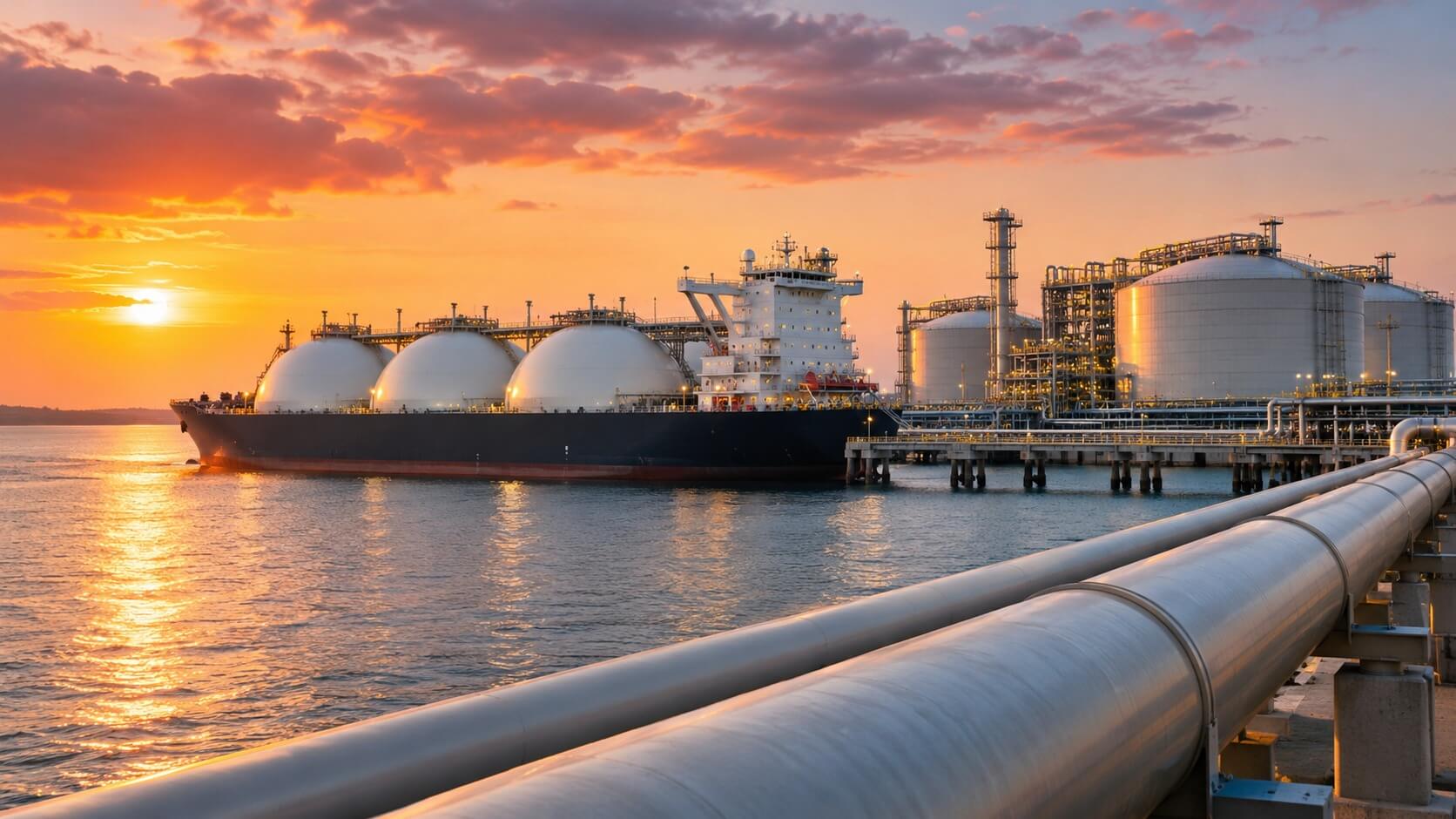
The United States is the world's leading exporter of liquefied natural gas (LNG), supported by natural gas production, extensive pipeline networks, coastal liquefaction facilities, and international shipping infrastructure.
US LNG exporters transport domestic natural gas to specialized terminals, cool it into liquid form, and ship it overseas. Importing countries then convert the LNG back into gas for electricity generation, heating, and industrial use.
According to the US Energy Information Administration (EIA), American LNG exports averaged 17.4 billion cubic feet per day during the first half of 2026, up 23% from the same period in 2025.
For investors, the key factors are operating capacity, long-term contracts, access to natural gas, construction costs, and international demand. These determine whether growing LNG exports translate into sustainable revenue and cash flow.
How Does the US LNG Export Industry Work?
Liquefied natural gas is primarily methane cooled to approximately minus 260 degrees Fahrenheit. At this temperature, it becomes a liquid occupying roughly one-six-hundredth of its original gaseous volume, making ocean transportation economically practical.
The US LNG export supply chain has five main stages.
1. Natural gas production
Natural gas is extracted from underground formations, including the Permian Basin in Texas and New Mexico, the Haynesville Shale in Louisiana and Texas, and the Appalachian Basin in Pennsylvania, West Virginia, and Ohio.
Some gas comes from dedicated natural gas wells, while other supplies are produced alongside crude oil. Production costs and available volumes influence the economics of LNG exports.
2. Pipeline transportation
After processing, natural gas travels through interstate and regional pipelines to export terminals.
Reliable pipeline access is essential. Even a large liquefaction facility may operate below capacity if surrounding infrastructure cannot deliver enough natural gas.
3. Liquefaction
At the export terminal, natural gas is purified and cooled into liquid form.
Liquefaction equipment is organized into production units called trains. Facilities can contain multiple trains, allowing operators to expand capacity in stages.
Liquefaction is among the most capital-intensive activities in the LNG supply chain because it requires specialized equipment, substantial energy consumption, and complex industrial infrastructure.
4. Storage and shipping
LNG is stored in insulated tanks before being loaded onto specialized carriers for overseas delivery.
Transportation costs depend on shipping distance, vessel availability, fuel prices, and trade conditions. These costs can affect the competitiveness of American LNG in different destination markets.
5. Regasification and delivery
At an importing terminal, LNG is unloaded, stored, and generally converted back into gas.
The gas enters domestic pipeline networks supplying power plants, factories, businesses, and households.
This final stage matters because export capacity alone cannot support international LNG trade. Importing countries also need adequate receiving and distribution infrastructure.
Who Are the Major US LNG Exporters?
The American LNG industry includes specialized exporters, integrated energy companies, infrastructure operators, and privately held businesses.
Major participants include:
| Company | Major LNG involvement | Business significance |
|---|---|---|
| Cheniere Energy (NYSE: LNG) | Sabine Pass and Corpus Christi | Established LNG liquefaction and export operator |
| Venture Global (NYSE: VG) | Calcasieu Pass and Plaquemines | LNG export operations and capacity expansion |
| Sempra (NYSE: SRE) | Cameron LNG and Port Arthur LNG | Infrastructure ownership and project development |
| ExxonMobil (NYSE: XOM) | Golden Pass LNG joint venture | Integrated energy operations and LNG investment |
| Kinder Morgan (NYSE: KMI) | Elba Island LNG and natural gas pipelines | Natural gas transportation and export infrastructure |
| Berkshire Hathaway Energy | Cove Point LNG | LNG infrastructure ownership and energy operations |
These companies have different sources of revenue and financial exposure.
Cheniere focuses heavily on LNG liquefaction and exports, while ExxonMobil operates across a much broader energy portfolio. Kinder Morgan earns substantial revenue from natural gas transportation infrastructure rather than depending primarily on international LNG sales.
Investors should also distinguish between companies operating existing facilities and developers investing in future capacity. Their construction exposure, financing requirements, and cash flow profiles can differ significantly.
Rankings depend on the measurement used, including operating capacity, LNG sales, ownership interests, and export volumes.
For a closer comparison, see Who Are the Largest LNG Exporters in the US?.
Where Are US LNG Export Terminals Located?
Most major American LNG export facilities are concentrated along the Gulf Coast, particularly in Louisiana and Texas.
The region offers several advantages:
- Access to major natural gas production areas.
- Extensive interstate pipeline networks.
- Deepwater ports suitable for LNG carriers.
- Established energy and petrochemical infrastructure.
- Experienced industrial workforces and supporting services.
- Access to international shipping routes.
These advantages make the Gulf Coast attractive for large-scale liquefaction projects. However, export facilities also operate in Maryland and Georgia.
Major US LNG export facilities
| Facility | Location | Principal operator or developer |
|---|---|---|
| Sabine Pass LNG | Louisiana | Cheniere Energy |
| Corpus Christi LNG | Texas | Cheniere Energy |
| Cameron LNG | Louisiana | Cameron LNG / Sempra |
| Freeport LNG | Texas | Freeport LNG |
| Calcasieu Pass LNG | Louisiana | Venture Global |
| Plaquemines LNG | Louisiana | Venture Global |
| Cove Point LNG | Maryland | Berkshire Hathaway Energy |
| Elba Island LNG | Georgia | Kinder Morgan |
| Golden Pass LNG | Texas | Golden Pass LNG |
These facilities do not all have identical operating status or completed capacity. Some projects have been expanding or commissioning production units during 2026.
For investors, an operating terminal generating revenue is fundamentally different from a facility still under construction or commissioning. Planned capacity represents potential future production, not guaranteed current cash flow.
Explore the geographical distribution and individual facilities in Where Are LNG Export Terminals Located in the US?.
What Determines the Size of an LNG Export Terminal?
LNG terminals are primarily compared by liquefaction capacity: how much natural gas they can process into LNG over a specified period.
Two commonly used measurements are:
- Bcf/d: Billion cubic feet per day, measuring natural gas volumes.
- MTPA: Million metric tons per annum, measuring annual LNG production capacity.
These measurements are related, although conversions depend on gas composition and energy content.
A larger facility can potentially export more LNG, but greater capacity does not automatically produce higher profitability. Utilization, contract pricing, operating expenses, financing costs, and maintenance also influence financial performance.
Why production trains matter
Each LNG train is a major processing unit that converts natural gas into liquid form.
Developers often expand existing facilities by adding trains rather than building entirely new terminals. This can allow them to reuse storage tanks, marine infrastructure, pipelines, and other supporting equipment.
However, additional trains still require substantial investment and can face construction delays.
Sabine Pass and Corpus Christi demonstrate how multiple trains support large-scale LNG operations.
For a detailed comparison of facility capacity and scale, see What Is the Largest LNG Export Plant in the US?.
How Do LNG Export Companies Make Money?
LNG export companies generate revenue through liquefaction services, LNG sales, and related infrastructure operations. Their earnings depend heavily on contract structures and exposure to commodity prices.
Because export terminals require billions of dollars in upfront investment, developers typically seek long-term customer agreements before committing to major construction projects.
Long-term liquefaction contracts
Some exporters earn fees for providing liquefaction capacity to customers.
Depending on the agreement, customers may owe fixed payments even when they do not take delivery of their full contracted volumes. These arrangements can make revenue more predictable than relying entirely on short-term LNG prices.
However, contract coverage does not eliminate risk. Customer creditworthiness, operating costs, financing obligations, and contractual conditions still matter.
LNG sales linked to commodity prices
Other agreements use pricing formulas linked to US natural gas benchmarks, international LNG prices, or combinations of fixed and variable charges.
Higher international LNG prices can improve the economics of certain sales arrangements, but they do not automatically increase profits for every exporter.
A company receiving mostly fixed liquefaction fees has a different earnings profile from one selling substantial volumes at market-linked prices.
Infrastructure ownership
Pipeline and storage operators can benefit from increased natural gas transportation demand without directly selling LNG cargoes.
For example, an infrastructure company may receive transportation fees based on contracted pipeline capacity rather than the final international selling price of LNG.
For investors, the central question is which activities generate cash flow, how predictable that cash flow is, and what risks the company assumes.
Which Countries Buy US LNG?
American LNG reaches customers across Europe, Asia, Africa, Latin America, and other regions.
Europe is an important destination as countries seek diversified gas supplies and alternatives to Russian pipeline deliveries.
Asia is another major market. Japan, South Korea, China, and India use imported LNG to support electricity generation, industrial activity, and broader energy requirements.
Other countries, including Egypt and several Latin American markets, may increase LNG purchases when domestic production declines or seasonal demand rises.
How global demand changed in 2026
According to the EIA, US LNG exports increased 23% during the first half of 2026 compared with the same period in 2025.
The agency also reported stronger shipments to Asia during that period amid international supply disruptions.
In June 2026, US LNG exports reached approximately 17.4 Bcf/d, with Department of Energy data identifying Asia as the largest regional destination that month, ahead of Europe.
These changes illustrate how LNG trade patterns can shift as buyers respond to supply disruptions, regional price differences, and changing energy requirements.
Why destination markets matter to investors
Exporters serving multiple regions may have greater commercial flexibility than companies dependent on a narrow customer base.
However, shipping distances, contract commitments, competition, and regional price differences determine whether particular deliveries are economically attractive.
For a closer examination of importing markets, see Which Countries Buy the Most LNG?.
Why Are LNG Import and Export Terminals Both Important?
International LNG trade requires functioning infrastructure at both ends of the shipping route.
Export terminals liquefy natural gas and load it onto carriers. Import terminals receive LNG, store it, and generally convert it back into gas for domestic distribution.
Some importing countries use floating storage and regasification units, known as FSRUs, instead of relying exclusively on permanent onshore terminals.
FSRUs can sometimes be deployed more quickly than large land-based facilities, although suitable ports, pipeline connections, and regulatory approvals remain necessary.
For American exporters, additional import capacity overseas can open new markets and expand the potential customer base.
However, receiving capacity does not guarantee actual LNG demand. Import terminals may operate below capacity when domestic consumption is weak, alternative energy supplies are cheaper, or distribution networks are constrained.
Countries with extensive receiving infrastructure generally have greater flexibility to purchase LNG from competing international suppliers.
The relationship between importing countries and their infrastructure is explored in Which Countries Have LNG Terminals and Why Do They Matter?.
Does the United States Have Enough Natural Gas for LNG Exports?
The United States has substantial natural gas resources and a large domestic production industry. Its production has generally exceeded domestic consumption, supporting its position as a net natural gas exporter.
However, abundant underground resources do not guarantee unlimited supplies at every location or price.
Natural gas production must keep pace with demand
New LNG export capacity increases demand for natural gas delivered through domestic pipeline systems.
This creates opportunities for producers but can also increase competition for supplies among exporters, power generators, manufacturers, and residential consumers.
The effect on domestic prices depends on production growth, weather, storage inventories, and infrastructure availability.
Infrastructure can constrain available supply
A producing region may have substantial reserves but insufficient pipeline capacity to deliver additional gas to export terminals.
New pipelines and processing facilities can reduce these constraints, although construction requires capital, permits, and time.
Investors should therefore assess whether gas can be produced economically and transported reliably, not simply whether underground resources exist.
Why domestic natural gas prices matter
Henry Hub is a major US natural gas pricing benchmark.
Higher domestic gas prices can increase feedgas costs for LNG businesses responsible for purchasing their own natural gas. At the same time, stronger prices may benefit upstream producers.
Consequently, LNG export growth can affect producers, pipeline operators, and terminal owners differently.
For a detailed assessment of domestic supply and infrastructure, see Does the US Have Enough Natural Gas to Support LNG Exports?.
What Are the Biggest Risks Facing US LNG Export Projects?
LNG export projects require substantial capital and complex infrastructure. Their risks vary depending on whether facilities are operating, under construction, or awaiting investment decisions.
Construction costs and delays
Large terminals require specialized equipment, engineering services, skilled labor, and supporting infrastructure.
Delays can increase financing expenses and postpone commercial revenue. Cost overruns may reduce expected returns even when a facility eventually operates successfully.
Regulatory and permitting uncertainty
Projects may require federal, state, and local approvals, including environmental reviews and export authorizations.
Policy changes, legal challenges, and permitting delays can affect project schedules and investment decisions.
International demand and pricing
Global LNG demand responds to economic conditions, energy policy, weather, and competing energy supplies.
Additional LNG capacity from countries such as Qatar and Australia can influence competition and international prices.
Developers must consider whether customers will need their production when a new terminal becomes operational, potentially years after construction begins.
Operational and weather risks
Equipment failures, maintenance outages, pipeline disruptions, and severe storms can interrupt exports.
Because much of the US LNG industry is concentrated along the Gulf Coast, hurricane exposure is particularly relevant.
Financing and contract risks
Major LNG developments frequently depend on debt financing and long-term customer commitments.
Higher borrowing costs, weak customer credit quality, or insufficient contracted volumes can make projects harder to finance.
Even a technically successful facility may generate disappointing returns if its construction and financing costs exceed the value of future cash flow.
These challenges are examined in What Are the Main Risks of LNG Export Projects?.
What Should Investors Look for in US LNG Companies?
Investors should compare LNG-related companies according to their operating assets, contract structures, financial strength, and exposure to natural gas prices.
Five considerations are particularly useful.
1. Operating capacity versus planned capacity
Distinguish facilities already generating revenue from projects that are approved, under construction, or only proposed.
Planned capacity can support future growth, but it carries execution and financing risks that established operations may not face to the same degree.
2. Contract coverage
Examine the duration of customer agreements, pricing formulas, counterparty credit quality, and the percentage of capacity committed under long-term contracts.
Strong contract coverage can improve revenue visibility, although the quality of the agreements matters as much as their duration.
3. Financial strength
Review debt, interest expenses, operating cash flow, and future capital commitments.
Expansion is not necessarily beneficial to shareholders if it requires excessive borrowing or repeated equity issuance.
4. Exposure to commodity prices
Determine whether revenue depends primarily on fixed infrastructure fees, international LNG prices, or domestic natural gas prices.
These differences can materially influence earnings volatility and performance across commodity market cycles.
5. Execution and operational performance
Monitor construction milestones, terminal utilization, maintenance expenses, and the ability to meet contractual delivery obligations.
Compare management forecasts with actual results rather than relying exclusively on announced capacity additions.
How Could the US LNG Export Industry Develop?
The long-term outlook for American LNG depends on global energy demand, domestic production, infrastructure investment, and international competition.
The EIA estimated that US LNG exports would average approximately 17.3 Bcf/d during the second half of 2026 and increase to 18.7 Bcf/d in the first half of 2027.
These are forecasts rather than guaranteed outcomes. Actual exports will depend on commissioning schedules, terminal utilization, feedgas availability, and customer demand.
Several developments could influence the industry:
- New export capacity: Additional liquefaction trains and terminals could increase potential US LNG shipments.
- Global competition: New production from other exporting countries may influence prices and purchasing decisions.
- Electricity demand: Growing consumption from data centers, industrial facilities, and other users could increase domestic natural gas requirements.
- Energy policy: Permitting, environmental regulations, trade relationships, and energy security priorities may affect investment decisions.
- Natural gas supply: Production growth and pipeline infrastructure must support additional export demand.
For investors, industry expansion and shareholder returns are not the same thing.
A growing LNG market can create opportunities for exporters, producers, and infrastructure operators without guaranteeing attractive returns for every company. Project costs, contract economics, financing, and valuation remain decisive.
Why US LNG Infrastructure Matters to the Energy Market
US LNG infrastructure connects American natural gas production with international energy consumers, supporting an extensive network of producers, pipeline operators, liquefaction facilities, shipping companies, and equipment suppliers.
The expansion of this infrastructure has strengthened the United States' position in global natural gas trade and created additional demand for domestic production and transportation services.
However, the investment outlook depends on more than export growth. Operating reliability, contract quality, project costs, financing requirements, and global supply-demand conditions all influence financial performance.
For retail investors, understanding how these activities interact provides a more useful foundation for evaluating LNG-related companies than focusing exclusively on export volumes, industry rankings, or announced expansion projects.
Disclaimer: This article is for informational and educational purposes only and does not constitute financial or investment advice. Energy investments involve market, operational, regulatory, and financial risks. Investors should conduct independent research before making investment decisions.