
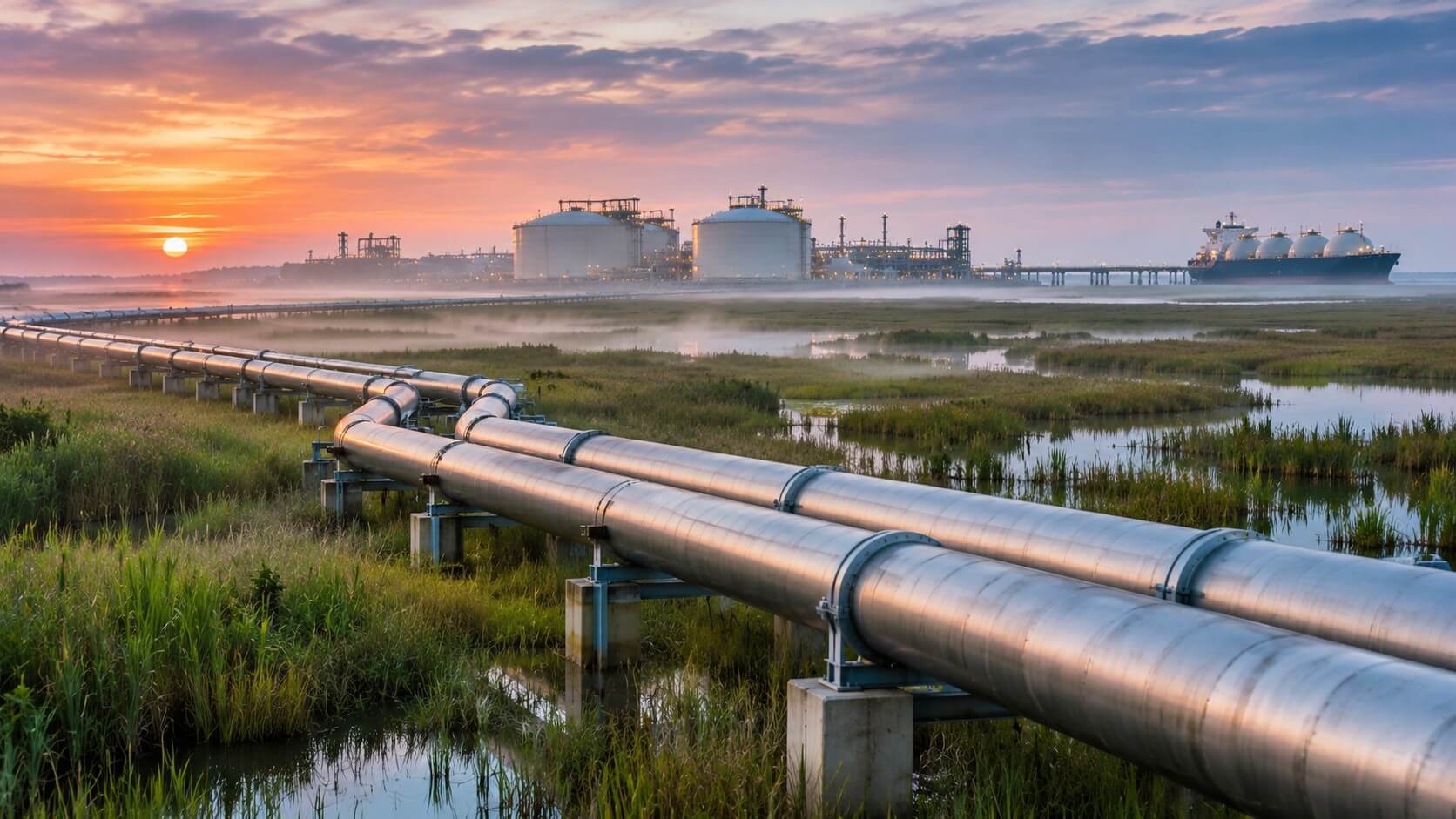
Yes, the United States has substantial natural gas resources and production capacity to support its LNG export industry. As the world's largest natural gas producer, the country has a large resource base capable of sustaining significant production for decades under many development scenarios.
However, abundant underground resources do not mean unlimited natural gas is immediately available for export.
US liquefied natural gas (LNG) exports depend on continued drilling, pipeline transportation, processing infrastructure, domestic consumption, market prices, and reliable export terminal operations.
For investors, the central question is whether American natural gas production and infrastructure can expand economically as LNG export capacity increases.
How Much Natural Gas Does the United States Produce?
The United States produces more natural gas than any other country.
According to the US Energy Information Administration (EIA), American dry natural gas production averaged approximately 103 billion cubic feet per day (Bcf/d) in 2024.
Production subsequently increased as output from major producing regions expanded.
The EIA's October 2026 Short-Term Energy Outlook projected US marketed natural gas production of approximately 119 Bcf/d in 2026 and 121 Bcf/d in 2027.
These figures measure different stages of natural gas production and should not be compared directly.
What Is the Difference Between Marketed and Dry Gas Production?
Marketed production measures natural gas after certain initial processing steps but before all nonhydrocarbon gases and natural gas liquids have been removed.
Dry natural gas production measures gas after additional processing, making it more relevant when comparing available supplies with pipeline consumption and LNG feedgas requirements.
For investors, consistent definitions are essential. An increase in marketed production does not necessarily translate into an identical increase in dry gas available for consumption or export.
Where Does America Get Most of Its Natural Gas?
US natural gas production comes primarily from onshore shale formations and other producing regions.
Several major basins account for a substantial share of domestic output.
| Producing Region | Main States | Importance to US Gas Supply |
|---|---|---|
| Appalachian Basin | Pennsylvania, West Virginia, Ohio | One of the largest natural gas producing regions |
| Permian Basin | Texas, New Mexico | Major source of associated natural gas from oil production |
| Haynesville Shale | Louisiana, Texas | Important supply source for Gulf Coast LNG terminals |
| Eagle Ford | Texas | Produces natural gas and associated gas |
| Anadarko Basin | Oklahoma, Texas | Established natural gas producing region |
| Other US basins | Multiple states | Contribute additional domestic supply |
These regions differ in production costs, drilling economics, pipeline availability, and proximity to LNG export facilities.
Appalachian Basin
The Appalachian Basin includes the Marcellus and Utica formations and is one of America's most productive natural gas regions.
Its major limitation is transportation. Pipeline constraints and permitting requirements can restrict deliveries to distant markets, even when substantial gas resources remain available underground.
Permian Basin
The Permian Basin is primarily associated with oil production but also generates substantial natural gas volumes.
Much of this is associated gas, produced alongside crude oil. Consequently, natural gas output can depend partly on oil drilling activity rather than gas prices alone.
This relationship makes Permian production economics different from those of gas-focused basins.
Haynesville Shale
The Haynesville Shale, located mainly in Louisiana and East Texas, is particularly important to American LNG exports.
Its proximity to Gulf Coast terminals can reduce transportation distances and provide exporters with access to nearby gas production.
However, Haynesville wells can be expensive to drill, and maintaining production requires continued investment.
Future output depends on natural gas prices, drilling economics, and infrastructure availability.
Does the US Have a Surplus of Natural Gas?
The United States produces substantially more natural gas than it imports and is a net exporter.
However, describing this position as an unlimited surplus would be misleading.
Natural gas supply and demand are continuously balanced through production, storage, pipeline flows, imports, exports, and market prices.
A country can export significant quantities of gas without having unlimited unused production capacity.
What Happens When Gas Production Exceeds Immediate Demand?
Additional gas may be injected into underground storage, exported, or contribute to lower market prices.
Lower prices can discourage drilling, eventually slowing production growth. Stronger demand may support higher prices and encourage additional investment.
Natural gas supply therefore changes in response to market conditions rather than remaining a fixed quantity.
Why Prices Matter
Natural gas production requires continuous capital investment because shale wells typically experience significant output declines after their initial production period.
Producers must drill new wells to replace declining output and increase total production.
If prices remain too low to justify drilling, production growth can slow despite the existence of substantial underground resources.
For investors, economically recoverable gas at prevailing prices matters more than the total theoretical resource base.
How Much Natural Gas Does the US Export as LNG?
American LNG exports have expanded substantially since large-scale shipments began from Sabine Pass in 2016.
The United States became the world's largest LNG exporter in 2023 and has continued adding liquefaction capacity.
The EIA reported that US LNG exports averaged approximately 17.4 Bcf/d during the first half of 2026, an increase of about 23% compared with the same period in 2025.
This growth reflects additional export capacity and international demand for natural gas.
Why LNG Exports Are Increasing
Several developments have supported American LNG export growth:
- Substantial domestic natural gas production.
- Construction of new liquefaction facilities.
- Expansion of existing export terminals.
- International demand for diversified gas supplies.
- Long-term agreements with overseas customers.
- European efforts to reduce dependence on traditional pipeline suppliers.
However, LNG exports represent only one component of total US natural gas demand. Domestic electricity generation, industrial activity, heating, and other uses consume much larger combined volumes.
The relationship between exporters, terminals, and international customers is explained in US LNG Exporters and Terminals: How the Industry Works.
How Much Natural Gas Does the US Use Domestically?
The United States is both a major natural gas producer and one of the world's largest consumers.
Domestic demand comes primarily from electricity generation, industrial activity, and residential and commercial buildings.
Electricity Generation
Natural gas is a major fuel for American power plants.
Gas-fired generation can respond relatively quickly to changes in electricity demand, making it useful for balancing variable renewable energy production and other power sources.
Demand also changes with weather, economic activity, and the development of energy-intensive facilities.
Industrial Consumption
Natural gas supports manufacturing, chemical production, fertilizer manufacturing, refining, and other industrial processes.
Some industries burn gas for heat, while others use it as a feedstock to manufacture products.
Industrial demand therefore depends partly on economic conditions and production activity.
Residential and Commercial Heating
Natural gas is widely used to heat homes and commercial buildings.
Consumption typically rises during cold weather, particularly in regions with extensive gas heating systems.
Severe winter conditions can create temporary demand spikes.
LNG Exports and Pipeline Exports
In addition to domestic consumption, the United States exports natural gas through pipelines to neighboring countries and as LNG to overseas markets.
These exports contribute to overall demand for American gas.
For investors, this means LNG exporters compete for supply within a much broader domestic energy market.
Could LNG Exports Cause a Natural Gas Shortage in the US?
A nationwide natural gas shortage is not an inevitable consequence of increasing LNG exports. The United States has substantial resources and an established production industry.
However, regional shortages, temporary supply constraints, and higher prices are possible when production or infrastructure cannot respond quickly enough to demand.
Production May Not Grow Immediately
Increasing natural gas output requires investment in drilling, well completion, and transportation infrastructure.
If LNG demand rises faster than producers can increase supply, domestic gas prices may face upward pressure.
Pipelines Can Become Bottlenecks
Natural gas must travel from producing regions to consumers and export terminals.
Insufficient pipeline capacity can create substantial regional price differences. One region may have abundant gas while another experiences higher prices because transportation infrastructure is constrained.
Weather Can Disrupt the Market
Extreme cold can increase heating demand while disrupting natural gas production.
Hurricanes can interrupt Gulf Coast energy infrastructure, including pipelines and LNG export operations.
These events may temporarily reduce supply or increase demand.
Storage Provides Flexibility
Underground natural gas storage helps balance seasonal consumption.
Gas is generally injected during lower-demand periods and withdrawn when consumption increases.
However, storage capacity and withdrawal rates are limited, so inventories cannot eliminate every supply disruption.
The risk of shortages depends on production, transportation, storage, and demand conditions rather than underground resources alone.
Will More LNG Exports Raise US Natural Gas Prices?
Increasing LNG exports can place upward pressure on domestic natural gas prices by adding demand.
However, the size of that effect depends on how quickly domestic production and pipeline infrastructure expand.
If producers increase supply sufficiently, additional export demand may have a smaller price impact. If production growth is constrained, stronger demand can contribute to higher prices.
How LNG Demand Affects Henry Hub
Henry Hub is a major natural gas pricing benchmark located in Louisiana.
It is widely used in US gas contracts and is particularly relevant to Gulf Coast LNG economics.
When export terminals purchase additional natural gas, they increase demand within the domestic market. This can influence Henry Hub prices, especially when available supply is relatively tight.
However, Henry Hub prices also depend on:
- Domestic natural gas production.
- Weather and seasonal heating demand.
- Electricity generation.
- Industrial consumption.
- Underground storage inventories.
- Pipeline constraints.
- Broader economic conditions.
It would therefore be misleading to attribute every increase in American natural gas prices to LNG exports.
Why Higher Gas Prices Affect Companies Differently
Natural gas producers may benefit from stronger selling prices, depending on their costs and hedging arrangements.
Pipeline operators may benefit from additional transportation demand, particularly when it supports new contracted capacity.
LNG exporters can experience different financial outcomes depending on their commercial agreements.
Companies earning fixed liquefaction fees generally have different commodity exposure from businesses purchasing gas and selling LNG directly into international markets.
For investors, contract structures are as important as the direction of natural gas prices.
Do US Natural Gas Reserves Guarantee Future LNG Supply?
No. Natural gas reserves and resources are different measures, and neither guarantees that sufficient gas can be delivered economically to export terminals.
Proved Reserves
Proved reserves represent quantities of natural gas that geological and engineering information indicates can be recovered with reasonable certainty under existing economic and operating conditions.
They can change with commodity prices, technology, development plans, and other factors.
Technically Recoverable Resources
Technically recoverable resources represent natural gas that could potentially be produced using available technology, regardless of whether extraction would be profitable.
This category is generally much larger than proved reserves.
Why the Distinction Matters
Large underground resources do not guarantee that all the gas will eventually be produced.
Production requires capital, infrastructure, regulatory approvals, and commercially attractive prices.
Because LNG terminals may operate for decades, their economics depend on reliable and competitively priced gas supplies throughout their operating lives.
Why Are Pipelines Critical to LNG Export Growth?
Large liquefaction facilities require enormous quantities of natural gas, sometimes several billion cubic feet of feedgas per day.
This gas must reach export terminals through pipeline networks.
Gulf Coast Infrastructure Advantages
Louisiana and Texas have extensive natural gas pipeline systems connecting producing regions, industrial facilities, and export ports.
These connections help explain why most American LNG export terminals are concentrated along the Gulf Coast.
Pipeline Expansion Can Support Production
Additional transportation capacity can connect producing regions with growing demand centers.
For example, new pipelines can help move gas from the Permian Basin or Haynesville Shale toward Gulf Coast export facilities.
Better market access can support producer investment and provide LNG exporters with additional supply options.
Pipeline Constraints Can Limit Growth
Pipeline projects require capital investment, regulatory approvals, and commercial commitments.
Construction delays or insufficient capacity can increase transportation costs and restrict feedgas deliveries.
For investors, pipeline availability is a critical factor in evaluating future LNG export growth.
Can US LNG Exports Keep Growing Through 2030?
Further growth is possible because the United States has additional LNG export capacity under construction or development.
However, not every proposed project will necessarily enter commercial operation.
Existing Terminals Can Expand
Companies can increase production by adding liquefaction trains to established terminals.
These expansions may benefit from existing pipelines, storage facilities, and marine infrastructure.
Cheniere Energy, for example, has expanded its Corpus Christi complex and pursued additional development opportunities.
New Facilities Can Add Capacity
Projects such as Golden Pass, Port Arthur, and Rio Grande LNG illustrate the scale of investment in American LNG infrastructure.
Their operating status and development schedules differ, and capacity under construction should not be counted as fully operational.
Domestic Gas Production Must Respond
Additional liquefaction capacity increases feedgas requirements.
Producers must maintain and expand output, while pipeline networks must provide sufficient transportation capacity.
International Demand Must Remain Competitive
American LNG competes with supplies from Qatar, Australia, and other exporting countries.
Future projects depend on international demand, delivered LNG prices, customer commitments, and financing costs.
For investors, continued export growth through 2030 is a plausible scenario rather than a guaranteed outcome.
How Does Global LNG Demand Influence US Natural Gas Supply?
International demand can encourage additional American natural gas production by supporting LNG export projects and long-term customer agreements.
However, overseas demand changes with economic conditions, energy policies, and competition from other fuels.
Europe
Europe is an important destination for American LNG.
Demand depends on energy security concerns, gas storage requirements, weather, industrial activity, and alternative energy supplies.
Asia
Major Asian LNG markets include China, Japan, South Korea, India, and Taiwan.
China's purchases depend partly on domestic gas production and pipeline imports. Japan and South Korea have mature LNG markets, while India's demand can be particularly sensitive to international prices.
Why Global Demand Matters to US Producers
Strong overseas demand can support export terminal utilization and encourage investment in domestic natural gas production.
However, weaker international demand or increased competition can reduce the economic incentive for additional supply.
For a detailed comparison of major importing markets, see Which Countries Buy the Most LNG?.
Which US Companies Could Benefit From Higher LNG Demand?
Different segments of the American natural gas industry can benefit from LNG export growth, but their financial exposure varies substantially.
Natural Gas Producers
Companies such as EQT Corporation and Expand Energy have significant exposure to American natural gas production.
Higher demand may support realized selling prices and production opportunities, although profitability also depends on drilling costs, hedging, debt, and capital spending.
LNG Exporters
Cheniere Energy and Venture Global are major participants in American LNG exports.
Both operate liquefaction infrastructure, but their facility portfolios, contractual arrangements, and financial risks differ.
Investors should evaluate production capacity, operating performance, customer agreements, and cash flow rather than assuming all exporters benefit equally from higher demand.
Pipeline Operators
Kinder Morgan and Williams operate important natural gas transportation infrastructure.
Additional LNG demand can support pipeline expansion and new transportation contracts.
However, pipeline revenue often depends more on contracted capacity and transportation fees than on commodity prices.
Diversified Energy Companies
ExxonMobil and other integrated energy companies participate in natural gas production and LNG infrastructure.
Their financial results also depend on oil production, refining, chemicals, and other operations, making LNG only one component of their overall business.
For a broader comparison of companies involved in American LNG exports, see Who Are the Largest LNG Exporters in the US?.
What Are the Biggest Risks to Future US Natural Gas Supply?
Despite America's substantial natural gas resources, several factors could restrict production growth or increase costs.
Low Natural Gas Prices
Prices below economically attractive drilling levels can cause producers to reduce investment, eventually slowing output growth.
High Drilling and Completion Costs
Labor, equipment, materials, and financing expenses affect the profitability of new wells.
Higher costs can discourage production expansion.
Pipeline Constraints
Insufficient transportation capacity can prevent natural gas from reaching markets where demand is strongest.
Environmental and Regulatory Requirements
Production and infrastructure development must comply with environmental, safety, and permitting requirements.
Regulatory changes can affect project costs and schedules.
Weather and Operational Disruptions
Extreme weather, equipment failures, and infrastructure problems can interrupt natural gas production, transportation, and LNG exports.
Demand Uncertainty
Producers and infrastructure companies invest based partly on expectations of future demand.
If LNG consumption grows more slowly than anticipated, some projects may struggle to achieve expected returns.
These uncertainties are explored further in What Are the Main Risks of LNG Export Projects?.
What Should Investors Monitor as LNG Exports Expand?
Investors evaluating US natural gas supply and LNG export growth should monitor several indicators together.
| Indicator | Why It Matters |
|---|---|
| US dry natural gas production | Measures growth in available domestic supply |
| Henry Hub natural gas prices | Reflect domestic gas market conditions |
| Underground storage inventories | Help indicate seasonal supply and demand balance |
| LNG feedgas deliveries | Show how much gas export terminals receive |
| LNG export volumes | Measure actual international shipments |
| Pipeline capacity additions | Influence access to producing regions |
| Natural gas drilling activity | Helps assess potential future production |
| LNG terminal commissioning | Indicates when additional export demand may emerge |
| Long-term LNG contracts | Support project financing and revenue visibility |
No single indicator provides a complete picture.
For example, increasing LNG exports may benefit natural gas producers, but financial returns still depend on realized prices and production costs.
Similarly, higher terminal utilization may support LNG export revenue while rising feedgas expenses reduce margins for companies exposed to commodity costs.
Investors should evaluate these relationships together rather than focusing exclusively on export growth.
Does the US Have Enough Natural Gas for the Long Term?
The United States has a substantial natural gas resource base and a highly developed production industry, supporting its position as a major LNG exporter.
However, long-term supply depends on continued investment and the ability to deliver gas economically.
Producers must replace declining output from existing wells. Pipelines must connect producing regions with demand centers. Export terminals must operate reliably, and international customers must continue purchasing LNG at commercially viable prices.
For investors, the critical distinction is between resource abundance and economically deliverable supply.
The United States has enough natural gas resources to support significant LNG exports under many plausible scenarios, but future growth is neither unlimited nor risk-free.
Companies combining competitive production costs, reliable infrastructure, disciplined capital spending, and strong commercial agreements may be better positioned to benefit from expanding LNG trade.
Disclaimer: This article is for informational and educational purposes only and does not constitute financial or investment advice. Natural gas and LNG investments involve commodity price, operational, regulatory, infrastructure, and financial risks. Investors should conduct independent research before making investment decisions.