
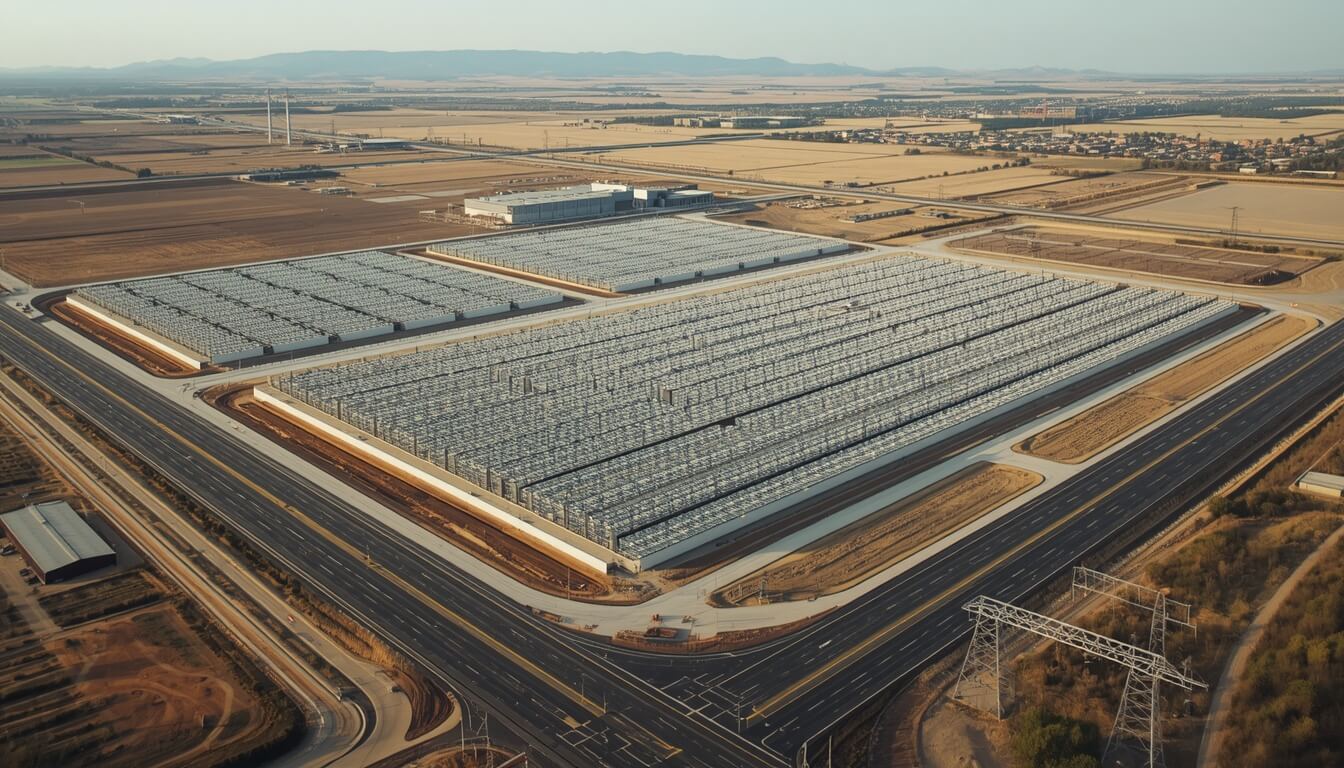
AI data centers are being built across the United States, but development is concentrated in a relatively small number of states. Virginia leads the country in existing facilities, while Texas and Georgia are among the biggest destinations for planned projects. Illinois, Arizona and Ohio are also important markets.
According to a February 2026 dataset analyzed by Pew Research Center, Virginia had 398 operating data centers and 287 planned facilities. Texas followed with 296 operating and 170 planned, while Georgia ranked third for planned projects with 141.
The geography of the industry is changing. Traditional data centers clustered around major cities and internet infrastructure. New AI campuses increasingly prioritize locations with sufficient electricity, available land and reliable grid connections.
For investors, understanding where AI data centers are being built helps identify which regions, utilities and infrastructure companies may benefit from expansion.
Which states have the most data centers?
Data center rankings depend on how facilities are counted. Some databases count individual buildings, while others include entire campuses or projects that have not yet been completed.
Pew Research Center analyzed Data Center Map information collected in February 2026, providing a snapshot of existing and planned development.
The five states with the most operating data centers were:
- Virginia — 398
- Texas — 296
- California — 277
- Ohio — 166
- New York — 148
For planned facilities, the ranking was different:
- Virginia — 287
- Texas — 170
- Georgia — 141
- Illinois — 123
- Arizona — 86
California and New York remain established markets, but Georgia and Arizona are becoming increasingly important destinations for new construction.
These figures count facilities rather than computing capacity. A single enormous AI campus can require substantially more electricity and investment than several smaller traditional data centers. Planned facilities also represent proposed development, not guaranteed construction.
Why does Virginia have so many data centers?
Virginia, particularly Northern Virginia, has been America's leading data center market for years.
The region combines extensive fiber-optic networks, proximity to major East Coast business markets, established electricity infrastructure and a large concentration of specialized developers.
These advantages reinforce one another. Once major operators establish facilities, other companies benefit from nearby networks, suppliers and technical expertise.
By the first half of 2026, Northern Virginia remained North America's largest data center market, with approximately 4,497 megawatts of existing capacity, according to CBRE.
The region had added more than one gigawatt of capacity over the preceding year, illustrating the scale of continued investment.
However, rapid growth creates challenges. As more facilities connect to the same electricity system, securing additional power and transmission capacity becomes increasingly difficult.
Virginia demonstrates both the advantages of an established data center ecosystem and the infrastructure constraints that can emerge when development expands rapidly.
Why is Texas becoming a major AI data center hub?
Texas offers extensive land availability, a large energy industry, expanding renewable generation and a business environment that has attracted major technology investment.
Electricity is particularly important. Large AI campuses can require hundreds of megawatts of power, making energy availability a decisive factor in choosing a location.
Texas has an enormous electricity system and substantial experience developing energy infrastructure. However, that does not mean power is immediately available everywhere. New facilities can face grid connection delays, transmission constraints and reliability concerns.
Texas ranked second nationally for both operating and planned data centers in Pew's February 2026 dataset.
For investors, the state's growth illustrates how AI infrastructure connects technology development with electricity generation, utilities and electrical equipment suppliers.
Why is Georgia attracting so many projects?
Georgia has become a major destination for data center development, with 141 planned facilities in Pew's February 2026 dataset, placing it third nationally.
The Atlanta metropolitan area offers extensive fiber connectivity, an established business environment and access to a large regional market.
Outside Atlanta, developers can find land for larger campuses and opportunities to expand industrial infrastructure.
However, rapid growth increases pressure on the electricity system. Utilities must determine how much additional generation, transmission capacity and supporting infrastructure will be required.
These investments can create opportunities for utilities, power producers and equipment manufacturers, but financing and construction timelines remain important challenges.
Georgia's growth shows that attracting data center investment is only the first step. Delivering sufficient electricity on schedule is equally important.
Why are Ohio, Illinois and Arizona attracting AI data centers?
These states offer different advantages for developers.
Ohio benefits from available industrial land, access to major population centers and an established technology and manufacturing base. It ranked among the five leading states for operating data centers in early 2026.
Illinois, particularly the Chicago area, offers extensive fiber networks, strong business connectivity and major communications infrastructure. The state ranked fourth nationally for planned facilities.
Arizona provides large development sites, connectivity to West Coast markets and an established technology industry. It ranked fifth for planned data centers.
Arizona also illustrates an important constraint: water availability.
In a dry climate, developers must carefully evaluate cooling technologies and freshwater consumption. Inexpensive land may offer little advantage if water or electricity requirements make a project difficult to operate.
No state offers every advantage. Developers must balance land costs, electricity availability, network connections, regulations and environmental conditions before committing billions of dollars.
What determines where an AI data center gets built?
Five factors play a particularly important role in location decisions.
1. Electricity availability
AI data centers require substantial electricity to operate servers and cooling equipment. The largest proposed campuses can demand power comparable to major industrial facilities.
A large, inexpensive site offers limited value if the local electricity system cannot support the project.
2. Grid connection time
Producing enough electricity in a region does not guarantee that a new facility can access it.
Substations, transformers or transmission upgrades may be required before a data center can connect to the grid. These projects can take years, making faster electricity access especially valuable.
3. Fiber connectivity
Data centers need reliable, high-capacity connections to cloud networks, other facilities and customers.
Established hubs such as Northern Virginia remain attractive partly because extensive network infrastructure already exists.
4. Land and expansion potential
Large AI campuses need space for buildings, cooling equipment, electrical infrastructure, backup generation and future expansion.
Developers increasingly consider locations outside dense urban areas where larger sites may be available.
5. Regulation and community acceptance
Zoning rules, environmental requirements, tax incentives and permitting timelines can determine whether a project moves forward.
Even a technically suitable location may become unattractive if obtaining approval is unusually difficult or expensive.
Are AI data centers moving into rural America?
Yes. One of the biggest changes in U.S. data center development is the growing number of projects planned outside major metropolitan areas.
According to Pew Research Center's 2026 analysis, 67% of planned U.S. data centers were located in rural areas, compared with 13% of existing facilities.
The analysis also found that 39% of planned facilities were in counties without an existing data center.
These figures suggest a substantial geographic shift, although planned projects may not all reach completion.
Traditional data centers often clustered near cities because proximity to customers, businesses and network infrastructure was valuable.
Large AI campuses increasingly prioritize extensive land, substantial electricity supplies and space for supporting infrastructure.
Rural locations may offer larger development sites and proximity to power generation or major transmission networks.
However, rural development is not automatically easier. Some areas lack sufficient fiber connections, grid capacity or local resources to support enormous facilities.
For communities previously outside the technology industry, these projects can introduce both economic opportunities and infrastructure challenges.
Why are the South and Midwest gaining ground?
The geographic shift is particularly visible in the South and Midwest.
Pew's 2026 analysis found that approximately three-quarters of planned U.S. data centers were located in these two regions, with the South alone accounting for about 48%.
Many states offer relatively affordable land, established industrial infrastructure and local governments interested in attracting major investment.
The Midwest benefits from major electricity networks and access to large development sites, while parts of the South offer expanding energy markets and technology infrastructure.
For investors, this shift means AI-related spending may increasingly benefit businesses outside traditional technology centers.
Regional utilities, power producers, engineering firms, construction companies and electrical equipment suppliers could experience additional demand.
However, announced projects do not guarantee completed construction. Electricity availability, financing and regulatory approvals remain important uncertainties.
Which U.S. town has the most data centers?
Ashburn, Virginia, in Loudoun County, is one of America's most concentrated data center communities.
The surrounding Northern Virginia area is widely known as "Data Center Alley" because of its extensive concentration of facilities and network infrastructure.
There is no universally accepted ranking of individual towns, since industry statistics often group facilities by city, county or metropolitan market.
However, Northern Virginia is clearly established as North America's largest data center market by capacity.
Its position reflects decades of investment in fiber networks, electricity infrastructure and interconnected facilities rather than one enormous campus.
That concentration continues to attract development, but it also increases competition for available electricity and grid connections.
Which states have the fewest data centers?
States with smaller populations, isolated locations or limited network infrastructure generally have fewer data centers.
Depending on the dataset, Vermont, Alaska, Hawaii, Maine and Rhode Island appear among the smaller markets. Exact rankings vary because databases use different definitions and coverage.
Having relatively few facilities does not necessarily mean a state opposes data center development. It may lack the combination of network connectivity, electricity availability, customer demand and infrastructure that historically attracted investment.
AI could change this pattern. A state does not need a large local technology industry to host computing infrastructure if it can provide reliable power, suitable land and high-capacity network connections.
However, low existing development alone is not evidence that a state will become a future AI hub.
Are any U.S. states banning data centers?
There is no simple nationwide list of states that have completely banned data center development.
Restrictions are more commonly introduced by cities and counties through temporary moratoriums, zoning changes or additional permitting requirements.
In October 2026, Raleigh, North Carolina approved a six-month moratorium on new data center development while reviewing rules related to noise, water and pollution.
A moratorium is not necessarily a permanent ban. It generally pauses certain approvals while local authorities evaluate future development rules.
For investors, the distinction matters: a state can remain broadly supportive of data centers even when individual communities restrict specific projects.
Why are some communities opposing new projects?
Large data centers can bring substantial investment and tax revenue, but residents also worry about electricity demand, water consumption, noise, land use and infrastructure costs.
They may question whether permanent employment and local economic benefits justify the resources required, especially when several facilities are proposed near residential neighborhoods.
Opposition can delay permits, increase development expenses and influence where companies choose to build.
Why Some Communities Oppose AI Data Centers examines the main reasons for local resistance and its consequences for development.
Could electricity availability redraw the U.S. data center map?
Yes. Electricity could become the most important factor determining where the next generation of AI data centers is built.
U.S. electricity consumption is expected to reach record levels in 2026 and 2027, with AI infrastructure contributing to rising demand.
The challenge is that data center construction and electricity infrastructure development do not always move at the same speed.
Servers and computing equipment can be installed relatively quickly, while new transmission lines, substations and power generation projects may take years.
A region with excellent fiber connectivity but a congested grid could therefore lose projects to another area offering faster electricity connections.
For investors, access to power can influence which states attract investment and which companies secure infrastructure contracts.
Could new technology change where data centers are built?
New technologies could gradually reduce some constraints affecting location decisions.
More efficient processors may lower electricity consumption for specific computing tasks, although total demand can still increase as AI usage grows. Improved cooling systems could also make facilities more practical in different climates.
Some companies are exploring alternatives, including underwater data centers, edge computing and facilities located near major power sources.
These approaches face different economic and technical challenges, and none is guaranteed to replace conventional data centers.
However, they could eventually influence where computing capacity is deployed and how much supporting infrastructure is required.
What Could Replace Traditional AI Data Centers explores these approaches and their potential implications.
Why does the data center map matter for investors?
The location of AI data centers can influence which businesses benefit from infrastructure spending.
Consider several examples:
- Utilities: Companies such as Dominion Energy in Virginia, American Electric Power in Ohio and Georgia Power, a Southern Company subsidiary, serve markets where data center development can increase electricity demand.
- Power producers: Companies such as Constellation Energy may benefit from opportunities to supply electricity to large computing facilities.
- Electrical equipment manufacturers: Eaton and GE Vernova supply equipment used in power distribution and grid infrastructure.
- Construction and engineering companies: Firms such as Quanta Services can benefit from demand for transmission lines, substations and related infrastructure.
- Data center operators: Companies such as Equinix and Digital Realty may benefit from expanding capacity where suitable land, power and connectivity are available.
These examples illustrate potential exposure to data center growth, not guaranteed revenue or investment returns.
Utilities may face expensive infrastructure requirements, developers can experience delays, and suppliers may see orders postponed when projects fail to secure electricity or permits.
Investors evaluating AI infrastructure companies should consider three practical questions:
- Where are the company's major projects or customers located?
- Does the region have sufficient electricity and infrastructure to support expansion?
- Are projects approved and under construction, or are they still preliminary announcements?
These distinctions help separate announced investment plans from projects more likely to generate actual business activity.
Where will the next wave of AI infrastructure investment go?
Virginia remains the dominant established U.S. data center market, while Texas, Georgia, Illinois, Arizona and other states are attracting significant planned development.
The broader trend is a movement beyond traditional technology hubs toward regions offering suitable land, electricity infrastructure and opportunities for large-scale expansion.
Rural America, the South and the Midwest are becoming increasingly important parts of that transformation.
But the number of announced facilities tells only part of the story. Projects must secure electricity, financing, network connections and regulatory approval before becoming operational.
For investors, the most important question is not simply where companies want to build AI data centers, but where those projects can realistically be completed.
Regions that can provide reliable electricity, suitable land, fiber connectivity and community support may capture a larger share of future AI infrastructure spending.
This article is for informational purposes only and does not constitute investment advice. Investing involves risk, including the possible loss of principal.