
Traditional AI data centers are unlikely to disappear anytime soon. Growing demand for artificial intelligence is driving the construction of more computing infrastructure, not less.
What could change is how data centers are built, where computing takes place and how much electricity and cooling they require.
Several technologies could reshape the industry. Edge computing can move AI processing closer to users. More efficient chips and smaller AI models can reduce the resources needed for individual tasks. Modular facilities can simplify construction, while locating data centers near major power sources could ease electricity constraints.
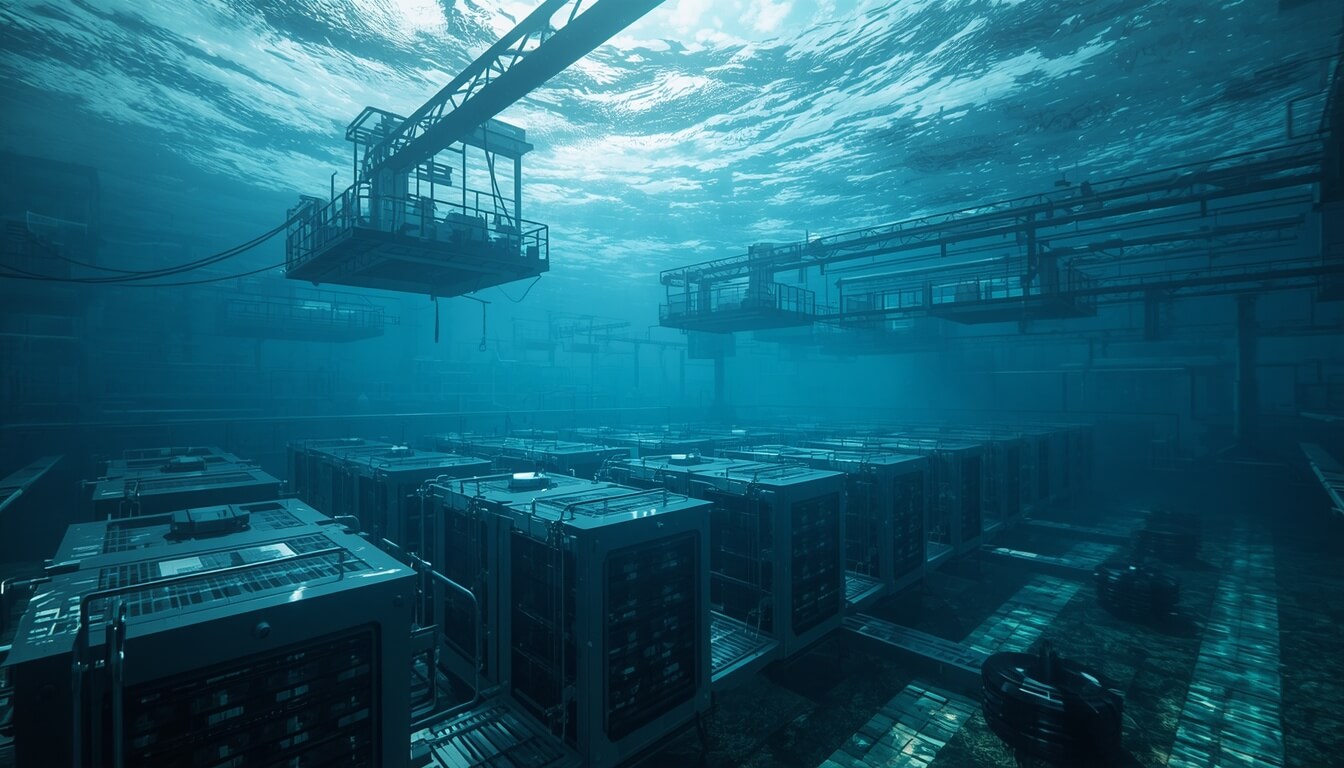
More experimental approaches are also emerging. China has developed commercial underwater data center projects, demonstrating that computing infrastructure does not always have to operate inside conventional buildings.
For investors, the important question is not which technology will suddenly replace data centers. It is which alternatives could reduce costs, overcome infrastructure constraints and change where companies spend money on AI computing.
Why would anyone want to replace traditional data centers?
Modern AI data centers face several expensive physical constraints:
- Electricity: Large AI campuses can require hundreds of megawatts of power.
- Cooling: Powerful processors generate substantial heat that must be removed continuously.
- Water: Some cooling systems consume significant amounts of freshwater.
- Land: Large facilities need space for buildings, electrical infrastructure and expansion.
- Grid connections: New substations and transmission lines can take years to complete.
U.S. electricity consumption is expected to reach record levels in 2026 and 2027, with data center expansion contributing to rising demand.
These constraints create incentives to develop alternatives.
If a company can perform the same AI workload using less electricity, it may reduce operating costs. Building closer to available power could help avoid lengthy grid upgrades, while more efficient cooling could support additional computing capacity.
The goal is not necessarily to eliminate data centers, but to make AI computing cheaper, more flexible and easier to expand.
For an explanation of existing infrastructure, see What AI Data Centers Do and Why They Matter for Investors.
Could edge computing replace some data center workloads?
Edge computing moves some data processing closer to the devices or people using it, rather than sending every request to a distant cloud data center.
Processing can happen on a smartphone, laptop, vehicle, factory computer or smaller regional server.
Consider an AI assistant running partly on your phone. Instead of sending every request to a remote facility, the device can handle certain tasks locally.
This offers several potential advantages:
- Faster responses for tasks that do not require remote processing.
- Less information traveling across networks.
- Improved privacy when sensitive information remains on the device.
- Reduced dependence on centralized computing for suitable applications.
However, a smartphone cannot provide the enormous processing capacity needed to train the largest AI models. Advanced applications may also require more memory and computing power than local devices can supply.
Edge computing is therefore more likely to complement traditional data centers than replace them entirely.
Smaller tasks can move closer to users, while demanding workloads remain in large centralized facilities.
Could better AI chips reduce the need for data centers?
More efficient processors and software could reduce the computing resources needed for individual AI applications.
If new chips perform the same workload using less electricity, companies may handle more computing within existing facilities.
But improved efficiency does not automatically mean fewer data centers. When computing becomes cheaper, businesses may use much more of it.
Imagine the cost of processing an AI request falls by 50%. A company could reduce spending, but it might instead introduce AI into more products, serve additional customers or process many more requests.
This creates two competing forces:
- Efficiency: Each AI task requires fewer computing resources.
- Demand growth: Lower costs encourage more applications and greater overall usage.
If efficiency improves faster than demand grows, fewer new facilities may be needed than previously expected. If demand grows faster, construction could continue expanding despite major improvements in chip performance.
For investors, faster processors do not necessarily translate into lower total infrastructure spending.
Could AI data centers move closer to power plants?
One increasingly important approach is locating computing facilities near major electricity sources.
Developers traditionally prioritized proximity to cities, customers and network infrastructure. Large AI campuses are changing that calculation because electricity availability can determine whether a project is practical.
Technology companies are signing long-term agreements with power producers, including nuclear energy companies, to secure electricity for future computing infrastructure.
In October 2026, Google and Constellation Energy announced agreements covering approximately 3.6 gigawatts of power, alongside plans for Constellation to invest more than $4.3 billion in upgrades to existing nuclear facilities.
Amazon, Microsoft and other major technology companies have also pursued nuclear-related electricity agreements.
However, securing electricity through a power agreement is not the same as physically building a data center next to a power plant.
Direct connections to nearby generation can introduce regulatory, technical and financial challenges. Some projects may still require substantial grid infrastructure.
The broader trend is that access to reliable electricity is becoming a central factor in determining where AI infrastructure can expand.
Where AI Data Centers Are Being Built in the US examines how electricity, land and infrastructure influence location decisions.
Could small nuclear reactors power future AI data centers?
Small modular reactors, commonly called SMRs, are another possibility attracting attention.
These nuclear reactors are designed to be smaller than conventional large nuclear plants, with some designs intended for standardized manufacturing and deployment.
For AI data centers, the attraction is reliable electricity available around the clock.
Unlike solar and wind generation, nuclear reactors can provide continuous power without depending on weather conditions.
However, commercial deployment of new reactor designs faces significant challenges:
- Regulatory approvals and safety requirements.
- High initial investment and financing costs.
- Construction and supply-chain risks.
- Uncertainty about commercial costs and deployment timelines.
Major technology companies have expressed interest in advanced nuclear power, but investors should distinguish future plans from reactors already producing electricity.
SMRs could eventually support some AI campuses. For now, agreements involving existing power plants offer a more immediate route to securing additional supply.
Are underwater data centers actually being built?
Yes. Underwater data centers are no longer purely experimental, although commercial deployment remains limited.
China has developed subsea computing projects, including facilities associated with Hainan and Shanghai.
The concept involves placing computing equipment inside sealed underwater modules and using surrounding seawater to help remove heat.
China's Hainan project reached commercial operation in 2025, while another project near Shanghai has combined underwater computing infrastructure with offshore wind power.
These developments show that subsea computing can operate beyond laboratory conditions.
However, commercial operation does not establish that underwater facilities are economically competitive with conventional data centers at every scale or for every application.
What did Microsoft's underwater data center experiment prove?
Microsoft explored underwater computing years before China's commercial projects.
Its research initiative, Project Natick, investigated whether sealed data center modules could operate reliably beneath the ocean.
In 2018, Microsoft deployed a module containing 864 servers on the seabed near Scotland's Orkney Islands.
After more than two years underwater, the module was recovered in 2020.
Microsoft reported that the underwater servers experienced a failure rate approximately one-eighth that of a comparable land-based control group.
The sealed environment may have contributed to the result. Equipment operated in a dry nitrogen atmosphere without routine human access, reducing some conditions associated with hardware failures.
However, the experiment involved a relatively small installation compared with modern hyperscale data centers.
It demonstrated technical feasibility and promising reliability, not that underwater computing was economically superior for every application.
Microsoft subsequently concluded the research project, but its findings helped establish the concept's technical potential.
What are the advantages of underwater data centers?
Underwater computing offers several potential benefits:
- Cooling efficiency: Seawater can help remove heat, potentially reducing energy used by conventional cooling equipment.
- Reduced land requirements: Subsea modules do not require the same large building sites as conventional facilities.
- Coastal connectivity: Facilities near population centers may provide relatively short network connections to users.
- Modular deployment: Standardized sealed units could be manufactured and installed as additional capacity is needed.
- Renewable energy integration: Some projects are exploring connections with offshore electricity generation.
These advantages could make underwater facilities attractive for specialized applications or locations where conventional development is expensive.
However, their economic value depends on installation costs, reliability, maintenance requirements and environmental conditions.
Why don't companies put every data center underwater?
Underwater facilities solve some problems while introducing others. The biggest challenge is maintenance.
In a conventional data center, technicians can replace failed servers, upgrade equipment and perform repairs inside the building.
When equipment is sealed inside a module on the seabed, physical access becomes far more difficult.
Other challenges include:
- Specialized vessels and equipment for deployment and retrieval.
- Reliable underwater electricity and fiber connections.
- Potentially expensive hardware replacement or upgrades.
- Environmental questions involving seabed infrastructure and heat released into surrounding water.
- Limited operating experience compared with conventional facilities.
These limitations matter particularly for AI infrastructure, where processors can become outdated relatively quickly.
Underwater data centers may serve useful commercial applications, but evidence remains insufficient to conclude that they can replace conventional hyperscale facilities across the industry.
Could data centers eventually move into space?
Space-based computing is another concept being explored, although it remains far less mature than terrestrial alternatives.
Potential advantages include access to solar energy and support for future industries operating in orbit.
However, major obstacles remain. Launching equipment is expensive, hardware is difficult to repair or replace, radiation can damage electronics, and transmitting large amounts of information between Earth and orbit requires reliable communications infrastructure.
Cooling also presents a challenge.
Space may be extremely cold, but equipment cannot simply release heat into surrounding air or water. Heat must be transferred through specialized systems and radiated away.
For most AI applications serving customers on Earth, conventional data centers remain substantially more practical.
Space-based computing is therefore better viewed as a long-term possibility for specialized workloads rather than an imminent replacement for terrestrial AI infrastructure.
Could modular data centers replace traditional buildings?
One of the more practical changes may be the growing use of modular construction.
Instead of designing and building every facility entirely on-site, companies can use standardized modules containing computing equipment, cooling systems and electrical infrastructure.
Some components can be manufactured in factories and transported to their final locations.
This approach offers potential advantages:
- Shorter construction timelines when suitable modules are available.
- More standardized equipment and installation processes.
- The ability to expand capacity in stages.
- Greater flexibility when locating facilities near customers or electricity sources.
Modular construction does not eliminate the need for land, power connections or cooling. It changes how computing infrastructure is assembled and expanded.
For investors, that could create opportunities for manufacturers of prefabricated infrastructure, cooling equipment and integrated electrical systems.
Could smaller AI models reduce centralized computing demand?
AI software is also becoming more efficient.
Smaller models designed for specific tasks can sometimes run directly on smartphones, laptops and other local devices.
For example, a company might use a compact AI model for document classification, voice recognition or a specialized customer-service function instead of relying on a much larger cloud-based system.
When a smaller model delivers acceptable results at lower cost, businesses have an incentive to use it.
This could move some AI processing away from centralized facilities, particularly for routine tasks that do not require the most powerful models.
However, training advanced models and running demanding applications still require substantial computing resources.
Smaller local models and enormous centralized AI systems can therefore expand simultaneously.
What could actually slow traditional data center growth?
The biggest long-term challenge to data center expansion may be several efficiency improvements working together rather than one revolutionary alternative.
Consider a scenario in which:
- AI processors become significantly more efficient.
- Smaller models handle more everyday applications.
- More processing moves onto personal devices.
- Software requires fewer calculations for the same results.
- Companies use existing computing infrastructure more effectively.
Together, these changes could reduce the amount of new computing capacity required for a given level of AI activity.
But the outcome depends on demand.
If efficiency improves faster than AI usage expands, future construction could fall short of current expectations. If adoption accelerates faster than efficiency gains, companies may need even more infrastructure.
For investors, this uncertainty matters because today's capital spending plans depend partly on expectations about future demand.
More efficient AI does not automatically mean lower infrastructure investment, but it could change which projects remain economically attractive.
Which companies could benefit from alternatives to traditional data centers?
Changes in data center design could shift spending toward different parts of the technology and infrastructure industries.
Several groups may benefit:
- AI chip manufacturers: Nvidia and AMD develop processors for centralized AI computing, while Qualcomm supplies chips supporting AI capabilities on smartphones and other devices.
- Cooling technology suppliers: Vertiv and Schneider Electric provide power and cooling infrastructure used in data centers.
- Electricity producers: Constellation Energy may benefit from demand for reliable electricity and long-term supply agreements.
- Modular infrastructure providers: Manufacturers of prefabricated electrical and computing systems could benefit if standardized construction becomes more widespread.
- Specialized engineering firms: Underwater computing could eventually create opportunities involving subsea cables, marine engineering and offshore infrastructure.
These are examples of companies and industries with relevant capabilities, not guarantees of financial benefits.
Some alternatives may remain small markets, while others could require years of investment before becoming commercially significant.
Investors should distinguish technologies already generating substantial business activity from concepts that remain experimental.
Who Builds AI Data Centers and Who Profits From Them explains how infrastructure spending currently reaches companies across the data center supply chain.
Traditional AI data centers are evolving, not disappearing
The most likely future is not one technology replacing every conventional data center.
Instead, AI computing could become more distributed and efficient through a combination of developments.
Edge computing and smaller models may move some processing onto local devices. Better chips and cooling systems could increase the capacity of existing facilities. Modular construction may shorten deployment times, while access to reliable electricity could influence where new campuses are built.
Underwater computing has demonstrated commercial potential in China, although its ability to compete with conventional facilities at large scale remains uncertain. Space-based computing is a much longer-term possibility.
For investors, the key is to watch which technologies can reduce electricity requirements, cooling costs, construction delays and other constraints without sacrificing performance or economic viability.
Those improvements could determine how future AI infrastructure is built, how much companies need to spend and which suppliers capture a greater share of investment.
This article is for informational purposes only and does not constitute investment advice. Investing involves risk, including the possible loss of principal.