
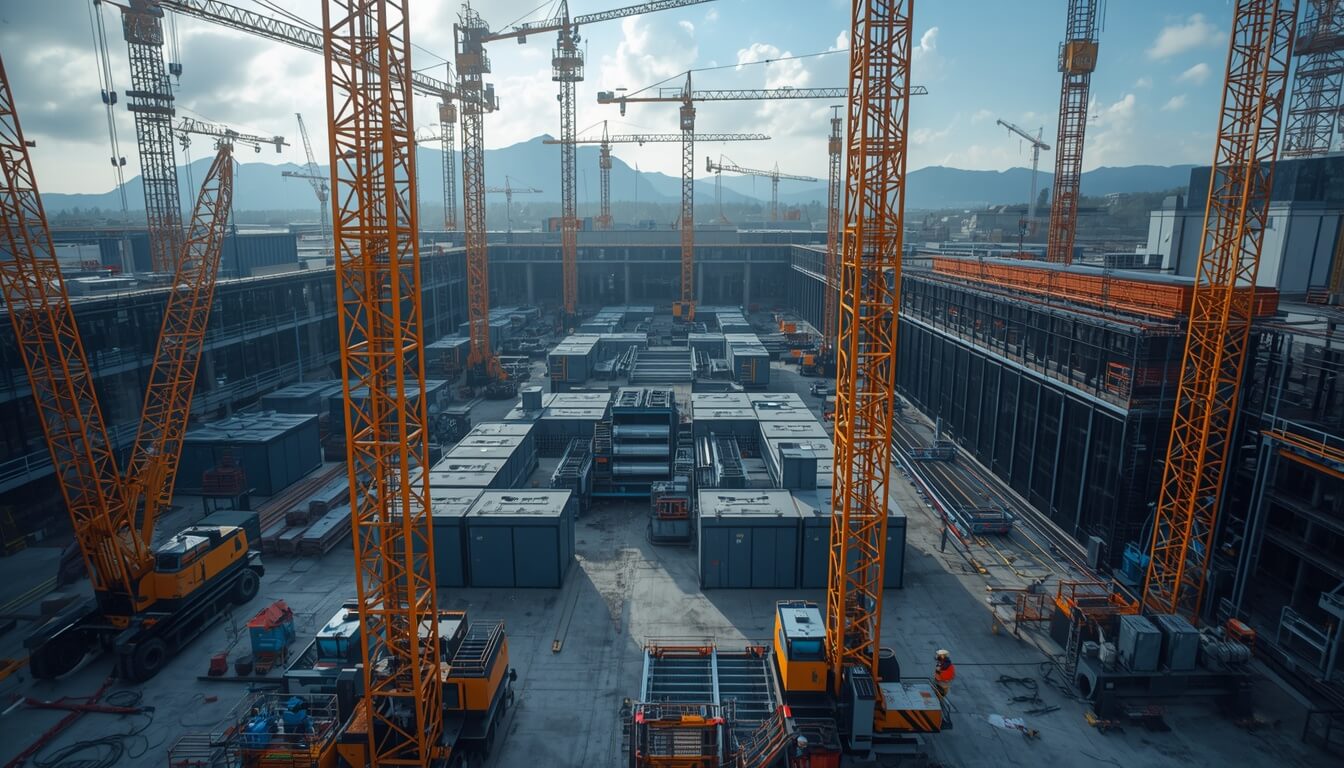
AI data centers are built, equipped and operated by companies across several industries. Amazon, Microsoft, Alphabet, Meta and Oracle are among the major investors financing new computing capacity, while suppliers such as Nvidia, TSMC, Dell, Vertiv and Schneider Electric provide essential equipment and infrastructure.
For investors, the key distinction is that the companies spending the most on AI data centers are not necessarily the ones earning the highest profits from them. Chipmakers, equipment suppliers and construction firms can earn revenue as facilities are built, while cloud providers and data center operators must generate enough customer income to recover their investments.
Understanding who builds AI data centers, who supplies their equipment and how each business makes money helps identify where the financial opportunities may be.
Who is behind the AI data centers being built?
Much of the demand comes from hyperscalers, large technology companies operating extensive cloud computing networks and data centers.
Major investors include:
- Amazon: Expands AI computing capacity through Amazon Web Services (AWS).
- Microsoft: Invests in Azure data centers and AI cloud services.
- Alphabet: Builds infrastructure for Google Cloud, AI models and consumer applications.
- Meta Platforms: Develops computing capacity for its AI models, advertising systems and digital platforms.
- Oracle: Expands cloud infrastructure for enterprise and AI customers.
Amazon, Microsoft, Alphabet and Meta collectively invest hundreds of billions of dollars annually in capital projects. Not all of that spending goes directly toward AI data centers, but computing infrastructure represents a major investment priority.
Their decisions determine how quickly capacity expands and which suppliers receive new orders.
For a broader explanation of the infrastructure itself, see What AI Data Centers Do and Why They Matter for Investors.
Who actually builds an AI data center?
Constructing an AI data center involves several industries working together.
Engineering and construction firms prepare sites, build facilities and install supporting infrastructure. Electrical equipment manufacturers supply transformers, power distribution systems and backup power equipment.
Cooling specialists install systems that prevent computing hardware from overheating. Server manufacturers assemble computing equipment, while networking companies provide connections between processors.
For example, Schneider Electric and Eaton supply electrical infrastructure, while Vertiv provides power and cooling equipment. Engineering firms such as AECOM and Jacobs also serve markets involved in data center development.
These businesses can benefit from construction activity, but their exposure to AI projects, competitive positions and profit margins differ.
Which chipmakers benefit from AI data centers?
Semiconductor manufacturers are among the most visible beneficiaries because AI computing requires specialized processors and advanced memory.
Nvidia is a leading supplier of AI accelerators, while AMD competes in the market. Major cloud providers also develop custom processors, including Google's Tensor Processing Units and Amazon's Trainium and Inferentia chips.
Other companies benefit from manufacturing and supplying essential components:
- TSMC: Manufactures advanced semiconductors designed by major technology companies.
- Micron: Supplies memory used in AI servers and computing systems.
- SK Hynix and Samsung: Produce advanced memory technologies for AI hardware.
High-bandwidth memory (HBM) is particularly important because it allows AI processors to access large amounts of information quickly.
For investors, the opportunity extends beyond the companies designing AI processors. Manufacturing capacity, memory supply and advanced chip production are also essential.
However, customer concentration, manufacturing costs and competition can significantly influence profitability.
How do server and networking companies make money?
AI processors need powerful servers and high-speed networks to operate efficiently.
Dell Technologies and Hewlett Packard Enterprise supply servers and related computing infrastructure used in data centers.
Networking companies such as Arista Networks, Broadcom and Nvidia provide technologies that move information between processors and servers.
These connections matter because large AI models can operate across thousands of processors. Slow communication reduces the efficiency of expensive computing equipment.
As AI systems expand, demand for specialized servers and faster networking can grow alongside processor demand.
However, hardware sales do not automatically translate into strong profits. Competition, component costs and pricing pressure can limit margins even when revenue increases.
Why can power and cooling companies profit from AI?
AI data centers need reliable electricity and cooling systems capable of handling powerful computing equipment.
This creates demand for transformers, electrical distribution equipment, backup power systems and technologies that remove heat from servers.
Vertiv is one example of a company exposed to this market through power management and cooling infrastructure.
Other major suppliers include Schneider Electric and Eaton, which provide electrical equipment used in data centers and other industrial applications.
Unlike semiconductor manufacturers, these businesses can benefit from the physical infrastructure required to operate AI systems, regardless of which company designs the processors.
For investors, important indicators include order growth, equipment backlogs, operating margins and the pace of new data center construction.
What about companies that own and operate data centers?
Not every company using AI computing wants to own the buildings and supporting infrastructure.
Specialized operators such as Equinix and Digital Realty provide data center facilities, connectivity and related services to customers.
Their business model differs from that of equipment manufacturers.
A semiconductor company generally earns revenue by selling chips. A data center operator can earn recurring revenue through agreements covering space, power capacity and connectivity.
This can provide more predictable income when facilities are occupied and customers maintain long-term contracts.
However, operating data centers requires substantial upfront investment. Companies must secure land, electricity, financing and construction capacity before new facilities generate revenue.
Specialized AI cloud providers face similar financing challenges. One example is Nvidia-backed Lambda's effort to raise up to $4 billion ahead of a planned 2027 IPO as it expands computing capacity.
For investors, recurring revenue can be attractive, but construction costs, borrowing expenses and future capital requirements remain important.
Who makes the most money from AI data centers?
There is no single company or industry guaranteed to capture the largest profits. Each part of the supply chain earns money differently.
| Industry | Example companies | How they earn money |
|---|---|---|
| AI processors | Nvidia, AMD | Selling specialized computing chips |
| Chip manufacturing and memory | TSMC, Micron | Manufacturing semiconductors and memory |
| Servers and networking | Dell, Arista Networks | Supplying computing and networking equipment |
| Power and cooling | Vertiv, Schneider Electric | Selling electrical and cooling systems |
| Data center operators | Equinix, Digital Realty | Leasing facilities, power capacity and connectivity |
| Cloud providers | Amazon, Microsoft, Alphabet | Selling cloud computing and AI services |
The distinction is between revenue generated by infrastructure spending and profit retained after expenses.
Chip suppliers can receive substantial orders while data centers are being equipped. Cloud providers financing those facilities may need years of customer payments to recover their investments.
Neither business model guarantees better investment returns. Profit margins, competitive advantages, capital requirements and stock valuations all matter.
Why isn't the biggest AI investor necessarily the biggest winner?
Consider a hypothetical technology company investing $100 billion in AI infrastructure.
That spending creates orders for chipmakers, server manufacturers, networking companies, cooling specialists and construction firms. Suppliers can earn revenue as equipment is delivered and projects are completed.
However, the company financing the infrastructure must generate enough future customer revenue to justify the investment.
If AI services attract strong demand, the facilities could produce attractive long-term returns. If revenue grows more slowly than expected, the same investment could become financially disappointing.
Suppliers face their own risks. If major cloud providers reduce capital spending, equipment orders could weaken even after several years of rapid growth.
For investors, the amount spent on AI infrastructure matters less than the sustainable profits companies ultimately generate from that spending.
Who pays for these massive projects?
AI data center development is financed through corporate investment, borrowing, outside investors or combinations of these sources.
Electricity infrastructure introduces additional financial questions.
Large facilities may require new substations, transmission lines or electricity generation capacity. Utilities and regulators must determine how the associated costs are divided between data center operators and other electricity customers.
These decisions can affect construction costs, project profitability and electricity prices.
The issue is explored in Who Pays for AI Data Centers and How They Affect Utility Bills.
Could new technology change which companies benefit?
AI infrastructure continues to evolve, and future facilities may not require exactly the same equipment used today.
More efficient processors, improved cooling technologies and new electricity supply arrangements could change construction and operating costs.
Some computing tasks may also move closer to users through edge computing, reducing the need to process every request inside a centralized facility.
These developments are unlikely to eliminate large data centers in the near term, but they could shift demand between suppliers.
For a deeper look, see What Could Replace Traditional AI Data Centers.
What should investors look for in AI data center stocks?
Not every company associated with AI infrastructure offers the same financial opportunity.
When evaluating a business, investors should consider several practical questions:
- Revenue exposure: How much of the company's sales actually comes from AI infrastructure rather than unrelated activities?
- Profitability: Are growing orders translating into stronger operating profits and cash flow?
- Competitive position: Does the company offer products or services that customers cannot easily replace?
- Capital requirements: How much additional investment is needed to support growth?
- Customer concentration: Does the business depend heavily on a few major technology companies?
- Valuation: Does the current stock price already assume years of exceptional growth?
Customer concentration deserves particular attention because much of the expansion depends on investment decisions made by a relatively small number of hyperscalers.
For example, a supplier reporting strong AI-related sales may still face significant risk if a large share of its orders comes from just two or three customers.
Investors should also distinguish companies with established AI infrastructure revenue from businesses that primarily discuss future opportunities without demonstrating meaningful sales.
Follow the money through the AI infrastructure chain
The AI data center boom connects companies with different roles, business models and financial risks.
Amazon, Microsoft, Alphabet, Meta and other technology companies finance much of the expansion. Semiconductor manufacturers supply computing power, server and networking companies provide essential hardware, electrical and cooling specialists support operations, and data center operators offer facilities and capacity.
For investors, understanding where a company sits in this chain, how it earns revenue and how much profit it retains is more useful than simply identifying businesses associated with artificial intelligence.
The companies building or financing the most infrastructure will not necessarily deliver the best stock market returns. Long-term winners will depend on customer demand, competitive advantages, financial discipline and the ability to convert AI infrastructure spending into sustainable profits.
This article is for informational purposes only and does not constitute investment advice. Investing involves risk, including the possible loss of principal.